Sunday, 23 August 2020

RARITIES OF PIANO MUSIC AT SCHLOSS VOR HUSUM / Part 1


RARITIES OF PIANO MUSIC

AT SCHLOSS VOR HUSUM 2019


Alas, this year’s festival of Rarities of Piano Music at Northern Germany’s Schloss vor Husum has been cancelled due to the worldwide Covid-19 pandemic. Thus I have to console myself with great memories of last year’s festival. It has taken me a painfully long time to write this, but as they say, its better late than never.


Preamble


As with previous trips to the Rarities of Piano Music at Schloss vor Husum, my sojourn begins with piano music in Singapore like some preparatory piece of homework. Over the weekend, I heard four young pianists in a gala concert of the Singapore Youth International Piano Competition. These included winners of the Japan Steinway Competition (Momona), Ettlingen Youth Piano Competition (Yu Lei), Epinal International Piano Competition (Lin Hao-Wei, only 15) and the Piano Island Competition (Singapore’s Pung Rae Yue). They were all excellent, representing a bright future for piano playing in East Asia.


As a corollary, it is staggering to see that there will be five Asian pianists playing this year’s Husum festival, some kind of record. Two will perform at the Scholarship Recital, two at the Piano Explorers Series, and one at the main festival proper. And to think that only four Asian pianists had previously performed at the festival, beginning with the Philippines’ Cecile Licad in 2005, followed by Jenny Lin (Taiwan), Hiroaki Takenouchi and Etsuko Hirose (both Japan) over the years. This might point to a trend to come.   


The Nordsee Canal (Kiel Canal)
as seen at Fischhütte

Friday 23 August 2019


I arrive in Husum this year with absolutely no hitches. Gertrud Feldhusen, who befriended me at last year’s festival, met me at Hamburg Airport. Instead of risking the Deutsche Bahn (fraught with the usual delays), we take a road trip through the flat Schleswig-Holstein landscape and a climactic crossing by ferry over the Kiel Canal at Fischhutte.


At Husum, we are met by the television crew from NDR (Nord Deutscher Rundfunk, or North German Broadcasting) who are making a documentary on international visitors who venture to Schleswig-Holstein for whatever reasons. Apparently I appear to be a curious and somewhat interesting subject (exotic for certain, but interesting?), having travelled all the way from Southeast Asia to Schleswig-Holstein to listen to piano playing. Somewhat crazy, maybe. Anyway, we film at Hotel Wohlert (home away from home for the 5th successive year), Hartmann’s Landküche (a favourite restaurant for country home-cooked fare), the Feldhusen farmhouse at Koldenbuttel and a dike on the North Sea coast. Varied and very nice locations, definitely.  


The Wattenmeer or North Sea coast
as seen from south of Husum. 


A documentary by Dörte Nielsen entitled Auf Weltreise nach Schleswig-Holstein (On a World Tour to Schleswig-Holstein) was released on 28 February 2020, and it may be viewed below for some laughs.

https://www.youtube.com/watch?v=9emG8OmQwLc 


PIANO RECITAL

by Husum Scholarship Holders (7.30 pm)


Last year, five young pianists from various German conservatories were awarded scholarships to attend the entire length of the festival. This year they repaid the faith thrusted upon them by playing a 20-minute recital each comprising piano rarities they have picked up along the way. Rarities are certainly not bread and butter in music schools, so it takes a certain adventurous spirit to indulge in them. The results are varied, variable but worth pursuing.


From Lithuanian pianist Onute Grazinyte, we got pleasant Lithuanian music (Dvarionas, Vitols and Remesa) and some Handel. From Japanese pianist Mari Namara came Toshio Hosokawa’s Mai (vigorous Japanese dance music) and a very spirited performance of Scriabin’s Seventh Sonata. Should Scriabin’s 7th be considered a rarity? The last time I’ve heard it was at the 2016 Sydney International Piano Competition, and much further back in 2004 in Hong Kong, by a certain M-A.Hamelin. Three performances in 15 years - that makes it a rarity indeed.


Stephen Hough’s My Favourite Things and Poulence’s Novelettes are no longer rarities, but Japan’s Kenji Miura (who later won 1st prize at the Marguerite Long International Piano Competition) offered two Mazurkas by Benjamin Godard. The best performances come from Elias Projahn and Jorma Marggraf, both Germans. From Projahn, his Liszt Fantasia and Fugue on BACH is suitably thunderous alongside two R.Strauss-Gieseking transcriptions. Leaving the best for the last, Marggraf’s reading of Szymanowski’s Third Sonata – brooding yet ecstatic – was most impressive. He feels this elusive idiom, allied with mind and fingers fully in service to this dissonant and suffocating piece.   


Saturday, 22 August 2020

RARITIES OF PIANO MUSIC AT SCHLOSS VOR HUSUM 2019 / Part 2


Saturday 24 August 2019

CLARISSE TEO 

Piano Recital (4.30 pm)


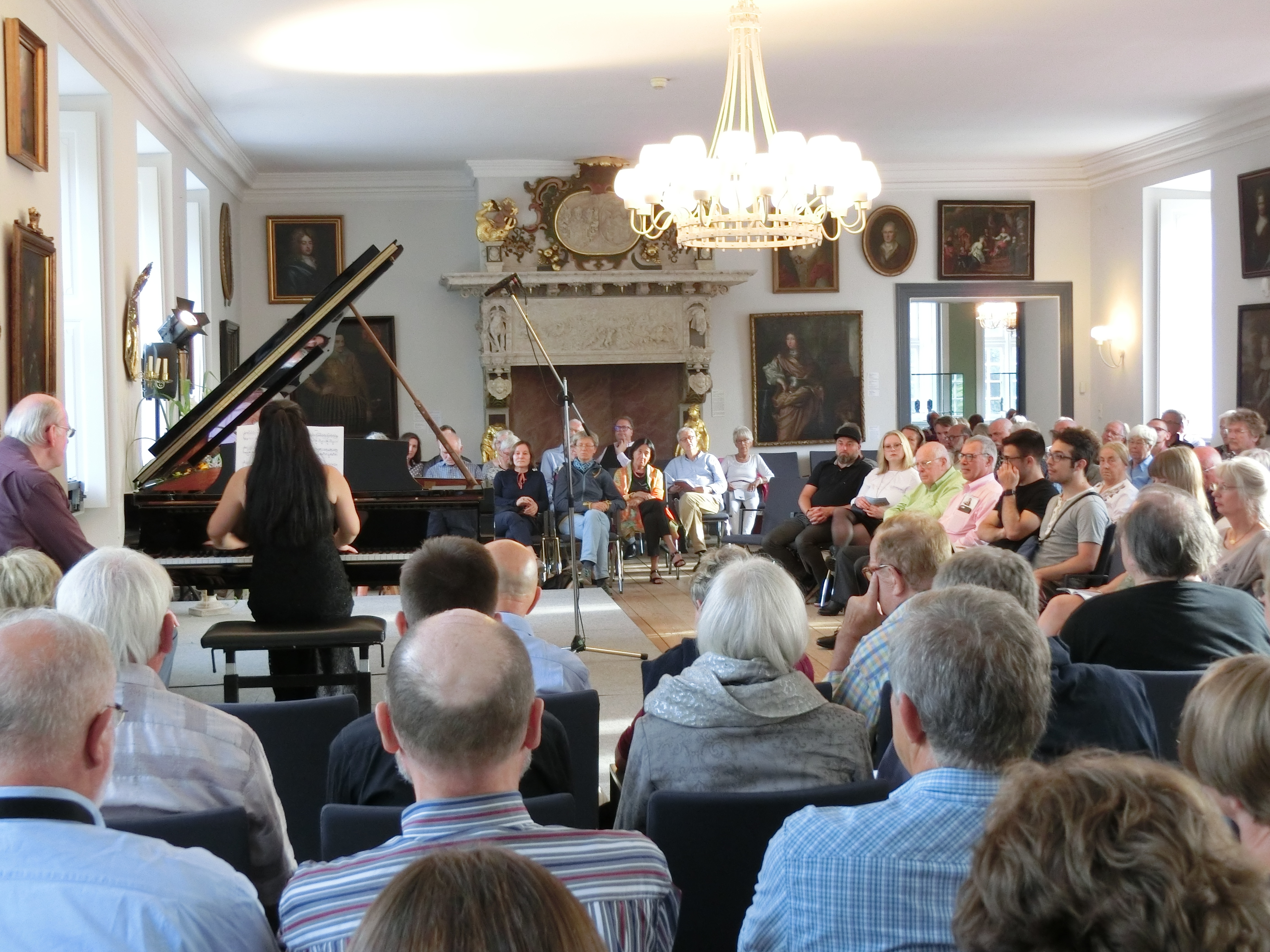
Nothing fills me with greater pride than witnessing a first ever-recital by a Singaporean pianist at  Husum. For me, Clarisse Teo’s hour-long recital is a Joseph Schooling moment, an artistic equivalent of Singapore’s first Olympic gold in 2016. This law-graduate turned concert pianist had me near speechless by her confidence and authority in her made-for-Husum programme of music by Xavier Montsalvatge, Vincent D’Indy and Anatoly Alexandrov. Who? Exactly. Even by Husum’s lofty standards, her programme was a rarity.


She took a little time to prepare herself at the keyboard, but when she set her fingers down, it was a non-stop roller-coaster ride of hair-raising notes. Montsalvatge’s Sonatina pour Yvette entranced with its quirky rhythms and piquant harmonies, and smiles were raised in the 3rd movement’s cheeky quotes of Ah, vous dirai-je Maman! Obviously this was written for a child, but there was nothing childlike in its delivery.


Then we entered hardcore Husum territory with D’Indy’s Theme varie, Fugue et Chanson, a work far removed from the world of his Symphony on a Mountain Air. No folksy melodies, but a theme which did not sound memorable at first but soon grew with each variation. The fugue was complex enough (every composer had to prove himself with this obligatory exercise) but the final chanson was a happy return home. The ante was upped for the Russian Alexandrov Fourth Sonata, as thorny as any post-Scriabin essay would prove. Even if the ears soon wearied with its litany of dissonances, nothing suggested that Clarisse was tired. Her responses remained hyperacute all through to its climactic close.


Her sole encore came like a pleasant after-dinner mint, Carlos Guastavino’s Cantos Popolares No.4, a delightful palate-cleanser to soothe the gall and brimstone that came before. If I sounded somewhat over-enthusiastic, that ought to be the case. I’ll probably never visit the Olympic Games or football World Cup with Singapore to support, but this would be one of Singapore’s proudest musical moments. By the way, I’m also happy to report that the Singaporean population in Husum had increased by by 800% on this weekend!


The Teo family comes to Husum.

Pianophile celeb alert:
Bulgarian pianist Nadezhda Vlaeva,
her husband Farhan Malik and
daughter were spotted at the festival.


KOTARO FUKUMA Piano Recital (7.30 pm)


The programme offered by the 2003 first prizewinner of the Cleveland International Piano Competition had to be the most eclectic programme I have witnessed in five years of visiting Husum. That’s a far cry from the usual piano competition fodder served up ad nauseum, which means the young Japanese Kotaro Fukuma has progressed beyond the mainstream. His programme began with Minako Tokuyama’s To No Mai, with echoes of Takemitsu and Ryuichi Sakamoto. Next was a melancholic piece from Liszt’s Album dun voyager, the First Nocturne and a Waltz by Bizet (piano music by Carmen’s composer are finally receiving their due), and appropriately a Hommage a Bizet by Theodor Adorno, of all people. This is a surprise by the philosopher and champion of atonalism, and how pleasant and lyrical the three movements sounded, perilously skirting at the edges of tonality.


The piece de resistance of Fukuma’s recital had to be the six posthumously-published Charles Trenet songs by Alexis Weissenberg (Mister Nobody in his younger and presumably wilder days) as realised by Marc-André Hamelin. This is heady and highly virtuosic stuff despite the relative simplicity of thematic material, and beautifully played too. One will not view Coin de rue or April in Paris in the same light again. Quite unusually too, he closed with Mieczyslaw Weinberg’s Sixth Sonata, which is acerbic, savage and viscerally exciting, as one would expect from a one-time Shostakovich student. One might even discern a hint of jazz at its close, which complimented the earlier goings-on.


Fukuma gave three encores, a Clara Schumann nocturne, more Bizet (Heimat) and his own over-the-top version of the familiar waltz-song Je te veux, which is Satie meets Mr Nobody. Naughty but nice! 


Friday, 21 August 2020

RARITIES OF PIANO MUSIC AT SCHLOSS VOR HUSUM 2019 / Part 3


Sunday 25 August 2019

JONATHAN SUMMERS Matinee (11 am)


In a festival for pianophiles by pianophiles, Husum has offered an interesting variety of piano-themed talks for its weekend matinees. Jonathan Summers is the curator of the British Library’s classical music sound archive, and his hour-long lecture was a treasure-trove of rare recordings of little-known works by historical pianists of repute. There are no Horowitz or Rubinstein recordings (considered common garden by Husum standards) but gems by the likes of Guiomar Novaes, José Vianna da Motta, Bernhard Stevenhagen, Victor Staub, Walter Rehberg, Mark Hambourg, Michael von Zadora, names so rare that only Peter Froundjian would recognise. Whole tracks were played, and one is astonished by the distinctive sound and colour heard on mostly 78 rpm discs.


MARCO RAPETTI 

Piano Recital (7.30 pm)


The Italian pianist Marco Rapetti presented an evening of Russian music, one interestingly characterised by a distinct absence of Russian nationalism. He has, for me, exorcised the notion that Cesar Cui (member of the Mighty Handful, and infamous critic of Rachmaninov’s First Symphony) was a bad composer. If anything, parts of his suite A Argenteau sounds more like Wagner (Parsifal and Tristan come to mind), and there’s even a Toy Soldiers’ March that seems to have escaped from The Nutcracker. Causerie, arguably the suite’s best-known piece reaches Rachmaninov-like heights of ecstacy.


Then we have the First Sonata of the tragically short-lived Alexei Stanchinsky (1888-1914, whose turbulent life was even briefer than Scriabin’s), which has nifty syncopations, saucy harmonies, moving lyricism, portentous moodiness and a jazzy presto finale to close. In Rapetti’s very capable hands, this is something I would like to hear again. Rather un-Russian in feel are are pieces by Arensky, Conus and the early-Chopin influenced Scriabin himself. Alexander Scriabin’s Canon is dry and academic but his early Sonata in E flat minor, which could be labelled Sonata No.0 (preceding his ten numbered sonatas), is quite something else.


This might just be Scriabin’s longest sonata. Its rambling and not fully-formed, filled with Chopinesque cliches but has enough of early Scriabinisms (think of his early sonatas and preludes) to merit some interest. Its full of ideas, ecstatic outbursts, impetuous and tempestuous pages, and awkward page-turns. Rapetti could have done with an alert page-turner (no shortage in Husum!) if anything to forestall untoward breaks, but he nonetheless survived. There were four encores, by Ornstein (To A Grecian Urn), Shchedrin (In Imitation of Albeniz), Scriabin (a prelude) and Borodin (Au Convent from Petite Suite), thus closing with gentle bell sounds. In short, a quintessentially Husum recital: very curious but totally enjoyable.


The serene harbour at Flensburg.
 
Oluf Samson Gang, one of Flensburg's
most picturesque streets,
once a red light district but now gentrified.


Monday 26 August 2019

MARKUS BECKER 

Piano Recital (7.30 pm)


This had to be the most intellectual programme at this year’s festival, founded on Bach, counterpoint, the fugue and thematic transformation. If a pianist were paid by the volume of notes alone, German pianist Markus Becker would be more prosperous than Lang Lang. I don’t know which combo has more notes, Bach-Busoni or Bach-Reger, but I reckon its the latter. In B-R’s Prelude and Fugue in E flat major, the piano attempts to relive the organ’s sonority. Throw in some over-indulgent pedalling, it comes as plethoric morass of sound. There are plenty of missed notes but Becker gives his all in this unbridled account that needs no apology.


Viktor Ullmann’s Variations and Double Fugue on a Theme by Schoenberg is one tough and thorny cookie to crack. The former student of Schoenberg’s, murdered by Nazis at Auschwitz, used one of his master’s atonal Kleine Klavierstücke (Op.19) and creates a grosse klavierstück in its place. The one thing about atonal works is that when a tone row gets heard repeatedly (as in a set of variations or gets worked contrapuntally), the ear gradually adapts and it does not sound so fearsome after all.

Hindemith’s Third Sonata is one of my favourites (thanks to Glenn Gould), so droll and quirky are its themes that its hard to dislike. While Becker may not have the devastating and evil wit of the loony Canadian, his is still a solid account that deserves plaudits.  


The piece de resistance had to be August Stradal’s transcription of Julius Reubke’s Sonata on the 94th Psalm, orginally an organ work. This masterpiece by the short-lived student of Liszt (Reubke was dead at 24) is the Liszt sonata on steroids, and should be heard more often. The only problem: who would bother to learn all these notes? Becker did, and more than delivered on its masses and expanses of sound with a passionate vehemence that was hard to ignore. Reubke was a blazing meteor who burnt himself out too soon. His encores made for delightful contrasts: the Bach-Reger Ich ruf’ zu dir and the witty finale from Haydn’s Sonata in E minor (Hob.XVI:34).   


Shostakovich and Sviatoslav Richter
were seen rummaging through the
bargain CDs at the Danacord booth.

Here's the proof that the Russian legends
are hiding out in Husum (and so is Elvis).

Thursday, 20 August 2020

RARITIES OF PIANO MUSIC AT SCHLOSS VOR HUSUM 2019 / Part 4


The marvel of engineering that is
the Rendsberg High Bridge


Tuesday 27 August 2019

ROLAND PÖNTINEN 

Piano Recital (7.30 pm)


I have been collecting the Swedish pianist Roland Pöntinen’s recordings (on BIS and many other labels) for decades, and it was great to actually hear and meet him in person. After the innocuous pleasantries of Swede William Seymer’s Sommarcroquiser (Summer Sketches), the first half comprised mostly transcriptions.


I hate to say this but not everything translated perfectly on the piano. Having loved Sibelius’ haunting Rakastava in its versions for strings and voices, the piano transcription by Leo Funtek just fails to sustain its long seamless and undulating lines. Similarly, Ronald Stevenson’s otherwise masterly transcription of the Adagio from Mahler’s Tenth Symphony sounds threadbare, and the 9-note chordal scream at its climax was somewhat a letdown, despite Pöntinen’s ardent advocacy.


The balance of  Pöntinen’s programme was excellent, including Fauré’s Barcarolles Nos.9 & 10 and Impromptu No.5 (all of which are rarely heard despite the Frenchman’s relative fame), Szymanowski’s Metopes - its steamy three movements (Isle of Sirens, Calypso and Nausicaa) inspired by Greek mythology, and a true rarity in Gustave Samazeuilh’s Nocturne. This nocturne was dedicated to Fauré and is filled with late-Fauréan harmonic ambiguities and Debussyan textures, a lovely piece that deserves to be better-known.


The evening closed with Villa-Lobos, the Brazilian folk-inspired A Tres Marias, and the last and best transcription of all: The Little Train of the Caipira, finale of Bachianas Brasileiras No.2 as arranged by American pianist-conductor Ira Levin. Now the last number is one heck of a showpiece, the firing of pistons, spouts of steam, chugging ostinatos, bells and whistles all sound totally idiomatic on the piano.  


His single encore was an excellent follow-up to the last piece, a Pöntinen original, étude ergonomique (à la maniere Thomas Newman), which delighted in an insistent F note ostinato.   


Hamburg: a view of the Rathaus,
Nikolaikirche Spire and Elbphilharmonie
from the Alster Lake.


Wednesday 28 August 2019

MARK VINER 

Piano Recital (7.30 pm)


On the strength of his recital, 30-year-old British pianist Mark Viner has surely inherited the mantle of the late Ronald Smith and Raymond Lewenthal, as well as the much-alive Marc-André Hamelin, as interpreter par excellence of the piano music of Alkan. Economy of notes and labour never encumbered the French-Jewish misanthropic pianist-composer (Birth-name: Charles-Valentin Morhange) whose horrendously difficult pieces even fazed the likes of Franz Liszt.


He performed four works by Alkan alone, culminating with his Symphony for solo piano (Études Nos.4-7 from his 12 Studies in Minor Keys), the companion to the notorious Concerto for solo piano. Granted this is a somewhat less fearsome work, but nobody but the most masochistic and intrepid would subject himself or herself to its multitudes of fast and relentless torrents of notes. To this end, Viner’s performance was a total triumph, making this sound seemingly effortless. I remember another stupendous performance from Liszt specialist Leslie Howard in Singapore some 15 years ago. Both will remain in my memory for a very long time to come. The other pieces swung between the extremes of sobriety and pomposity, namely Chant d’amour (from 12 Studies in Major Keys), Funeral March (Op.26) and Triumphal March (Op.27), the result being more sound and fury as we have come to expect from Alkan.


Besides, Viner also performed fantasies on Donizetti operas (Dom Sebastien and Lucrezia Borgia) by Liszt and Thalberg (piano rivals with quite divergent fates), demonstrating that bel canto and prodigious note-spinning were never strangers at all. The only departure from the Alkan-Liszt-Thalberg axis of extreme virtuosity was Cecile Chaminade’s Automne (her most famous piece, an étude and not such a rarity these days), performed with a lovely singing tone and understated good taste. Viner’s encore was a rarity among rarities: The Cross of Granite (La Croix de Granit) by little known Belgian Goeau (student of Joseph Jongen), a short but spiritual number that provided ultimate relief from the many, many notes that came before.


Wednesday, 19 August 2020

RARITIES OF PIANO MUSIC AT SCHLOSS VOR HUSUM 2019 / Part 5

The Engelsgrübe, one of the most 
picturesque streets in Lübeck

The Heiligengeist Hospital in Lübeck
was an operating refuge for the destitute
from the Middle Ages till the 1960s.


Thursday 29 August 2019

ROBERTO PIANA Piano Recital (7.30 pm)


If the name Roberto Piana sounds familiar, that is because some of his excellent piano transcriptions (of Edith Piaf songs and Astor Piazzolla tangos) have previously been performed in Husum by his good friend Antonio Pompa-Baldi. We heard some of these today, part of a rather diverse Italianate and Mediterranean programme. Giulio Ricordi is better known as a publisher (the firm which had Verdi, Puccini and other opera composers on its books), but as a composer, his Romance Poudrée (Powdery Romance) is a little gem, a song-like serenade in D major which opened the evening.


Stefano Golinelli is a totally new name for me, with three movements from his Ricordanza di un tempo che fu (Remembrance of a Time There Was) being a combination lyricism and outright virtuosic display. This made a good companion for Piana’s own Hommage a Turina, which is just as hot-blooded that the Latino temperament can get. Amid the fiery Iberian rhythms, melodrama of pathos and tragedy, there was even time for a fugue! There were also short pieces by Pergolesi (transcribed by Rafael Joseffy), Reynaldo Hahn and Alberto Nepomuceno, all very pleasant. However, time could have been spared by omitting Ignaz Moscheles’ Fantaisie a la Paganini, possibly the worst piece of the entire festival. The attempts to translate violin technique to the piano and empty note-spinning made this a truly bathetic display despite Piana’s earnest pleadings.


There were seven Astor Piazzolla tangos to close, three originals and four Piana transcriptions. This was easy listening throughout, some of which confirm that the Argentine tango-meister was no one-trick pony but someone who should be taken seriously. Among the transcriptions were Imperial, Milonga del Angel and the ubiquitous Libertango. In the generous spirit of Husum, Piano played five encores, by Rimsky-Korsakov-Siloti (Song of India), Gershwin-Grainger (The Man I Love), Turina, Edith Piaf and Manuel de Falla (Ritual Fire Dance).   


It took me an almost 90-minute trek
from Klanxbull to German artist
Emil Nolde's house, but it was worth it!

The centrepiece of one of Emil Nolde's most famous
paintings, once considered degenerate (entärtete)
by the Nazi regime.


Friday 30 August 2019

XIAYIN WANG 

Piano Recital (6 pm)


Of the young generation of young Chinese pianists (which includes the likes of Lang Lang and Yuja Wang), the one I have been most wanting to hear is Xiayin Wang. Her recordings on the Chandos and Naxos labels have captivated my attention for years. Up close in person, she may not look as alluring as her glamourous cover photos but her playing is every bit as vivid and gorgeous as her recordings suggest.


Her range of sound and colour on the keyboard is enormous, as evident in her playing of American composer Richard Danielpour’s Bagatelles and Preludes (Book 2) which open and close her recital. The Bagatelles were dedicated to her, and the 11 variegated short pieces were made to sound like sparkling gems. The seven Preludes are longer and alternate from beatific calm to ragtime on steroids (Mean Kat Stride for example, Joplin and Bolcom may both take a seat). I predict these to be on the repertoire of young pianists pretty soon, much like Ligeti, Kapustin and Carl Vine.   


In between, Wang played Earl Wild’s Sonata 2000, an attempt of a Golden Age pianist to connect with the new worlds of beat, punk and Latino heat. He does not completely convince these ears, and that had nothing to do with Wang’s scintillating playing, which burnt a track in the madcap finale, called Toccata a la Ricky Martin. Her selections from Granados’ Goyescas – The Maiden and the Nightingale and Requiebros (Flatteries) – were by no means rarities, but her sumptuous readings were a balm to the ears.


Her encores were like chalk and cheese. Zhu Wang Hua’s To Our Glorious Future (and 50 million deaths, that addition is wholly mine) is pure 1949 Chinese realist-socialist claptrap, while Gershwin’s I Got Rhythm was definitely more our cup of tea. She has got to play in Singapore sometime.


CHRISTIAN NAGEL 

Late Night Piano Recital (10 pm)


For the first time ever, this festival held a late night concert, something to send listeners to a musical kind of dreamland. No Chopin Nocturnes or Ravel’s Gaspard were heard, but German pianist Christian G. Nagel (a former student of Peter Froundjian) performed an interesting hour-long palindromic recital. Allow me to explain. The concert began with German avantgardeists Dieter Schnebel and Karl-Heinz Stockhausen, followed by a series alternating several versions of Liszt’s Ave Marias with selections from Messiaen’s Vingt Regards sur l’enfant Jesus, before closing with Stockhausen and Schnebel. In short, a programmatic sandwich.


The sounds he generated were varied and interesting, from sharp dissonances to solace-inducing warm tones, and the ever-reassuring clangour of bells. Of much interest was the penultimate Stockhausen piece (Natürliche Dauern No.10) which required the tinkle of small bells attached to the fingers of the right hand. To facilitate that unusual arrangement, Nagel fashioned a glove (a la Glenn Gould) with the bells sewn into the finger apertures. His smokily crafted encore of M-A.Hamelin’s Meditation on Laura (after David Raksin’s movie music) added an extra gloss to the already entrancing evening.


Carillons for Stockhausen!

 
Now I head off to Berlin!

Saturday 31 August 2019


Regretfully, my Husum sojourn comes to an end, one day early. Thus I would miss Danish record company Danacord owner Jesper Buhl’s talk on My Favourite Things and Cyprien Katasris’ recital of Polish music by Stanislaw Moniuzsko and students of Chopin. My wrong. But there had to be a good reason: the Singapore Chinese Orchestra performs this evening at the Berlin Konzerthaus Gendarmenmarkt. That should make another interesting story.


The Rarities of Piano Music at Schloss vor Husum festival for 2021 has been announced! It takes place from 13-21 August 2021, featuring the same cast of pianists who would have performed at the 2020 festival. For more details, check out: piano-festival-husum.com


Be seeing you again in Husum!


Tuesday, 18 August 2020

SINGAPORE SYMPHONY ORCHESTRA NATIONAL DAY CONCERT / Review


SSO NATIONAL DAY CONCERT:

A NATION IN HARMONY

Singapore Symphony Orchestra

Streamed online via SISTIC Live

Saturday (15 August 2020)


This review was published in The Straits Times on 18 August 2020  with the title "Joyous showcase of local music canon".


Over the last three years, the Singapore Symphony Orchestra’s National Day Concerts have become proud showcases of works by Singaporean and locally-based composers. This year’s offerings, conducted by Darrell Ang, included four new works. Three were by young composers who by their ages would be known as millennials. Never in Singapore’s 55-year history has there been such a glut of composing talent.


The concert began with New Beginnings by Sandra Lim  (born 1991), a slickly orchestrated fantasy on two popular songs, Di Tanjong Katong and Singapura. Resembling the scores of Hollywood epics à la John Williams, motifs of both songs were wittily bandied about but never heard in full. As per social distancing requirements, the orchestra was chamber-sized, with musicians widely separated on the Esplanade Concert Hall stage, and all masked-up (wind players excepted) which is for now standard concert attire.  


More modern and ominous in feel was Metro by Tan Yuting (born 1993), a portrayal of urban hyperactivity, perhaps not of Singapore’s pristine streets, but somewhere far less secure or savoury. Over an ostinato beat established by Jonathan Fox on hi-hat cymbals, a quasi-minimalist scenario unfolded with Stravinskyan economy but always poised on a razor’s edge. As if violence might erupt at any moment, this seemed a portent of the uncertain times we live in.


Exuberant would aptly describe City Arising by Jonathan Shin (born 1992), a bustling morning scene as the nation awakes to another fraught and frenetic day. Even the ear-piercing call of the koel is quoted, heard on Ma Yue’s solo clarinet, and the ensuing hubbub is a good-natured and comically optimistic one, recalling socialist-realist overtures of Shostakovich and Kabalevsky.  


The Texan John Sharpley (born 1955), resident here since the mid-1980s, is the sole boomer among  young upstarts. His chamber opera Kannagi (2009), based on the Tamil saga Silapathikaram (The Anklet) has now become part of the Singapore opera canon.


Brahman: Kannagi’s Realization, the penultimate section of the opera, is a sequence building up to a grand climax. Anticipation and expectancy is driven to seemingly insurmountable levels, heightened by Shane Thio’s runs on the celesta. This intoxicating music accompanied Bharatanayam dancer Kshirja Govind’s entrancing movements playing the eponymous heroine-turned-goddess.  


After the serious stuff, Dick Lee’s Home (orchestrated by Kelly Tang) provided some levity in a video from the 2018 National Day Concert featuring the Singapore Symphony Choruses. National Day Parade favourite Count On Me, Singapore by the Canadian Hugh Harrison (whose other hit song was Stand Up For Singapore) was sung jazz-styled by Benjamin Kheng in a super slick commercially produced video that also recounted landmarks in SSO’s history.


Finally, it was left to Zubir Said’s national anthem Majulah Singapura (in Tang’s 2020 reorchestration for chamber forces) to do the honours. So what is Singapore music? A fuller picture emerges with each and every National Day concert, so long may this continue. 


Monday, 3 August 2020

BEETHOVEN 360° / Wong Kah Chun et al / Reveiw


BEETHOVEN 360°

WONG KAH CHUN, Conductor

Streamed on the Internet @ YouTube Live

Thursday (30 July 2020)


This review was published in The Straits Times on 3 August 2020 with the title "Uplifting performance delivers message of friendship and unity". 

On Christmas Day 1989, a concert at Berlin’s Konzerthaus saw a performance of Beethoven’s Ninth Symphony, known as his Choral Symphony, led by legendary American conductor Leonard Bernstein. The orchestra and singers comprised an international legion of musicians from Germany, United Kingdom, France, Soviet Union and United States of America. The celebratory occasion had marked the fall of the Berlin Wall just the month before.


A similar assemblage of performers, now over a thousand-strong from around the planet, reprised the symphony’s final movement Ode To Joy on International Friendship Day (30 July). Conducting the Internet-united ensemble was Singapore’s Wong Kah Chun (or Kahchun Wong as he is known internationally), winner of the Gustav Mahler International Conducting Competition and Chief Conductor of the Nuremberg Symphony Orchestra.


In what is possibly mankind’s darkest hour of the new millennium, besieged by the Covid-19 global pandemic, Wong’s “universal musical kampong” delivered a heartwarming message. “Alle Menschen Werden Bruder”, or All People Become Brothers, was Friedrich Schiller’s clarion call of 1785, which became Beethoven’s personal credo in his final symphony of 1824.


All 25 minutes or so of the Ode was performed. Even for those with limited attention spans, it seemed a breeze. The virtual concert hall, with a 360° view of all the performers in socially distanced screens with Wong leading at its centre, was a marvel of modern innovation and technology.


The opening outburst and low string declamations suggested a world in primordial chaos, and the visual was that of Wong conducting within a fiery sea of lava and rising steam. With each measure of Beethoven’s iconic melody, each player was introduced in a puff of smoke, until a revolving wall of humanity surrounded the maestro. Disorder had given way to a semblance of form.


Then it was bass-baritone Nicholas Brownlee’s declaration of O Freunde (O Friends), a coming together of peoples, leading into the greenery of Beethoven Im Garten, Wong and Singapore German Embassy’s shared vision of bringing Beethoven to the masses. A celestial band of angel-winged players (providing unusually comic moments) accompanied tenor Gerard Schneider for the Turkish march episode before the tutti chorus’ glorious statement of the big tune.


With hundreds, possibly a thousand faces appearing onscreen for the first time, this was the proverbial “lump in the throat” moment, sending shocks of frisson coursing down the spine. The choral fugue was accompanied by four staves in German (with English transliterations), each corresponding to a SATB (soprano alto tenor bass) voice part, a nifty concept that hinted of karaoke inspirations at play.


The ensemble was then transported into a smart pencil-drawn 3-D representation of Esplanade Concert Hall before closing with a coda in the clouds, all players being united for the final time. With excellent recorded sound and crystal clear visuals, Beethoven 360° was a truly memorable and immersive experience to savoured over and over. 


Watch it here: