Thursday, 23 December 2021

COMPOSIUM 2021: PRIZE-WINNERS CONCERT / Ding Yi Music Company / Review


COMPOSIUM 2021

PRIZEWINNERS CONCERT

Ding Yi Music Company

Esplanade Recital Studio

Sunday (19 December 2021)


A perfect pre-Christmas weekend of Chinese music was completed with the Prizewinners Concert of Composium, Singapore’s international composition competition for Chinese chamber music. Organised by Ding Yi Music Company, this composer’s festival is now in its fourth edition. Nine prize-winning works were selected from a field of 88 works by composers from eight countries. Dominating the victors was China with seven members, and there were also singleton finalists from Singapore and Taiwan. 


Contemporary Chinese chamber music is a relatively new concept, despite the fact that traditional Chinese music essentially began as chamber music. The notion of chamber music for Chinese instruments is to distinguish it from Chinese orchestral composition, which has already been served by a separate competition organised by the Singapore Chinese Orchestra. Whatever these distinctions may be, both organisations have set an important precedent in promoting Chinese instrumental music outside of mainland China, and this is something our nation can be very proud of.


Conductor Quek Ling Kiong
and the Dings, awarded to first prize-winners.


This year’s competition was expanded to include three separate groups for entries, Category B1 and B2 covering works inspired by life sentiments (and experiences), and Category A with works inspired by Chinese festivals and customs. Three works from each category were performed this evening, and judged remotely by a panel of internationally distinguised composers and musicians from the Asia-Pacific sphere. Doing the honours were ensembles from the Ding Yi Music Company led with missionary zeal by the indefatigable Quek Ling Kiong.  


Category B1 opened the concert with works scored for huqin, guzheng, pipa, dizi, cello and percussion (six players). With this instrumental combination in mind, there was no great surprise that composers would be channeling their inner Takemitsu, and so it proved. The first piece by Zhang Yi Meng (China), Ode On The Spring, was impressionist in colour and spirit, opening quietly and mysteriously with dizi solo. Hints of a nascent season coming to being - in the form of rhythm and dance - emerge and then recede. Shards of melody from erhu, cello and dizi tease the ear, but there is no full-blown dance as its premise is the promise of spring.  


Sitting Together Among The Clouds by Liu Peng (China) takes on a more modern and abstract idiom, with highly effective use of timbral colour. Dizi and vibraphone greet listeners in this pointillist canvas, with stasis being the mainstay. There is a very slow and gradual crescendo, punctuated by erhu bird calls and guzheng drones, and one is left with the illusion of suspension of gravity, time and space.    


The Covid pandemic was the inspiration for Memory by Xie Qin Wei (China), a work which attempted to juxtapose earthshaking events (sudden outbursts) with the normality of life (rhythms of a dance). The ubiquitous dizi and drum are heard on the outset, and several motifs are worked upon.  While the dance signifies that life goes on despite adversities, darker emotions like angst, anxiety and fear are stirred in its louder sections.


Next was Category B2 works, written for huqin, yangqin, liuqin, sheng and percussion, also for six players but eliciting quite different timbres from the earlier category. Ding Jian Han (Singapore), who will surely win the Best Young Singaporean Composer Award, offered Lu(nox) as his response to the current pandemic. Easily the most modern sounding and atonal work on show, it had a violent opening followed by seemingly random outbursts of sound. He really knows how to get under one’s skin, aided by Bartok pizzicatos (plucked with extreme force) from the bass and the sheng’s eerie cries. With ear-piercing eructations guaranteed to sow uncertainty, doubt and fear, he had certainly succeeded beyond all measure, if this were his intention.  


More soothing and engaging was He Jia Ning (China) in Ocean Breath, not so much a descriptive seascape like Debussy’s La Mer but a work that dwells on emotions the ocean evokes in one’s consciousness. A quiet opening, and the yangqin traipses over bass murmurs. Huqins bring sadness and past memories, while the reassuring sheng sings of nostalgia. Over gently pulsing ostinatos, thoughts are revived and brought into the open. Some of these linger but others are washed away by the ebb and flow.      


Zhang Zhi Liang (China) from Sichuan has a very similar name to mine, so I was curious what to make of Tumbleweed. Supposedly inspired by his pet collie’s fur-balls blown by a breeze, this modernistic work is about motion and stasis, represented by its miniscule crescendos and decrescendos. Erhu portamenti and tremolos, sheng shrieks and yangqin microtones all paint a desolate landscape populated by the constant buzz and hum of insects (fleas?). He referred to it as an uplifting work, so I guess he also has a sense of humour.   


Finally, Category A compositions were scored for 15-member orchestra, encompassing instruments previously listed and more, hence widening the scope of sonorities to be heard. The first work, Twinkling Of Bonfire Night by Zhou Jia Ying (China) was the most traditional work on show, a dance celebration of the Yi tribe which populates the provinces of Yunnan, Sichuan and Guizhou. After opening with a short guan solo, its colourfully scored dances alternate between slow and fast sequences, culminating in a episode of foot-stamping by all musicians. Not dissimilar to the famous Dance of the Yao which audiences are familiar with, I suspect that this work will be performed the most. Predictably, it also won the live Audience Award.


It appears that Liu Yu Hui (China) conceived his Rhythm Of Lv Opera IV: New Year Pictures as part of an ongoing cycle inspired by Chinese opera. In a pre-recorded video segment, he shared three hand-drawn pictures (of goldfish, deities and the iconic Lunar New Year baby) commonly found in Chinese homes and altars during the festive period. Instead of three separate movements, these were merged into a rowdily colourful work which most skilfully exploited the full gamut of instruments. Festive drumming was de rigeuer and episodes of solo playing reminiscent of Beijing opera rendered this a most raucous and evocative encounter of all. This really also makes one want to hear the other segments of his Lv Opera cycle.


Chilly Autumn With Misshapen Beauty Moon by Cheng Kuang-Chih (Taiwan) was most awkwardly titled, a terrible translation into English of the far more poetic Len Qiu Chan Yue in Chinese. Cold Autumn, Cruel Moon might just sum it up better, as huqin harmonics which greeted the work provided the chill of a misty and mysterious night. Was this the mid-Autumn festival or the Hungry Ghost Festival or even Halloween? The eerie soundscapes conjured up included a gong struck while immersed in a bucket of water, redolent of supernatural phenomena and befitting the best of haunted house movie effects.


Composer Liu Peng finds out
he was awarded 1st prize for Category B1. 


The results of the Composium Competition were as follows:


Category B1

1st: Sitting Together Among The Clouds by Liu Peng (China)

2nd: Ode On The Spring by Zhang Yi Meng (China)

3rd: Memory by Xie Qin Wei (China)


Category B2

1st: Lu (Nox) by Ding Jian Han (Singapore)

2nd: Tumbleweed by Zhang Zhi Liang (China)

3rd: Ocean Breath by He Jia Ning (China)


Category A

1st: Rhythm Of Lv Opera IV: New Year Pictures by Liu Yu Hui (China)

2nd: Chilly Autumn With Misshapen Beauty Moon by Cheng Kuang-Chih (Taiwan)

3rd: Twinkling Of Bonfire Night by Zhou Jia Ying (China)


Most importantly, Composium by Ding Yi Music Company has cemented itself as a vital international platform for young composers to display their artistry and creative output. Hopefully these pieces will stand the test of time and reappear in the repertoire of Chinese chamber orchestras around the globe for years to come.   


All photographs by the kind courtesy of Ding Yi Music Company.


Monday, 20 December 2021

FIRST STEP / Singapore National Youth Chinese Orchestra / Review


FIRST STEP

Singapore National Youth Chinese Orchestra

Singapore Conference Hall

Saturday (18 December 2021)


It has long been a misconception of mine that Chinese classical music, specifically music played on traditional Chinese instruments, is a preserve of the senior demographic. I have often remarked that audiences at Singapore Chinese Orchestra concerts were mostly boomers and older, and more young people needed to come to these concerts lest this hallowed tradition becomes extinct. This evening I heaved a sigh of relief, to find that the Singapore National Youth Chinese Orchestra (SNYCO) is the very antidote to this notion of musical extinction. Encouragingly, more young Singaporeans are learning to play Chinese instruments, and consequently more young composers are writing works for these instruments.


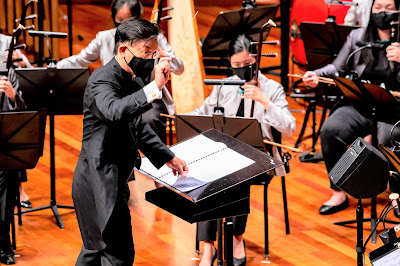
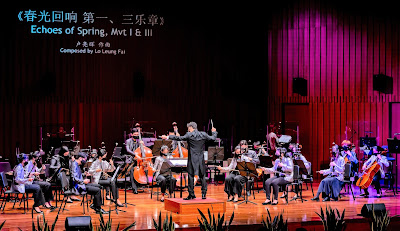
Conducted by Quek Ling Kiong, the SNYCO gave its first concert in almost two years, the hiatus caused by the Covid pandemic’s disruptions. It opened with two movements from Lo Leung Fai’s Echoes of Spring, almost a Chinese version of Rossini’s Sonatas for strings or Mendelssohn’s Symphonies for strings. The bowed strings – huqins with four cellos and two double basses – were in fine form despite not having played for a long while. The prestidigitation achieved in both fast movements was impressive, the opening serving as a warm-up for the furious finale.


A larger mixed ensemble converged for young Singaporean composer Jon Lin Chua’s Princess Miao Shan, a symphonic poem receiving its Singapore premiere. Inspired by the legend of how Guanyin Boddhisatva (the Goddess of Mercy) came to be, it is a colourful melange of sound beginning tumultuously and a suona solo. Despite its modern idiom, there was still room for a big melody evoking the open country and broad landscapes. Percussion provided the dramatics and a poignant dizi solo paved the way for music which portrayed profound sadness and tragedy, representing the ultimate sacrifice the eponymous princess was to make. Ending quietly rather than in the customary blaze of glory gave the work an extra dimension of sobriety it needed.   


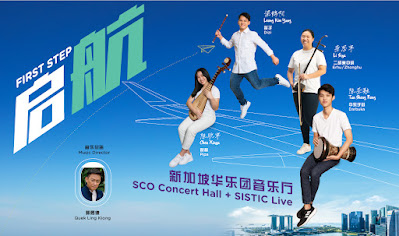
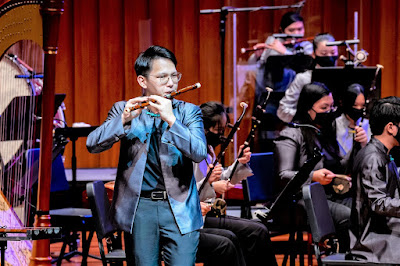
There were two concertante works, the first being Lo Leung Fai’s Joyful (Xi) with Leong Kim Yang’s dextrous dizi solo. Scherzo-like for most part, this dizi occupied the piccolo register, its timbre and nimbleness suggesting that mischief and pranks were also part of its definition of joy. The virtuoso role included two really demanding cadenzas which Leong nailed most impressively despite his relative youth, having joined the orchestra just two years ago.


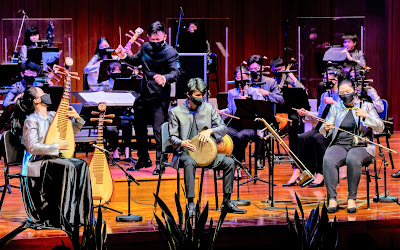
Sulwyn Lok’s Sand Mystique was the second concertante work, essentially a concerto grosso for erhu/zhonghu, pipa and darbuka (a Middle-Eastern hand-held drum). Soloists Li Siyu, Chen Xinyu and Tan Sheng Rong stole the show in a work which opened Mahler-like (the pedal-point of his First Symphony) in its rapt evocation of dawn in the desert. The idiom was distinctly Middle-Eastern or Central Asian whichever direction one travelled, with the aromatic flavours of the exotic Silk Road richly relived. The accompanying orchestra also contributed with a spot of rhythmic clapping in this lively dance built upon vigorous ostinatos.  


When writing music about outer space and the cosmos, the obvious influences are Holst or Hollywood. Chen Si Ang’s Interstellar went for the latter in a sonorous soundscape accompanied by lighting illuminations that evoked the Milky Way and distant galaxies. The opening was quiet, with dizi solo breaking the silence, then came ostinatos of The X Files variety, leading one on a journey of wonderment. The quote from Oscar Wilde, “We are all in the gutters, but some of us are looking at stars” was ever-present as the odyssey closed with typical bombast that such a title foretold.


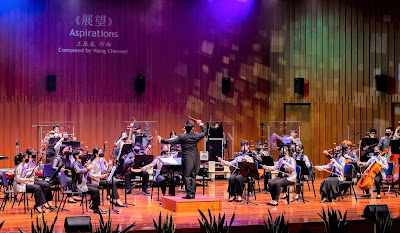
Closing the 75-minute long concert was present Singapore Chinese Orchestra composer-in-residence Wang Chen Wei’s Aspirations, composed as far back as 2008. This is an extended version of its original, which revelled in the cheerful melodies heard in television and film music depicting heartland life. Nothing wrong with that, but as soon as new ideas are wanting, always rely on the trusty fugato. That spot of Bachian counterpoint – with sheng, dizi and zhongruan thrown into the mix - was a welcome departure as the concert wound to a happy and optimistic conclusion.


The Singapore National Youth Chinese Orchestra and its talented young musicians represent the bright future for Chinese instrumental music in Singapore. This bright future is in the best of hands, and long may the enterprise thrive.    


All photographs by the kind courtesy of SNYCO/SCO.

Saturday, 18 December 2021

DON'T MISS THIS CONCERT: SHALL WE DANCE? BY SÉRINE DE LABAUME


SHALL WE DANCE?

CHRISTMAS EVE RECITAL

BY SÉRINE DE LABAUME


Now we know that soprano Sérine de Labaume can really sing, why not enjoy a sparkling Christmas Eve recital with her and pianist Low Shao Ying?


Let’s dance this Christmas Eve! Come share the joy of music with Sérine de Labaume; she promises not to bombard you with opera arias this time!

 
Mostly lighthearted easy-listeners, but not limited to... tangos, waltzes, boleros and habañeras by Poulenc, Satie, Tchaikovsky, Weill, Guastavino, Gardel and more!


What we can promise you is that you’ll be swayed away and will want to dance all night. See you there!


Programme :


Waltzes

POULENC Les Chemins de l’Amour

TCHAIKOVSKY At the ball

SATIE Je te veux

GERMAN For Tonight


Boleros

DELIBES Les Filles de Cadix

BERLIOZ Zaïde


Habañeras

DE FUENTES Tu!

WEILL Youkali


Tangos

GUASTAVINO Milonga de dos Hermanos

DI LAZZARO Chitarra Romana

GARDEL Por una cabeza


Esplanade Recital Studio

Friday 24 December 2021, 7:00 pm

Tickets on Peatix : https://serine3.peatix.com/ 

Thursday, 16 December 2021

LORENZO VIOTTI & ANDREAS OTTENSAMER / RAISE A GLASS TO MOZART, WITH ANDREAS OTTENSAMER / Review


LORENZO VIOTTI & 

ANDREAS OTTENSAMER

Singapore Symphony Orchestra

Esplanade Concert Hall

Friday (10 December 2021)


RAISE A GLASS TO MOZART,

WITH ANDREAS OTTENSAMER

With SSO Musicians

Victoria Concert Hall

Saturday (11 December 2021)


This review was published in The Straits Times on 15 December 2021 with the title "Viennese warmth and informality in clarinettist's Singapore debut".


Andreas Ottensamer, Principal Clarinettist of Berlin Philharmonic, made his Singapore debut as guest soloist of the Singapore Symphony Orchestra in a pair of orchestral concerts and a chamber concert partnering with local musicians. Given his high profile with recordings on the Deutsche Grammophon label, much was expected from his Singapore premiere of Brahms’s Clarinet Sonata in F minor (Op.120 No.1) accompanied by strings in an arrangement by one P.Cueto.


Photo: SSO / Jack Yam


Quite disappointingly, just two of four movements were performed. These, however, revealed a beauty of tone in the elegiac Andante movement and mellowness in the third movement which radiated pure Viennese warmth and informality. The absence of the four-movement clarinet concerto was partly made up by a selection of three Mendelssohn Songs Without Words, arranged by Ottensamer himself. The best of these was Op.67 No.5, sometimes known as The Shepherd’s Complaint, more like a lament for which the clarinet’s plaintive quality was eminently suited.


Led by Swiss conductor Lorenzo Viotti, Dvorak’s Serenade for Strings took on a polished sheen, its five movements sounding lush but also transparent such that finer details were also heard. Prokofiev’s popular Classical Symphony, so named as it was a pastiche of Haydn and Mozart, raced off at a blistering pace as to sound almost impatient. However, the exuberance of delivery in closing the concert was well appreciated by the audience.


Photo: SSO / Jack Yam


The title of the Victoria Concert Hall Presents chamber concert was somewhat misleading as the altered programme saw only one movement of four from Mozart’s late Clarinet Quintet performed. That was the Larghetto slow movement, for which Ottensamer’s honeyed lines were simply breathtaking, such that one longed to have heard the work whole.


As a sop for Mozart lovers, a suite of seven Mendelssohn Songs Without Words was offered, including three heard in the night before. The contrasted short pieces accompanied by five string players were quite lovely, especially the popular Spring Song (with pizzicato strings) and two gently rocking Venetian Boat Songs.   


This chamber concert took place in separate three parts, the first two featuring only SSO musicians. Percussionists Mark Suter and Mario Choo commanded three marimbas in Philip Glass’s Mad Rush and Ann Southam’s Glass Houses No.5. Both are minimalist works most pleasing to the ear, contrasting Glass’s alternating fast and slow machinations with Southam’s busier and more kinetically driven number, which relived polyphonic effects like those of the gamelan.  


Also not to be forgotten was Carl Nielsen’s Wind Quintet performed by Evgueni Brokmiller (flute), Elaine Yeo (oboe), Yoko Liu (clarinet), Liu Chang (bassoon) and Jamie Hersch (French horn). This cornerstone of 20th century wind quintet repertoire received a marvelous reading, which revelled in piquant harmonies, occasionally pungent and occasionally perfumed. Tautly held together by a well-seasoned ensemble, might one have guessed that clarinettist Liu – with her excellent solos in the jolly and bucolic central movement - to be the equal of Ottensamer? It is in concerts like these where one realises that local musicians are also true virtuosos in their own right.


Wednesday, 8 December 2021

BAIBA SKRIDE PLAYS MOZART / SALIERI-MOZART DOUBLE BILL / Review


BAIBA SKRIDE PLAYS MOZART

Singapore Symphony Orchestra

Esplanade Concert Hall

Wednesday (1 December 2021)


OPERA DOUBLE BILL:

SALIERI & MOZART

Singapore Lyric Opera

Esplanade Theatre

Friday (3 December 2021)


This review was published in The Straits Times on 8 December 2021 with the title "Mozart tributes in orchestra and opera". 


One beneficiary of the current Covid pandemic has been the music of Mozart. Ironic as it seems, the Singapore Symphony Orchestra has never played more Mozart in its 42-year history. Far from being staid or boring, new life has been breathed into these classics. Not content with merely sounding pretty, a perfection of form and execution was witnessed in prize-winning Latvian violinist Baiba Skride’s view of  Mozart’s Violin Concerto No.4 in D major.


One of his less showy works, its beauty lies in sheer lyricism, which Skride revealed from the outset. Her tone was lush, with a healthy vibrato that was not overdone and precise intonation throughout. She also projected well above the orchestra which did not mince notes in the accompaniment. Any concession for virtuosity took place in the cadenzas of all three movements, and these were also beautifully proportioned.


The orchestra led by French conductor Pierre Bleuse lent excellent support without trying to sound like those period instrument bands, and this vigour continued into Mozart’s Symphony No.40, one of just two symphonies cast in the minor key. The associated storms and stresses did not arrive, as the very familiar opening movement came across breezy rather than hectic.


This is music that takes a nice long breath, none more so in the expansive slow movement which was all elegance and grace. Even the relative urgency of the third movement soon dissolved into ebullience in the finale, which recalled the lively antics of Mozart’s comic operas.


Speaking of the theatre, Singapore Lyric Opera deserves credit for conceiving a Salieri-Mozart double bill of two short comic operas that were premiered simultaneously at Vienna’s Schonbrunn Palace one February day in 1786. Far from being bitter rivals, there existed a respectful and collegial relationship between Antonio Salieri and Mozart, but posterity has always favoured the latter.


Conducted by Lien Boon Hua, Salieri’s Prima La Musica e Poi Le Parole (First The Music, Then The Words) was performed before Mozart’s Der Schauspieldirektor (The Impresario), both united by a common plot about artists, their occupational quirks and supposed rivalries. Tang Xinxin’s clever direction eschewed long dialogues in Italian and German, opting instead for English repartee between sung bits which greatly enhanced the appreciation and enjoyment of both operas.


There was a common cast, led by the excellent duelling sopranos Joyce Lee and Sylvia Lee, who came close to cat fights as each tried to gain an upper hand. Short excerpts from other Mozart operas were inserted into both operas, also to good effect. The men completed the buffo element for the farces, with David Tao as Poet/Buff squaring off against Daniel Fong’s Composer and Jonathan MacPherson’s Vogelsang. Their much smaller singing parts were made up by comedic acting and solid characterisations.


Plaudits also go to Dorothy Png’s set, lighting and constume design, which plumbed for traditional in Salieri in contrast with modernity in Mozart. The slick movements of curtains and backdrop while Mozart’s Overture to Der Schauspieldirektor was being played represented a symbolic changing of the guard. Whichever way one looked at it, Mozart still won.      


Tuesday, 7 December 2021

CULTURAL MEDALLION EXHIBITION @ THE ARTS HOUSE


CELEBRATING THE 

CULTURAL MEDALLION


If you happen to be in the vicinity of Victoria Concert Hall / Theatre and have a half hour or so to spare, why not visit the exhibition of the Cultural Medallion at The Arts House? Located at its ground floor (formerly occupied by a gift shop and café), here is a nostalgic look at the artists who have defined Singapore’s cultural scene over the past half-century and more.


Inaugurated in 1980, the Cultural Medallion (CM) is Singapore’s highest accolade for the arts awarded by the government, and stands apart from the many thousands of service awards dished out annually in the National Day Awards. Only a select handful of artists are awarded each year. There were only two recipients this year and just 132 CMs have been awarded in total. In short, it is a very special and rare privilege to receive one.


How many of these Cultural Medallion
recipients can you name? 

There are three chambers for the exhibition, the first comprising photo discs of each CM recipient. How many of them can you name? Just pick a familiar face and flip it around for the name and the year in which his or her CM was presented. The second and third chambers includes archival photos from ceremonies over the years as well as video interviews. There is an interactive element and also a sitting area with reference books on all the recipients on loan from the National Library Board.


This exhibitions keeps alive the invaluable work contributed by these artists as well as refresh our memories on the very people who made us appreciate and value art. I was particularly thrilled to see photos of the men who facilitated and encouraged my own modest journey in the arts. They presented me my first paid accompaniment job (David Lim), my first editorship of a newsletter and programme notes writing gig (Lim Yau), my first paid research job (Paul and Alex Abisheganaden), and there are many others whom I have written about for The Straits Times and this blog.  


Early years of the Cultural Medallion.
Can you identify some of the winners?


As more artists of significance emerge from within our ever-thriving arts scene, it becomes even more difficult to receive the CM. One cannot help but feel that many deserving artists in our midst who have yet to receive this accolade would have been recognised had they been born a decade or two earlier. The reverse is also true, to ponder the notion that some recipients would not have gotten their award had they emerged a decade or two later. 

In short, the competition is much stiffer and the bar has been set so much higher for today’s rising artists, such that a CM really becomes more treasurable an achievement than it would have been previously.  


It took some time before artists in the field 
of popular music and entertainment were finally
recognised, including Jeremy Monteiro (above),
Dick Lee, Liang Wern Fook and Jerry Soliano.


Another quibble of mine is the failure of the CM to acknowledge grouped rather than individual artistic endeavour. As such, it remains elusive to deserving groups like the T’ang Quartet (Ng Yu Ying, Ang Chek Meng, Lionel Tan and Leslie Tan) and the incomparable piano duo of Dennis Lee and Toh Chee Hung, whose joint efforts surpass individual ones. 

Artists better known as teachers and pedagogues such as Lucien Wang, Victor Doggett, Yu Chun Yee and Ong Lip Tat (to name only the piano people) have been bypassed. Perhaps a new category of Arts Awards may be created to honour these people. For political reasons, artists like pianists Melvyn Tan and the fellow who wrote Crazy Rich Asians will doubtlessly be overlooked.   


The more recent musical maestros
who have been honoured:
Lan Shui, Tsung Yeh,
Margaret Leng Tan & Eric Watson.

Entry is free for this exhibition, except for the unvaccinated (who will be turned away), and is deserving of your time and indulgence.


The young Lynnette Seah bids you
to come visit the exhibition sometime.

Monday, 6 December 2021

NATIONAL PIANO & VIOLIN COMPETITION 2021: PIANO & VIOLIN ARTIST FINALS / Review


NATIONAL PIANO & 

VIOLIN COMPETITION 2021

PIANO (ARTIST) & 

VIOLIN (ARTIST) FINALS

Victoria Concert Hall, 

livestreamed on SSO Facebook

Sunday (5 December 2021)


If you are an advanced piano or violin student in Singapore, and December rolls up on an odd-numbered year, there can only be one thing in mind – the National Piano & Violin Competition (NPVC). This is the most prestigious musical competition of the island-state, representing the pinnacle of what music students can achieve when they put their minds and hands to it. Taking place every two years, the NPVC identifies the nation’s top young talents on both instruments, many of whom later become important members of the musical community, enriching our concert halls for years to come.


The Artist Category for musicians under the age of 25 is the most demanding of the four categories, and entails a performance of a full-length concerto in the final round. This is also the climax and most anticipated event of the competition, typically involving six concerto performances with no less than the Singapore Symphony Orchestra (also the competition’s organiser).


Due to the Covid pandemic, there was to be no orchestra accompanying soloists for the first time in 20 years. Thus this year’s finals performances were accompanied on piano instead. A downer for certain, but that did not diminish the efforts and quality of the performances by the deserving finalists. The finals were also closed to the public, but thanks to live-streaming, it could be enjoyed from the comfort from home. Slouching snugly on an armchair, here are my observations of the actual performances...


Piano (Artist) Finals


Kuo Lyu-Yan gave an exciting and taut account of Rachmaninov’s Rhapsody on a Theme of Paganini. After the relative strait-jacket of its opening six variations, there were opportunities to let loose. She took these in her stride, fearlessly launching into the cadenza of Var.XI. Some caution was observed in the free-wheeling Var.XV, thus preventing proceedings from going off the rails as less controlled performances tend to do. The transition to minor to major mode in Var.XVIII provided a magical moment, leading into the glorious D flat major melody which was milked for all its worth. There was a short stretch of uncertainty in Var.XX but cool heads prevailed, ensuring the build-up to a grandstanding finish to be a thrilling one. The nonchalance of its final bar, Rachmaninov at his most sardonic, was also delivered spot-on.   


Sean Gan Chu Chao’s lyrical account Chopin’s Second Piano Concerto in F minor also had much to recommend. The orchestral ritornello which typically builds up for the piano’s dramatic entry was severely truncated for purposes of the competition, but that did little to diminish the overall music making. He has a beautiful touch, and an instinctive feel for the ebb and flow of the music that is admirable. When it came to fast running bits, his fingers were also up to the task. This poetry continued into the nocturne-like Larghetto slow movement, with further scope for sheer lyricism and soul-searching. The Rondo finale could have caught fire, but it was more of a slow burn. The rhythmic lilt of the mazurka-like dance was infectious, and the musicality and artistry involved made it all the more absorbing.


It was interesting to note that Gan accompanied Kuo in her Rachmaninov, while the roles were reversed with Kao accompanying Gan in the Chopin. Having to play two concertos in quick succession seems like a superhuman feat. This arrangement might also have put Gan at a disadvantage having to accompany first and play solo after that. And would this gambit have lessened the chances of both aiming for the top prize?  


It would thus depend on the performance of the third pianist Chong Jun Hao, whose account of Rachmaninov’s Piano Concerto No.2 in C minor is as assured as they come. The chord-laden solo that opened the concerto was gripping in intensity, without the navel-gazing associated with self-absorbed players (Lang Lang comes to mind). The next half-hour showed that for this young artist, music comes first. The fine balance of lyrical playing and barnstorming fireworks was well maintained for all three movements of this totally musical reading. Close to flawless, he let the music speak for itself, and when push came to shove, he was unafraid to let it all go. And he also had an excellent accompanist in Dean Fu who had only this sole task for the morning.  


The jury of Anna Tsybuleva (Russia, 2015 Leeds winner), Ewa Kupiec (Poland) and Lan Shui (SSO Conductor Laureate) awarded two 1st prizes to Guo Lyu-Yan (Rach Pag) and Sean Gan Chu Chao (Chopin No.2), no 2nd prize and a 3rd prize to Chong Jun Hao (Rach No.2). Should this come as a surprise? After all, a joint 1st prize at the NPVC Artist Finals has been unprecedented. However, it is the clearest testimony to the high standards of piano playing and teaching achieved over the years.


Violin (Artist) Finals  


There have always been fewer participating violinists in NPVC, so it is little surprise that there were just two finalists, selected from a small pool of five. It is quality than quantity that really matters, and so it proved.


Chien Chin’s unaccompanied solo to open Prokofiev’s Violin Concerto No.2 in G minor, confidently taken and breathtaking to boot, was proof of intent in this trickily thorny yet lyrical work. Her tone was fulsome and intonation spotless, and the sense of soaring came across  winningly in the central Andante assai slow movement, which had the heady feel of Romeo and Juliet about it. Her technique stood up well to scrutiny in the fast outer movements, including the wild dance of the rondo finale which almost came to grief at the final stretch but nerves held for a stunning and somewhat abrupt close. There were no castanets but Ge Xiaozhe provided excellent accompaniment on the piano.


It was an arguable claim that Dai Ailin had the slightly easier task in Wieniawski Violin Concerto No.2, a Romantic work where the solo part was more exposed. No worries, as she overcame the requisite pyrotechnics with seeming effortlessness. Like Chien, her tone was voluminous and articulation precise, and like the performance before had the most heartrending moments in the central slow movement – a Romance with a treacly sweetness like no other. Despite some nervy moments in Michelle Seah’s piano accompaniment for the finale, here was a commanding solo performance that swept the board, one which will be happily relived as long as YouTube still exists.  


The violin jury of Denis Goldfeld (Russia), Ezster Haffner (Austria) and Joshua Tan (Singapore National Youth Orchestra Music Director) had no doubts in awarding Dai Ailin with the 1st prize and Chien Chin in 2nd place.


Unlike previous editions where first prizes were parsimoniously witheld, it was good to see the immense efforts of the young artists (and their teachers) being rewarded and affirmed with due recognition and prizes they richly deserved. There were no poor performances in the Artist Finals, only performances that can get better with further experience and encouragement. This was finally an NPVC to warm the see-hums of the hearts.