Monday, 31 January 2022

FOLLOWING THE RIVER: MUSIC ALONG THE DANUBE / FLORIAN MITREA, Piano / Review


FOLLOWING THE RIVER:

MUSIC ALONG THE DANUBE

FLORIAN MITREA, Piano

Acousence Classics 13317 / TT:61’43”  


How many Romanian composers does one know whose names are not Georges Enesco, Dinu Lipatti or Grigoras Dinicu? This fascinating album by prize-winning young Romanian pianist Florian Mitrea, graduate of London’s Royal Academy of Music, follows him on a trip to his homeland via the arterial waterway known as the Danube.


Traversing through Vienna, Budapest and Bucharest (sort of), his recital also includes music from Austria and Hungary. There are fine performances of Schubert’s Hungarian Melody (D.817), Liszt’s Hungarian Rhapsody No.5 (the slow and stately one also called Héroïde-élégiaque) and Bartok’s Six Dances in Bulgarian Rhythm (Nos.148-153 of Mikroskosmos), which will be familiar to most piano fanciers and students.


Thus the main interest here lies in the music of Sigismund Toduta, Paul Constantinescu and Radu Paladi. Who? Exactly. In the helpful programme notes penned by Mitrea himself, the Rome-schooled Toduta (1908-1991) is described as one who had a “preference for writing music on Christian subjects, while complying with the communist regime”. His  Passacaglia: 12 Variations on a Romanian Christmas Carol may be considered neoclassical and requires a virtuoso’s technique to pull off, as does the slow-fast sequence of Chorale and Toccata, closing the album on a brilliant high. The Suite of Romanian Songs and Dances is a more extended and complex cousin to Bartok’s Romanian Folk Dances, the reward of dedicated ethno-musicological research and studies.


Constantinescu (1909-1963) studied with Franz Schmidt in Vienna. His Cantec or Variations on a Romanian Folksong plays on nostalgia while employing exotic harmonies, while Joc Dobrogean (Dobrogean Dance) or Toccata, which delights in rapidly repeating notes and chords, was composed as the set piece for the 1958 Enescu International Piano Competition. It possesses the same playfully unfettered spirit as Dinicu’s Hora Staccato. Paladi (1927-2013) was a piano student of Florica Musicescu (Lipatti and Radu Lupu’s teacher), and his Rondo a Capriccio is light-hearted and scherzo-like, is also based on folk music.


This is much to enjoy and discover in this recital, which confirms Florian Mitrea as a sympathetic virtuoso and consummate musician of the highest order.  


You can listen to this album on Spotify:

Spotify – Following the River: Music Along the Danube

Saturday, 29 January 2022

TEDD JOSELSON'S COMPANIONSHIP OF CONCERTOS / Review


TEDD JOSELSON’S

COMPANIONSHIP OF CONCERTOS

Tedd Joselson, Piano

Royal Philharmonic

Philharmonia Orchestra

Arthur Fagen, Conductor

Signum Classics 675 / TT: 65’34”


The unusual title of this album merits an explanation, as the simple description of Grieg and Rachmaninov Piano Concertos just would not do. This Romantic pairing of Grieg and Rachmaninov is merely two thirds of a trilogy that also includes the Lim Fantasy of Companionship, a work for piano and orchestra (to be covered in another review) that is the brainchild of prominent Singaporean surgeon Susan Lim. Her close friendship with Belgian-American pianist Tedd Joselson, a permanent resident in Singapore, led to the former Horowitz-protege recording all three “companion” piano concertos with three top London orchestras under the direction of American conductor Arthur Fagen.


Joselson’s concerto recordings on the RCA Victor label from the 1970s (which include Tchaikovsky No.1, Prokofiev Nos.2 & 3, and Ravel G major) and reissued in a box-set by Sony Classical are already well known. This new album of the Grieg and Rachmaninov No.2, recorded in 2019 at London’s Abbey Road, and released in time for Joselson’s 70th birthday finds him in irresistibly sizzling form. Years of retirement from active public performance have done little to blunt his interpretive insight and digital prowess.


The opening cascade of octaves and chords in the Grieg is full-blooded, delivered fearlessly and without apology. This sets the tone for both concertos where no punches are pulled and no mincing of notes. There is also room for tenderness and lyricism, which is never milked for cheap effect. Joselson avoids the parody of protractedness in the opening solo of Rachmaninov’s Second, instead goes for the jugular. In that respect, the spirit of Rachmaninov’s own recordings is upheld. Ecstatic climaxes are passionate without being overdone. The Royal Philharmonic (Grieg) and The Philharmonia (Rachmaninov) also sound like perfect partners.


Collectors will no doubt already have their favourites in this repertoire, Rubinstein, Cliburn, Hough or Andsnes for example, but any pianophile following the career of Tedd Joselson should not be without this coupling - or companionship - to be more precise.


Friday, 28 January 2022

ILLUMINE: PIANO MUSIC OF CARTER, HO & RACHMANINOFF / Review


ILLUMINE

Music of CARTER, HO & RACHMANINOFF

NICHOLAS HO, Piano

Arabesque Z6940 / TT: 59’22”


Some years ago, I wrote about a teenage pianist in Singapore whose “obsession with speed and volume clouded any semblance of nuance or clarity”, and who brought to Rachmaninov’s music a “surfeit of feral instincts and emotional excess”. I however sensed a musical soul beneath all the raw edges and youthful exuberance and hoped that, “May he, with patience and introspection, rediscover that muse”.


That pianist was Nicholas Ho, who presently pursues doctoral studies at the Cincinnati College-Conservatory of Music. His teachers have included Ong Lip Tat, Tan Chan Boon, Tedd Joselson, Edward Auer and Ran Dank. Having made his New York City and Chicago solo debuts, this recording on the American Arabesque label (which released Garrick Ohlsson’s complete Chopin cycle more than two decades ago) marks a coming of age. His unusual programming of sonatas by Elliott Carter and Sergei Rachmaninoff with his original music make for compelling listening.


The recital which plays for exactly an hour opens with late American avant-gardist Elliott Carter’s Piano Sonata (1945/6). An early work in two movements, its harmonic language is gratifyingly tonal, and is distinguished by complex and infectious rhythms which allude to modern dance movements. Ho handles these with clarity and suitable aplomb. Australian composer Carl Vine’s very popular First Sonata (1990), also cast in two movements and similar in idiom, is supposedly inspired by Carter’s Sonata. There is thus no reason why the Carter should not achieve similar success, and rank along Barber, Copland and Griffes among the great 20th century American sonatas.  


Ho’s own Inner States of Mind (Op.3), a suite in five movements, dovetails neatly between the two sonatas. Tonal and neo-Romantic in spirit, the movements are eclectic by assimilating diverse 20th century styles, such as impressionism in What If?, a simulation of the Chinese guzheng (plucked zither) in Rainbows, Bartokian dissonances in Étude: Mirror Image and gospel pop in Vantage Point. The  fourth movement, Benediction, is a modern look at the ancient hymn Veni, Veni, Emanuel.  


For Rachmaninoff’s Sonata No.2 in B flat minor (Op.36), Ho crafts his own version combining both the 1913 and 1931 editions quite similar to Vladimir Horowitz’s highly effective conflation. This is a mellow yet smouldering and passionate reading, a far cry from the untamed fire and brimstone of his teenage self. He has learnt that restraint and focus is key in many crucial moments, a requisite before leading to full-blown climaxes, where the pay-off becomes all the more satisfying. This is an hour well-spent with one of Singapore’s top young pianistic talents. 


You can hear Nicholas Ho on these digital platforms:

https://open.spotify.com/album/7ySSLasWe9VSLjzNYZw8b7?si=8uaJHvioRwal5TVD5m23Cw

Thursday, 27 January 2022

KHACHATURIAN Piano Music on Grand Piano / Review


KHACHATURIAN

Recitatives & Fugues / Children’s Albums

Charlene Farrugia, Piano

Grand Piano GP834 / TT: 67’40”


The Armenian Soviet era composer Aram Khachaturian (1903-1978) is best remembered for his ballets Spartacus and Gayaneh, dance movements from which have now become part of popular culture. His concertos for violin and piano are still heard in concert halls and recordings. However, his piano music, with the sole exception of the Toccata – a favourite of teenaged piano students and virtuoso wannabes – is far less well-known, and may be even described as neglected. This album is a wholly commendable attempt to redress that injustice.


Khachaturian’s 7 Recitatives and Fugues were composed in 1928-29 and revised in 1966-70, finally published in 1974. These are in the hallowed tradition of contrapuntal exercises, with recitatives taking the place of preludes. A vocal element is suggested and some sound as if inspired by folk music, as much of the Armenian’s music is. The fugues are well-crafted, and one imagines them to be less ambitious country cousins of Shostakovich’s much celebrated Preludes and Fugues Op.87. Do note that Khachaturian predate Shostakovich by over 20 years, the latter’s being conceived in the 1950s.  


The Children’s Albums come in two parts, Book I (Pictures of Childhood, 1947) and Book 2 (Sounds of Childhood, 1964-65), each book comprising ten short pieces inspired by childhood scenes and memories. These vignettes are all tonal, melodic but not necessarily child’s play. Some will be readily recognised as music by Khachaturian if one is familiar with the style of his ballet music. For example, No.8 from Book I, entitled Invention: Adagio, is that same hauntingly bleak Adagio from Gayane, famously exploited in Stanley Kubrick’s 2001: A Space Odyssey. Like his Soviet colleagues Prokofiev and Shostakovich, Khachaturian could not resist recycling his music, as the fugues which close both books come from the Recitatives and Fugues. Fugue II concludes Book I, while Fugue V is the last piece of Book II.


Maltese pianist Charlene Farrugia plays with crispness of articulation and no little lyricism, and is a most persuasive advocate for this unforbidding and easy to like music. My thanks go to Kenneth Hamilton for introducing me to this unusual yet interesting album.


Wednesday, 26 January 2022

TAPESTRY / Jeremy Monteiro with re:Sound / Review


TAPESTRY

Jeremy Monteiro with re:Sound

Singapore Conference Hall

Saturday (22 January 2022)


This review was published in The Straits Times on 26 January 2022 with the title "Jazz meets classical as Jeremy Monteiro plays with re:Sound".


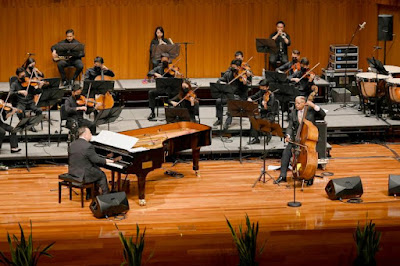
Singaporean jazz pianist and Cultural Medallion recipient Jeremy Monteiro’s collaborations with local Western classical groups have been too few and far in between. This has largely to do with the paucity of repertoire that successfully merges classical forms with the art of jazz improvisation. Hopefully this will change as more of Monteiro’s own compositions become accepted as concert works, the very subject of this showcase in collaboration with crack chamber ensemble re:Sound.


One often regards the likes of George Gershwin, Duke Ellington, Friedrich Gulda and Nikolai Kapustin as composers who have successfully bridged the classical and jazz divide. Now add Monteiro to this illustrious ensemble.


The 80-minute long concert opened with two movements from French composer Maurice Ravel’s String Quartet in an arrangement by Rudolf Barshai for string orchestra. Both movements have in common strong rhythmic elements and modal tunes often encountered in folk music and jazz idioms. Ravel was known to have dabbled in the blues, much to great popular acclaim.


Photo: Clive Choo / re:Sound


This vigorous start paved the way for Monteiro’s own compositions, displaying his versatility and virtuosity in equal measure. Directing from the keyboard, his Overture No.2, titled Through The Golden Doors, was a C major homage to Mozart in a form of a set of theme and variations.


Falling In Love Again was written in the popular vein, with much room for improvisations by flautist Rit Xu and saxophonist Sean Hong Wei. The slow and reflective Nostalgia brought out Slavic melancholy, beginning like a Chopin nocturne and closing like a Rachmaninov romance accompanied by lush strings.


Monteiro joked that it has become his civic duty to write works inspired by the births of his friends’ children. Thus Waltz For Amelia and Elora’s Theme were conceived. The former is a happy and insouciant dance, while the latter demonstrated the master tunesmith in Monteiro, by using a simple melody and transforming it into something rather special.


Also memorable was From Paris To Segré, a railway piece built upon piano ostinatos, generating melody and inexorable motion in the best tradition of train music by Villa-Lobos and Billy Mayerl. Through all this, the players of re:Sound supported Monteiro’s own jazz band (which also included double bass, drums, Latin percussion and tabla) to the hilt.


To prove that the orchestra was indispensable to the enterprise, arranger Germaine Goh’s orchestration of John Coltrane’s Naima turned a sultry saxophone melody into a full-blown symphonic poem. There were solos from French horn and trumpet, while strings and timpani made their presence keenly felt. On piano, Monteiro experimented on harp-like textures and even spread out tone clusters.


For the record, the other arrangers of works were Jordan Wei and Scott Routenberg, who contributed to the colour and variety of the concert. Time passed like a flash when performers and listeners were both having fun, and the encore of Chick Corea’s Windows served as the much-appreciated parting note.    


Tuesday, 25 January 2022

ZEE ZEE IN CONCERT / Review


ZEE ZEE IN CONCERT

Esplanade Concert Hall

Sunday & Monday (23 & 24 January 2022)


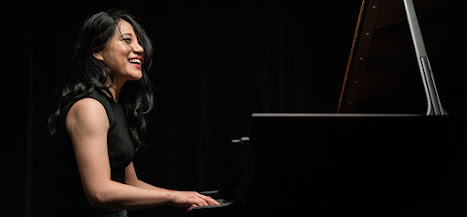
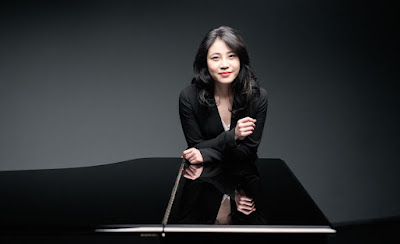
Around the Chinese New Year season every year, Esplanade presents an ethnic Chinese pianist in recital as part of its Huayi Chinese Festival of Arts. This year’s two recitals by Zee Zee were however not in this festival, but the Classics Series and co-sponsered by Kris Foundation. This is Kris Foundation’s biggest coup to date as Zee Zee is none other than Zhang Zuo (or Zuo Zhang), joint First Prize winner of the First China Shenzhen International Piano Competition, and finalist at the Queen Elisabeth and Van Cliburn International Piano Competitions.


Her career follows the familiar trajectory of young Chinese pianists, students of Shenzhen-based pedagogue Dan Zhaoyi such as Li Yundi, Chen Sa and Zhang Haochen, who pursued further studies in the West (Eastman and Juilliard in her case) before hitting the international big time. The choice of repertoire in both recitals also demonstrated a sophistication that went beyond the familiar Beethoven-Chopin-Rachmaninov axis beloved of most Chinese pianists.


Opening the first recital with Ravel’s Gaspard de la nuit must be a terrifying prospect, but little fazed ZZ, who was attired in a tinsel-laden black top, matching pants and 6-inch stilettos. The right hand complex tremolos were as even as one could hope for in the opening Ondine, the water sprite whose lovelorn escapade on land wreaked a terrible vengeance. A most evocative portrayal of the fluid realm, its glistening glissandi and sweeping arpeggios handled with delicacy and vehemence to equal measure made it a thrilling ride.


In the central movement Le Gibet, the ceaselessly tolling bell in B flat cast a hypnotic spell, over which shadowy figures gathered to witness a hanging. The morbid speculation then segued seamlessly into the malevolence of Scarbo, whose knock-kneed scampering is the very stuff of Gothic nightmares. ZZ’s take no prisoners approach served this music to the tee right down to the evil goblin’s final cackle. How did she accomplish such acrobatics with stilettos? Simple, she had taken her left shoe off!     


The harmonic ambivalence of tonal Gaspard could only lead to Arnold Schoenberg’s Three Piano Pieces Op.11 (1909), the first ever atonal piano pieces ever written. If any thematic links were to be found joining Ravel and Schoenberg, that might be the three-note motifs in the first and second pieces which may be considered extensions of the three-note motif that opens Scarbo. ZZ gave a very absorbing account of these rarefied pieces (heard perhaps for the first time in Singapore?), balancing transient lyricism with knuckle-dusters to the ears. She brought a score on stage, but hardly had to look at it. Referring to my score on hand, she hardly had a wrong note.


The inspiration for the Ravel was certainly Franz Liszt, whose three pieces from three books of Années de pélérinage (Years of Pilgrimage) completed the first recital. ZZ took an epic view to the popular Vallee d’Obermann, a tone poem in miniature, reveling in its harmonic vagaries and then letting rip in the tempest scene. Travelling from Switzerland to Italy, Le jeux d’eau a la Villa d’Este  and its water spouts left little doubt that this essay was the fount from which Ravel’s Jeux d’eau and Ondine sprang forth. The programme was making even more sense now.


Spiritual inspiration gave way to the earthly domain of Neapolitan folksong in the rip-roaring Tarantella from the Venezia e Napoli book. The spellbinding speed which she took at the outset of the vertiginous dance seemed scarcely credible, and there were smudged notes aplenty. And how could she possibly build from there? The central folksong section provided some respite as well as several hair-raising cadenzas which almost seemed like childplay. When it came to the final romp, it was imperious and full-blooded. Nothing subtle about this piece, but ZZ had the blood and guts to make it work. The applause was tumultuous, and her encore of the Intermezzo from Schumann’s Faschingsschwank aus Wien was a rehearsal for her second recital.


A different pianist, however, turned up to perform the second recital. Now attired more conservatively (had she run out of snazzy outfits?), Zee Zee appeared like she had aged overnight. For some reason, she played only one of three Clara Schumann Romances (Op.11), a beautiful song without words from which she brought the best with sensitive passage work and judicious pedalling. That was the highlight of the evening, which went south from there.


Robert Schumann’s Faschingsschwank aus Wien (Carnival Jest in Vienna, Op.26) received a strong reading as far as the notes went, but the whimsical aspects of the music (akin in spirit to his Papillons Op.2 and Carnaval Op.9) were not fully realised. More could have been made of the sly quotes from La Marseillaise and Beethoven (Sonata Op.31 No.3) inserted into the opening movement, but the tender Romanze that followed came through most prettily. The last three movements picked up on speed progressively, with the Finale breaking all speed records, almost careening off the tracks before coming to a sturdy close. Lots of haste, but not so much jest.


The biggest disappointment was Brahms Handel Variations, which simply put, were mishandled. The statement of the theme was the best part. Each of the variations that followed were fraught with danger and mishaps, as she ploughed into deeper trouble as the work progressed. As soon as she hit a snag, she would conclude the variation and swiftly move on to the next one with further inherent risks. From hot soup, onto the frying pan, and into the fire. She did however observe the cardinal rule of all concert pianists: never stop playing. One really felt for her in this ordeal which closed with a mighty fugue, summoning every ounce of reserve that was left in a fast depleting tank.


There was loud and grateful applause for her toils, but no encore, which was just as well. Count this as a bad day at the office, as the hero of the night before had become a spent force this evening.         


BEETHOVEN, 1806 / Singapore Symphony Orchestra / Review


BEETHOVEN, 1806

Singapore Symphony Orchestra

Esplanade Concert Hall

Friday (21 January 2022)


This review was first published on Bachtrack on 24 January with the title "Major Beethoven makes a welcome return to Singapore". 


Concert life in Singapore has been inching its way to normality over the past few months. Audience and ensemble sizes are still restricted by social distancing rules, but concert programmes are reverting to their usual lengths. Just last week, the Singapore Symphony led by chief conductor Hans Graf performed a two-hour long concert without intermission, showcasing Schumann’s Piano Concerto (with Herbert Schuch) and two Mozart symphonies. This evening, two major Beethoven works were on the cards.


Robert Schumann’s description of Beethoven’s Fourth Symphony being the slender Grecian maiden between two Nordic giants was apt. Its quiet opening built upon a long-held pedal point on B flat, over which a motif (incidentally shared by the opening of the Fifth) is etched, was delivered with full restraint and total control. Despite being polar opposite of the Eroica and the Fifth, the approach Hans Graf took seemed to point to the future of the symphony form. In those early minutes, thoughts of Berlioz’s Symphonie Fantastique and Mahler’s First came to mind albeit fleetingly,


The ensuing Allegro was no mere fast and loud outburst, but one of swift lightness, distinguished by lithe textures and clarity of playing. The slow movement continued along this vein, gradually building up in volume and intensity like a series of waves. Humour ruled in the Scherzo and Trio movement, where the deliberate impression of ungainliness was contrasted by courtliness. What impressed most was the finale, its perpetual motion of rapid tarantella rhythm delivered with a crispness and precision that seemed scarcely possible. This Grecian maiden can certainly fly.


Hans Graf demonstrates the four
timpani taps in Beethoven's Violin Concerto.


In lieu of an intermission, conductor Graf gave a short preamble on Beethoven’s Violin Concerto, demonstrating the four timpani taps that opened the work and describing that as its DNA. The monumental work, he assured, was to be pivotal in the history of violin concerto writing. It has been ages since this concerto was last heard in Singapore, and young Chinese violinist He Ziyu, student of the Mozarteum University Salzburg, rose to the occasion. 


Possessing the maturity and poise belying his twenty-two years, he carved out a rock solid reading characterised by clean and clear tone, allied with impeccable intonation. His entry was confident, and built on from there. The orchestra’s partnership was discreet, and even in the development section’s darker-hued pages, He weathered the storms with steadfastness and fortitude. Even the Romanticised and frankly outsized cadenza by Fritz Kreisler held no terrors for the young man.


The slow movement seemed like the model of chaste virtue, its prayer-like subject upheld by violin playing in the highest registers. He’s fine control held sway even when it seemed most uncomfortable to do so, and the Rondo finale’s romp provided just the release. Here, earlier trials and tribulations were cast away in a show of joy and jubilation. A dance-like buoyancy was maintained from start to end, with another implausibly anachronistic cadenza (Kreisler again) adding spice to the proceedings. It nevertheless made for a suitably spectacular end to the most sublime of works.


Despite a prolonged clamour for an encore, none was forthcoming from the young soloist. After that close to perfect show of Beethoven, anything more would have been superfluous.        


Rating: *****


He Ziyu photographs by Aloysius Lim, with the kind courtesy of Singapore Symphony Orchestra.

Friday, 21 January 2022

SEASONS OF LIFE / KAJENG WONG / Review


SEASONS OF LIFE

Music of SCHUBERT, SCRIABIN & SCHUMANN

KAJENG WONG, Piano

Atlas Music Co. Ltd.


The special administrative region of Hong Kong has produced young news-making pianists over the years, including international competition winners Colleen Lee and Rachel Cheung, Piano Duo Ping & Ting, and Youtube sensation Tiffany Poon. Another name to add to this august list is KaJeng Wong, or KJ for short, who was the subject of the 2010 docu-movie KJ: Music & Life. The award-winning biopic detailed the trials and tribulations of a child prodigy pianist who grows up and faces an uncertain future.


This 2020 début recital recording entitled Seasons of Life (or Theatre of Life in the translation from Chinese) is a snapshot of that future. In the movie, the child KJ was quoted, “I want to be a human being”. As opposed to being an automaton, one supposes. This manifesto of humanity comes in three chapters, Departure, Lost and Return, and dedicated to his mother, “for giving breath to my departure, for never being away when I’m lost, and for being home when I return,” as the booklet notes explicitly states.


The Chinese simply love concept albums and this one has the physical appearance of a pop CD, but strip away the surface, and one gets music-making that is entirely serious. There are however no programme notes on the music, which begins with Schubert’s Impromptu (D.899 No.1) as the opening chapter. The Austrian lieder composer’s songfulness comes through with a heartfelt outpouring of sadness and regret. He enters the maelstrom with Scriabin’s Sonata No.3 (Op.23), nicknamed “States of the Soul”, its four movements representing myriad personal conflicts within an embattled being. KJ has the mystical Russian’s idiom down pat, reveling in his volatility and sensuousness with equal measure.


The works get progressively longer, culminating with Schumann’s Fantasy (Op.17). This music speaks of the German Romantic’s longing in the physical absence of a loved one, embodied in the quote of Beethoven’s An die ferne Geliebte (To the Distant Beloved) at the end of the rapturous first movement. The imperious march in the central movement holds no terrors to KJ’s technical armamentarium, not least its outsized octave leaps, while the valedictory final slow movement represents a heartfelt homecoming. A return to where the heart truly lies.   


Harmonically speaking, KJ’s character arc begins in sombre C minor, journeys to remote F sharp minor with its tonal ambiguities, before closing in glorious C major. Although this recital ends in beatific quietude, seldom has there been a sense of all-encompassing satisfaction, having been part of KJ’s hope-filled and angst-ridden journey of life.   


Thanks go to Phan Ming Yen for introducing me to this sensitive, thought-provoking and probing artist through the gift of this CD. Further albums by KJ are to be anticipated with enthusiasm.

Thursday, 20 January 2022

TWO PIANO RECITALS NOT TO MISS: ZEE ZEE IN CONCERT @ ESPLANADE CONCERT HALL


TWO PIANO RECITALS

YOU WON’T WANT TO MISS:

ZEE ZEE IN CONCERT


Making her Singapore début is prize-winning Chinese pianist Zee Zee, formerly known as Zhang Zuo, in two piano recitals at Esplanade Concert Hall. Known for her expressive and ebullient styles, she will be performing two separate programmes on 23 & 24 January 2022.


Sunday 23 January


SCHOENBERG Three Pieces Op.11

RAVEL Gaspard de la nuit

LISZT Années de pélérinage (Selections):

  Vallee d’Obermann

  Les jeux d’eau a la Villa d’Este

  Tarantella


Monday 24 January 17, 2022


CLARA SCHUMANN Three Romances, Op.11

ROBERT SCHUMANN 

Faschingsschwank aus Wien

(Carnival Jest in Vienna), Op.28

BRAHMS Handel Variations, Op.24


Both recitals at Esplanade Concert Hall at 7.30 pm


Tickets are still available at SISTIC:

Zee Zee in Concert - Esplanade

Classics 2021 - Esplanade


This presentation is sponsored by Kris Foundation.