Wednesday, 28 September 2022

STRINGS FANTASY / Singapore Chinese Orchestra / Review


STRINGS FANTASY

Singapore Chinese Orchestra

Singapore Conference Hall

Saturday (24 September 2022)


This review was published in The Straits Times on 28 September 2022 with the title "Night of scintillating strings".


The sound of strings is one of the most evocative sensations known to the human ear. Those who attended the Singapore Symphony Orchestra’s screenings of Alfred Hitchcock’s horror movie Psycho will know exactly what fear feels like by just listening. The Singapore Chinese Orchestra’s latest string concert led by Yeh Tsung did quite the opposite, with sounds that soothed, entertained and excited.


All that, of course, depends on the repertoire performed, and Liu Changyuan’s Memories, opening the concert, did all the these. Conceived in two parts, Warm Memories was a gentle dance with string pizzicatos accompanying melodic lines, while Passionate Memories upped the ante with perpetual motion from the gaohus. Then it went for broke with an abrupt shift to dissonance, harmonics and high pitches, as if to shock one’s innermost emotions. Somehow, violent and tumultuous memories seem to stick most in the mind.


Chinese composer Zhao Jiping, well-known for his movie scores for Farewell, My Concubine and Raise The Red Lantern, was represented by two string concertos. His Violin Concerto No.1 received its premiere in 2017 in Beijing by Chinese violinist Ning Feng, who brought warmth and lyricism to the proceedings. More like a single-movement symphonic poem with violin so, his job involved engaging the orchestra in intimate conversation at its outset, before letting it rip with virtuosic exercises and a recurring big melody.


Resembling the best of film music, the rhapsodic score had moments of tear-jerking melodrama, the obligatory fugal passages and a riproaring cadenza. That big tune first introduced by the guan and accompanied by harp did what was intended, to bring down the house at its apotheosis. Ning’s encore of Massenet’s Meditation from Thais, accompanied by huqins and harp, was a heart-warmer as well.
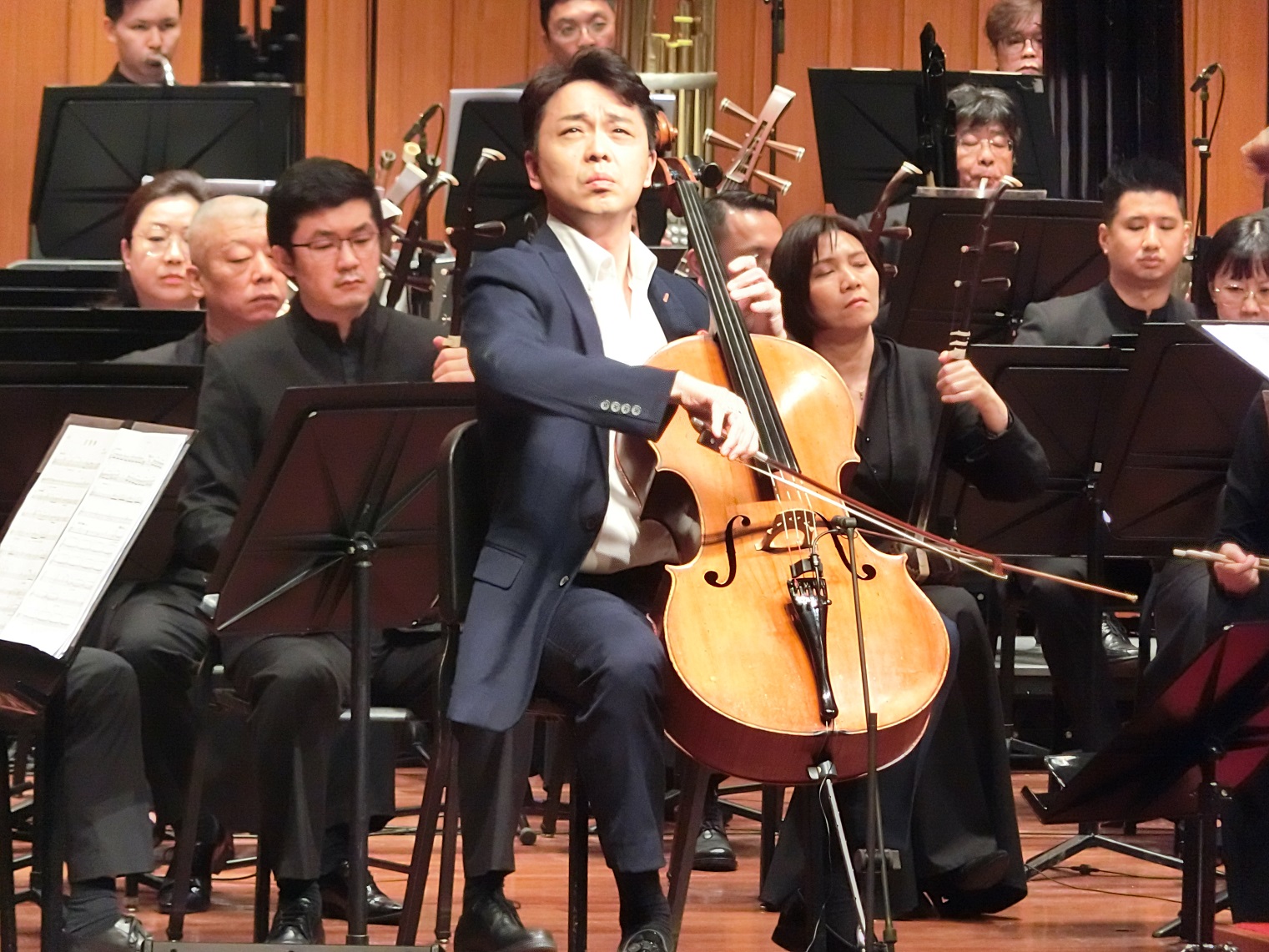


Zhao’s Zhuang Zhou’s Dream was the more subtle concertante work, its long-breathed lyrical lines well suited to Australian-Chinese cellist Qin Li-Wei’s glorious tone production. World weariness was worn heart-on-sleeve, the elegiac mood enhanced by the use of temple bell, singing bowl and drumming. The music did go into full battle mode before retiring to a serene close which embraced tenets of Taoist philosophy. Qin also had an encore of his own: Saint-Saens’ The Swan from Carnival of the Animals accompanied by harpist Nigel Foo.


One would have totally loved to see both Ning and Qin in some sort of double concerto but instead, the audience was treated to Law Wai Lun’s cantata The Celestial Web in its version for chorus and orchestra. Using verses by Tan Swie Hian, this was a paean to universal brotherhood (including sentient and non-sentient beings), a nod to Schiller and Beethoven’s Ode To Joy.


Even its opening in D minor had an obvious debt to the German, but beyond that the music was unremittingly  colourful and joyous, abetted in large part by the well-drilled SYC Ensemble Singers (Chorusmaster: Chong Wai Lun) which sang in Mandarin. It made for a satisfying end to an evening otherwise dominated by strings.


Friday, 23 September 2022

PSYCHO / Singapore Symphony Orchestra / Review


PSYCHO

Singapore Symphony Orchestra

Victoria Concert Hall

Thursday (22 September 2022)


I have watched Alfred Hitchcock’s Psycho (1960) only once in my life until this evening. And I hated it. I cannot abide the idea that the murderer of four people (possibly more) could get away without extreme consequences. That Norman Bates would return in Psycho II and further sequels, again causing the deaths of others. was just unacceptable to me. However, what captured my attention most, watching the black and white movie on television as a teenager during the early 1980s, was its music.


American composer Bernard Herrmann’s score was easily the best thing about the movie. And it was a pleasure encountering it again in this screening at Victoria Concert Hall accompanied by the strings of Singapore Symphony Orchestra led by Australian conductor Nicholas Buc. It was a sold-out event meant to entertain, such that the pre-concert announcement was read by a creepy low voice, something out of the Addams Family. After the warning of not showering or attending the concert with mother, the movie began.


A short synopsis: Marion Crane (played by Janet Leigh) absconds with forty thousand dollars and stays overnight at the Bates Motel managed by Norman Bates (Anthony Perkins). She is offed, sparking an investigation that leads to more horrifying discoveries. It is more a crime movie, of the noir variety, rather than a typical slasher horror flick. There is blood but no gratuitous gore or nudity, with the bloodlust left to the imagination.


The imagination is fuelled most by Herrmann’s totally effective score. String sounds can conjure a seemingly infinite variety of moods and emotions, playing on a receptive mind like putty in one’s hands. The main title was stressful enough with its repetitive pulsating beat, jagged ostinatos and a single short melody that could have been written by Prokofiev or Shostakovich. These recurring motifs come back to haunt, not least in Marion’s anxiety-filled drive through the Arizona countryside, with conflicting thoughts pursuing her, and later amid a rainstorm.


Interestingly, the string music shares the same dark mood of Shostakovich’s String Quartet No.8 (and its corresponding chamber symphony by Rudolf Barshai), both scores coincidentally composed in 1960. It is likely that neither composer knew of each other’s death-laden prized score at the time. Great minds think alike, one supposes.


The ability of the music to get under one’s skin is Herrmann’s greatest gambit. His use of sul ponticello (bowing near the bridge) producing a wiry metallic timbre, con sordino (use of mutes) which dampen and muffle the sound, bass rhythms that approximates the human heartbeat which get faster as the anxiety level increases, all add to the tension. The premonitions that come with such music are the most terrifying part, and both Hitch and Herr really know how to manipulate emotions. I remember ladies in the audience being audibly distressed, while a senior executive of the orchestra (whom I shall not name) closed his eyes throughout some sequences.


What about that most infamous sound effect of all? Slashing stabbing shrieking strings were perfected by Herrmann for the murders of Marion and detective Arbogast, and have been imitated, parodied and memed ever since. Even when viewed today, that never loses its propensity to shock and horrify. This can be summed up in two words: creative genius.  


I am not a psychiatrist, but the behaviour of the movie’s two protagonists may be described as psychopathic (as the title of the movie implied) or sociopathic. Marion for her intention to commit criminal breach of trust and pathological lying (albeit unsuccessful, suspicions of the cop and car dealer being aroused pretty quickly) and Norman for his apparently mild manner (quickly escalating to rage when triggered), the cool methodical way he disposed of his victims’ remains, and a love of taxidermy. The deranged human mind is the scariest thing of all. 


I still hate the movie Psycho. As much as I hate Norman Bates. But now, I love Bernard Herrmann’s music even more.  


If you love the music from Alfred Hitchcock's movies, check out this wonderful recording on Toccata Classics:


Toccata Classics TOCC0241

Listen to it / buy it here:


Tuesday, 20 September 2022

FANTASIA, FAREWELLS AND FAURE / Singapore Symphony Orchestra / Review


FANTASIA, FAREWELLS & FAURE

Singapore Symphony Orchestra 

Victoria Concert Hall, Singapore

Friday (16 September 2022)


This review was first published in Bachtrack on 20 September 2022 with the title "A Requiem of repose: Stephen Layton conducts Fauré in Singapore"


British choral conductor Stephen Layton was to have led the Singapore Symphony Orchestra and its choruses in Fauré’s Requiem in March 2020. The Covid pandemic put an end to that. Two and a half years later, with the virus now endemic, Layton finally arrived and never has there been a more appropriate time for this masterpiece to be heard. The passing of HM Queen Elizabeth II on 8 September had cast a pall around the world, but this concert held in a historic hall memorialising Queen Victoria in the former Straits Settlements colony of Singapore seemed like the most timely response.


Thomas Tallis’s Why fumeth in fight sung by an offstage chorus opened the evening’s music, those being the very strains quoted by Ralph Vaughan Williams in his Fantasia on a Theme by Thomas Tallis which followed without a break. Despite having just 28 string players onstage (21 in the main body and 7 standing behind), Layton coaxed from the ensemble a cathedral of sonority. Having former SSO Concertmaster Igor Yuzefovich (now with the BBC Symphony) as leader certainly helped with crafting textures of evenness and homogeneity. His own quartet of soloists, including violinist Michael Loh, violist Zhang Manchin and cellist Yu Jing, also stood out above the harmonious throng. Seldom has three choirs of strings sung with such moving intensity.


Still with string music, two short pieces from William Walton’s film music for Henry V lent further relevance and significance with their inclusion. In Passacaglia – Death of Falstaff, a slow throbbing pulse held sway, later giving way to the more richly harmonised Touch her soft lips and part in gentle sicilienne rhythm. There was no pretence to lugubriousness, just the regret of parting and bidding farewell.    


The Singapore Symphony Youth Choir (Choirmaster: Wong Lai Foon) with woodwinds, French horn and harp joined the string orchestra for Gabriel Fauré’s lilting Pavane. Has anyone actually paid attention to Robert de Montesquiou’s words, which include Les reines de nos coeurs (Queens of our hearts) and Adieu donc et bons jours aux tyrans de nos coeurs (Farewell and good days to the tyrants of our hearts)? A soothing benediction followed in Cantique de Jean Racine, with the splendid choir’s reassuring mellowness approximating voices of angels.


Photograph: Jack Yam / Singapore Symphony Orchestra


The concert’s centrepiece was Fauré’s Requiem, in John Rutter and Stephen Layton’s edition for soprano and alto voices, performed by the boys, girls and ladies from both the Singapore Symphony Children’s and Youth Choirs (Choirmaster: Wong Lai Foon). Sung completely from memory, this was a show of perfect deportment and discipline. Yet there was a depth of feeling from the opening Requiem aeternam, allied by vocal clarity and excellent enunciation of consonants, all through to the close.


The soloists:
Baritone Martin Ng, soprano Victoria Songwei Li
and violinist Igor Yuzefovich (behind harp)


Organist Isaac Lee provided steadfast support on the hall’s Klais organ, and Yuzefovich’s delightful obbligato violin solos in Sanctus and In Paradisum were the gilded edge. Two of Singapore’s finest young opera singers also had spots to shine. Baritone Martin Ng lent gravitas in Hostias and the rapturous Libera me, while London-based soprano Victoria Songwei Li’s cameo in Pie Jesu revealed a voice of rare beauty. The closing In Paradisum floated on angels’ wings, its ethereal lightness finding a perfect match in the purity of the voices. It would have been hard to find dry eyes among the audience in this requiem of repose.


Photo: Jack Yam / Singapore Symphony Orchestra


Star Rating: *****

Monday, 19 September 2022

FAIRYTALES AND OTHER STORIES / More Than Music & Friends / Review


FAIRYTALES AND OTHER STORIES

More Than Music & Friends

Esplanade Recital Studio

Sunday (18 September 2022)


More Than Music is a duo formed in 2013 by violinist Loh Jun Hong and pianist Abigail Sin, who were fellow students at the Yong Siew Toh Conservatory. Their chamber concerts have covered more than duo music, as they frequently involve friends who play other instruments, including guitar and trumpet. This evening, they were joined by SSO musicians, principal cellist Ng Pei-Sian and violist Wang Dandan, and in their typically informal style, waxed lyrical about the music.


This concert opened with just strings, Jun Hong and Dandan in Sibelius’ rarely heard Duo for violin and viola. A world apart from his gritty symphonic works, this piece oozed a somewhat austere kind of Nordic salon charm. The violin’s melodic lines were well supported by the viola’s harmonisations which were anything but facile or superficial. This served as an apt “once upon a time” introduction to the fare to follow.


Dandan came into her own for the first two movements of Robert Schumann’s Märchenbilder (Fairytale Pictures, Op.113). There are no actual stories attached to the pieces, but one can imagine the scenes. The lyricism and dreamy mood of the opening brought out from her a lovely tone, luscious and full-bodied, contrasted with the more resolute and martial strains of the piece that followed.


Abigail was a most sensitive accompanist, later continuing into Janacek’s Pohadka (Fairy Tale) with Pei-Sian’s cello as protagonist. The Czech’s musical idiom is unmistakable, vividly conjuring a fantasy world of yearning nostalgia and loss of innocence through simple and sharply contoured motifs. Pizzicatos opened the first of three short and linked movements, with a turn for the dramatic looming with each page. The second was more whimsical, rapturous in part yet tinged by an inner lament, with folk music strongly colouring this and the final section. Audiences are all ears whenever Pei-Sian plays, and this was no different.


More folk music followed with Samuel Dushkin’s violin and piano transcription of Stravinsky’s Danse Russe from Petrushka. Ensemble could have been a little tidier in this riproaring music, but there was no denying the energy and exhilaration the duo generated.


The main event of the concert was Brahms’ First Piano Quartet in G minor (Op.25), four movements of symphonic pretensions by the young German. Arnold Schoenberg was moved to orchestrate it, in a famously overblown piece bantered as “Brahms’ Fifth Symphony". It is a wonderfully ambitious work, so dripping with red meat and raw emotion as to become endearing in a certain strange way. The foursome, which had greatly impressed in Brahms’ Third Piano Quartet last year, was no less trenchant this time around.


The beefy musical material, offset by Pei-Sian’s lyrical cello in the second subject, was well-sustained in a performance bristling with pathos and tension. With Brahms, even an Intermezzo could be laden with an inner tension, but a scherzo-like section signalled a lightening of mood. The slow movement in E flat major showed that unison voices could sound just as profound, then rising in a march-like episode to a full-blooded and ecstatic climax before gently retiring.


Guilty pleasure has always been derived in the final Rondo alla Zingarese, a rollicking Hungarian-styled dance movement possibly more infectious than Covid itself. In supporting the strings, Abigail’s prestidigitation was always assured, later culminating with a cascading cadenza down to the foot of the keyboard. This exciting romp is guaranteed to bring out the loudest of cheers from the audience, and so it proved.


Still sticking with the dance theme, the quartet’s encore was Alexander Oon’s rocking arrangement of Astor Piazzolla’s Libertango. Its rhythms were more than infectious, the performance more than exuberant, offering a more than satisfying end to a concert that delivered more than expected.  


Wednesday, 14 September 2022

UNBRIDLED PASSIONS / The Philharmonic Orchestra / Review


UNBRIDLED PASSIONS

WORKS OF HECTOR BERLIOZ

The Philharmonic Orchestra

Esplanade Concert Hall

Tuesday (13 September 2022)


It has been several years since I last heard The Philharmonic Orchestra (TPO) playing at full strength. Last year’s New Year’s Eve Concert, under Covid pandemic restrictions, had a maximum of 30 players, but this concert was to be different. Lest one forgot, TPO was the orchestra every young player wanted to be in before the coming of OMM (Orchestra of the Music Makers). TPO under founding Music Director Lim Yau performed the first cycles of Beethoven, Brahms, Schumann and Sibelius symphonies at the Esplanade during the noughties. For that, the outfit which continues to attract many talented young players, deserves total respect.


Lim Yau, having turned 70 this year, has now handed the baton to his son Lin Juan, who continues in the fine tradition. Lin is only the second second-generation conductor in Singapore, the first being Goh Soon Tioe and Vivien Goh dating back almost 40 years ago. Nonetheless, Lin is a force to reckon with his understated and quiet confidence in leadership, quite different from the awe and deference (some say fear) that his father commanded (unintended or otherwise) from his charges.


The evening opened with Berlioz’s song cycle Les nuits d'été (Summer Nights), six settings on verses by Theophile Gautier with soprano Teng Xiang Ting. Teng alone would have been the reason to attend the concert as there is no other singer like her, one with a most beautiful and well-rounded voice, supported by the widest range of registers and emotions possible. The late music critic Marc Rochester was spot on in naming her Singapore’s first opera star.


In just two songs, a taste of delectation beckoned; lightness and airiness in Villanelle, and depth of feeling with a sense of the epic in Le spectre de la rose. By the way she voiced Reviens (Come back) in Absence, one knew she really meant it. By the final L'île inconnue (The Unknown Island), the persuasion to join her on that unattainable voyage – any voyage to anywhere - becomes all the more irresistible. The chamber-sized orchestra that accompanied Teng was sensitive and responsive, and there was never a fear she would be overwhelmed. Her voice simply does not allow for that.


Following the intermission, the full orchestra came on for the monumental Symphonie Fantastique. I still remember Lim Senior leading in the SSO in this same work almost 30 years ago, with a first half filled with orchestrated Beatles songs (laudanum-LSD being the supposed common inspiration). Lim Junior’s account was no less vivid, even when working with mostly student musicians. In the opening Reveries-Passions, strings in particularly fine form generated a rich and mellow sonority, stepping up accordingly with heightening tensions. Un bal (The Ball), a waltz in a Parisian ballroom, provided more pleasure with the contribution of two harps.


Even Scene aux champs (Scene in the Fields), the symphony’s “boring” movement was actually made to sound eventful. Kudos to the fine cor anglais and offstage oboe soloists, playing the communing shepherds, a marvellous solo clarinet for a reminder of the idee fixe and gripping timpani rolls as the sound of distant thunder. As expected, the Marche au supplice (March to the Scaffold) built up inexorable pace and momentum, with brass having a field day, all the way to the falling blade. Songe d’une nuit du sabbat (Dream of the Witches Sabbath) was a riot of sound, complete with a wonderfully blaring Dies Irae and tolling tubular bells, but one that was kept under control without going full "Shining" Jack Nicholson. All in all, a memorable performance from a dynamic young group that seemed almost inconceivable 20 years ago.  


Over the past fortnight or so, one has witnessed in Singapore very good (some stellar) performances of Richard Strauss’ Alpine Symphony, Piazzolla’s Four Seasons, Bartok’s Divertimento, Brahms’ Second Piano Concerto, Beethoven’s Fifth Symphony and now Berlioz Symphonie Fantastique, none of which were by the Singapore Symphony Orchestra. Does that spell progress, or what?


ONES TO WATCH: VERONA QUARTET / Review


ONES TO WATCH:

VERONA QUARTET

Yong Siew Toh Conservatory Concert Hall

Thursday (8 September 2022)


This review was published by The Straits Times on 14 September 2022 with the title "Verona Quartet played with pinpoint accuracy".


Lovers of chamber music are blessed by the wealth of international string quartets that have performed and conducted residencies at the Conservatory. One can rattle off their names: Takacs, Hagen, Juilliard, Endellion, Shanghai and Jerusalem Quartets. Add the Ohio-based Verona Quartet, quartet-in-residence of Oberlin Conservatory, to that illustrious list.


Formed in 2013, the foursome praised for interpretation of contemporary music has a Singaporean, Jonathan Ong, as its first violinist. The other members, second violinist Dorothy Ro (Korean-Canadian), violist Abigail Rojansky (American) and cellist Jonathan Dormand (British), make it one of the most cosmopolitan chamber groups of today.


Verona Quartet’s recital, presented by the Conservatory and Shaw Foundation’s Ones To Watch Series, was a showcase of versatility and virtuosity. The most familiar work on the programme, Beethoven’s String Quartet in F major (Op.18 No.1), began the concert. Its unison opening served as a barometer of the foursome’s togetherness, and they did not disappoint. Tautness of ensemble, pin-point accuracy, and a warm sonority all served to make the performance a pleasure.


As first violinist, Ong had many of the plum lines and virtuoso turns, and was matched by the other Jonathan’s cello plaints. This was most apparent in the slow second movement in D minor, which sang with the intensity of a sad aria. The rest of the work had a lightness and buoyancy, delivered with the keenest of spirits.


In stark contrast, 20th century Hungarian composer Gyorgy Ligeti’s First String Quartet (1953-54), also entitled Metamorphoses Nocturnes, was an absolute riot of avant-garde sound and colour. Taking several pages from Hungary’s most venerated composer Bela Bartok, the Singapore premiere of this 20-minute continuous canvas of sound exhausted every modernistic device and technique of string playing thought possible.


A simple motif of four notes was put through the proverbial wringer, subject to short but wildly disparate variations for which the term metamorphoses was used. Its seventeen linked sections sprung many surprises, including a faux-sentimental waltz, schmaltzy interludes, surprise cadences, all conducted with tongue lodged firmly-in-cheek. Displaying a jaw-dropping degree of adroitness, there was not a dull moment to be had.


Not often heard is Dvorak’s sprawling String Quartet No.13 in G major (Op.106), with four movements which play for almost 40 minutes. Composed after his famous American sojourn (where he created his New World Symphony and American Quartet), the music returned to his Bohemian roots, with the creative use of folk melodies and rhythms.  


While the opening movement had lighter serenade-like moments, the slow movement breathed with the sighing quality of a lament or Slavic dumka. Memories of his famous Largo (from the New World Symphony) were relived in minutes which expressed longing and regret. The lively skipping Scherzo and the finale’s rustic energy, with a reprise of the first movement motifs, completed a masterly showing.  


With all that seriousness behind them, the Verona Quartet offered as an encore Duke Ellington’s Cotton Club Stomp, in all its toe-tapping and foot-stamping gaiety.
