Monday, 27 March 2023

KAHCHUN WONG AND DANIEL LOVAKOVICH / Singapore Symphony Orchestra / Review


KAHCHUN WONG AND 

DANIEL LOZAKOVICH

Singapore Symphony Orchestra

Esplanade Concert Hall

Saturday (25 March 2023)


This review was published in The Straits Times on 27 March 2023 with the title "Kahchun Wong, Syafiqah 'Adha Sallehin shine in SSO concert".


A short twelve years ago, Kahchun Wong and Syafiqah ‘Adha Sallehin were fellow composition students at the Yong Siew Toh Conservatory. Together, they were pioneering members of the Asian Contemporary Ensemble (ACE). Founded by Wong, who was also its conductor, the visionary ensemble championed modern works and music by young Asian composers. All that changed when Wong was awarded first prize at the Gustav Mahler International Conducting Competition in 2016.


ACE was disbanded while the ace became Chief Conductor of the Nuremberg Philharmonic. In September this year, Wong will assume the helm of the Japan Philharmonic. Syafiqah, the first Singaporean Malay music graduate from the Conservatory, composes music which fuse Malay and Western classical idioms, besides being an accomplished accordion player.


The two were united again in the world premiere of Syafiqah’s Aeriq’s Lullaby, a 9-minute programmatic work inspired by motherhood and the birth of her son. There were no ethnic influences here, instead its idiom was closer to Disney film music, being very easy on the ear.


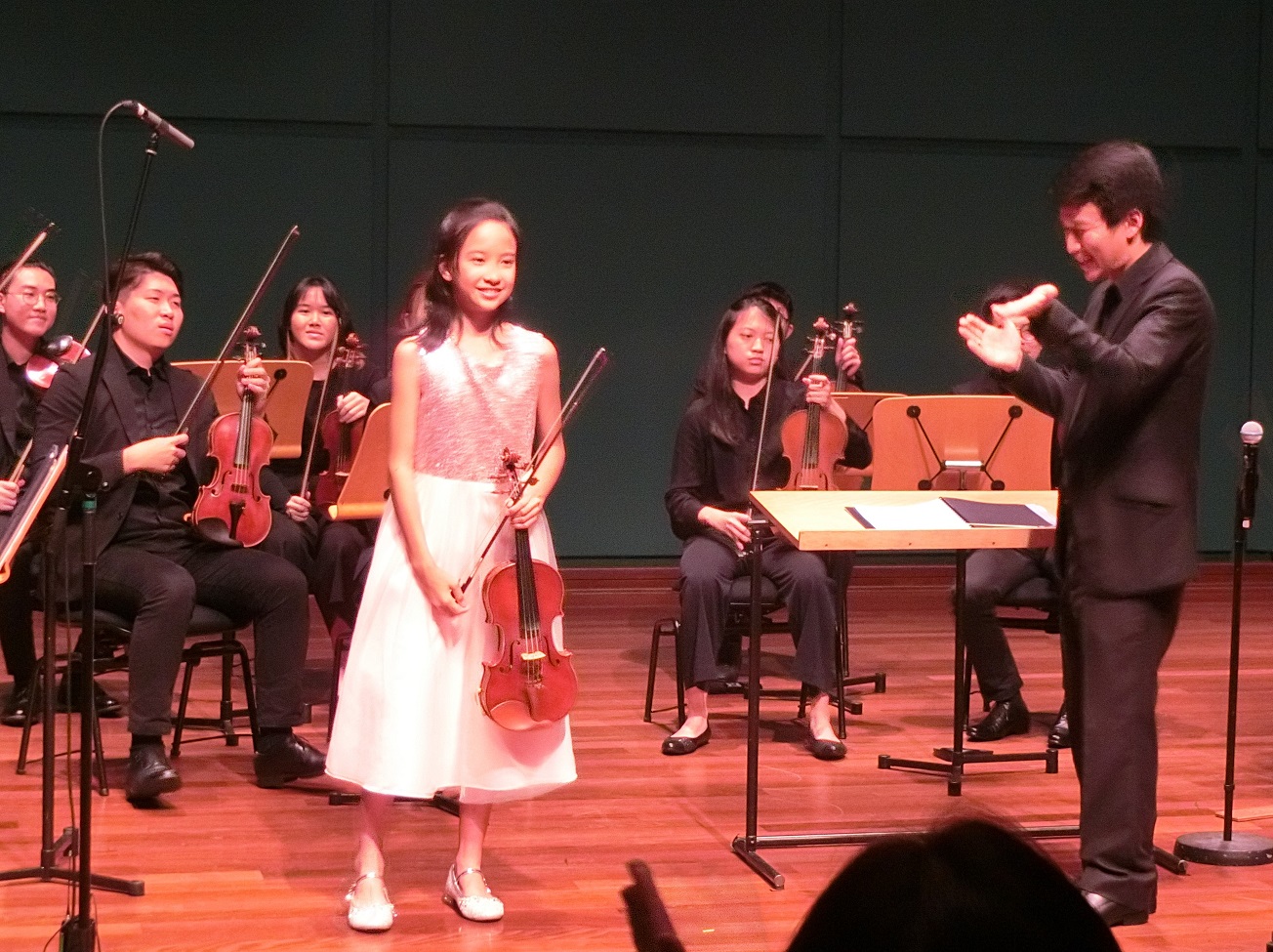
Kahchun Wong holds up the score
of Syafiqah's Aeriq's Dream
.


There were some dissonances in the central section Through Sleepless Nights, with woodwind glissandi and brassy wails depicting night terrors and a baby’s distress. Guest concertmaster Wang Jing’s violin solo provided reassurance and the closing A Mother’s Prayer was bathed in the warm embrace of C major. All’s well that ends well in this child’s world.     


Equally agreeable was Mendelssohn’s Violin Concerto in E minor with Swedish violinist Daniel Lozakovich in the solo role. His modestly-scaled tone suggested intimacy, more like chamber music than a commanding show of virtuoso prowess. Coming into his own in the first movement cadenza, the slow movement that followed was pure lyricism belied by underlying tension. The finale’s elfin dance, prodigious in his control, pulled out all the stops.


Lozakovich’s two solo encores were also excellent. Nathan Milstein’s Paganiniana brought a collective gasp of surprise from the audience as it recognised Paganini’s Caprice No.24 as the main subject, while Tchaikovsky’s Valse Sentimentale, a salon piece, sounded even better when unaccompanied.


For the concert’s second half, conductor Wong emerged with a change of outfit to conduct Brahms’s Symphony No.4 in E minor from memory. And what a memorable performance it was. The opening Allegro non troppo was taken at a measured tempo, allowing much orchestral detail to be savoured and the climax to be sufficiently shattering. Similarly, the second movement’s procession exhibited restraint before blooming into expansiveness on the crest of a wave.


The rousing Scherzo's adrenaline rush saw the audience applauding prematurely, and Wong used this to acknowledge Mark Suter's few minutes of tingling frisson on the triangle. The closing Passacaglia was the symphony’s crowning glory, its series of short variations on a ground bass tautly held together with an inner urgency.


Marshalling orchestral forces at full tilt and bringing both symphony and concert to a grandstanding conclusion, Kahchun Wong showed exactly why he has become Singapore’s most sought-after maestro on the international concert circuit today. 


Post concert: Syafiqah meets
with fans and signs autographs.

Syafiqah and her composition teacher
Prof. Ho Chee Kong.

Another version of this review was published on Bachtrack on 27 March 2023, and can be viewed here:

Kahchun Wong’s return to hometown Singapore garners a warm reception | Bachtrack

Saturday, 25 March 2023

NACHTMUSIK / KOTARO FUKUMA Piano Recital / Review


NACHTMUSIK

KOTARO FUKUMA Piano Recital

Victoria Concert Hall

Friday (24 March 2023)


It seems odd that Japanese pianist Kotaro Fukuma, 1st prizewinner of the 2003 Cleveland International Piano Competition, who concertises actively in Japan and Europe, has never performed in Singapore. Until now, so it is a case of better late than never. His recital, presented by C.Bechstein Concerts, was built around the theme of “Night”, a celebration of romance, mysteries and terrors associated with the dark hours.


Photo: Yong Junyi


Opening with the serene Bach-Siloti Aria in D major from Orchestral Suite No.3 (better known as the Air on G String), he coaxed a beautiful and luscious tone from the Bechstein 9-footer, an apt prelude for things to come. Fukuma’s own transcription of Mozart’s Serenade in G major (K.525), the familiar Eine Kleine Nachtmusik, was a special surprise. One never thought its string-based melodies and textures could translate so well on the piano.


Photo: Yong Junyi


This was no light-footed or prissy account associated with the period instrument movement, but one which relived full orchestral textures, where forte means forte, and outright virtuosity was a means to an end. The opening movement’s robustness was balanced by a Romanze of Rococo charm until  machinations of busy counterpoint took over. Fukuma made it sound so simple, a feat that was reprised in the mercurial finale’s free-wheeling dealings.


The Austro-German first half continued with Clara Schumann’s Notturno in G minor (Op.6 No.2), a Mendelssohnian song without words which occasionally strayed into Chopin territory (notably the Andante Spianato). Without a break, its lyrical beauty segued seamlessly into her husband Robert’s familiar Traumerei (Dreaming) from Kinderszenen (Scenes from Childhood), its most natural companion. When reverie turns into tumultuous struggle was the lot of In der Nacht (In The Night) from Fantasiestucke (Fantasy Pieces) Op.12, a work of true Romantic angst filled with disquiet and smouldering tension. Also technically the most difficult of the set, Fukuma faced its thorny pages head on without flinching, and some release was found in the whimsical Traumes Wirren (Dreams Confusion), bringing the Schumann segment to a grandstanding close.


Photo: Yong Junyi


There were many children in the audience, but their silence throughout the recital spoke volumes of how Fukuma communicated to all kinds of listeners in his music-making. Their good behaviour was rewarded with Alfred Grünfeld’s Soiree de Vienne, a waltz fantasy built around the popular number from Johann Strauss the Younger’s Die Fledermaus. Its ubiquitous melody kept popping up in a playful game of counterpoint, the result proving a big hit with the audience.


The French-flavoured second half opened with three Nocturnes performed without a break. Two of Chopin’s most familiar showcased wide contrasts, the E flat major (Op.9 No.2) in a version augmented with ornamentations of filigreed finery, and the dark and stormy C minor (Op.48 No.1).  In the latter, gentility gave way to full-blooded passion, and no one could accuse Chopin of being soft or effete. What followed was a rarity, as Gabriel Fauré's piano music is not played enough in Singapore. His Nocturne No.5 in B flat major is a gem, which Fukuma polished to a fine sheen. Its melting lyricism contrasted with outpourings from the broken heart was a natural progression from Chopin. New rule: every conservatory piano student must learn a Fauré nocturne (pick any one of 13) for every Chopin nocturne played.


Photo: Yong Junyi


Debussy’s Clair de lune from Suite Bergamasque had to be included, its gentle evocation of twilight beautifully rendered, and it was a masterstroke to have its D flat major close flow directly into the C sharp-centred delicate right hand tremolo of Ravel’s Ondine from Gaspard de la nuit. These are essentially the same note on the keyboard, and aurally made perfect sense and synergy. Fukuma’s mastery of the music’s big sweeps and glissandi was awe-inspiring to say the least.


The stroke of midnight, with twelve tolls of the bell heralded Saint-Saens’s Danse Macabre in the rambunctious transcription by Franz Liszt. Frightful visions of dancing skeletons and the Devil’s evil laughter came alive in Fukuma’s hands, which even included a furious fugato of clattering bones, bringing the recital to a stirring conclusion. His encore had little to do with night, but who could resist Japanese composer Kozaburo Hirai’s Fantasy on Sakura Sakura? Erik Satie’s delightful valse-chanson Je Te Veux (I Want You) took on a new life in Fukuma’s elaborations, all tarted up and with everywhere to go. Kotaro Fukuma’s return to Singapore will be keenly anticipated.


Photo: Yong Junyi


Wednesday, 22 March 2023

YOUNG VIRTUOSI 2023 / Musicians Initiative / Review


YOUNG VIRTUOSI 2023

Musicians Initiative

Esplanade Recital Studio

Tuesday (21 March 2023)


Ever wondered how the likes of violinist Chloe Chua or pianist Toby Tan came about? Musical child prodigies are rare miracles of nature and nurture, but given the right environment, education, guidance and encouragement, many children can aspire to great heights. It is a matter of time that their talents are revealed, and there are many more prodigies than one suspects. Chloe and Toby, winners of international music competitions, are the only the tip of a giant iceberg.


It repays to discover how big this talent pool is, and this special concert for young soloists presented by Musicians Initiative (now in its second edition), was a big step in the right direction. Six string players played concerto movements and showpieces with the string ensemble from Musicians Initiative led by conductor Edward Tan, better-known as the concertmaster of re:Sound and first violinist of Concordia Quartet.


The 80-minute concert opened with Timothy Chua (12 years old) performing the first movement from Haydn’s Cello Concerto in D major. A picture of confidence, his healthy and robust tone served the music well, including a technically demanding cadenza by Steven Isserlis. Despite a short segment of desynchronisation between soloist and orchestra, he shrugged it off without batting an eyelid and continued to complete his task at hand. Composure is not something easily acquired or grasped, but he has it in shovels.


Despite 10-year-old Korean boy YooJun Curtis Lee being the tiniest of the six, he exhibited the heart of a lion. So natural he was in the first movement of Mozart’s Violin Concerto No.3 in G major (K.216) that it seemed as normal as breathing. Totally unfazed by the double stopping in the cadenza that might have unnerved older players, his reading was one of total control and confidence.


Alyssa Anne Low (11) was perhaps over-ambitious to have chosen Sarasate’s very tricky Zigeunerweisen (Gypsy Airs), but she launched into it with steely determination. She produced a voluminous tone but had intonation issues in the most technically demanding parts. While the slow movement sang prettily, the romping finale came across as a little messy. With the passage of time and more practice, she will certainly grow into this showpiece.   


The surname Qin is almost synonymous with the cello in Singapore, Australia and China, so it was not a total surprise to see Jayden Qin (11) appear in the first movement of Haydn’s Cello Concerto in C major. His was a very nuanced and thoughtful reading, displaying good tone and an understated kind of virtuosity. He is certainly a chip off the old block (and apologies for calling Li-Wei an old block!).


Yuto Lim, despite being just 11, already appears like a seasoned veteran. In Winter from Vivaldi’s Four Seasons, he started playing as if a member of the orchestra, and his solo that emerged from the throng was distinguished by clarity of articulation and tone. His was a no-holds-barred reading, unafraid to let rip in the fiery outer movements yet maintaining a reassuring warmth and glow at its core. He might just be the one to emulate the world-beating feats of Chloe Chua.


Jacob Cheng (14) was the most mature of the six talents, and his view of Ravel’s gypsy rhapsody Tzigane had the requisite virtuosity demanded from an adult performer. His opening unaccompanied solo was spell-binding and the ensuing ride being a thrilling show of swaggering pyrotechnics. Most alertly accompanied by the orchestra, as with the other works, this brought the concert to a stunning close.  


All six young virtuosi returned to perform an encore: the first movement of Vivaldi’s popular Concerto in B minor for four violins. This was an absolute blast, simply because each player had already completed their individual projects and was now enjoying the company of the others. The audience was just as enchanted, erupting with a big communal cheer, the best encouragement the soloists could possibly get. It was the best way of saying,“We want to hear you play again!” 


10TH ANNIVERSARY CONCERT / More Than Music & Friends / Review


10TH ANNIVERSARY CONCERT

More Than Music & Friends

Esplanade Recital Studio

Sunday (19 March 2023)


This review was published in The Straits Times on 23 March 2023


About ten years ago, a violin and piano duo called More Than Music was formed by two young alumni of the Yong Siew Toh Conservatory, with their first concert presented by Kris Foundation. It was the intention of violinist Loh Jun Hong and pianist Abigail Sin to present classical music as accessible and unstuffy, yet without needing to dumb down.


Their unqualified success led to concerts involving more members of the musical community, including violinists, violists, cellists, and the odd guitarist and trumpeter. During the height of the Covid pandemic in 2020, they invited fellow musicians to present all ten of Beethoven’s violin sonatas in a series of digital concerts. 


More Than Music’s tenth anniversary concert featured some more musical partners, but it was Loh and Sin who opened with Brahms’ Scherzo in C minor. Part of the four-movement F-A-E Sonata crafted by three composers for the violinist Joseph Joachim, its recurrent motif of three short stabs and one long note was reminiscent of Beethoven’s famous Fate theme.


Its sheer insistence, placated by a swooning lyrical melody, provided cuts and thrusts of this short impactful movement. Both players were in one mind throughout, bonded by a chemistry developed over the past decade, making for an impressive opening.  


Ironically, that would be the duo’s last outing for the evening, with Sin joined by fellow Conservatory colleague Albert Tiu in Rachmaninov’s Second Suite for two pianos (Op.17). Its inclusion also marked the 150th birth and 80th death anniversaries of the popular Russian composer. The first movement’s Alla Marcia, with quick successions of chords could have made for heavy weather, but their response was both crisp and devastatingly accurate.


Split-second razor reflexes ruled in the mercurial Waltz, dispatched with almost nonchalant ease, while the Romance simply oozed sensuality from every pore. The finale’s swirling Tarantella could have been even more scintillating had they gone absolutely for broke. Cooler heads prevailed, but the outcome was still a satisfying one.


As the pianists retired, Loh was joined by violinist Yang Shuxiang, violists Zhang Manchin and Wang Dandan, and cellists Ng Pei-Sian and Jamshid Saydikarimov (the latter four all Singapore Symphony musicians) for Tchaikovsky’s String Sextet in D minor (Op.70), also known as Souvenir De Florence.


This has to be the usually-morose Russian composer’s most cheerful and uplifting work, the music filled with Mediterranean sunshine and high spirits. From the outset, all six players bathed the hall with a warm sonorous glow, with each and every part distinctly discerned. Passion was in full flow for the fast outer movements, balanced by playing of true finesse in the slower second movement.


Here, pizzicato strings laid the way for a love-in between Loh’s violin and Ng’s cello, their parts so closely intertwined as to delight the inner voyeur of every music-lover. Most of all, it was the unbridled joy of music-making exhibited between friends which was the essence and lifeblood of chamber music. May we have many more years of More Than Music.  


An impressive wall of posters
from past concerts 2013-2023.


Tuesday, 21 March 2023

FRIENDSHIP / Singapore National Youth Chinese Orchestra / Review


FRIENDSHIP

Singapore National Youth Chinese Orchestra

Singapore Conference Hall

Saturday (18 March 2023)


This review was published in The Straits Times on 20 March 2023 with the title "Friendship, camaraderie at Singapore National Youth Chinese Orchestra's 20th anniversary show".


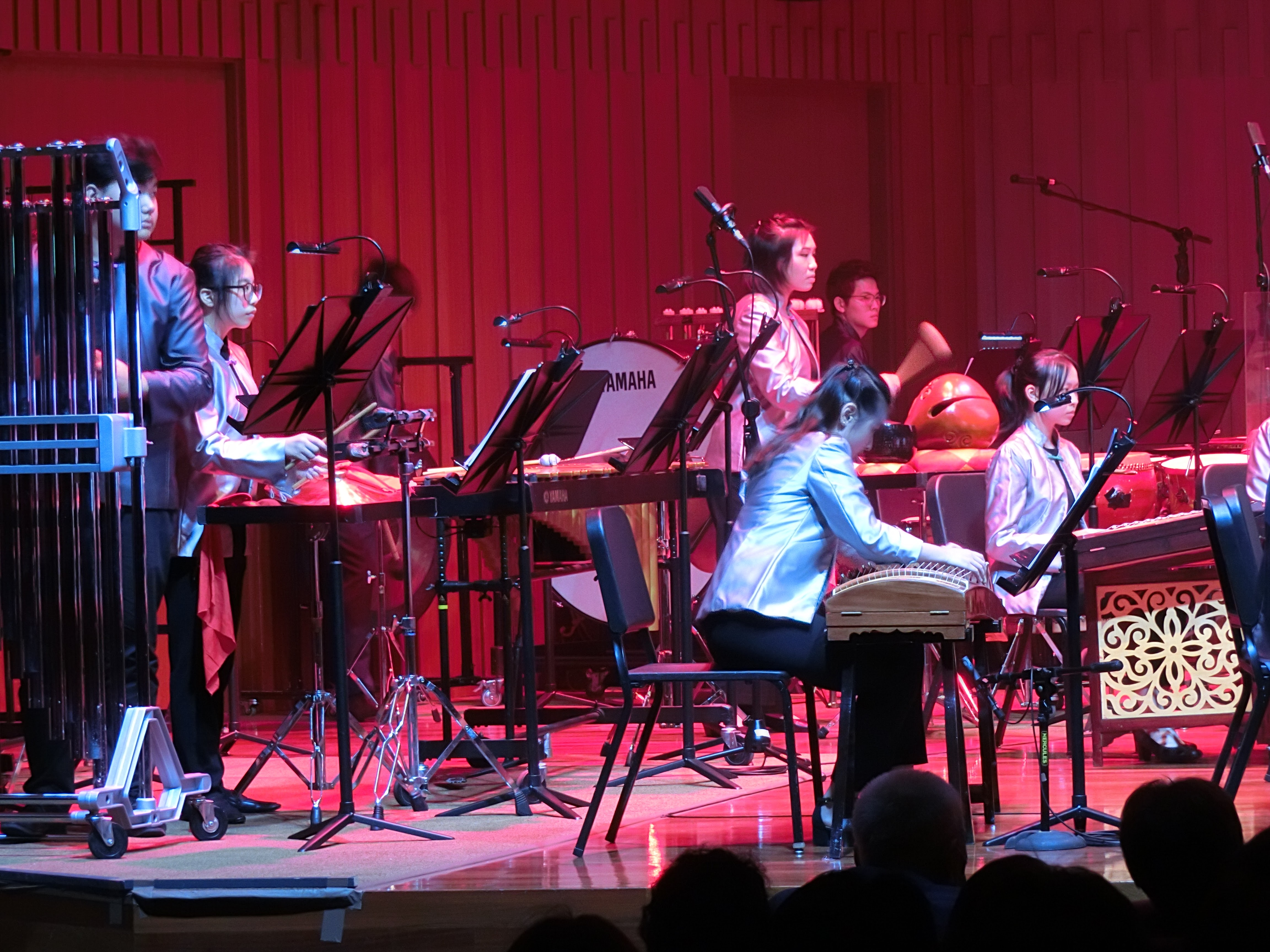
This concert marked the 20th anniversary of the Singapore National Youth Chinese Orchestra (SNYCO) as a ensemble assembled under the auspices of the Singapore Chinese Orchestra. Its 80-minute programme, featuring five works performed without an interval, was a showcase of how far the group has progressed.


Music Director Quek Ling Kiong, who had been at the helm since inception, was his usual bubbly best, not just as a podium maestro but also cheerleader. Friendship and camaraderie was the concert’s overall theme, also the subject of Liu Xing’s Bian Ba, named after the composer’s close Tibetan friend and colleague. The music was more reflective than exuberant, with solo and grouped erhus (Bian’s own instrument) in lyrical repose before rising to a crescendo, reflecting the blossoming of a friendship.


Its restrained and congenial tones could not have been more contrasted with Wang Danhong’s Strings On Yangko Dance, inspired by rural celebrations in Northern China on the fifteenth day of the first lunar month. This raucous commemoration of the equivalent of our Chap Goh Meh was characterised by the virile play of strings and incessant percussion. Standing tall amid the throng were solo and grouped suonas, resonating like the earthy voices of humanity, providing an orgiastic  climax before dissipating to nothingness.  


Liu Wenjin’s orchestral fantasy on Molihua (Jasmine) was more traditional, with cellos and basses opening the work and various orchestral groups taking on the popular melody. First it was the dizis, then huqins and later pipas, building up to a drum roll and somewhat overblown apotheosis. When you have a memorable tune, milking it to the max seemed to be the message.   


Far more exotic was Xu Jingxin and Chen Dawei’s Fei Tian (Flying Apsaras), inspired by murals in the famous Mogao caves of Dunhuang. Beginning with an air of mystery, the piercing high pitch of the whistle (from a dizi player) was particularly haunting. Its Central Asian feel was heightened with yangqin, guzheng and percussion (wood blocks, cymbals and xylophone) as the dance wound to a high before returning to an idyll of serene whistling.


Law Wai Lun’s tone poem Prince Sang Nila Utama and Singa provided the evening’s only example of Nanyang music, works with distinct Southeast Asia influences and inspiration. The score was a curious blend of impressionistic colour reminiscent of Ravel and Debussy and use of Indonesian scales, giving it a very local flavour. Dizi, suona and guan were used to ear-catching effect, and a stentorian melody at its close represented the prince’s encounter with the lion and the ensuing historical myth-making.  


That made for a suitably rowdy close, and with the slightest bit of prompting, the orchestra launched into its encore, Kuan Nai-chung’s Da Gui (Vanquishing Demons) from A Trip To Lhasa, an ear-worm of a piece if any. Cheered on by an audience filled to the rafters, one foresees in these talented young musicians a very bright future ahead for Chinese instrumental music in Singapore.