Showing posts with label Chen Qigang. Show all posts

Monday, 5 August 2013

MODERN VOICES - CLASS OF 1978 / Ding Yi Music Company / Review


MODERN VOICES – CLASS OF 1978
Ding Yi Music Company
Esplanade Recital Studio
Saturday (3 August 2013)

This review was published in The Straits Times on 5 August 2013 with the title "Invigorating mix in new music".

The year 1978 was an important one for Chinese music. With Chairman Mao Zedong dead and the Cultural Revolution ended, the Central Conservatory in Beijing reopened its doors to a cohort of students whose lives had been disrupted by years of chaos, mayhem and forced labour. They would later become the voice of Musical China in the West in the 21st century, their legacies celebrated in this two-hour-long concert by the Ding Yi Music Company directed by Lim Yau.   


The evening began with Zhou Long’s Mount A Long Wind (2004), scored for erhu, pipa, dizi, guzheng and percussion. Impressionist in colour, the work inspired by Li Bai’s Xing Lu Nan (The Hard Road) was evocative of wind, water and nature’s elements. Poetic and meditative in part, it also drew upon a raw primal energy that gave the concert a stirring opening.


Tan Dun’s Ghost Opera (1994) is one of his best known scores, almost a microcosm of his entire well-exposed output. The parts played by a western string quartet (violinists Siew Yi Li and Lim Hui, violist Mervyn Wong and cellist Lin Juan) and pipa soloist Chua Yew Kok, all of whom multi-tasked as percussionists and vocalists, were both visual and musical. The hall was cloaked in darkness, with spotlights on the soloists and glass bowls of water.

Music from a Bach Prelude merged with the Chinese folksong Xiao Bai Cai (Little Cabbage), shamanistic yelps and Shakespearean quotes, traditions representing the “past”. The sounds of water (and the effects of gongs being immersed), metal (percussion), stone (struck close to resonating open mouths) and paper (a long roll being flapped in space) were the symbols of “eternity”, played by performers of “now”.


This 40-minute theatrical experience played out as an enthralling dialogue between “ghosts” of the past and future, confronting the present. Its symbolism was not lost on the full-house audience, which greeted the convincing performance with a most stirring of ovations.

Chen Yi’s Huqin Suite (1997) was brought on tour by the Singapore Symphony to Germany in 2000. This was however the Singapore premiere of the version scored for Chinese instruments (2007), with Chin Yen Choong playing on three bowed instruments. The erhu with its mellifluous singing was contrasted with the lower and more guttural zhonghu recitations, and capped by the diminutive squeak of the gaohu in the furious final dance. 


The concert closed with Extase III (2010) by Chen Qigang, well known for having been the Music Director of the 2008 Beijing Olympics. A virtuosic score much in the tradition of Messiaen and Boulez, Veda Lin stood out for her ceaseless acrobatics and breathtaking long phrases (circular breathing being the secret) on the oboe. This fantasy on the folksong San Shi Li Pu also pitted her with Wong Deli’s suona, as the music drew to a feverish and raucous climax. Both soloist and ensemble emerged first among equals, in a concert of new music that was both invigorating and inspiring. 


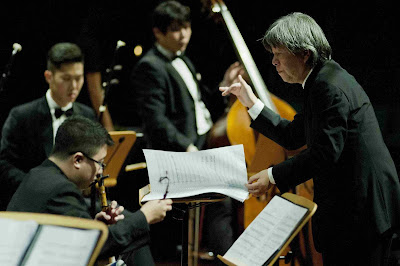
Concert photographs courtesy of Ding Yi Music Company.

Thursday, 23 September 2010

SINGAPORE CHINESE ORCHESTRA IN PARIS / Sneak Preview / Review

SCO IN PARIS A Sneak Preview
Singapore Chinese Orchestra
Tsung Yeh, Conductor
SCO Concert Hall
Wednesday (22 September 2010)


Parisians will get a taste of Singapore when the Singapore Chinese Orchestra performs at the Musée du Quai Branly on two evenings in October, part of the Singapour Festivarts exchange programme between the two nations. But what will they get to hear? Singaporean music, Chinese music or Asian music?

The one-hour programme devised for 25 instrumentalists by SCO Music Director Yeh Tsung was an excellent showcase of the orchestra’s virtuosity, and had a little bit of everything. It was however unfortunate that no Singaporean composers were represented. The Nanyang segment (incorporating music of Indo-Malayan flavour) came from the Malaysian composer Yii Kah Hoe’s Buka Panggang, his musical vision of an overture to a wayang kulit play.

The sheng’s piercing timbre and wails of the diyin suona opened this ten-minute tone poem that gradually expanded into a full-scale processional replete with kampung drumming. This was not Chinese music per se, for its essence lay somewhere lying far south, much nearer the equator. But could it pass off as Singaporean? Perhaps so, if we were not so busy sacrificing our heritage for modern trappings, IRs, Formula One and their like.

The middle two numbers were chamber music. Xing Jie (Strolling Down The Street), a Jiangnan melody played by seven players was the most traditional and recognisably Chinese work. Not so, Hongkonger Chan Hing Yan’s Seven Images of the Moon scored for erhu, pipa, guzheng and percussion. A work where John Cage-like silences and pauses were as vital as the intimate instrumental sounds, its static and minimalist leanings provided an unusual and almost soporific contrast.
The strongest impression came from Extase by Paris-based Chinese composer Chen Qigang, Olivier Messiaen’s last student and better known as the Music Director for the 2008 Beijing Olympics. Guest soloist Jean-Louis Capezzali’s evocative oboe solo began the work, which rhapsodically swung from contemplative to wildly kinetic, as its title implied. Fragments of an Oriental theme emerged, gradually coalescing into something discernibly Chinese as the Frenchman’s fiendish riffs tore through the collage of raucous sound for an energetic finish.

This was not the usual fare served up at subscription concerts, but for a French audience more familiar with Ensemble Intercontemporain and Boulez musings, the Singapore Chinese Orchestra will be more than well received. In fact, it stakes a claim at the vanguard of music’s cutting edge.

Monday, 11 May 2009

SSO Concert: The Stuff of Legends / Review

THE STUFF OF LEGENDS
Singapore Symphony Orchestra
Lan Shui, Conductor
Esplanade Concert Hall
Friday (8 May 2009)

This review was published in The Straits Times on 11 May 2009.

It seems like posterity and the passage of time has dictated that local composer Leong Yoon Pin’s Dayong Sampan Overture becomes the iconic Singaporean classical work of our age. It is also the only local work (barring Ho Chee Kong’s Symphony commissioned by Keppel Corporation) to feature in the Singapore Symphony Orchestra’s 30th anniversary season.

Its popularity lies in the quotation of the Malay song Dayong Sampan, a melody that has traveled long and far, finding its way into the households and hearts of many mainland Chinese. Leong’s genius (left) was to skillfully weave it into a collage of counterpoint in this likeable symphonic poem. The SSO recorded it in 1989, and one can only venture that the present cohort takes it several notches further. In concert, the work sounds slicker, coming off with more lustre.

The other Asian piece on the card was China-born Chen Qigang’s Wu Xing (The Five Elements). Its five 2-minute movements represent water, wood, fire, earth and metal in that order. While it is impossible to reduce these universal icons into programme music, each movement suggests a separate state of being in its pointillist orchestration.

The sound alternates between warmth and iciness, familiarity and obscurity, and a whole gamut of responses in between. This is music that is initially elusive, but judging by the warm response that greeted this almost persuasive performance, will repay further listening.

The celebrated Chinese cellist Wang Jian (left) took centrestage in Shostakovich’s ironic and witty Cello Concerto No.1. Putting it plainly, he owns the piece. Seldom has technical mastery been so keenly allied with an intuitive sense into its deep and dark secrets. The slow movement, in particular, moved with such poignancy and pathos as to expose the composer’s true intentions. Despite the outward jocularity, also displayed in abundance by the excellent French hornist Jamie Hersch, this work lays bare the tragedy that was Soviet Russia.

Altogether lighter was Tchaikovsky’s Francesca da Rimini, although its subject of ill-fated lovers being tormented in Dante’s inferno was not for the faint-hearted. The Russian’s melodramatic music, aided by Ma Yue’s frothy clarinet solo made for a sumptuous treat. As one might expect from Music Director Shui who loves to extract every drop of juice from hyper-emotional climaxes, it was hair-raising stuff to close the evening. When tragedies can bring on the smiles, the power of music is triumphant.