Showing posts with label Leslie Tay. Show all posts

Wednesday, 6 July 2022

SPEED DATING TONIGHT! / L'arietta / Review


SPEED DATING TONIGHT!

L’arietta

Black Box, Stamford Arts Centre

Friday (1 July 2022)


This review was published in The Straits Times on 6 July 2022 with the title "Speed dating opera relevant and topical".


American composer and librettist Michael Ching’s 2013 opera Speed Dating Tonight! might just be the most relevant and topical opera of our times. Its Asian premiere last weekend, a production undertaken by local opera company L’arietta, was a minor miracle in itself.


Originally slated for May 2020, its initial run had been postponed by the pandemic. During the lean months for singers socially-distanced by law, All Dressed Up (No Place To Go) – a 9-part prequel to the opera – made its debut as an online entity, also produced by L’arietta. The first night of the actual opera had to be cancelled after three cast members were diagnosed with Covid-19. They were replaced by three singers and one dancer, who learnt their parts within 24 hours.
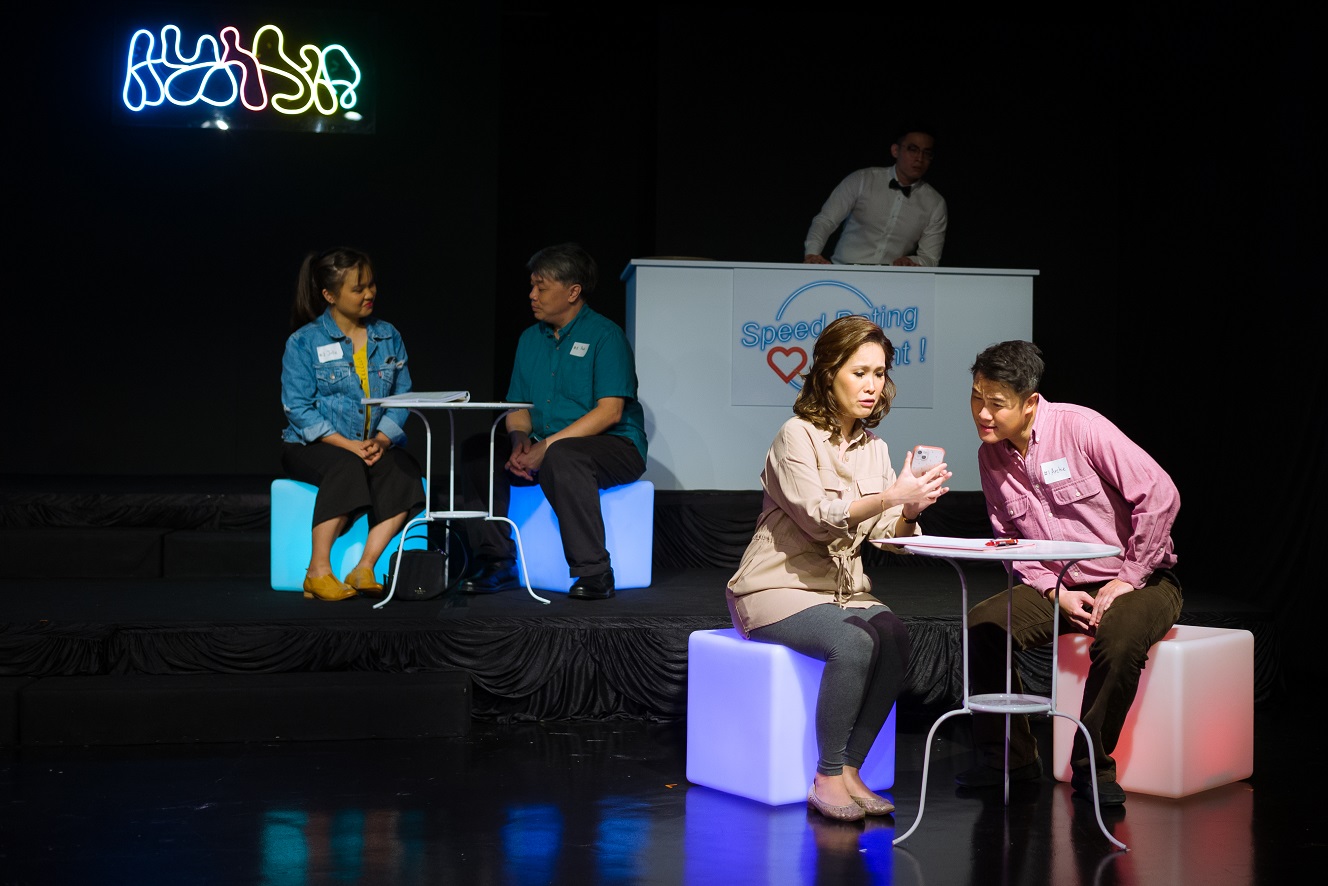


Improvisation was the name of the game, as is the role-playing seen in speed dating. A mostly 21st century phenomenon, speed dating brings many people together within a short space of time in a hope that mutually beneficial interactions take place. The opera, directed by Eleanor Tan, is set in a bar with tables for two, where hopefuls meet to share their likes, loves and lives.     


Christina The as Kaylee, Dating Coordinator.


Flexibility was given to cast size, and ten artists accompanied by pianist Aloysius Foong seemed the right number to make the narrative flow for its interrupted 75 minutes. Other than the Dating Coordinator Kaylee (sung by Christina The), Bartender Quinn (Samuel Ng), waitress Stephanie (Ng Jingyun and Chloe Chua) and Busboy Marc (Ted Ngoo), the number of daters and their profiles were variable.


Dan (Preston Lim) receives a singing birthday card.


Awkwardness and anxieties were revealed by daters Pat (Reuben Lai) and Julie (Natasha Michella Da Costa) in their short arias, while Deborah (Akiko Otao), Archie (Leslie Tay) and Dan (Preston Lim) all displayed quirks and foibles. There were several stereotypes, including cat-fancying, cellphone addiction, bassoon-playing, or being a liaison of the governmental Covid taskforce. Personnel and scenarios are interchangeable, but with varying results. Some meetings lead to possible promise but with real doubts, a few strike gold while others just fall flat.


Deborah (Akiko Otao) and Pat (Reuben Lai),
co-founders of L'arietta
find a certain chemistry.


Genuine chemistry was displayed in the duet by Lai and Otao, both co-founders of L’arietta, and the audience could be excused for having a warm and fuzzy feeling for their characters together. But as life and fate would have it, Deborah and Julie later waltz off into the sunset, leaving Pat perplexed and back in square one. This is an opera unafraid to tackle LGBTQ issues face-on, delivering it with forthrightness and humour.


Deborah and Julie (Natasha Michella Da Costa)
find themselves and love it!


The music employed was gratifyingly tonal, a comfortable cross between artsong, operetta and American musical theatre. There were no pretentions to grand opera, although two duets took liberties of setting modern English words to melodies from Bizet’s Carmen and Mozart’s The Magic Flute. The latter, Papageno and Papagena’s duet, was rather apt given “birds of the same feather” got to find each other in the end.
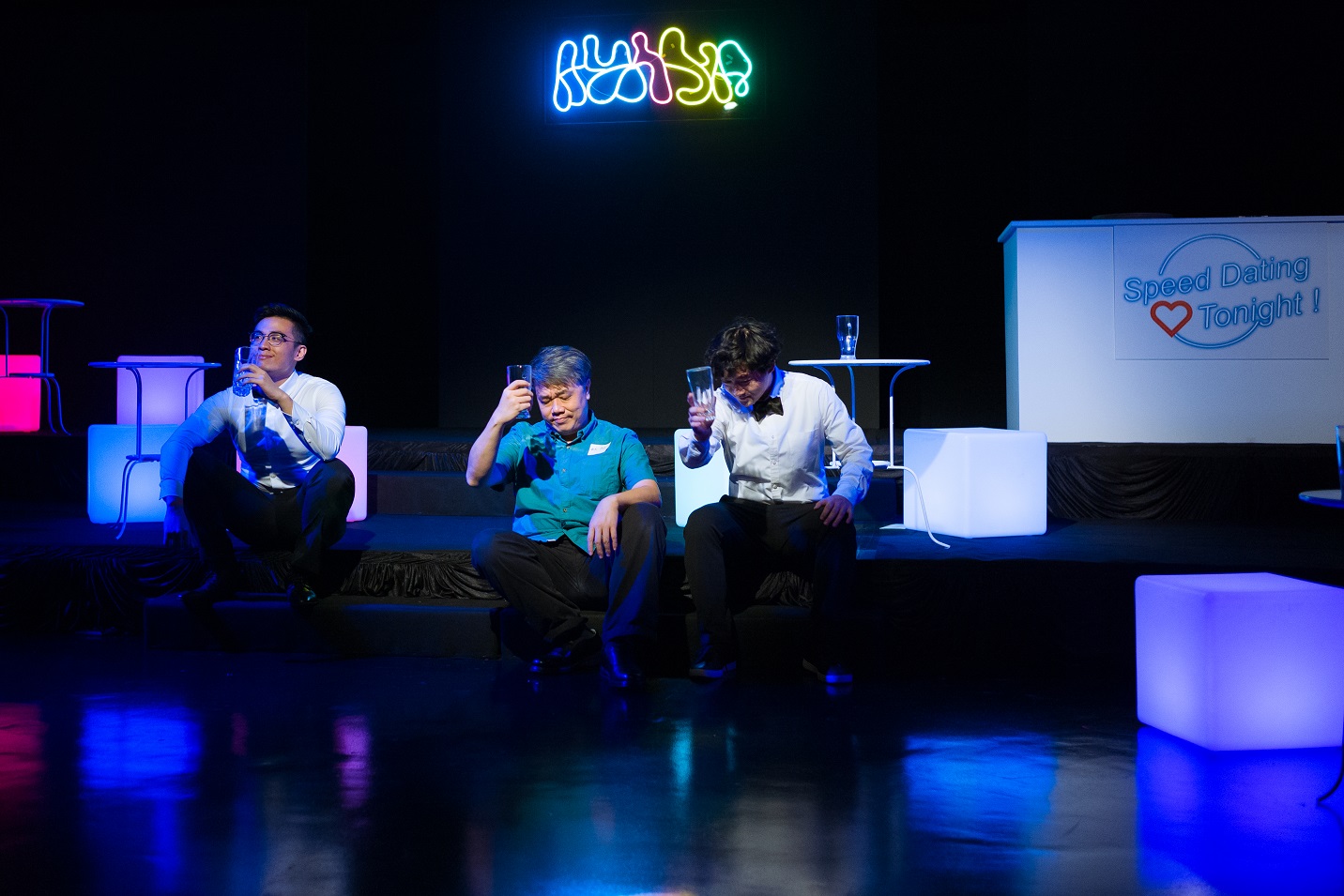
 

Pat is alone again,
and looks forward to another 
evening of Speed Dating.


Judging by the warm reception by the sold-out audience, one foresees this opera as having a long shelf-life, with new characters and fresh material updated for uncertain times ahead. 


All photos by Jamie Chan, courtesy of L'arietta Productions.

Monday, 27 November 2017

Photographs from OPERA MIXER: THE ITALIAN EDITION


If you love music for the voice, but are not too familiar about opera and its finer points, then Opera Mixer is right for you. Presented by Opera Viva, Opera Mixer aims to demystify the mystique and intrigue about opera by presenting arias, duets and ensembles in a fun and unstuffy manner. Melissa Chan, the evening's mezzo-soprano (also a Board Member of Opera Viva) set the tone by inviting the audience to relax and imagine attending a party on Venice's Grand Canal. Over drinks, crackers and cheese, the evening of Italian operatic highlights unfolded with lots of melodrama and very good singing.


This evening's programme was drawn exclusively from Italian opera, with a healthy dose from the bel canto tradition - Bellini, Donizetti and Rossini. There was just one Puccini aria, some Verdi and the occasional rarity, mostly because one did not expect such demanding numbers to be performed in Singapore! 

All four singers, soprano Wendy Woon, mezzo Melissa Chan, tenor Leslie Tay and baritone Alvin Tan were not only excellent in their delivery but also very conversant in sharing their passion for singing with the audience. They mused about their roles, revealing details and finer points about being an opera singer - their ups and downs - and also provided helpful synopses about each opera. It all came across as informal, informative and mostly enjoyable fun. In these days when the arts play second fiddle to entertainment and sports, such an injection of life is not only necessary but vital.

The evening opened with soprano Wendy Woon
singing Un bel di from Puccini's Madama Butterfly.
Baritone Alvin Tan sang some Handel and
Verdi's Di Provenza il mare (La Traviata)
Tenor Leslie Tay spoke about castrati and
offered more Handel and the gem that is
Una furtiva lagrima from Donizetti's L'elisir d'Amore.
Mezzo Melissa Chan explained and demonstrated
the "trouser role" by portraying Romeo in
Bellini's I Montecchi e I Capuleti.
Parigi o cara from Verdi's La Traviata.
Many expressions of Melissa Chan
in Bellini and Rossini (Non piu mesta from La Cenerentola)
A duet from Bellini's I Montecchi e I Capuleti.
Bromance time in a duet from
Verdi's Don Carlo.
Wendy Woon sensitively plays the ill-fated
Anna Bolena from Donizetti's opera.
The grand finale was the famous Quartet
from Verdi's Rigoletto.
All four singers take their bow and stand with
their "orchestra" pianist Benjamin Lim (extreme left).

Monday, 31 July 2017

MONTEVERDI'S L'INCORONAZIONE DI POPPEA / New Opera Singapore / Review


MONTEVERDI'S
L'INCORONAZIONE DI POPPEA
New Opera Singapore
Victoria Theatre
Saturday (29 July 2017)

An edited version of this review was published in The Straits Times on 31 July 2017 with the title "A morality tale cloaked with symbolism".

Thank goodness for New Opera Singapore. More specifically, thank goodness for the wife-and- husband team of Jeong Ae Ree and Chan Wei Shing, who have energised the production of opera in Singapore by reminding local audiences there is much more life beyond the spectacles of Verdi, Puccini and the odd Merry Widow or Fledermaus.

Claudio Monteverdi's L'Incoronazione di Poppea (The Coronation of Poppea) was first performed in Venice in 1643, not long after the birth of the opera artform. New Opera Singapore's production directed by Jeong was updated to a mythical present, with three acts condensed into two. Although  running over two-and-a-half hours, it was nonetheless an absorbing show.

The story was based on events in ancient Rome during the nefarious reign of Emperor Nero. In a morality tale of sorts, Nerone's concubine Poppea installs herself as empress through intrigue and guile by ruthlessly removing all opponents and obstacles. Also in an ironic twist, Love triumphs over Virtue and Fortune, while the bad guys win in the end.


Casting was a major strength, with soprano Victoria Li (Poppea) making a stunning debut in a major role, with a strong and clear voice to match her oozing sexuality. Opposite her, tenor Leslie Tay (Nerone) was outstanding for his formidable presence, in a role that surprisingly displayed mercy as well.


Korean countertenor Yohan Cho as Poppea's cast-aside lover Ottone impressed with his hangdog look, and there were excellent portrayals by Akiko Otao (the self-sacrificing Drusilla), Yun Seung Woo (the compromised Seneca), Eun-Jeong Koo (the conniving Arnalta) and Grace Kuo (the jealous Ottavia).

The entire cast of 15 was strikingly attired in white with faces whitened as well, a shade which cleverly masked ambivalent personal values. An illuminated white marble floor was angled at an incline to reflect morals and ethics not always being upstanding or upright.


Symbolism was strong, down to the blood red in Poppea's wig and the lighting design when the condemned Seneca opened his veins. The characters Love (Christina The), Fortune (Rachel Ong) and Virtue (Wang Tong), who jostle for the moral high ground in the Prologue, are portrayed as mental asylum inmates. There were also homoerotic undertones in the duets of Damigella (Evangeline Ng) with Valletto (The), and Nerone with Lucano (Martins Smaukstelis), coming across as both comic and unabashedly overt.

The small orchestra was well-helmed by conductor Chan Wei Shing who doubled on the cello in passages of basso continuo accompaniment. Also key to the enterprise were harpsichordist Shane Thio and organist Song Ziliang, who were rock steady throughout.


From the comedic Prologue to the final duet of Poppea and Nerone, Pur ti miro (I Gaze At You), this production was one sensitive to detail and nuance. At the final note of the twin villains' union, when Nerone turns his eye at the voluptuous Damigella for a split second, the audience immediately knows, “Here we go again!”   


All photos courtesy of New Opera Singapore.

Tuesday, 8 November 2016

OPERACALYPSE NOW!! / L'arietta / Review


OPERACALYPSE NOW!!
L'arietta
Aliwal Arts Centre
Sunday (6 November 2016)

This review was published in The Straits Times on 8 November 2016 with the title "Fun opera apocalypse keeps kids riveted".

Halloween has come and gone but its macabre spirit lingered on for newly-formed local opera company L'arietta's latest production, which cramped three short operas into a single act, not for the first time. 

Gravestones of the opera divas
and Al B Bach (1685-1750)

The black box space in the Aliwal Arts Centre was transformed into a spooky cavern with various Halloween paraphernalia and two wine bars, one of which was tended by the monosyllabic tenor Reuben Lai as the world comes to a cataclysmic end.


A newsflash announces that an asteroid is hurtling towards the planet and extinction is imminent in ten minutes, which was where tenor Leslie Tay's Figaro Montague and soprano Kristin Symes' Carmen Capulet came into the picture in the first opera, Figaro's Last Hangover by Patrick Soluri. Short snippets from the eponymous operas were relived, while old loves rekindled for one last time.


This was not so much a scena lyrique but an acted-out melodrama, where the singers' vivid characterisation of its comedic characters stole the show. Their voices were clearly projected and no surtitles were needed. As their surnames suggested, the couple soon began feuding over past amours and the romance unravelled to laughter from the audience.


The impending disaster is however delayed, which allowed for Michael Hurd's The Widow of Ephesus, the longest and most lyrical part of the trilogy, to be played out. Here the vocal qualities of the singers came to the fore. Symes' cynical Maid, Lai's unlikely Soldier, and soprano Angela Hodgins' grieving Widow all shined in this romance which took place outside a tomb.


What happens when the Soldier's dereliction of duty as a result of his tryst threatens to lead to a court-martial and possible execution? A neat solution provided by corpse-swapping saved the day, with all parties happy in the end. The Widow gets a new lover while the Soldier gets off the hook.

Whatever's left over from
the head of a music critic!

Mary Ann Tear's direction ensured that story-telling and interaction between performers, television screen and the informally seated audience (which included many children kept in rapt attention) remained paramount. This was vital in conveying the message that modern opera could be unstuffy, accessible and even fun. Music director Aloysius Foong was an ever-alert presence with his demanding part sympathetically helmed on the piano.


The asteroid has struck, the characters are still alive but Earth has been overrun by the living dead, which was the basis of the concluding opera, Soluri's Figaro and the Zombie Apocalypse. The lovelorn Figaro returned to the bar for one last fling, and so did Carmen, but never the twain shall meet as the squabbles began once again. As this entertaining production keenly alluded to, some things are destined never to change, even after the zombies have come home.    

Zombies and music critics meet
(frankly is there a difference?)

Saturday, 16 May 2015

GEORGE AND THE MUSIC BOX / Bellepoque / Review


GEORGE AND THE MUSIC BOX
Bellepoque
Esplanade Recital Studio
Thursday (14 May 2015)

This review was published in The Straits Times on 16 May 2015 with the title "Bedtime fun with stories and toys".

The name of Jacques Offenbach (1819-1880) has been synonymous with light comic operettas in French and his single important opera The Tales Of Hoffmann. Credit goes to local musical theatre company Bellepoque for unearthing his Six Fables de la Fontaine, little known musical settings of children's tales by 17th century writer Jean de la Fontaine, neatly packaged as a one-act musical called George and the Music Box by playwright Susana Jose.


George is a restless young descendant of the writer, who needs his bedtime stories and toy companions to lull him into slumber. He has a somewhat dysfunctional relationship with his maman, quirkily portrayed and sung by Italian soprano Sabrina Zuber, who is also founder-director of Bellepoque. An element of abuse and oppression is hinted at by their absent father/husband, who gets his snarling voice in by way of director-pianist Robert Casteels. His peripheral but glowering presence, attired in concert garb and armed to the teeth with metronomes, was surely symbolic of discipline and over-regimentation.

Their dynamics made for some uneasy viewing, George's petulance caught perfectly by local tenor Jeremy Koh as a foil to his parents' schizophrenic comings and goings. With their berating and taunts “George is a naughty boy”, it would take some miracle if he does not grow up to become some French Amos Yee.


His consolations are the fables and his toy soldier (sung by tenor Leslie Tay), dancing doll (soprano Angela Cortez) and teddy bear (baritone Daniel Ho), who sing and act out his fantasies at bedtime. Despite none of them being native Francophones, their parts in sung French and spoken English came out credibly, aided by projected translations on a screen behind.


Some of the fables, like those of Aesop's with morals and cautionary dictums, would be familiar to many. These included La laitiere et le pot de lait (The Milkmaid and the Pot of Milk) and Le corbeau et le renard (The Crow and the Fox) which remind the listener “not to count chickens before they hatch” and “flattery feeds on the vain”. The latter and Le rat de ville et le rat des champs (The Town Rat and the Country Rat) cleverly highlighted hand puppets, and La cigale et la fourmi  (The Cricket and the Ant) utilised shadow play, to aid the narrative.


The music, as expected, was light and frothy, and as each fable lasted a matter of minutes, there was some padding up with highlights from The Tales of Hoffmann and La Vie Parisienne. These gave the singers ample opportunities for solos and ensemble work, which came out very well.

In case one thought that this was a production for children, it was decidedly not. The relatively late hour ensured that there were only a few youngsters in the audience, and stage director Sharon Joy Frese's scenarios were aimed mostly at adults, albeit those young at heart. Visual designer Caterina Minganti's children's bedroom, the painted clownish faces, maman's movements, and that man-sized and man-shaped comfort pillow named Doudou which George hugs in his deep stupor all had a touch of the creepy (think the horror movie genre) about them.


Little matter, as this was a largely enjoyable and musically satisfying outing fully consistent with Bellepoque's ethos to challenge the status quo through simple yet sophisticated departures, and to entertain. George and the Music Box, part of the European Season and Voilah! French Festival, plays for one final evening on Saturday, which would be well worth your time.
