Showing posts with label NAFA Project Strings. Show all posts

Saturday, 5 March 2016

TRANSFIGURED NIGHT / NAFA Project Strings / Review


TRANSFIGURED NIGHT
NAFA Project Strings
Lee Foundation Theatre
Thursday (3 March 2016)

This review was published in The Straits Times on 5 March 2016  

The subject of a man's love for a woman superimposed on a canvas of late Austro-Germanic musical Romanticism was the theme for this all-strings concert. It was also a showcase of the impressive Nanyang Academy of Fine Arts' Project Strings, formed and led by Singapore Symphony Orchestra first violinist Foo Say Ming since 2012.

The music had previously been heard in separate concerts by Foo's elite string band re:mix. However, this evening's coupling of Mahler and Schoenberg's music had a strong synergism because of their shared compositional idioms and estranged relationships with their respective spouses, all set in fin de siecle Vienna  This was highlighted in helpful programme notes written by  students rather than their lecturers.


Narrator Angel Cortez set the tone by reading a love letter and the strings took off with Adagietto, the 4th movement from Mahler's Fifth Symphony. One of his most serene creations, it began with the gentlest of whispers and a hint of rhythm provided by Tan Li Shan's harp. This finesse of control, of hushed voices and tender caresses, spoke volumes of Foo's charges, as the music wound its way to a yearning passionate climax before ebbing into silence.


This movement was merely a third of the length of the next work, Arnold Schoenberg's Verklarte Nacht, or Transfigured Night. Originally scored for string sextet (two each of violins, violas and cellos), its amplification for string orchestra is the modernist composer's most performed work. Youthful and tonally based, it far outstrips all of his atonal compositions in terms of popularity by a long chalk.    
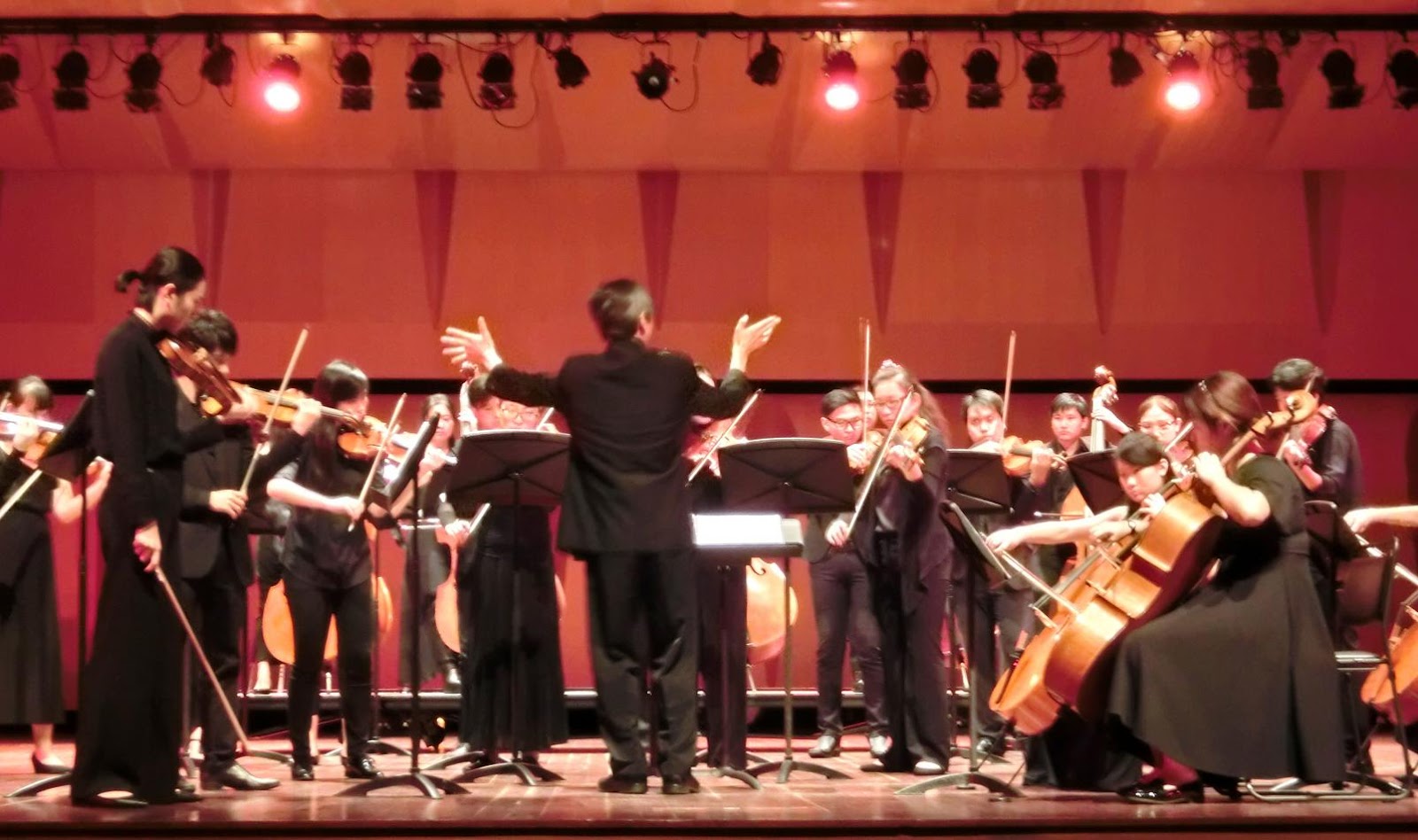

It was inspired by Richard Dehmel's poem in German about a man and woman who take an evening walk. She reveals that she is with child, but not by him. Instead of rejection, he offers love and warmth, with the promise he will regard the unborn infant as his own. The work is thus a rollercoaster of emotion, from tension and uncertainty, to overwhelming feelings and finally love and acceptance.

English transliterations were projected on a screen above as the music unfolded, with gentle violas making the first statement. Foo's leadership was one of directness and honesty, never one for histrionics nor superficial effect for its own sake. He coaxed a rich homogeneous sonority from his 35 players, which moved as one co-dependent entity through its half-hour duration.


The music mirrored the poem's narrative, traversing from darkness to illumination, and encompassing a whole spectrum of shadows and half-lights. There were occasional episodes of thinness in string sound but these were merely transitional. The frenzied development, tension-laden and angst-filled, provided some this performance's most gripping moments.

The final denouement, amounting to a lengthy musical sigh of relief, returned the massed strings to the calm of perfect equanamity. Expect more from this dynamic group of string players, and the many future orchestras they will populate in years to come.  


Saturday, 11 April 2015

DEATH AND THE MAIDEN / NAFA Project Strings / Review


DEATH AND THE MAIDEN
NAFA Project Strings
Lee Foundation Theatre
Thursday (9 April 2015)

This review was published in The Straits Times on 11 April 2015 with the title "Skilful shifting of gears".

NAFA Project Strings is the brainchild of Singaporean violinist Foo Say Ming, with the aim of promoting excellence in string playing among music students at the Nanyang Academy of Fine Arts. Its various concerts since 2012 have covered the bread and butter of the string repertoire, with a keen emphasis on ensemble work rather than solo virtuosity. 


Its latest concert began with the Aria from Brazilian composer Heitor Villa-Lobos' Bachianas Brasileiras No.5 which employs eight cellists accompanying a singer. Young Indonesian soprano Isyana Sarasvati, one of NAFA's most promising voice students, has a bright ringing voice well-suited for coloratura arias. However more shades of subtlety could have been employed in this sensuous, even mysterious song, which is mostly wordless. 

The cellos first provided a background rumbling counterpoint, before emerging with the glorious melody on its own. They did so with an intensity that closely matched the singer's. It was a pity that the fast and trickier second movement, which would have revealed different aspects of both skills, had been omitted.


As a prelude to the main work, Franz Schubert's original lied Der Tod und Das Mädchen (Death and the Maiden) was performed by Saravasti with pianist Chin Kim Hung. The opening chords played on the piano rather than the sung melody served as the subject for the composer's famous string quartet of the same title. Chin was sturdy in his delivery and Saravasti impressed with her lower registers which evoked true pathos.

The houselights dimmed and came on to reveal Foo conducting the full string ensemble of 33 members in an augmented version of Schubert's String Quartet No.14 in D minor (D.810). Gustav Mahler had written his own version for string orchestra, which in turn was further adapted by Foo for this performance. Notably, double basses were given parts to add body and heft to the overall sound.


Barely ten days ago, the celebrated Juilliard String Quartet had given a stunningly riveting account of the original work at the Yong Siew Toh Conservatory in a lunchtime concert. The NAFA version was to be no less committed despite the youth and inexperience of the players involved. The opening movement was taken with an urgency and tautness that held its seams like glue. The exposition repeat was included without sounding weary and the subsequent development ratcheted the tension several notches.

The Andante second movement was a set of variations on the afore-mentioned lied, the spiritual heart of the work. The ensemble was sensitive to the change of dynamics with each variation and there was a sublime moment when the melody sung by the cellos was accompanied by delicate flitting violin figurations. A passionate climax had been reached, but there was more to do in the 3rd movement's Scherzo and Trio, which was guided with alternating agitation and lilting grace.  


Gaining in confidence, the finale's tarantella rhythm was led at a furious pace, but witness how the frenzy dissolved immediately with the second subject's broad and generous entrance. It was this ability to shift gears so skilfully and musically in rapid succession that spelt the success of this endeavour. If the seemingly unwieldy 33 could come close to emulating a slick foursome, something has to been said about the level of guidance and instruction. More is to be expected from this worthwhile project.
