Showing posts with label Tengku Irfan. Show all posts

Monday, 12 June 2023

TENGKU IRFAN IN RECITAL / Singapore International Piano Festival / Review


TENGKU IRFAN IN RECITAL

Singapore International Piano Festival 2023

Victoria Concert Hall

Friday (9 June 2023)


This review was published in The Straits Times on 12 June 2023 with the title "A genius recital by Malaysian pianist Tengku Irfan".


The cancellation of Argentine pianist Nelson Goerner’s recital on Thursday due to illness meant that young Malaysian pianist Tengku Irfan opened this year’s Singapore International Piano Festival. Hailed as Malaysia’s Mozart, the former prodigy who also composes and conducts is the latest Malaysia-born pianist to perform in the festival since the late-lamented Dennis Lee in 2005.


His recital opened with Beethoven’s Sonata No.22 in F major (Op.54), a short-winded work in two movements. His crispness of articulation and mastery of pedalling ensured that the minuet-like first movement possessed sonority without sounding cut and dried. The ensuing finale’s perpetual motion was a tour de force of propulsive momentum which did not let off till the final bar.  


Gabriel Faure’s Theme and Variations (Op.73), a rarity, had a welcome airing. Its apparent austerity belied sheer craftsmanship and inventiveness involved, unfolding convincingly in Irfan’s faultless fingers before closing serenely in the major key. This underrated masterpiece might someday become as popular as Schumann’s Etudes Symphoniques or Mendelssohn’s Variations Serieuses.


Closing the first half was the Asian premiere of Tota Pulchra Es (Latin for You Are Completely Beautiful) by New York-based Singaporean composer Koh Cheng Jin who is also Irfan’s wife. It began with an eruption of violence, the atonal music later transcending to a realm of inner peace, with lyrical centres which channelled spirituality through Messiaen-like chords.  


The recital’s most substantial and familiar work was Schumann’s Fantasy in C major (Op.17), three movements reliving the restless and sublime inspiration of Beethoven. Its Romantic sweep was well captured in splashy chords and swirling arpeggios, with tumultuous swells quelled by the quotation from Beethoven’s song cycle An die Ferne Geliebte (To The Distant Beloved) at the close of the first movement.


In Irfan’s sharply contoured reading, the striding second movement was not so much an all-conquering heroic march but troubled journey beset with the trials and tribulations of love. As if to reinforce that notion, he even had a minor lapse but closed triumphantly with its fearsome octave leaps well vanquished.   


The valedictory closing movement brought on expected emotional highs and the added surprise of Schumann’s original ending, reprising the earlier Beethoven quotation albeit with altered harmonies. A genuine case of deja vu, the past being revisited but with not quite the same outcome.


Closing the unusually eclectic recital was Brazilian composer Heitor Villa-Lobos’ Rudepoema (Savage Poems), 18 minutes of musical intoxication once described as “The Rite Of Spring Meets Brazilian Jungle”. Irfan was at his imperious best, imbuing the brashly dissonant essay with brawn and brain, where the lacerating and the lyrical sit cheek-by-jowl at the same table.


A pleasing symmetry was provided in the encore, his own transcription of Ausklang, the final segment from Richard Strauss’ Alpine Symphony. Its reprise of earlier themes echoed Schumann’s own nod to Beethoven, and the final outcome being solace, also reflected in Koh’s music. This programme may be summed up in one word, genius.


Tengku Irfan with the missus,
Singapore composer Koh Cheng Jin.

Monday, 20 November 2017

SONG OF DESTINY. BRAHMS SYMPHONIES / Singapore Symphony Orchestra / Review


SONG OF DESTINY. BRAHMS SYMPHONIES
Singapore Symphony Orchestra
Esplanade Concert Hall
Friday (17 November 2017)

This review was published in The Straits Times on 20 November 2017 with the title "A night when darkness passed into light".

This was the programme that the Singapore Symphony Orchestra under Music Director Shui Lan was to play in its first concert in Kuala Lumpur's Dewan Filharmonik Petronas after a hiatus of 17 years. It appropriately began with the world premiere of Meditation, a very short work by the prodigious 19-year-old pianist-composer Tengku Irfan, once hailed in these pages as the Malaysian Mozart.


Originally a piano piece, its orchestration relived the lush atonality of Second Viennese School composer Alban Berg. Before any discernible development could even take place, it ended as quietly as it began. That served as a teaser for two choral works by Johannes Brahms, Gesang der Parzen (Song Of The Fates) and Schicksalslied (Song Of Destiny), performed by a combined choir comprising the Singapore Symphony Chorus, Singapore Symphony Youth Choir and Choir of the Transylvanian State Philharmonic, Cluj-Napoca.


Those familiar with A German Requiem will readily recognise Brahms' musical idiom, but the words here do not offer succour, instead cynicism and bitterness in the writings of Goethe and Holderlin respectively. Heavenly hosts conspire against mortals, and the gods are indifferent to earthly matters. Its anti-theist message was as clear as the diction and enunciation of the 110-strong mass of voices.


While Gesang der Parzen coloured its eternal struggle and despair in tragic and sombre tones, Schicksalslied did offer a mere measure of solace in its C major close. These contrasts were keenly brought out by the choir, now under the wing of new choral director Eudenice Palaruan, who succeeded Lim Yau's illustrious over 30-year-long tenure earlier this year. The accompanying orchestra played with discreetness and transparency throughout.


After the spare and grim choral works of the first half, Brahms' Second Symphony played after the interval shone like many rays of sunshine. This was the concluding chapter of the orchestra's Brahms symphony cycle under Shui, and in many ways its most optimistic.

Unlike his view of Beethoven symphonies which tended to be on the brisk side, Shui adopted more expansive tempos for this Brahms symphony. One might even use the description of leisurely, but it never felt draggy or bogged down unlike the portentous reading by veteran Russian conductor Gennady Rozhdestvensky of several years ago.


Lilting strings were a pleasure in the 1st movement's second theme, the one that recalled Brahms' universally sung Wiegenlied (Cradle Song). Textures were also kept on the light side, and even the serious slow movement could afford a smile in its longeurs. Principal French horn Han Chang Chou's solos were immaculately phrased, and woodwinds stood out in the chirpy narrative of the third movement.


If one longed for a more pressing approach, that eventually came in the finale, which was taken in one slick lick.  If pure joy could be expressed, it could not have been better captured, as the concert  passed from darkness to light. 


Monday, 23 January 2017

RACHMANINOFF 3 / Orchestra of the Music Makers / Review


RACHMANINOFF 3
Orchestra of the Music Makers
Esplanade Concert Hall
Friday (20 January 2017)

This review was published in The Straits Times on 23 January 2017 with the title "A night of guilty pleasures".

If listeners were asked which classical composers were sources of their most guilty pleasures, chances are Sergei Rachmaninoff and Camille Saint-Saëns would crop up. Both the Russian and Frenchman wrote some of the classical repertoire's most unabashedly tuneful scores, the sort music snobs (particularly lovers of Bach and Schoenberg) turn up their noses to.

There was a heavy dose of Rachmaninoff and Saint-Saëns in the Orchestra of the Music Makers' latest concert, directed by young conductor Seow Yibin. First heard were World Premieres of four Rachmaninoff piano Préludes, in orchestrations by three young composers. Alexander Oon was responsible for two of these, Op.32 No.3 and Op.23 No.5, with martial character transformed into something more festive and dancelike.


Darren Sng's take on the lugubrious Op.23 No.1 deftly incorporated clarinet, oboe and flute solos, taking on an impressionist hue. Phoon Yu's vision of Op.23 No.3 was gavotte-like, cleverly utilising strings and woodwinds, even giving concertmaster Chan Yoong Han's violin an exquisite solo. These imaginative efforts follow in the illustrious tradition of Respighi and Stokowski in transcribing Rachmaninoff.

Watch Alexander Oon's orchestral transcription of Rachmaninov's Prelude Op.23 No.5 here:


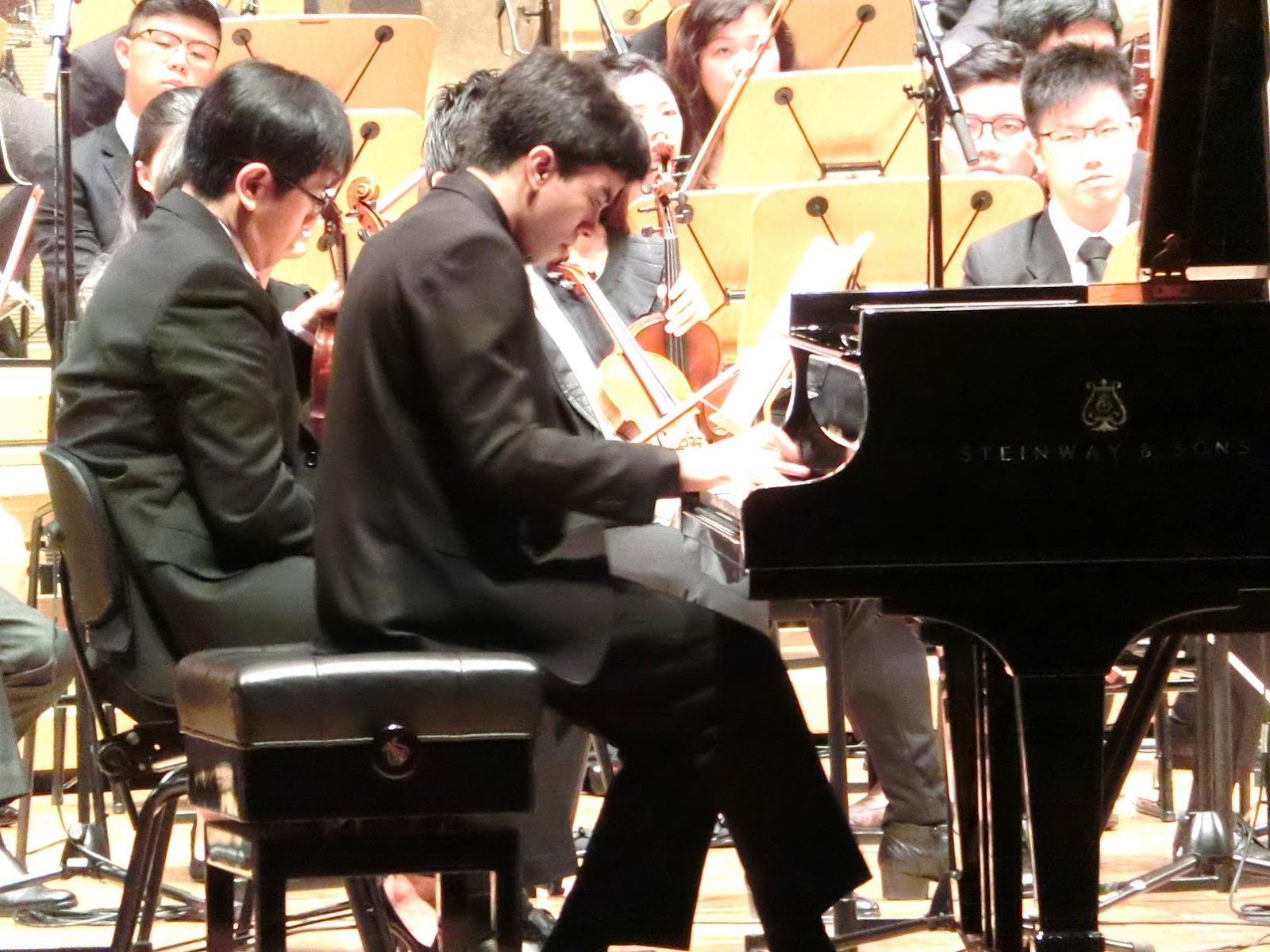
Rachmaninoff's mighty Third Piano Concerto was next, with 18-year-old former child prodigy Tengku Irfan, previously described in these pages as the “Malaysian Mozart”, as soloist. To say that the Juilliard undergraduate conquered and vanquished the “Everest of piano concertos” would be mere understatement.


Beginning quietly and steadily, the performance grew in character and stature over its rapturous journey of over 40 minutes, Without any hint of narcissicism or self-indulgence, his apparent coolness while generating white heat in playing must be the most enviable trait in this profession.


The massive 1st movement cadenza, the Adagio's climax and skittish waltz, and the finale's mercurial free-wheeling were among moments to savour. A standing ovation greeted this outing, which stands proudly alongside the work's best performances by the Singapore Symphony Orchestra (with pianists Sergio Tiempo and Alexei Volodin) in recent years.


Orchestra and conductor played a major part in its success, and the good work continued in Saint-Saens' Third Symphony, also known as the “Organ Symphony”. Hushed strings and an opening oboe solo set a mood of mystique before escalating to the movement proper's nervous tension. Flexibility of ensemble ensured that the work's ebbs and flows was kept on a heightened edge.


Joanna Paul's organ entry in the slow movement was memorable for its subtlety. Her part here was mainly to provide a bed of soft harmonies over which the tender music floated. The big moment came in the dramatic finale, and her huge striding chords did not disappoint. There was a brief stretch when both orchestra and soloist threatened to go off the rails, but cools heads prevailed for that most glorious and reassuring of C major chords to close.


As an encore, the orchestra conjured a somewhat belated tribute to actress Carrie Fisher, with Princess Leia's Theme from John Williams' Star Wars soundtrack. That was another guilty pleasure few would regret.  

Pianist Tengku Irfan with
OMM Music Director Chan Tze Law.


Watch Tengku Irfan perform the finale of Rach 3 with OMM here: 


Monday, 2 February 2015

SSO Concert: PASSIONATE PILGRIMAGE / Review


PASSIONATE PILGRIMAGE
Singapore Symphony Orchestra
Esplanade Concert Hall
Friday (30 January 2015)

This review was published in The Straits Times on 2 February 2015 with the title "Makings of a Malaysian Mozart".

Having foreign child prodigies perform concertos with the Singapore Symphony Orchestra is nothing new. Not since the first coming of the 15-year-old Lang Lang in 1997 has a young soloist made quite an impact as 16-year-old Malaysian pianist Tengku Irfan. Presently attending Juilliard Pre-College, Irfan studies piano performance, conducting and composing. His works have already been performed by the New York and Malaysian Philharmonic Orchestras.


In Beethoven's Third Piano Concerto, there may have been initial fears when his entry with successive C minor scales seemed brusque and over-emphatic. Catching the attention in so startling a manner, he soon eased off with a reading that balanced passion with lyricism, and carefully honed nuances. A young person's vitality but one imbued with a mature outlook well beyond his years made this a compelling outing.

When one might have expected him to craft his own cadenzas, Irfan deferred to Beethoven's wisdom instead but marked his personality by highlighting its contours. In his hands, the slow movement became sheer poetry. Discretely accompanied by the orchestra, this was an oasis of calm before the finale's high spirits. In the latter, his crisp articulation, lightness of touch and joie de vivre were distinguishing features which won the audience's wholehearted approval. Irfan is still young, but what a shining future he has in front of him.  


Attending the concert was former Malaysia prime minister Dr Mahathir Mohamad and his wife. It would not be lost to him that his far-reaching policies in promoting Western culture and arts in Malaysia (including setting up the Malaysian Philharmonic Orchestra) helped make this Malaysian Mozart possible.

Also propitious was the programming of the Second Symphony by Sir Edward Elgar, from the land that colonised both Malaya and Singapore for well over a century. This symphony was prompted by the death of King Edward VII in 1910. Playing for over 50 minutes, the work could have been plagued by pomposity and bombast but young Singaporean conductor Darrell Ang kept taut his rein, coaxing a performance that was cogent and united by an inner tension.  

Nobilmente was a term Elgar used in a number of his works, which described playing in a noble and dignified manner that has become almost synonymous with being British. The opening movement oozed nobilmente, but within that exterior Ang was able to bring out a sense of mystery and sadness which eschewed sentimentality. While the brass stole most of the show, the mood of the slow movement was perfectly set by elegiac strings, which ushered in a funereal march that gradually built up to high emotion.    


The mercurial third movement had moments that ran close to hysteria but never descended to caricature. A good flowing tempo dictated the finale, with an obligatory fugato for its climax, but the best was left to the last, in a quite spectacular unwinding of the earlier tension. It was as if the symphony was giving up its ghost, but doing so with great subtlety and grace in quiet closure. 

The encore, Nimrod from Elgar's Enigma Variations, performed with true feeling and pathos, was dedicated to the memory of British conductor Frank Shipway, who was to have led this concert but tragically died in a vehicular accident last year. With that moving tribute, Ang led his troops triumphantly off the stage.


Sunday, 17 October 2010

Breakfast Meeting of The Chopin Society of Hong Kong


THE JOY OF MUSIC FESTIVAL 2010
Breakfast Meeting of 
The Chopin Society of Hong Kong
YMCA Salisbury
Friday (15 October 2010)

Thank goodness for Friday afternoon flights on JetStar, as this allowed me the time to attend The Chopin Society of Hong Kong’s annual breakfast meeting, held in conjunction with each The Joy of Music Festival. As before, this extremely informal event was a meeting of minds on the discussion of issues in music, and the subject on this occasion was about inspiration versus perspiration in musical composition. “How much of a composer’s work was an act of pure inspiration?” asked Dr Andrew Freris (above).

Thirty-seven Hong Kong composers were invited, but none attended (presumably there was neither monetary incentive nor publicity involved), however present were two composers – the Uruguayan Carlos Levin and the Malaysian Tengku Irfan.


According to Levin (above), inspiration was the least of a composer’s problems. He quoted Stravinsky who once remarked that composition was like living within a society – it is constrained by certain rules and social customs. A composer has to work within a narrow set of norms and utilising limited means. He does not create something out of nothing but brings together sounds and musical ideas, or what he refers to as “elements of original stimuli”. There is order in this self-limiting process, and anything that functions outside of this brings only a chaos of sounds.


It is thus more comforting for composers to work within form and a fixed framework, but they could be original, like the famous example of Haydn holed up for decades in Esterhaza, whom without distraction or influence was “forced to be creative”. Tonality itself effectively determines how a piece of music will eventually pan out. A classical triad of notes already predetermines how a melody would go. A composer just goes on to add a second line, turning monody to polyphony, and to build vertically, adding further notes that would alter the colour of the music. He demonstrated this on a piano, speaking in Spanish while the Andrew and Anabella Freris translated.

While this predetermination takes the “romanticism” out of composition, a creative composer is one who works well within these rules, developing his own ideas, elaborating and making variations. The most inspired of them go on to break with tradition and do something new.


Then Tengku Irfan was invited to demonstrate on the piano some of the ideas he had hatched in his recent compositions, which included a piano quintet and a symphony. Irfan is only eleven years old, and is already a celebrity pianist in his own nation, one who performs his own cadenzas in piano concertos. Immediately, he brought out an idea on the piano, a descending scale from his piano quintet and then went on to break it up into varying motifs and fragments, which became his exposition. Following that he played the opening movement of his symphony, much to the amazement of all around. He also spoke of his admiration of Mahler symphonies and their inspirations and looked forward to hearing all the symphonies played by the Malaysian Philharmonic Orchestra.


Clearly he had understood a composer’s craft. Was it something innate or was it taught? Perhaps it was a bit of both, and he was encouraged to continue learning, listening and experiencing all forms of music and the arts without limitation or constraints. This young man is well worth watching out for in the years to come.


Pianomaniac gets to meet Carlos Levin.
whose chamber transcriptions of Chopin's piano concertos
were premiered at The Joy of Music Festival 2010.