Showing posts with label Zhuang Jie. Show all posts

Friday, 21 June 2024

COMPOSITIONS EXCHANGE 2024 / Association of Composers (Singapore) / Review


COMPOSITIONS EXCHANGE 2024 
Association of Composers (Singapore) 
Esplanade Recital Studio 
Wednesday (19 June 2024)

This review was published in The Straits Times on 21 June 2024 with the title "Singapore composers showcase works".

For a composer in Singapore, the most important thing is to have your work performed. First impressions matter, so having best possible performers for the premiere is a priority. The annual concert of the Association of Composers (Singapore), which showcased 12 works by 12 composers, was fortunate in having some of most accomplished locally-based professional musicians involved. 

Subtitled “Capriccio In The Style Of Folk Melodies”, most of the works were based on earlier music and crafted in the form of variations, fantasies and rhapsodies. The Chinese artsongs and instrumental works were sensitively accompanied by pianists Clarence Lee and Andren Koh respectively. 


Soprano He Miya sang two songs, opening the concert with Lee Yuk Chuan’s Yinghua Village Scenery Is Wonderful, extolling the land’s pristine beauty. Her expressive quality and ability to reach high notes effortlessly also touched in Quek Yong Siu’s Mother’s Smile, a song possessed with tenderness and nostalgia. 


Tenor Zhuang Jie had three songs, exhibiting exemplary vocal control in Liu Bin’s Homesickness, another mother-centred work more than tinged with melancholy. Quite different was Xiao Chunyuan’s An Auspicious Place, its rhythmic accompaniment supporting a more emphatic stance, further contrasted with a feel-good, pop-inspired sentimentality of Gan Yun Zhuo’s Everlasting Love


Of the instrumental works, Red Peach Blossom & White Apricot Blossom as arranged by Cao Ying was dressed with French impressionist colours. Sin Jin How’s flute ably provided virtuosic turns and nuances, transforming this Shanxi folksong into an almost improvisatory fantasy. 


Violinist Siew Yi Li was the busiest instrumentalist after pianist Koh, having performed no less than five showpieces. Chiew Keng Hoon’s arrangement of Xinjiang folksong Swallow Capriccio had a typically Central Asian flavour, and closed in soulful repose. Daniel Kom’s Variations On The More We Get Together, after the Austrian children’s song O Du Lieber Augustin, included a waltz, rhumba, romance in minor key and a variation a la Johann Pachelbel for good measure. 

Lee Ngoh Wah’s Galloping Horses was a variation of the popular erhu melody Sai Ma (Horse-racing). Its familiarity was topped by Lian Sek Lin’s Kaka Dan Mama, which merged the Indonesian folksongs Burung Kakak Tua and Aiyo Mama into a melange which the audience simply loved. 

Just as recognisable was the melody of Di Tanjung Katong Rhapsody, as crafted by Frederick Ng Eng Thong. The music played with polytonality and obliged the violinist to jump through several Paganinian hoops of string calisthenics before its grandstanding close. 


Pride of place, however, went to Lisa Zhao Lingyan’s Variations Of Yi Folk Dance, which transformed Wang Huiran’s simple Yunnan theme into something truly special. Its reimagination as a riveting rhapsody from Roarin’ Twenties Paris saw cellist Olivia Chuang and pianist Koh playing like people possessed. Its fanciful flight of ostinatos chanelled the spirits of Darius Milhaud, Bohuslav Martinu, Igor Stravinsky and hot jazz without imitating them. Hearing this work was alone worth the price of entry.


Here are the composers and performers:
He Miya, Lisa Zhao Lingyan, Clarence Lee,
Zhuang Jie, Quek Yong Siu, Xiao Chunyuan,
Lee Yuk Chuan, Chiew Keng Hoon, Lian Sek Lin,
Cao Ying, Frederick Ng Eng Thong, Daniel Kom,
Liu Bin, Andren Koh & MC (from L)

Wednesday, 23 November 2022

TSUNG YEH 20 / Singapore Chinese Orchestra / Review


TSUNG YEH 20

Singapore Chinese Orchestra

Singapore Conference Hall

Saturday (19 November 2022) 


This review was published in The Straits Times on 23 November 2022 with the title "Yeh Tsung leads superbly honed charges".


Twenty years may be considered a relatively short stretch of time, but what Yeh Tsung has accomplished with the Singapore Chinese Orchestra as its Music Director since 2002 has been little short of awe-inspiring. During his tenure, he commissioned many new works for the medium of massed traditional Chinese instruments, including establishing a musical genre incorporating Southeast Asian elements now known as Nanyang music.


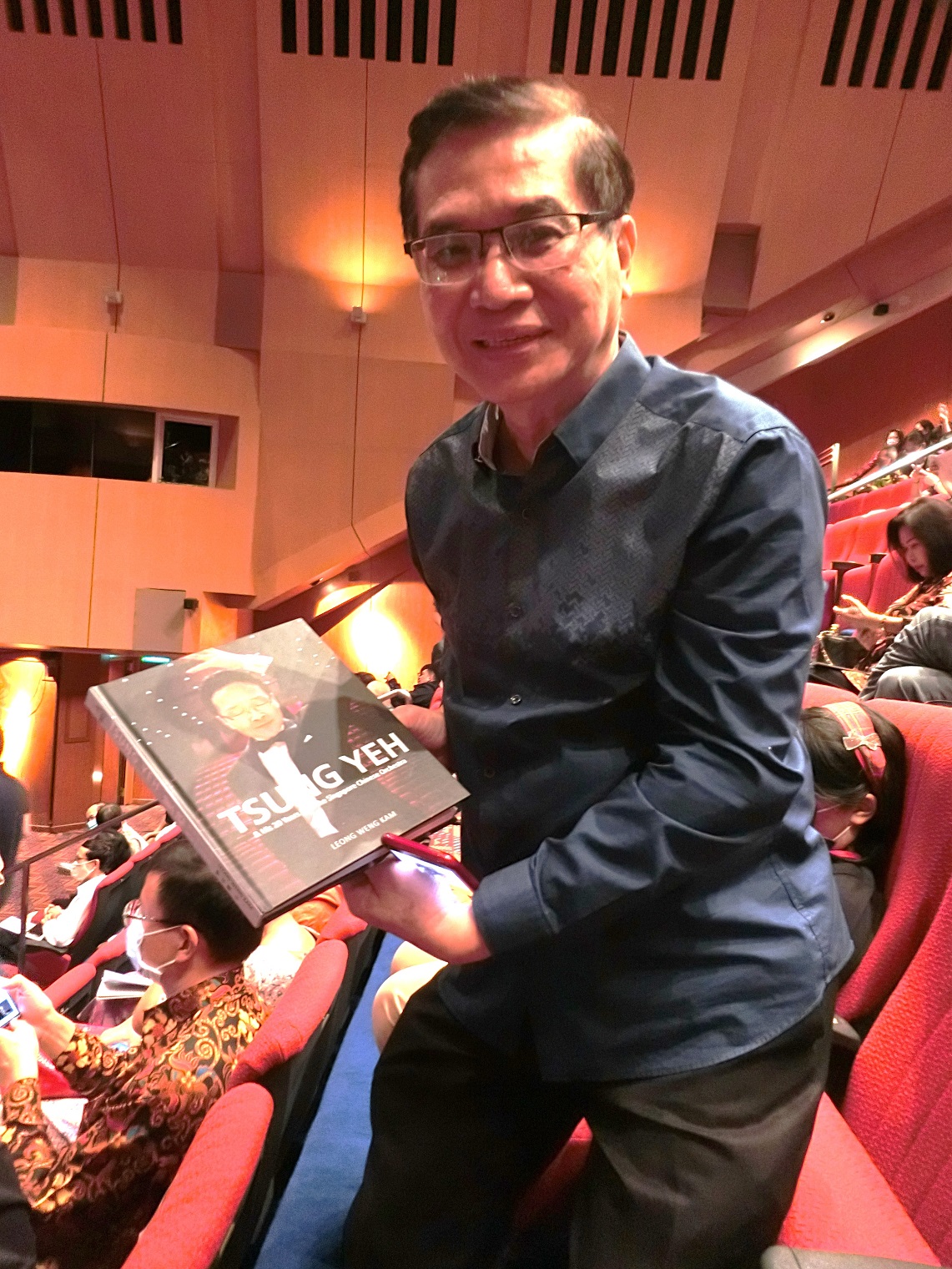
The official launch of the
Tsung Yeh 20 commemorative book.


This concert, commemorating his 20th anniversary at SCO’s helm, had a maritime theme which relived landmark works from his first ten years. Central to its narrative were two explorers of historical times, Zheng He (Cheng Ho) and Marco Polo, alluding to Yeh’s role as an intrepid discoverer of new pathways in Chinese music.    


Former SCO Composer-in-Residence Eric Watson’s Sea – The Source of Life, written for the 2007 National Day Parade opened the concert. Its quiet beginning was a beautiful evocation of dawn, leading to a faster section filled with dance rhythms reflecting different cultures and ethnicities. The lively music declared that the sea belonged to everybody, and this feel-good number made for a rousing prelude.   


Next were three movements from another former Composer-in-Residence Law Wai Lun’s Zheng He - Admiral Of The Seven Seas, a large-scaled work commissioned for the 2005 Singapore Arts Festival. Its imposing opening, Sea Burial, led by plangent winds and percussion, saw the Hand of Fate deal the Ming dynasty commander an untimely demise. With SYC Ensemble Singers (Chong Wai Lun, Chorus Master) at full tilt, the echoes of O Fortuna from Carl Orff’s Carmina Burana seemed almost appropriate even if the latter had more to do with itinerant Bavarian monks.


For this cantata, there were a key roles for narrator Jeffrey Low and tenor Zhuang Jie, and a cameo for soprano Joyce Lee Tung, who were excellent in fleshing out the romance of Zheng’s humble origins. The Voyage was the performance’s most colourful segment, a quasi-Wagnerian sojourn from Orient to Middle East, a picturesque seascape with birdsong later culminating in a rhapsody of Arabian dance movements. Here the imaginative scoring revealed Chinese orchestral instruments at their fullest potential.        


The concert’s second half comprised three movements from Liu Yuan’s Marco Polo and Princess Blue, composed for the Esplanade Opening Festival in 2002. Featuring similar forces and projecting as big sonorities as Zheng He, this was unfortunately the most derivative work of all.   


Its story centred on a fictional romance between Venetian explorer Marco Polo and the Kokachin Princess Buluhan, as he escorted the royal from Cathay by sea to her prospective marriage in Persia. As Providence has it, when they reach Eden in the East (guess where?), love blossoms. With every exposure, this music becomes increasingly cringeworthy and embarrassing.


The supposed love music with Italianate flavour (Neapolitan to be said) builds up inexorably, reaching a grand apotheosis with none other than the 1960s song Singapura (Oh Singapura, Sunny Island Set In The Sea)! Its grandiose Mahlerian ending, magnificently delivered by all on stage, nevertheless elicited a standing ovation. Hopefully this was for Maestro Yeh and his superbly honed charges, rather than the music. 


Leong Weng Kam, author of the
Tsung Yeh 20 commemorative book.