Showing posts with label Lukas Geniusas. Show all posts

Friday, 20 October 2023

LUKAS GENIUSAS Piano Recital / Review


LUKAS GENIUSAS Piano Recital

Victoria Concert Hall

Thursday (19 October 2023)


It seemed strange to have had Anna Geniushene and Lukas Geniusas perform within two weeks of each other in Singapore, in separate solo piano recitals presented by two different presenters. The wife-and-husband pairing might have made for a superb two-piano recital. Being unlucky to have missed Geniushene’s solo recital (6 October) due to a conflicting concert, I had to make sure not to forego Geniusas’ recital, having seen attended his performances at Schloss vor Husum (Germany, 2017 & 2018) and Esplanade (2018), the last when he performed Rachmaninov’s Paganini Rhapsody with the SSO under Charles Dutoit.  


Lithuanian-Russian pianist Lukas Geniusas, runner-up in the 2010 Chopin and 2015 Tchaikovsky International Piano Competitions, opened his recital with a rarity. Schubert’s Minuet in C sharp minor (D.600) was once thought to be a missing third movement from an uncompleted sonata. It is a quietly charming miniature accompanied by soft left hand octaves, which could have been mistaken for a neo-Baroque dance from hyphenated Handel or Bach. Geniusas’ sensitivity in touch and tone made this a perfect prelude to Schubert’s Four Impromptus (Op.142).


From Geniusas, one got nothing less than seamless singing vocal lines and unfailing natural musicality. The first two impromptus breezed through effortlessly, but true tests came in the famous B flat major Theme and Variations (No.3) which could get fussy at times, and the Hungarian-flavoured F minor No.4, which required a fair degree of barnstorming. There were a few slipped notes but these did little to mar the impression of fine musicianship.


The second half was devoted to the original version of Rachmaninov’s rarely-heard Sonata No.1 in D minor (Op.28). Its rarity is well-founded, being the far longer, more blustery and thornier of the Russian’s two sonatas. Whoever knew there was even an earlier version? This was the edition premiered by Konstantin Igumnov in 1908, after which over 100 bars were excised to get the version we are now familiar with. Geniusas found the original score in a Moscow archive two years ago and has championed it, having also made a world premiere recording on the Mirare label. The programme booklet, probably written by some Music Elective Programme (MEP) student, made no mention of this nor its Faustian inspiration and narrative which so captivated Rachmaninov. (One certainly misses Lionel Choi’s knowing and erudite programme notes on such occasions.)


The small audience (which could not have numbered over 200 people) got to witness a Singapore premiere. And it was truly epic. Any pianist who would even dream of attempting this sonata will be armed with a formidable arsenal of technique and endurance. Geniusas possesses these in abundance and more. This version was distended to some 45 minutes, with the excesses limited to the first and third movements. Only the Gretchen-inspired central slow movement was spared cuts.


Following with score in hand, Geniusas hardly missed a note and one marvelled at the effort expended in the extra bars which came at the end of the first movement’s development. One might refer to this as a extended recapitulation. Does it work? Yes, but only in the right hands. Geniusas made the loads of original notes, which do not present new material or themes, sound convincing rather than superfluous.


Similarly, the finale had its extras past the midway mark, and Geniusas’ totally emphatic account was just as valid and a wonder to behold. One understands why Igumnov and Rachmaninov chose to excise all these bars (the accusation of being repetitious and note-spinning among the reasons), which is to spare the already beleaguered pianist further knotty knolls to scale. Having heard superb performances by Kun Woo Paik, Albert Tiu (twice!), Vadym Kholodenko and Zlata Chochieva, I am happy to add Geniusas to this hallowed list of great artists.


The cheering audience at its blistering and hell-for-leather conclusion proved that Geniusas made his point, and some. His encores of Godowsky’s Alt Wien (from Triakontameron) and Rachmaninov’s transcription of Mussorsgky’s Gopak from Sorochintsy Fair with fair dollops of rubato, were further icing on a more than well-baked cake.


Lukas Geniusas was presented by Finger Waltz Music Productions. 


With memories from Husum,
where Geniusas performed music by
Hindemith, Hahn, Desyatnikov and Arzoumanov.
Photo: Wu Yang

Friday, 16 August 2019

YET ANOTHER HUSUM BLOG 2018 / Part 5


Saturday 25 August 2018

MICHAEL SPRING Matinee

The second of two Husum matinees, was a show-and-tell by record producer Mike Spring, a name familiar to those who own Hyperion and Appian (APR) recordings. He was responsible for Hyperion’s Romantic Piano Concerto series and a whole slew of newly “discovered” and re-mastered historical recordings on the APR label, which he had bought from founder Bryan Crimp. 

His talk My Favourite Things was a loving recollection on historical piano playing and the revelation of many forgotten names of Romantic and “Golden Age” pianism. A true labour of love, one cannot imagine him ever recouping the costs of producing these discs (which are often bargains on the internet), but one must remain grateful. Now this was one lecture that I was happy more than happy to stay long overtime for! 

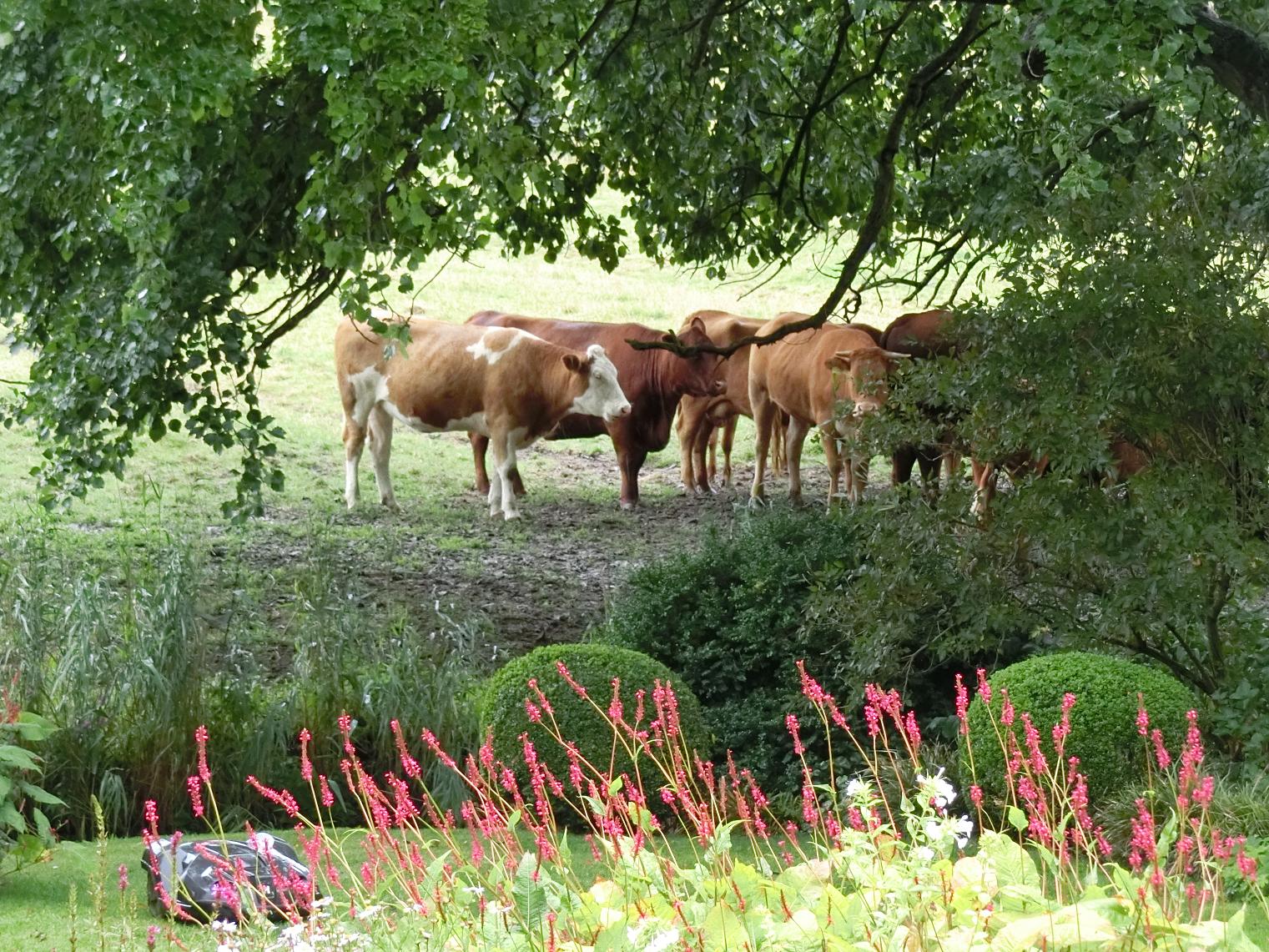
Cattle grazing near Koldenbüttel,
just outside  the Feldhusen farmhouse.
The old farmhouse of Rote Haubarg,
now a heritage museum and restaurant.


LUKAS GENIUSAS Piano Recital

The last recital in this year’s festival fell to the Lithuanian-Russian Lukas Geniusas, who so impressed with Hindemith’s Ludus Tonalis in last year’s festival. He too has graduated from “Young Explorer” status and his showing with an unlikely programme of 37 disparate short pieces in four suites was no less interesting.

The first half opened with Bizet’s Bilder vom Rhein (Pictures from the Rhine), last heard from Johann Blanchard among the 2016 Rarities. Neither Carmen nor L’Arlesienne, these are however pretty enough to be worth listening to again. Also by another song composer, seven pieces from Reynaldo Hahn’s Le Rossignal Eperdu (The Bewildered Nightingale, a cycle of 51 shorts!) were very well-chosen and contrasted. The 19th piece is entitled Berceuse Feroce (here’s an oxymoron if any) which is a quiet but tenacious ostinato. The short cycle closed with a lyrical Adieux (No.51) with a lovely left hand melody.


The second half’s selections from Valery Arzoumanov’s 27 Pieces Op.74 (1985) and Leonid Desyatnikov’s Preludes: Songs from the Bukovina sound like a mixed bag. Character pieces they certainly are: some are child-like, some with jazz inflexions, folk influences, snatches of film-like music, spiced up with mild dissonances. With atonality and serialism kept at bay, these sound pleasant, entertaining but ultimately inconsequential. Geniusas’ enthusiasm is infectious, and his four encores include two more Desyatnikov preludes, Prokofiev’s harp-like Prelude (Op.12 No.7) and a Bartok Hungarian peasant song. A light and nice way to end yet another memorable edition of the Rarities festival.

With Ludwig Madlener,
Bavarians and Singaporeans all love Husum!

Taking off from Hamburg airport,
a great view of the Elbphilharmonie,
St Michael's Church and a WWII flak-tower.

Sunday 26 August 2018

Its back to Singapore for me, back to work (bah!) via London Heathrow (double bah!), but in life, one has to take the good and the not so good in one’s stride. Husum and rarities will always be a good, and so here’s to 2019!

Postlude: 12 October 2018

I have just received an e-mail from none other than Peter Froundjian, Artistic Director and Founder of the Rarities of Piano Music at Schloss vor Husum. I had almost forgotten that I had handed him a copy of Clarisse Teo’s Esplanade recital on my first day in Husum, and now an invitation to Singapore’s newest concert pianist beckons. In particular, he was “very pleased about the programming and her convincing playing”. 

Clarisse will become a Husumite Young Explorer in 2019!    


A bit of Husum in Singapore:
Clarisse Teo performing D'Indy at
the Katzensaal of Schloss Woollerton.
See the resemblance?

Tuesday, 10 October 2017

ANOTHER HUSUM DIARY 2017: DAY ONE


ANOTHER HUSUM DIARY 2017

This is the third year in succession that I will be attending that rarest of piano festivals, Rarities of Piano Music at Schloss vor Husum. Held in the northern German seaside town of Husum, this festival delights in presenting piano music that is not often heard, the unknown, underrated and undiscovered gems of the piano repertory. All too often, the likes of Chopin, Schumann, Liszt and Rachmaninov dominates the programmes of piano recitals (and piano competitions), and the risk of over-familiarity and contempt looms large for pianists and listeners alike.

Husum is that breath of fresh air and much-needed shot in the arm, a chance to listen to music afresh, without pre-conceived ideas and prejudices. Some works may prove to be too arcane but much awaits discovery and the experience of new ears.  This 31st edition of a well-loved and all too unusual institution provided me with year another 9 days of musical bliss, a welcome relief from the humdrum of daily toil.   


DAY 1: Saturday (19 August 2017)

It did not start well at all. First, my flight to Helsinki was cancelled. I only learnt that fact a few hours before leaving for the airport. Thankfully, there weren't so many people flying British Airways, so I arrived in Hamburg via Heathrow. Next, having not read the weather reports, my suitcase was packed with beachwear all set for last year's sunny Husum summer. The reality was cold and drizzly. I will freeze but will survive.

A canopy of green leading to the Schloss.

Nothing beats the frisson of anticipation when one walks through Husum's Schlossgang and be greeted by the canopy of trees leading to the Schloss and the chatter of birdsong. It is a good sign, and the familiar faces that make it to the Mecca of pianophiles – Satoru, Ludwig, Jesper, the Peters (Froundjian and Grove), Elisabeth, Kathy, Bertrand, Fritz und Norbert - all add to this unremitting sense of well-being. We're all on first-name basis now.


Recital 1 (4.30 pm)
LUKAS GENIUSAS

No matter what one thinks, Paul Hindemith's Ludus Tonalis will always be a rarity. This was his version of The Well-Tempered Clavier and Die Kunst der Fuge wrapped in one, comprising a Prologue and a series of Interludes and Fugues, all in his typically quirky and astringent style. There is as much conformity to structure and form as there is much wit, the improvisatory interludes followed by the wryly wrung fugues, brought out trenchantly by the young Lithuanian-Russian's hands.

Some of the themes sound atonal (borne from tone rows), but when heard repeated through a series of voices, these become listenable, even likeable. The piano sounds more reverberant that usual, and this serves the music well. Dryness makes its taste like cardboard, but we're having chocolate mousse now. Geniusas' encores of Wagner's Elegie (hints of Tristan), Leonid Desyatnikov's madcap Chasing Rondo and Grieg's Vision (from Lyric Pieces) close the first of two Young Explorers recitals on a winning high.


Recital 2 (8 pm)
SATU PAAVOLA

The Schloss' longtime avian residents are on full song today, noisily greeting the second of the Young Explorers recitals by the Finn Satu Paavola. The personable young lady looks far younger that her bio suggests. She's supposed to be 37 but appears less that half that age. A teenager appearing in Husum would be a first. But she is as serious as they come, playing a rare combo of Sigismond Thalberg and Charles-Valentin Alkan, both early Romantics. The two Thalberg opera fantasies (after Mercadante and Donizetti) showcase the best bel canto qualities on the piano, a singing line and florid filigree.

One almost feared she be overmatched in Alkan's Sonata “The Four Ages”, a wild 4-movement beast that begins with the uproarious 20s and ending with a resigned 50s (people did not live that long in the early 19th century). Her phrasing is clipped and almost awkward in its opening but she soon settled as the ages progressed. One supposes it gets easier when the tempos slow down. She compensates for her diminutive physical stature by projecting a big sound in the octaves and chords. Her two encores, Thalberg's well-known transcription Casta Diva (Bellini's Norma) and obscure Air d'Eglise (Fetis) served as slow and satisfying bookends.    

The Art of Listening,
a collage I made from last year's festival.