Showing posts with label Rhapsodies of Spring. Show all posts

Monday, 20 January 2025

RHAPSODIES OF SPRING 2025 / Singapore Chinese Orchestra / Review


RHAPSODIES OF SPRING 2025 
Singapore Chinese Orchestra 
Singapore Conference Hall 
Friday (17 January 2025)

This review was published in The Straits Times on 20 January 2024 with the title "Welcoming the new year with feel-good concert".

As to be expected, the Singapore Chinese Orchestra’s annual Chinese New Year concert – Rhapsodies of Spring – was a festive and celebratory affair. Conducted by Quek Ling Kiong, it opened with Tang Jianping’s Overture for the New Century Concert. An apt greeting for the “Year of the Snake”, this was a richly orchestrated fantasy on Nie Er’s well-known Dance of the Golden Snake. 


Vibrant and vigourously percussive, that was followed by Peng Xiuwen’s The First Lunar Month, from a cycle of 12 pieces that represented a Chinese calendar year, which was equally raucous and rousing. 


There were two concertante works on the subject of spring which highlighted impressive soloists, both members of the orchestra. The first had graceful kebaya-clad Zhang Li on the liuqin in Wang Huiran’s Spring on Yi River. This high-pitched plucked instrument waxed lyrical in a slow introduction before breaking out into a lively and dazzling dance. 

This little Nonya's more than talented.


Not to be outdone was Xu Hui on guzheng, who had an elaborate solo in Ning Baosheng’s Spring on Xiang River. The music was suitably picturesque and atmospheric, before the orchestra joined in for a luxuriant finish. 


The orchestra was on its own for Lo Leung Fai’s very engaging symphonic poem Spring, which had three connected movements. Quiet string tremolos opened Dawn in Spring where Zeng Zhi’s dizi solo evoked birdsong before the emergence of a big melody resembling Molihua. 


The scherzo-like Wandering in Spring showcased Benjamin Boo on xylophone in a fast dance, while a glorious reprise of the big melody closed with the final movement Ode to Spring. 

Not just faces made for radio.

After the intermission, the familiar element of Chinese variety shows of yonder years returned in Reunion by Sulwyn Lok, a drama skit scripted by Situ Bi and directed by Judy Ngo. Acted by a host of deejays from Mediacorp’s Capital 958 radio station, this was a sympathetic look at family, filial piety and good age-old values. 

Family: then and now.

A daughter returns from overseas for a reunion to find her family restaurant business in disarray. All’s well that ends well, as it transpires that she had secretly quit college to become a chef and thus saves the day. 


She cooks the reunion dinner and also gets engaged. The music was pleasant and unobtrusive, but frankly nobody was going to hear the details over the dialogue. 


Two world premieres completed the feel-good concert. Phang Kok Jun’s Spring in the Lion City was a set of variations on an original theme, with each variation named after a flower or fruit associated with Chinese New Year. These were so well strung together that it was hard to tell when one variation ended and the next began. 


Finally, Liong Kit Yeng’s Chinese New Year Medley built around four popular seasonal songs saw the participation from children of the Purple Symphony Choir (Chorus Master: Khor Ai Ming). The singing was underpowered, and the clap-along tepid, but nobody was going to deny that new year to come is going to be a very eventful one.


Monday, 13 January 2020

RHAPSODIES OF SPRING 2020 / Singapore Chinese Orchestra / Review


RHAPSODIES OF SPRING 2020
Singapore Chinese Orchestra
Singapore Conference Hall
Saturday (11 January 2020)

This review was published in The Straits Times on 13 January 2020 with the title "Seasonal favourites and comedy act for Chinese New Year".

The Singapore Chinese Orchestra’s annual Chinese New Year concerts are as much about engendering nostalgic feelings as festive fervour. This year’s offering conducted by Yeh Tsung was a 2-hour-long variety show which appealed to certain age demographics, but had good music on top of seasonal favourites.


Li Huanzhi’s familiar Spring Festival Overture was de rigeuer, and did much to rouse spirits as a rowdy opener. More modern in feel was Cheng Dazhao’s The Rodent’s Wedding, greeting the next animal character of the Chinese zodiac. Terse chords and fanfares issued from the winds, while drumrolls heralded subterranean rumblings of scurrying strings.


The rats evoked in this symphonic poem were not of the benign country variety but rather rugged and gritty denizens that thrived in the urban jungle. Unpitched percussion displayed a rhythmic vigour that was consistent for this hard-hitting and dramatic piece.


Eve of the Wedding Day was a single-act comedy scripted by Tung Ka Wai with music by Phang Kok Jun. Employing the thespian talents of nine disc jockeys from Mediacorp Chinese language radio station Capital 98.5 FM, the amusing story centred on Chinese wedding traditions as experienced by three generations of a local family, each with its own ingrained values and prejudices.


The music included a cheery prelude, a procession by winds and percussion, and several interludes. These separated the present and flashbacks to 1967 and 1991, when times were different but traditions remained steadfast and strictly adhered to. There were many funny moments, the best being a trade of hidden barbs and jibes between to be mother-in-laws conducted with landline telephones. At risk was the unfathomable position of losing face to the other side. How very Chinese, however tongue-in-cheek.

  
After the interval was the concert’s longest segment, Symphonic Medley “Teresa Teng” by SCO Composer-in-Residence Law Wai Lun. Running for some 35 minutes, this comprised an overture, three movements and a finale filled with songs popularised by the late-lamented Taiwanese songstress in the 70s and 80s. Shanghai-born singer Yuan Jin, getai star and hailed as “young Teresa Teng of Singapore”, did the honours.


The overture included the melody Ye Lai Xiang (Midnight Fragrance), while each ensuing movement comprised two songs and capturing varied moods. Most familiar was the 3rd movement entitled True Sentiments, which saw Tian Mi Mi (the Chinese version of Indonesian folksong Dayung Sampan) and Yue Liang Dai Biao Wo De Xin (The Moon Represents My Heart) relived.

While Yuan did a good job in Law’s idiomatic arrangements, the likes of Teresa Teng’s innocence, sweetness and inimitable style will never be seen again.

  
The concert closed with Sim Boon Yew’s Spring Festival Medley, sung by Yuan and all the Capital 95.8FM stars. The lyrics to In The Spring, Red Couplets and Da Di Hui Chun (Spring Returns To The World) were quite a mouthful so it became a merry clap-along for the audience.    


Monday, 21 January 2019

RHAPSODIES OF SPRING 2019 / Singapore Chinese Orchestra / Review


RHAPSODIES OF SPRING 2019
Singapore Chinese Orchestra
Singapore Conference Hall
Saturday (19 January 2019)

This review was published in The Straits Times on 21 January 2019 with the title "High jinks and nostalgia to usher in new year".

Like Singapore Symphony Orchestra’s annual Christmas Concerts, Singapore Chinese Orchestra’s Lunar New Year concerts, entitled Rhapsodies Of Spring, are must-attend events for those who enjoy seasonal favourites delivered with healthy doses of light-heartedness. Conducted by Yeh Tsung, this year’s offerings were high on humour and nostalgia.


The concert opened with Li Huan Zhi’s familiar Spring Festival Overture, an old-fashioned rouser which sounded oh-so traditional before SCO Composer-on-Residence Law Wai Lun’s Celebrating New Year. There was a deliberate schlockiness to this medley which reeked of gaudy Geylang a-go-go bars of the 1960s.


More power to a smart parody of styles which saw Cai Shen Dao (God Of Fortune Arrives) and Ying Chun Hua (Spring Blossoms) dressed up as a rumba and cha cha respectively. And one has not really lived without experiencing that ear-worm Gong Xi Gong Xi taking the form of a ridiculously camp tango.   


What truly distinguished the evening were four World Premieres of Chinese evergreens re-orchestrated as popular culture-influenced concertante works by four local composers. Simon Kong’s Flight Of Bossa Nova saw Chang Le and Meng Jie in a duel of suonas updating the woodwind classic Bai Niao Chao Feng (Hundreds Of Birds Paying Respect To The Phoenix).


There were many jazzy turns to erhu classic Erquan Yingyue (Moon’s Reflection On Erquan) in Phang Kok Jun’s Erquan In Swing. Tan Man Man’s hip-gyrating solo was the perfect foil to Ling Hock Siang’s reliving of the legendary blind erhu exponent Abing’s soulful plaint.


In Wang Chenwei’s Interstellar Ambush, the pipa showpiece Shi Mian Mai Fu (Ambush From All Sides) took on the ominous strides of Darth Vader’s Imperial March. The always spectacular Yu Jia in a multi-sequined gown did the honours, but something was lost by not being dressed like a stormtrooper.


For Hard Rock Fight, Eric Watson pitted two percussionists, Xu Fan on Chinese drums (dagu and paigu) against Ngoh Keng Seng on timpanis in a pitched battle where Long Hu Dou (Dragon Tiger Feud) was transformed into a rock fantasy. Art or kitsch? The side-splitting in-jokes in these four new works meant they were not to be taken too seriously.


After the first half’s high jinks, the second half was more retrospective and sedate. Heady Shanghai of the 1930s was relived with Fang Qiong in a selection of songs popularised by singer-actress Zhou Xuan in Law Wai Lun’s The Wandering Songstress Symphonic Suite. She certainly had the full measure these numbers which included Song Of Four Seasons, Waiting For A Beloved, May Breezes and Soaring Phoenix.


Conductor Yeh was in his element too, reciting poetry in both Mandarin and antique Shanghainese, performing dance steps and even downing a glass of red wine. Had the audience been similarly stimulated, there would have been a more raucous response to Sim Boon Yew’s Spring Suite 2019, which closed the concert with the customary glad tidings. Gong xi gong xi...

Monday, 1 February 2016

RHAPSODIES OF SPRING 2016 / Singapore Chinese Orchestra / Review


RHAPSODIES OF SPRING 2016
Singapore Chinese Orchestra
The Star Theatre
Saturday (30 January 2016)

This review was published in The Straits Times on 1 February 2016

Rhapsodies Of Spring is the Singapore Chinese Orchestra's way of celebrating the Lunar New Year in concert, and for the first time it performed in the massive arena that is The Star Theatre. As with previous editions, the concert took on the form of a variety show, and who better to host it than well-known local television personality Marcus Chin (Chen Jian Bin), emcee of the popular Golden Age Talentime?
He and conductor Yeh Tsung displayed good chemistry in their playful banter in Mandarin, peppered with a few English phrases, which most centred around how busy they were and how young each other looked. There were no skits from radio personalities this year but more music, which began with Li Huan Zhi's Spring Festival Overture.


This familiar work was accompanied by visuals of the orchestra projected on a giant screen behind the stage, which focused on groups of soloists. This was soon overtaken by the entrance of the 9-member ZingO Festival Drum Group which raised a racket that was wholly appropriate for the occasion. Its synchronised drumming in Soar and Xu Chang Jun's Dragon Dance was an impressive show of precision and togetherness.


The first half was otherwise the Marcus Chin show, who had no less than four costume changes and enthralled the aunties with his crooning in the Nostalgic Song Medley (arranged by Tan Kah Yong) and Mix Match Song Medley (Phang Kok Jun). He does not have an operatic voice for songs like Man Chang Fei, Azaleas Bloom, Yue Qin and The Traveller With A Bamboo Pole, but his tenor comfortably scaled the heights with oodles of personality and some epileptic dancing.

The Chinese Folksong Medley curiously included a Russian song, Under The Shimmering Moonlight (but sung in Mandarin) and concluded with Radiant With Joy, rendered in an authentic Sichuan accent. Then the concert took on the feel of a typical episode from Saturday Night Live. With the lights dimmed, the main orchestra dispersed leaving behind the 16-strong SCO Pop Ensemble, which resembled and played like a jazz combo.


TV Golden Medley (arranged by Law Wai Lun) revived melodies like Striving (from the early local serial The Awakening), Good Morning, Sir! and  Kopi O. Suona Principal Jin Shi Yi had a field day with his assorted reeds in the Taiwanese song Tian Hei Hei, alternating between jazzy riffs and Donald Duck imitations. Not to be outdone was Han Lei on guanzi in Beijing jazz pianist Kong Hong Wei's Summer Palace, with a stirring display that brought on loud cheers.


The 2-hour concert concluded with bidding farewell to the Year of the Goat and ushering the Year of the Monkey. Wang Li Ping's Shepherd Song gave way to Xu Jing Qing's Gan Wen Lu Zai He Fang from Journey To The West, which saw Chin imitating the moves of Sun Wu Kong (Monkey God). Joined by four ladies in gaudy red, a motley Chinese version of Solid Gold Dancers, the glittery ensemble got the audience singing and clapping along to Sim Boon Yew's Spring Suite VI.

Has there been that many Chinese New Year songs in circulation? The Singapore Chinese Orchestra under Yeh Tsung has played them all. 


Monday, 13 January 2014

RHAPSODIES OF SPRING 2014 / Singapore Chinese Orchestra / Review


RHAPSODIES OF SPRING 2014
Singapore Chinese Orchestra
Singapore Conference Hall
Friday (10 January 2014)

This review was published in The Straits Times on 13 January 2014 with the title "Festive start to spring".

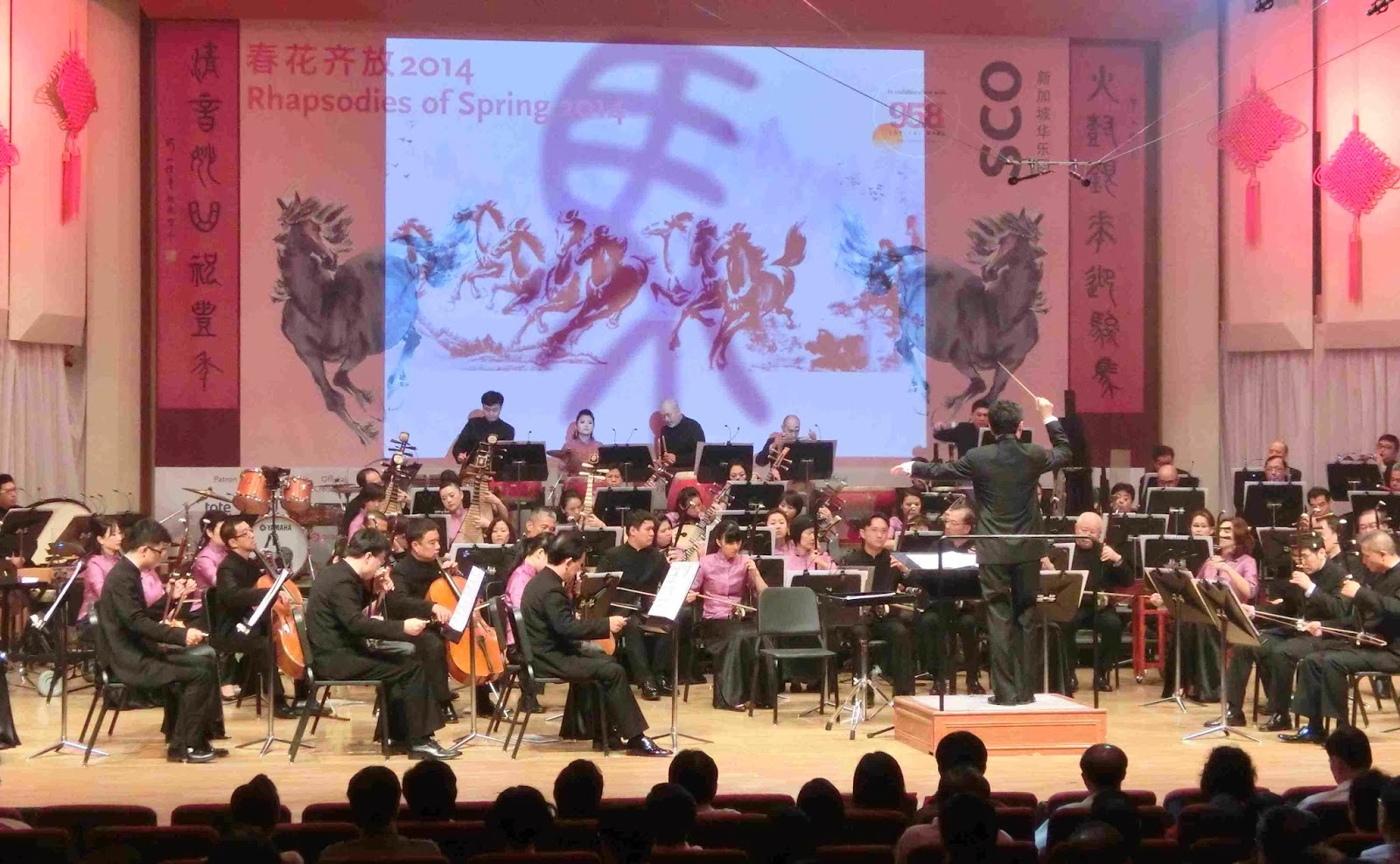
Chinese New Year is a dual celebration of the turn of the lunar calendar and the heralding of spring. Thus the Singapore Chinese Orchestra’s annual New Year Concerts conducted by its Music Director Yeh Tsung shares a similar festive spirit as the Singapore Symphony Orchestra’s Christmas Concerts, with the added flavour of a television variety show.


Li Huan Zhi’s Spring Festival Overture rowdily opened the concert, and before anyone could applaud, went directly into Huang Hai Huai’s Horse Racing. The familiar melody served to greet the Chinese zodiacal “Year of The Horse”, its stampeding hoof-beats and chorus of synchronised neighing providing marked contrasts with the gentle trot and amble of Leroy Anderson’s Horse and Buggy.


Then the show belonged to the disc jockeys of Capital 95.8, the popular Chinese language radio station, who acted out a skit The Swordsman Saga which brought legendary heroes and villains of wuxia or Chinese sword-fighting escapades into the mix. By some quirk of magic, the denizens of folklore arrived in modern-day Singapore and went on air with comical consequences. The accompanying music was arranged by Tan Kah Yong, with a segment quoting Prokofiev’s Montagues and Capulets from the ballet Romeo and Juliet.


The DJs also had a rap of their own, but the second half was distinguished by three soloists. Han Lei (above) demonstrated his versatility on the guanzi, the short reed instrument which revelled in folk-like slides in the Hebei melody Grazing The Burro and a saxophone’s revelry in the infectious Caribbean rhythm of Kong Hong Wei’s Summer Palace.


Vocalist Fan Qiong oozed sultriness and sensuality in the Mongolian folksong Swan Goose and Huang Yi Jun’s Misty Rain. In the latter, she was joined by violinist Qian Zhou whose lyrical obbligato part was equally alluring. There was a folksy lilt in Tang Ni’s The Story of Small Town and dazzling coloratura in the waltz-song Hai Yan (Swallow) by Chen Ge Xin, probably China’s answer to Johann Strauss’s Voices of Spring.


Unlike last month’s mass participation Messiah, this audience is not one for singing, so there was a clap-along instead for Sim Boon Yew’s Spring Festival Suite II, which contains the four most popular and overplayed Chinese New Year anthems of all. The DJs provided a makeshift unison choir, their contribution made all the apparent when soloist Fan finally joined the fray.


With the arrival of a costumed God of Wealth, an Oriental Santa Claus of sorts, their communal message was “Make Prosperous”. There could not be a more propitious Chinese greeting than that. 
 

Concert photographs by the kind courtesy of the Singapore Chinese Orchestra.
