Showing posts with label Singapore Festival Orchestra. Show all posts

Monday, 30 January 2012

TAN DUN'S MARTIAL ARTS TRILOGY / Singapore Festival Orchestra / Review


TAN DUN’S MARTIAL ARTS TRILOGY
Esplanade Huayi Festival
Singapore Festival Orchestra
Esplanade Concert Hall
Friday (27 January 2012)


This review was published in The Straits Times on 30 January 2012 with the title "Tan Dun's trilogy a feast for the senses".


The one sure sign that Chinese culture has been wholly embraced by the global mainstream and consciousness was how Hollywood greeted Ang Lee’s martial arts epic movie Crouching Tiger, Hidden Dragon of 2000. Central to its phenomenal success was the Oscar-winning original score by Chinese-American composer Tan Dun, whose music has become as much a part of cinematographic lore as the scores of John Williams, Miklos Rozsa, Sergei Prokofiev and Erich Korngold before him.

The Martial Arts Trilogy presented Tan’s music from three wuxia movies for concert hall consumption in the form of three concertos, performed alongside action sequences projected on the screen. Suites would have been the more accurate description for these scores, as the music unfolded in multiple disparate movements, providing a capsule overview of the narrative.

Heard on its own, the 45-minute long Hero Concerto for violin and orchestra, written for Zhang Yimou’s film about the first emperor Shi Huangdi, might have been a tiresome prospect. However the magic about movies is the contemporary synthesis of various art forms into a glorious whole, serving present times what grand opera did for the 18th and 19th centuries.


Effectively written music makes a movie come alive by providing the story-telling an added dimension for the senses. Thus Wang Jiamin’s violin pyrotechnics, abetted by Zhao Xiaoxia’s atmospheric guqin, came to ably portray the self-sacrificing hero and heroine amid gravity-defying swordplay, intimate love scenes and breathtaking landscapes.

SSO Principal Cellist Ng Pei Sian reprised Yo-Yo Ma’s role for the Crouching Tiger Concerto, containing the most familiar music of the lot. Going beyond mere notes, his demanding part, full of sliding portamentos, violent pizzicatos and assorted effects, lived the role with absolute gusto. The Singapore Festival Orchestra, surely now the Republic’s de facto film orchestra, responded to Tan’s precise and dramatic directions with great immediacy and responsiveness, with a busy percussion section particularly relishing their parts.


The Banquet Concerto, with pianist Sun Jiayi as pugilist in a fiery red dress, had the least Chinese-sounding music. Tan cited as compositional influences Bartok and Stravinsky, for their raw percussive ostinatos, but it was the unbridled lyricism of Rachmaninov that stood out. That was perhaps the very reason, despite the death and mayhem it accompanied, that sent the full-house audience home happy and sated.


Two Maestros Meet: Tan Dun with Chan Tze Law, Music Director of the Singapore Festival Orchestra.

Tuesday, 13 December 2011

SINGAPORE NATIONAL PIANO AND VIOLIN COMPETITION 2011 / GRAND FINALS / Review


NATIONAL PIANO & VIOLIN COMPETITION 2011
Grand Finals & Awards Ceremony
Yong Siew Toh Conservatory Concert Hall
Saturday & Sunday (10 & 11 December 2011)

A much-edited version of this review was published in The Straits Times on 13 December 2011 with the title "Alan Choo wins violin finals".

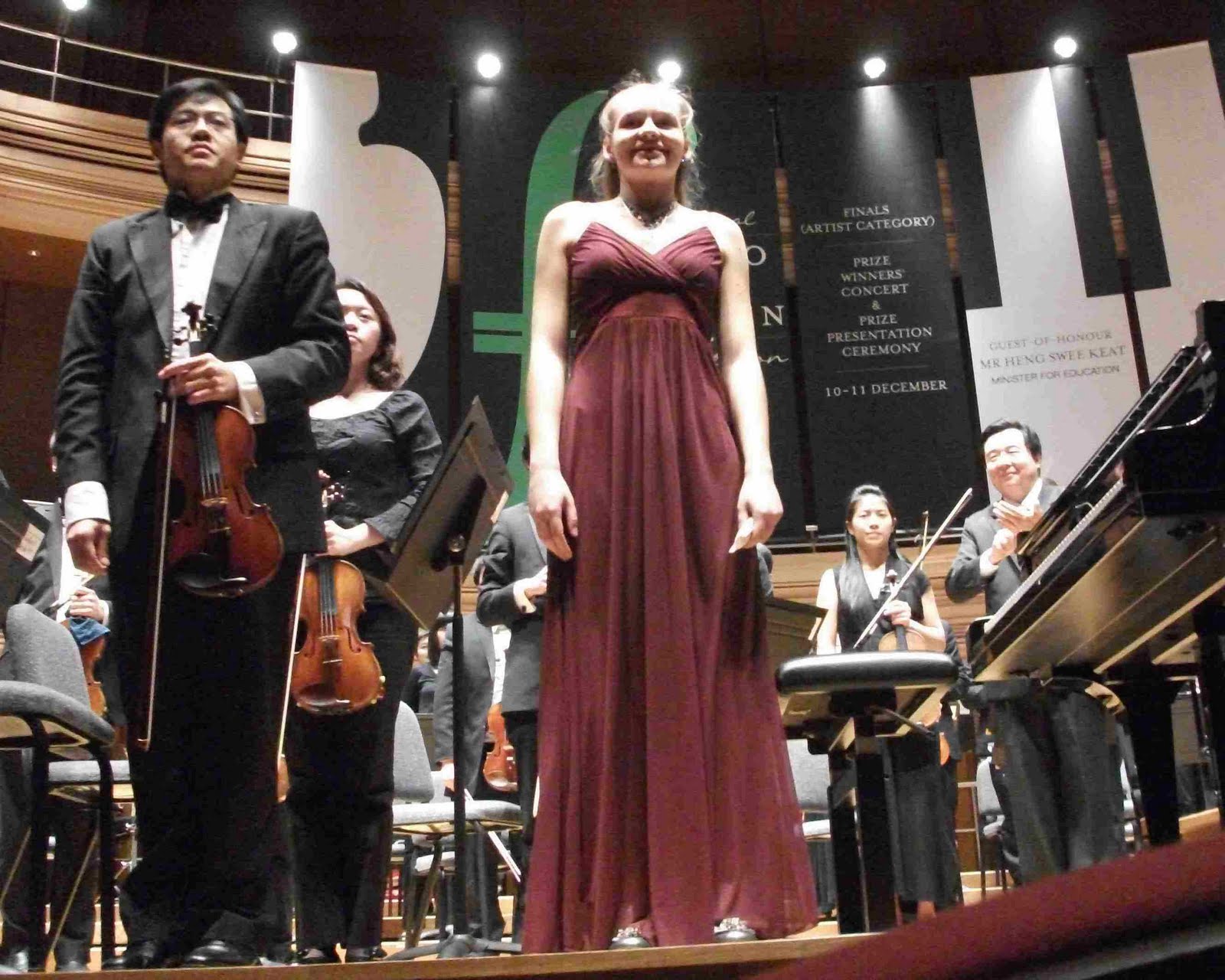
Singapore has yet to have an international piano or violin competition to call its own but the Finals of the Artist Categories in the National Piano and Violin Competition, supported by the Singapore Festival Orchestra conducted by Chan Tze Law, comes very close. In terms of the diversity of nationalities represented by the finalists, all of whom are pursuing their musical studies here, and the quality of performances, there is much to be proud of.

Violin (Artist) 2nd Prize: 
Adelya Nartadjieva


This year’s violin finals marked a new high. Only a wafer-thin margin separated two front runners, Uzbekistan’s Adelya Nartadjieva and Singapore’s Alan Choo, both Conservatory students. In Tchaikovsky’s evergreen Violin Concerto, Nartadjieva proudly upheld the Russian school of Oistrakh and Kogan with a sizzling reading of passion and poise. Exhibiting a full and gorgeous tone, its numerous technical hurdles were overcome with an ease and aplomb that came as naturally as breathing.

Violin (Artist) 1st prize: Alan Choo Su-Ho

Choo opted for the Armenian Aram Khachaturian’s ethnic-flavoured Violin Concerto, an unabashed showpiece which he attacked with ferocity and fervour. He also had a free-wheeling quality, resounding as if improvised on the spot. The intoxicating brew of poetry and dare-devilry was persuasive enough to edge Nartadjieva for the First Prize. Choo is the first Singapore-born violinist to win this accolade since 2001. Third place went to China’s Yang Yunjie whose very musical but cautious performance of Prokofiev’s Second Violin Concerto was more than competent.

Violin (Artist) 3rd prize: Yang Yunjie

The piano finals on Sunday afternoon was equally riveting, with Singapore’s Clarence Lee opening with a rock solid, honest to goodness account of Rachmaninov’s Second Piano Concerto.

Piano (Artist) 2nd prize: 
Clarence Lee Zheng Le

Blending brawn with sensitivity, his wide-striding playing comfortably matched the dense orchestral textures. In the treacherous central section of the finale, a cool head averted almost certain disaster when the accompaniment went off kilter for a split second. Saving the day, he closed with thunderous authority.

Piano (Artist) 3rd prize: 
Kseniia Vokhmianina

There were two performances of Chopin’s First Piano Concerto. Ukraine’s Kseniia Vokhmianina brought out many lovely insights but was dogged by mistakes and lapses. Taiwan’s Yeh Shih-Hsien was far more confident, with note perfection transcending into a nuanced reading of rare polish and elegance. His uncanny mastery of rubato, that most intuitive and Romantic of expressive devices, provided a gilded edge that earned him the victor’s title. Lee was awarded the second prize.

Piano (Artist) 1st prize: 
Yeh Shih-Hsien

The evening award ceremony and concert also showcased four set-pieces chosen for the competition from local composers Eric Watson, Bernard Lee, Emily Koh and Denise Lee, demonstrating that the creative front was no less impressive.

Goh Soon Tioe Award: 
Elvina Sung-Eun Auh

The Goh Soon Tioe Outstanding Performer Award of ten thousand dollars, by far the biggest bounty, went to 12-year-old violinist Elvina Sung-Eun Auh from the Junior Category, presently a student in England’s Menuhin School. Her stunning performances of works by Suk and Wieniawski, so mature in conception and faultless in execution, have to be witnessed to be believed. Mere words do scant justice. Have we just found Singapore’s own version of Midori and Sarah Chang?

Some of the winning pianists and 
their teachers with jury members 
Phillip Shovk and John Perry.


Albert Tiu's Midas touch does it again, 
with winning pianists Li Churen 
(1st Prize, Senior Category) and 
Yeh Shih-Hsien (1st prize, Artist Category)

Monday, 24 May 2010

CARNIVAL OF THE ANIMALS / PETER AND THE WOLF / Kamchatka Theatre Company and Singapore Festival Orchestra / Review

CARNIVAL OF THE ANIMALS
PETER & THE WOLF
Kamchatka Theatre Company
Singapore Festival Orchestra
Esplanade Concert Hall
Friday (21 May 2010)

This review was published in The Straits Times on 24 May 2010.

(The "sacking" of Esplanade Concert Hall, as reported earlier, was part of this act... just in case you were wondering.)

It looked like a scene from Bangkok today. Graffiti on the walls, litter strewn on every inch, and concertgoers were cordoned off, barred from entering the hall. A minivan then gatecrashed the foyer. Instead of riot police, it was 16 members of Spain’s Kamchatka Theatre Company, an outfit more in league with the Keystone Cops.

Music was on the plate, but not before a prolonged foreplay of acrobatics, juggling and visual comedy to set the mood. This reviewer was literally carried away, fireman-lifted by one of the troupe and unceremoniously dumped onto the stage (some say a fate befitting all critics).

Director Adrian Schvarzstein, perfect for the part with his brow-beaten demeanor, engaged and teased. When former Deputy Prime Minister Dr Tony Tan left his seat with grandchild in tow, probably to use the conveniences, he quipped, “You are going to do pee pee now?” Prostate problem or otherwise, the concert resumed after the duo returned.

The first part was a choreographed Carnival of the Animals by Camille Saint-Saens, with the twin sister act of pianists Low Shao Ying and Shao Suan, both of whom were royally carried to their stools. But first, a conductor had to be found. The chubby boy in the second row tried his luck and was ejected. Then a pretty senorita emerged from the audience, “I’ve got conducting lessons!” she pleaded. The orchestra seemed to like her looks, and so maestra Virginia Martinez raised her baton.
SFO cellist Elizabeth Tan does her best Jackie du Pré impression.

Placards with big bold titles were flashed in each of the 14 movements. The street actors did their spiels, which included Mister Bean and Monty Pythonesque routines, culminating with The Swan, a gravity-defying ballet on drapes slung high above the stage.

“The second part is the part after the first part,” drolly declared Schvarzstein. Without an intermission, the Singapore Festival Orchestra accompanied Suzie Templeton’s 2006 animated film Peter & the Wolf. Radically different from previous incarnations, there was a gritty edge to the production, which swung between genuine tension and humour, and an eco-conscious twist at the end. There was no need for narration, as the story told itself with split second synchronisation from the musicians playing Prokofiev’s familiar score.

More anarchic than Babies Proms and more riotous than a Taiwanese parliamentary session, the 2010 Singapore Arts Festival has midwifed a winning act of uncommon pedigree.

Everybody loves the Singapore Festival Orchestra!

Take a bow, Kamchatka!

Tuesday, 15 December 2009

NATIONAL PIANO / VIOLIN COMPETITION 2009 Grand Finals / Review

NATIONAL PIANO & VIOLIN COMPETITION 2009
Grand Finals
Victoria Concert Hall
Sunday (13 December 2009)

This review was published in The Straits Times on 15 December 2009.

This year’s edition of the National Piano & Violin Competition drew a record number of entries: 215 for piano and 106 for violin. Thankfully quality rose in equal measure with quantity, and often surpassed it. The grand finals featured the best in the Artist categories, and a 4-hour-long concert with six concertos (three each for violin and piano) partnered by the indefatigable Singapore Festival Orchestra conducted by Chan Tze Law ensued.
Winners of the NPVC Artist category:
Li Zhen & Zhao Meng Chan (from L)
Photo: The Straits Times
Two artists emerged head and shoulders above the rest. Violinist Zhao Meng Chan (China), from the Yong Siew Toh Conservatory, had the most natural way with Sibelius’ ruggedly hewn Violin Concerto in D minor. He ran the full gamut of emotions, cutting through swathes of orchestral sound with a searing intensity that went beyond superficial brilliance. His brand of dare-devilry, coupled with an unusual charisma, suggests he is ready to walk onto any world platform.

Zhao was the undisputed first prizewinner, edging out Wendy Toh (Singapore), whose version of the same concerto was well-disciplined, textbook-perfect and ultimately safe. Her exercise in good taste had to be content with third place, trailing behind Du Shuaili (China), whose free-spirited, wild and wayward stabs at Dvorak’s folksy Violin Concerto in A minor threatened to derail the proceedings on more than a few occasions.

On the piano, Shaun Choo (Singapore, left), who studies in Salzburg, cut the most elegant and aristocratic figure. His Rachmaninov Second Piano Concerto was a wonder in self-restraint and control, erupting into full-blown passion and unabated poetry right when the music demanded it. His expansive vistas in the slow movement which spoke of love and regret, contrasted with of the febrile excitement of outer movements, was easily the evening’s revelation.

Choo’s relegation to third place will be a cause celebré for time to come, but that should not diminish the achievements of Maria Immaculata Setiadi (Indonesia) and Li Zhen (China), both Conservatory students, who finished second and first respectively. Both punched way above their weight in Liszt’s fearsome concertos, exulting in salvoes of octaves while delicately filling in the pretty bits. It was Li in the First Piano Concerto in E flat major who packed in the tauter and more exciting performance than Setiadi, who was slightly less immaculate in the Second Concerto in A major.

Controversy is the stuff of musical competitions worldwide. However winners and also-rans can always remind themselves that true artistry is not a horse race, but a lifelong quest.

Thursday, 10 December 2009

SINGAPORE NATIONAL PIANO / VIOLIN COMPETITION 2009


The National Piano & Violin Competition 2009 has begun, with the quarter, semi-final rounds held at Yong Siew Toh Conservatory (piano) and Esplanade Recital Studio (violin). The National Arts Council reports a record number of entries, 321 in total, including 215 for piano and 106 for violin. A sign that serious music-making by young people in Singapore is progressing at a more than rudely healthy pace.

The Steinway Grand at the
Yong Siew Toh Conservatory.

The Piano Artist Competition already looks like a mini-international piano competition. There are a record 42 participants, including Singaporeans and names from Malaysia, Thailand, Indonesia, Vietnam, China, Taiwan, Korea and Ukraine!

Masterclasses by the members of the jury will take place at the Young Musicians Society (Waterloo Street) on Saturday (12 December 2009). Jurors include: Rae de Lisle, Bryce Morrison & Logan Skelton (piano), Kam Ning, Dong-Suk Kang & Walter Verdehr (violin).

The Grand, Grand Finals on Sunday (13 December 2009) afternoon is going to be a marathon music-making session, likely to last some six hours (!!!) from 2 pm to 8 pm at Victoria Concert Hall. It will include six concerto performances (3 violin concertos & 3 piano concertos) with the Singapore Festival Orchestra conducted by Chan Tze Law, and solo performances from the winners of the junior, intermediate and senior categories for both piano & violin. Shades of Beethoven's Vienna 1808 super-concert!

Reviews of the grand finals and piano competition sessions will be posted later. In the meanwhile, enjoy the music! All tickets available at SISTIC.

Wednesday, 3 September 2008

Two World Premieres by Two Singaporean Composers

TAN CHAN BOON Cherish
HO CHEE KONG Shades of Oil Lamps
Singapore Festival Orchestra 
(14 June 2008)
London Sinfonietta (21 June 2008)
Esplanade Concert Hall

Two Singaporean composers received world premieres of their commissioned orchestral works at this year’s Singapore Arts Festival.

Tan Chan Boon, 43, who teaches musical theory and composition privately, already has four full-length symphonies under his belt. None of these have been performed in their entirety in Singapore. Cherish, an 8-minute “prelude for orchestra” with an ecological message, gave a short glimpse of the enormity of his symphonic visions and cathedral-like sonorities.

Moved by mankind’s desecration of Gaia, the music opened quietly with a low heaving Wagnerian groan accompanied by eerie string glissandi. A trombone chorale perforating the calm suggested the spiritual and quasi-Oriental sound world of Armenian-American composer Alan Hovhaness. The conflict of man and Nature brought up the decibel factor briefly but resolution was to be found in a broad lingering melody which dominated the work’s latter half, reminding this listener of the Afro-American spiritual Deep River.

Tan’s Cherish isn’t just a symphonic slow movement, but a microcosm of a possible fifth symphony. The Singapore Festival Orchestra, led by Chan Tze Law, was ever sensitive to the music’s nuances and dynamics, delivering a very satisfying reading that makes one want to hear much more of Tan’s music.

Shades of Oil Lamps by Ho Chee Kong, 45, composition professor at the Yong Siew Toh Conservatory, was scored for just nine musicians. Its subject is a 1960s and 70s itinerant roadside story-teller who keeps his audience entranced with his spun yarns. Ho’s music is similarly captivating with its transparency of scoring, piquant instrumental colour and sheer dynamism. Beginning with the “tick-tock” of the temple block and a sinuous flute solo that begins the tale, familiar and well-loved aromas begin to fill the senses.

Members of the London Sinfonietta conducted by veteran avant-gardist Diego Masson, all virtuoso soloists in their own right, performed one to a part. Their mastery of individual lines and as an ensemble was impeccable, delivering a performance that could scarcely be bettered. An unmistakable Oriental feel, with its scales and modes, permeated the work, which took flight into a land of fantasy and imaginary personages before its abrupt ending. Like the afore-mentioned story-teller (and Scheherazade, folklore’s most famous) who leaves his listeners dangling at the climax, one is left yearning for more.

Credit goes to National Arts Council for commissioning these memorable works, which amply demonstrate the fertile imagination of Singapore composers, mastery of their art and a burning desire to communicate. Bravissimo!