Showing posts with label Tasmin Little. Show all posts

Friday, 23 October 2020

PETWORTH FESTIVAL 2020 / Concert Reviews III

Tuesday 20 October 2020

TASMIN LITTLE, Violin

with JOHN LENEHAN, Piano


It is hard to believe that Tasmin Little is retiring from the world of performing. This might very well be one of her last concerts, having given a world farewell tour (including a date with the Singapore Symphony in February) to call a close to a stellar international career of over 2000 concerts in thirty years. I am privileged to have seen her perform in Singapore, Sydney and Hong Kong, and why not include Petworth into this august list?


Tasmin Little in Singapore,
playing Bruch's Violin Concerto No.1
with the Singapore Symphony Orchestra


Her programme with regular piano collaborator John Lenehan was all Romantic, opening with Brahms’ Scherzo in C minor from the so-called FAE Sonata written for Joseph Joachim by three composers (Brahms, Schumann and Dietrich). It is the only movement anybody remembers today, with the hot-blooded young Brahms sending sparks fly, amply reciprocated by the duo in a passionate reading. This was merely the prelude to the young Richard Strauss’ Violin Sonata in E flat major, the concert’s main piece, composed long before his great tone poems and operas.  


Here Little’s lyrical gifts come to the fore, with the work’s succession of luscious and flowing melodies given a gilded edge. Her tone is voluminous, sweet but not cloying, and intonation en point through its three movements. The slow movement is titled Improvisation, but its more of a meditation, its aria-like beauty shining through at every turn. The finale mirrored the first movement’s passionate throes, and with virtuosity to burn, the duo dispatched its pyrotechnics for a powerful close.


The next two works were by women composers: Lili Boulanger’s lovely Nocturne and Amy Beach’s Invocation (shorter and less well-known than her Romance, but just as pretty) were simply oases of calm and charm, played with a heartwarming sincerity. The closing piece, Tchaikovskyana, was a fantasy on popular melodies from the ballet Swan Lake, cunningly crafted by Little and Lenehan. In the hallowed tradition of such fantasies by Sarasate, Wieniawski and Ernst, this was a distillation of good tunes and virtuoso playing, throwing in snatches of Tchaikovsky’s First Piano Concerto and Violin Concerto for good measure. Naughty but nice, and brilliantly dispatched. To Tasmin, we bid adieu and thank you for the music.


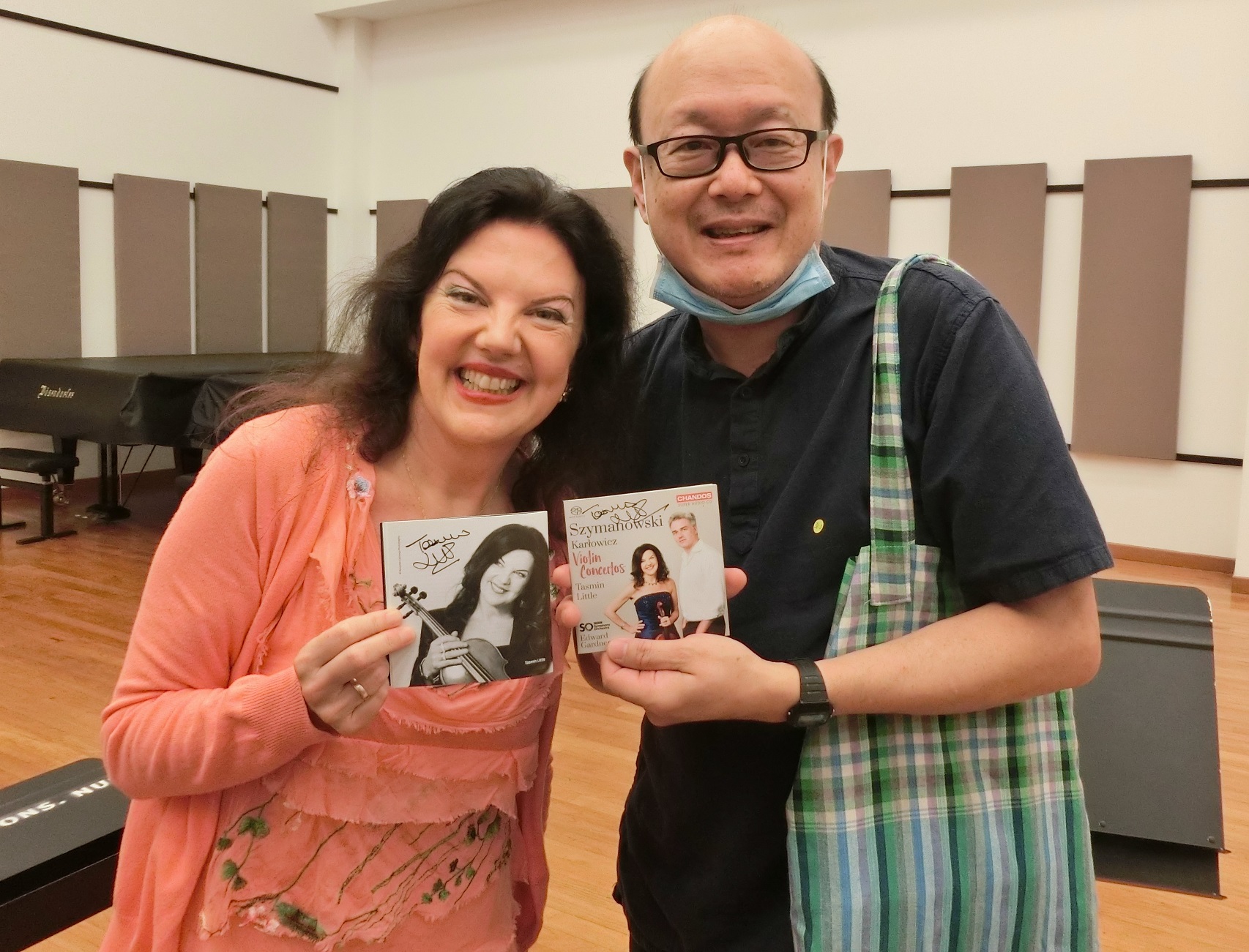
Tasmin's got a fan in Singapore!


Wednesday 21 October 2020

CLARE TEAL & Friends


I can’t say I know much about jazz singing, for this is music one should be chilling to and simply enjoyed rather than analysed or critiqued. So I will keep this short and say I tremendously enjoyed Clare’s soothing mezzo voice, swinging vibe, and ad libbing, supported by an excellent trio of pianist Jason Rebello, bassist Simon Little and Ben Reynolds on drums, who also lent their voices for some numbers.


For the record, the songs she styled included I Love Being Here With You (Peggy Lee), An Occasional Man (Jeri Southern), They Say Its Spring (Blossom Dearie), You’ve Changed (Billie Holiday), Let’s Do It, Let’s Fall In Love (Ella Fitzgerald), If I Had A Ribbon Bow (Maxine Sullivan), It’s A Good Day (Peggy Lee), La Belle Dame Sans Regrets (Sting), The Song Is You (Doris Day), I Will (Lennon & McCartney), My Funny Valentine (Rodgers & Hart), Into Each Life Some Rain Must Fall (Ella & The Inkspots), Don’t (Elvis Presley), It Don’t Mean A Thing If It Ain’t Got That Swing (Duke Ellington) and several which I’ve either missed or forgotten. After a long day of work, this was certainly the perfect sort of tonic to go home to and lounge about.


Thursday, 11 January 2018

CD Review (The Straits Times, January 2018)


SZYMANOWSKI &
KARLOWICZ Violin Concertos
TASMIN LITTLE, Violin
BBC Symphony / EDWARD GARDNER
Chandos 5185 / *****

Some sixteen years separate the two violin concertos of Polish nationalist composer Karol Szymanowski (1882-1937), but when heard one after another, they sound like contiguous movements of a mega-concerto that plays for some 45 minutes. 

The First Violin Concerto (1916) is so ethereally beautiful that its neglect in concert halls is perplexing. The outsized demands for the soloist, both technical and expressive, are likely the reason. Its rhapsodic nature and dynamic shifts from impressionistic dreaminess to boisterous drama makes it an exciting listen. The Second Violin Concerto (1932-33) that follows is more compact, utilising gritty folk music elements in its two movements linked by a cadenza.    

The Violin Concerto in A major (1902) by the short-lived Mieczyslaw Karlowicz (1876-1909, killed in an avalanche while mountaineering) comes from a different era. Its spirit is closer to the effusive Romanticism of Wieniawski, Bruch and Glazunov with the requisite fireworks to match. 

All three concertos receive gorgeous performances by British violinist Tasmin Little that go to the music's heart, the perfumed decadence of Szymanowski and the showmanship of Karlowicz. Every detail of is captured on demonstration sound by Edward Gardner's excellent BBC Symphony Orchestra. A must listen for violin lovers.

Tuesday, 27 June 2017

VIOLIN AND PIANO DUO CONCERT / TASMIN LITTLE & MARY WU / Review


VIOLIN & PIANO DUO RECITAL
TASMIN LITTLE, Violin
& MARY WU, Piano
City Hall Concert Hall, Hong Kong
Sunday (25 June 2017)

It is a short distance between Shenzhen and Hong Kong, such that I was able to hop over the China-Hong Kong boundary to spend a couple of days in Hong Kong – to shop, eat and listen to more music. After four nights of relentless piano concertos at the Shenzhen International Piano Competition finals, it came as a relief to hear the solo violin again. The source was the great British violinist Tasmin Little herself, partnered by her former schoolmate and good friend, the Hong Kong pianist Mary Wu.

To refer to Tasmin Little as a virtuoso would be an understatement. Her many recordings through the years (on the EMI labels, Decca and now Chandos) attest to her musicianship and versatility, and it was a pleasure to hear her in a full-length recital rather than just in concertos. The evening opened with the short Scherzo in C minor by Brahms, part of the multi-composer F.A.E. Sonata written for Joseph Joachim, which yielded a fiery response from both violinist and pianist.


This was the appetiser for Schubert’s lovely Sonata (or Sonatina, as it is sometimes known) in D major D.384 which was a lyrical balm for the ears. Here is the Lieder composer at his most congenial, aided by Little’s sweet and lovely tone in its three movements. Never too cloying or over-sentimental, the singing tone was what one would expect in this most effable of chamber music.

This was contrasted with the impressionist textures of Frederick Delius’ Second Sonata, a work championed by Little and which she recorded with Piers Lane on the Conifer label during the 1990s. The shortest of four sonatas, it swept through breezily in a single movement, revealing sumptuous melodies and harmonies. There was an element of folk and dance music, playfully captured before closing in the comfortable home key of C major.    


Both Little and Wu had solo works on their own. During the first half, Mary performed Debussy’s L’Isle Joyeuse, a reading that dazzled in its play of colour and light, revelling in a glorious climax before a truly joyous close. Tasmin’s arrangement (with her friend Rachel Jennings) of Albeniz’s Asturias was just as stunning. Despite its repetitious figurations and rhythms, it traversed through an entire gamut of mostly jaw-dropping technical tricks.

The concert proper closed with a masterful account of Cesar Franck’s popular Sonata in A major. As with the earlier works, Little’s mellifluous voice impressed in the static beauty of the slower first and third movements. This was backed by Wu’s impressive pianism, not least in the treacherously difficult second movement’s thrills and spills. The finale’s canon was a thing of beauty, its simple theme first heard on the piano and repeated on the violin, building to an impassioned climax and rapturous close.  


The audience was treated to four encores from the duo. Following two of Brahms’ Hungarian Dances, the peach was Lili Boulanger’s utterly beautiful Nocturne, a work that deserves to be heard over and over again. Following that, William Kroll’s playful Banjo and Fiddle provided the icing on the cake. My stopover in Hong Kong was well-rewarded indeed. 


Thursday, 2 January 2014

CD Reviews (The Straits Times, January 2014)


LEON FLEISHER
Complete Album Collection
Sony Classical (23 CDs) / *****

This handsome box-set was issued in honour of Leon Fleisher’s 85th birthday this year. He belonged to the “lost generation” of American pianists born during the 1920s and 30s whose careers were curtailed by death, illness or early retirement. Fleisher’s affliction was focal dystonia which for several decades robbed him the use of his right hand. Before that, he had produced some of the best recordings of Beethoven and Brahms piano concertos with the Cleveland Orchestra conducted by George Szell, solidly musical and no-nonsense accounts which still stand the test of time.

These have been lovingly reproduced with the original LP designs and sleeve-notes. Also issued are several rarities appearing on disc for the first time, including Rachmaninov’s Paganini Rhapsody, Franck’s Symphonic Variations and Hindemith’s Four Temperaments, concerte works based on the theme and variations form. Collectors will also treasure his fine recording of Brahms’s Piano Quintet with the Juilliard Quartet and piano music by 20th century American composers Copland, Kirshner and Sessions. 

There are three CDs which document Fleisher’s years as a left handed pianist, featuring a solo recital, left hand piano concertos (by Ravel, Britten and Prokofiev) and chamber music by Korngold and Franz Schmidt. The final CD from 2009 sees a glorious return to playing with both hands in Mozart piano concertos (No.12 and 23, both in A major) and the Double Piano Concerto (K.242) alongside his former student and present wife Katherine Jacobson. Here is a great career in music translated into a feast for the ears.


BRITISH VIOLIN SONATAS
TASMIN LITTLE, Violin
PIERS LANE, Piano
Chandos 10770 / ****1/2

This is Volume One of a highly promising survey of British violin sonatas from the excellent British duo of Tasmin Little and Piers Lane. The music of the two major sonatas by William Walton (composed 1947-49) and Howard Ferguson (1946) is gratifyingly tonal, tinged with a bittersweet lyricism from that bygone age. The 1950s and 60s would later usher in an age of atonalism that altered the face of music for several decades. The Walton, which shares a similar aesthetic as his celebrated Violin Concerto, is unusual in having just two movements, the second is an absorbing set of variations on a simple theme. The Ferguson is more traditional, in three movements, but no less enjoyable.
 
The true rarity is Benjamin Britten very early and eclectic Suite Op.6 (1934-35) which comprises four character studies as movements. A feel of the burlesque and grotesquerie occupy the March, Moto Perpetuo (Perpetuel Motion) and final Waltz. Those who enjoy his very accessible Piano Concerto (also from the 1930s) will appreciate his ironic sense of humour here. An added bonus are two short pieces by Walton from 1948-50, a Canzonetta and Scherzetto, dedicated to the Brangelina of that era, Laurence Olivier and Vivien Leigh. Little, known for championing rarely-performed known British works, produces a sweet and beguiling tone, gloriously backed by the ever-sensitive Lane.