Showing posts with label Chiyan Wong. Show all posts

Sunday, 26 February 2023

MOZART'S STARLING / Singapore Symphony Orchestra / Review


MOZART’S STARLING

Singapore Symphony Orchestra

Victoria Concert Hall

Friday (24 February 2023)


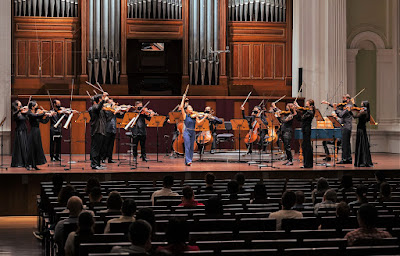
The Singapore Symphony Orchestra continues on its Mozart crusade, with another programme built around Salzburg’s greatest son. Conducted by Chinese maestra Xian Zhang, Music Director of the New Jersey Symphony Orchestra and making her first appearance in Singapore, the concert opened with Chinese composer Chen Qigang’s L’Eloignement (2004) for string orchestra.


Chen Qigang (born 1952),
Olivier Messiaen's last student.


The French term translates from the Chinese phrase zou xi kou, or “going west”, synonymous with parting or departure. Based on a brief nostalgic theme, resembling those heard on erhu or huqins, a quick succession of variations unfolded, lush with rich harmonies, long-held resonances, and mild dissonances not unlike those in Britten or Messiaen (Chen was the Frenchman’s last pupil). There were lovely short solos from the principals, leading to stretches of serene beauty, before culminating with an Elgarian climax albeit with a Chinese accent. A Bartok-like earthiness also coloured its final pages, with serene glissandi and harmonics before closing in utmost serenity.


Next came Mozart’s popular Piano Concerto No.17 in G major (K.453) with young Hong Kong-born pianist Wong Chiyan as soloist. Wong is known for very personal interpretations, often with revisionist ideas. Even seemingly sacrosanct Mozart was fair game in a performance which raised more questions than provided answers.


Appearing extremely restless during the orchestral ritornello, he would softly and randomly depress the piano keys, and also gaze at the audience. When the solos came, Wong evinced a crisp, crystalline and somewhat brittle sound, as if treading on eggshells. There was none of the “flow like oil” quality which Mozart would have liked. Liberally added notes and ear-catching ornamental passages sprung from his ever-active imagination, but there were also some wrong and missed notes. A very interesting and provocative personality nonetheless, he contributed his own cadenza which was creative, mostly idiomatic and none too obstrusive.


The slow movement had a stark and lean quality, as if describing a desolate landscape. The finale with its melody mimicked by Mozart’s pet starling (hence the concert’s title) became more fodder for Wong’s tinkerings. One cannot imagine a more freely re-written Mozart than this, like an act of a Hong Kong rebel sticking the middle finger at orthodoxy. Any other Chinese pianist (Yuja or Haochen) would have been sent for “re-education” in some Xinjiang gulag. While senses get piqued in concert, one cannot imagine living with a recording of this.     


Wong is a “marmite pianist”, you either love him or loathe him. In this case, the audience leaned firmly on his side, their applause rewarded with a very brief encore, the first airing of his seconds-long musical doodling entitled Bone Dusting. The jazz harmony-inflected miniature referred to the Chinese practice of dusting one’s ancestors’ remains after exhumation. One also supposes the long dead could not be left well alone too.


The orchestra had been a respectful accompanist in the concerto, and its own showcase was Mozart’s Symphony No.39 in E flat major (K.543), part of his famous “final trilogy” composed in the space of six weeks. Conductor Zhang conducted from memory a performance of raw blood and guts, with none of the authentic period instrument prissiness. The opening E flat major chords (looking forward to Beethoven’s Eroica) packed a terrific punch, paving the way for a reading of unapologetic boisterousness.


The audience, filled with many newcomers (mostly Rotarian in a fundraiser marking World Understanding and Peace Day), applauded heartily between the movements, which Zhang even encouraged with her approving gestures. Smiling from ear to ear, the music traversed from a nicely phrased Andante to a rollicking Menuetto and trio (with clarinets in peak form) before closing with a mercurial but no-holds-barred finale. A performance of such unrelieved fun and good humour should not be easily forgotten. 


Photos by Jack Yam, 
courtesy of Singapore Symphony Orchestra.

Wednesday, 3 November 2021

KAM NING. THE ARTISTRY OF STRINGS / THE GOLDBERG VARIATIONS. CHIYAN WONG IN RECITAL / Review


KAM NING – THE ARTISTRY OF STRINGS

Singapore Symphony Orchestra

Victoria Concert Hall

Wednesday (27 October 2021)


THE GOLDBERG VARIATIONS

Chiyan Wong, Piano Recital

Esplanade Concert Hall

Sunday (31 October 2021)


This review was published in The Straits Times on 3 November 2021 with the title "Violinist excites, pianist tricks and treats".


The opening of travel lanes for overseas artists to perform here has invigorated the musical scene, not least London-based Singapore violinist Kam Ning’s two week residency with the Singapore Symphony Orchestra. She capped last week’s two performances of Mendelssohn’s E Minor Violin Concerto with a splendid chamber concert leading the orchestra’s strings.


Photo: Nathaniel Lim


Haydn’s underrated Violin Concerto No.1 in C major saw her projecting a rich and healthy tone, alternating between solos and joining the general ensemble in the tuttis. While the outer movements buzzed with fervent activity, it was in the central slow movement where she was allowed to truly shine. Her seamless aria-like solo line radiated an unmatched beauty while accompanied by gentle pizzicato strings.  


Photo: Nathaniel Lim 


An unbridled sense of exhilaration possessed the finale, which continued into the hour-long concert’s second work, the dissonantly exciting Divertimento by 20th century Hungarian composer Bela Bartok. The refinement of Haydn was now replaced by rough-hewn and earthy textures, and this made for fascinating contrasts.


Photo: Nathaniel Lim


Kam’s leadership kept the ensemble on a fine razor’s edge throughout, capable of switching from rapt pianissimos to loud slashing discords within a matter of seconds. While a gypsy fiddler’s insouciance defined her solos, it was her joie de vivre that proved to be most infectious. For want of a better word, she and her charges went headlong on a uninhibited romp in its final passages. The encore, Leroy Anderson’s pizzicato paradise, Plink, Plank, Plunk!, was no less enthusiastically received.


Photo: Ung Ruey Loon


Also making a welcome return was Berlin-based Hong Kong pianist Chiyan Wong, presented by Altenburg Arts. In recent years, Wong has made a name for himself as a Liszt and Busoni specialist, with a penchant for unusually eclectic programmes. His recital began neo-baroque with two movements from Ravel’s Le Tombeau de Couperin, displaying limpid and crystal clear articulation aided by judicious and subtle pedalling.


Photo: Ung Ruey Loon


In Wong’s take on Italian pianist-composer Ferruccio Busoni’s edition of J.S.Bach’s Goldberg Variations, tricks and treats came aplenty on Halloween night. This performing version omitted all repeats, removed several variations, introduced surprising ear-catching new voices and dabbled in octave doublings. Purists will recoil at these revisions, but Wong’s missionary zeal aided with no little delicacy and outright virtuosity made this a compelling listen. Running under 34 minutes, this was a right Goldberg for people in a hurry.      


Chopin’s brief Mazurka in C sharp minor (Op.63 No.3), ravishingly voiced, was the prelude to Busoni’s Nine Variations on a Chopin Prélude. The subject was none other than the famous chord-laden Prélude in C minor (Op.28 No.20), and the modernist phantasmagorical set of variations held a 20th century distorting mirror to the earlier Bach.


Wong’s love for the offbeat also extended to his encore, Busoni’s Elegy No.4 or Turandots Frauengemach (Turandot’s Boudoir), which turned out to be the most outrageous transcription thought possible of Greensleeves. Naughty but nice.


Monday, 5 June 2017

WONG CHIYAN Piano Recital / 24th Singapore International Piano Festival / Review


WONG CHIYAN Piano Recital
24th Singapore International Piano Festival
Victoria Concert Hall
Friday (2 June 2017)

This review was published in The Straits Times on 5 June 2017 with the title "Spine-tingling pianistic mayhem".

The young Hong Kong-born pianist Wong Chiyan is a fast-rising name in the over-populated circus of 20-somethings vying to be the piano world's “next big thing”. His route is not by winning international piano competitions, which are frankly dime-a-dozen now, but by the scholarship and specialisation of certain composers. In his case, Franz Liszt and Ferruccio Busoni have been targets of interest.

In a very well-crafted programme, he used Mozart as a start-point, before branching into the transcendental pianism of Chopin, Liszt and Busoni. Almost Romantic in character, the Fantasy in C minor (K.475) is Mozart's most modern-sounding piano work, and it resonated like late Liszt in Wong's hands. Heavy octaves, stark chords and amplification of dissonances rid the already austere work of any sentimentality, thus paving the way for his dissertation.


One wished that Chopin's popular Third Sonata in B minor (Op.58) were not tarred with the same brush. Taking an epic view and emphasising architecture over lyricism, his very nimble fingers easily conquered the masses of notes, but at the cost of the music's soft centre and inner warmth.

When the nocturne-like slow movement began to sound like a sermon, one wondered if Chopin was being disrespected. Worse came when some imbecile's digital watch alarm went off unchecked for almost a minute, signalling eight o'clock and all was not well. Wong carried on and at least got off without sounding as ponderous as Lang Lang's infamous recording.

The second half was most interesting, beginning with Italian pianist-composer Busoni's transmogrifications of Mozart's music. If the name of Busoni be appended to anyone else's, expect thick layers of countrapuntal dressing applied with shovels. Nach Mozart (After Mozart) and Giga, Bolero e Variazione were witty takes on short operatic excerpts and a little piano piece, performed with no little delicacy and charm.


Busoni's Second Sonatina was a wholly originally work but with a Mozartian inspiration, which Wong eloquently elaborated to the audience. This most dissonant and violent work, looking forward to a Schoenbergian future, was despatched with fearless aplomb and uncompromising authority.

The concert closed with the Singaporean premiere of the Busoni-Wong edition of Liszt's Reminiscences de Don Juan, a fantasy on popular melodies from Mozart's opera Don Giovanni. What could one expect from this quadruple transcription (Mozart-Liszt-Busoni-Wong) other than total pianistic mayhem?


Wong's no-holds-barred approach was totally appropriate, rendering the dead Commendatore's stentorian curse a truly malevolent edge that was jaw-dropping and spine-tingling. In quick succession came the duet La ci darem la mano and ensuing variations, raising the temperature to a hellish fever pitch. Wong snipped off a variation or two, tightened the overall sprawl, added further decorative devices of his own, and the final outcome brought down the house.

Wong's encore was quietly sublime for a change, the noble Andante from Book One of Busoni's Indianische Tagebuch (Indian Diary). Here are how legends are made.

Wong Chiyan with SIPF Director Lionel Choi.

Monday, 4 April 2016

SSO CONCERT: EROICA / Review


EROICA
Singapore Symphony Orchestra
Esplanade Concert Hall
Friday (1 April 2016)

This review was published in The Straits Times on 4 April 2016 with the title "Strings shine in musical picture postcard".

Felix Mendelssohn's Hebrides Overture might just be the best example of a musical picture postcard. It records his impressions of Fingal's Cave, a geographical phenomenon of basalt pillars amid crashing waves off Scotland's remote Staffa island. That the Singapore Symphony Orchestra led by its Principal Guest Conductor Okko Kamu took a leisurely view to its opening came as a surprise.

Theirs was a vista of a calm sea with more than a hint of the sun, given its gently lapping rhythm. The strings shone with the geniality of a warm English summer, and it seemed a long while coming before a windswept spray arrived, and it did so with a welcome surge in pulse and volume.


If Mendelssohn was a portrait of politeness, Sergei Prokofiev struck like a serpent baring fangs in his iconoclastic Second Piano Concerto in G minor. This has become the signature piece of young piano virtuosos willing to hyperflex their muscles and raise the roof. Even among overwrought performances which are a norm, Hong Kong-born Chiyan Wong's account stood out for being vastly different and often revisionist.


How he stressed and stretched the opening movement's slow tempos, peppering it with ear-catching accents at unexpected places and dragging out the massive cadenza to almost eternity was certain to perk one up. His quickfire reflexes in the machine-gun-like Scherzo - concluded within all of two minutes - was almost a given. The rambunctious Intermezzo and tempestuous Finale gave him much opportunity to redefine the meaning of the word “grotesque”.


One suspects the enfant terrible in Prokofiev would not have minded at all. With excellent accounts on disc by youngsters Yuja Wang, Kirill Gerstein and Beatrice Rana available for reference, Wong is very much his own man with many things valid to say. His encore, Liszt's late and bleak Nuages Gris (Grey Clouds) – also in G minor – and the very antithesis of the concerto, was also proof of unique thought processes at work. 

More conventional was conductor Kamu's expansive leadership in Beethoven's Third Symphony, popularly known as the Eroica Symphony, yet it was anything but run of the mill. Two vehemently registered E flat major chords rang out his intent, and the life and death struggle of the 1st movement unfolded with a magisterial directness.


The Funeral March slow movement meandered within its longeurs, coming across as stately and not doom-laden. Principal oboist Rachel Walker's fine solos lit up this sombre preocession, and patience was rewarded with a very personal view of tragedy, unfurling itself at the impassioned climax.

The rollicking Scherzo 3rd movement skipped with a litheness that was disarming, but the best part was the French horn trio of Han Chang Chou, Marc-Antoine Robillard and Alan Kartik whose whooping triads leapt up unabashedly to steal the show. The finale's variations on a quirky theme from The Creatures of Prometheus provided that welcome bit of rowdy humour. Beethoven was all blood and guts, but it was his human side that was most heartwarming, as this performance amply demonstrated.


Tuesday, 3 July 2012

FANTASIES IN SOUND / Singapore International Piano Festival 2012 / Review


FANTASIS IN SOUND
19th Singapore International Piano Festival
School of the Arts Concert Hall
Last Thursday, Saturday and Sunday
(28 and 30 June, 1 July 2012)

This review was published in The Straits Times on 3 July 2012 with the title "Piano fantasies come true".


The theme of this year’s piano festival, Fantasies In Sound, was apt in a number of ways. First it explored the genre of the piano sonata, coming from the Italian word sonare, which means “to sound”. The festival also moved to the accommodatingly reverberant acoustics of SOTA Concert Hall, a venue that matches the old Victoria Concert Hall’s engaging ambience with the added quality of greater intimacy.

And there can be no more intimate music than Franz Schubert’s, who found the most sensitive and wonderfully imaginative of advocates in the Briton Paul Lewis on the festival’s first evening. The Moments Musicaux, six very different short pieces, were crafted with the love and caring detail of a lapidary. The familiar F minor number (No.3) had a rustic Slavic charm, contrasted with the martial goose-stepping and song-like plaint of the final pieces.

These served as the prelude to two Sonatas in A minor, a key often portraying tragedy and introspection. Far from sounding monochromatic, Lewis’s journey read like two consecutive chapters of a rather absorbing book. The shorter sonata (D.784) evoked initially tension, then bell-like clarity in the slow movement before rippling brilliance of a quicksilver finale. The longer sonata (D.845), which began with similar moroseness, then expanded into an epic sprawl, expertly guided by the pianist’s compelling sense of narrative.  

Saturday evening introduced 24-year-old Chiyan Wong, a rising star from Hong Kong based in London. In Schumann’s rhapsodic Kreisleriana, he brought out the elements of fantasy with a keen mastery of its myriad dynamics and shades, but his vision of the eight conjoint movements as a whole lacked cohesiveness. Perhaps more time is needed to live and grow with this often elusive masterpiece.

No reservations about the Lisztian second half, which skilfully juxtaposed the poetic with the pugilistic. Liszt’s By The Lake of Wallenstadt and his transcription of Hans von Bulow’s Dante Sonnet revealed Wong’s sublime way with legato and inner voices. Fingers and fists of fury livened up the Dante Sonata and a much-truncated version of the chop-socky Hexameron Variations, based on a march from Bellini’s opera I Puritani.  

In the latter, a number of variations were dropped while Wong added several of his own to spectacular effect. Vulgar music, no doubt, but played with polish and finesse. This statuesque and charismatic young man is the “Bruce Lee of the piano”.  

The final night was a re-acquaintance with a familiar favourite, Britain’s Stephen Hough who demonstrated the broadest definition of the sonata form thought possible. Even the opening Beethoven Moonlight Sonata was unconventional in its form. Its tumultuous finale led into Hough’s own sonata Broken Branches, a 16-part anti-virtuoso essay that was anything but non-virtuosic. The seeming paradox was borne by the music’s reticence and eloquent restraint that reflected his devout Catholic faith.

The quiet that opened and closed its 16 minutes or so was starkly contrasted with the violent orgasmic catharsis that is Scriabin’s Fifth Sonata, the supposed “poem of ecstasy”. The effect was like that of a tightly wound spring suddenly let loose with the consequent repercussions.

A similar hell-for-leather ride awaited in Liszt’s mighty Sonata in B minor, perhaps the greatest single movement in the repertoire. Anger and anguish coloured this account which saw Hough operating much of its half-hour on the edge, as if his life and very existence depended on it.

This was the sort of once-in-a-lifetime reading that can never be repeated, only experienced viscerally in the flesh. Seeing the unflappable Hough come close to sweating blood, not to mention his four generous encores, are the very reasons why people turn off their electronic gadgets and still come to live concerts.

Some Photos from the Singapore International Piano Festival 2012

Paul Lewis acknowledges the applause.

Its really nice to attend to Singapore's International Piano Festival as an outsider, rather than a member of its artistic / organising group. The pressure's off and you get to enjoy the music more, without worrying about the logistics, box office sales et cetera. You still get to meet old friends and make new acquaintances, all in the shared love of the pianoforté. Here are some pics I took at this year's festival, the first time its being held at the School of the Arts.

Paul Lewis performed as his second encore Schubert's Moment Musicaux No.2, a piece he had earlier played in his recital programme. By this time, his fingers had fully "warmed up", and it sounded even better.

Singaporean piano virtuoso Albert Lin and his mother meet Paul Lewis. Mrs Lin is a big fan of Lewis, and has a large cache of his Youtube videos in her PC. 

Australian piano technician Walter Haass is the reason why the Steinway grand pianos sound great whether in VCH, YST or SOTA. Here he is flanked by two of Britain's finest pianists of our time, Stephen Hough and Paul Lewis. 

I've always wanted to meet Bruce Lee. Here he is reincarnated as the young Hong Kong virtuoso Chiyan Wong!

Stephen Hough performed no less than four encores, including the fastest and most furious version of Chopin's First Ballade.

Stephen Hough autographs a copy of his piano sonata Broken Branches, plus makes a few changes to its dynamic markings.

Pianophiles of the world unite! Pianomaniac has a final evening drink with Stany Kol (France/Laos) and Satoru Takaku (Japan), who are regular overseas visitors to the Festival. Only Buzz Singer (USA/Thailand) is missing in action this year!