Showing posts with label Gerard Schwarz. Show all posts

Thursday, 9 August 2012

CD Reviews (The Straits Times, August 2012)


RIMSKY-KORSAKOV
Capriccio Espagnol / Overtures
Seattle Symphony / GERARD SCHWARZ
Naxos 8.572788 / ****1/2

Nikolai Rimsky-Korsakov (1844-1908), the creator of Scheherazade, was a naval officer who later became a venerated professor of composition at the Saint Petersburg Conservatory. Largely self-taught and drawing inspiration from folk music of Russian and neighbouring Central Asian peoples, he became the longest-lived and most successful of the “Mighty Handful” clique of composers. His orchestral works are known for their extraordinary colour and imaginative use of instrumental resources. In his Capriccio Espagnol (Spanish Caprice), authenticity however takes a distant second place to a Russian’s stylised impression of sunny Spain and its dances. Its sultry serenade and hot-blooded fandango however leave an indelible impression.

His Russian Easter Overture quotes from Orthodox liturgical themes and is a stand-alone showpiece of grandeur, pomp and pageantry. If the Overture On Russian Themes sounds familiar, that is because it uses the iconic Slava theme that appears in Mussorgsky’s opera Boris Godunov and other melodies to be found in Borodin’s Second Symphony and Tchaikovsky’s 1812 Overture. Rimsky-Korsakov’s little march Dubinushka (Little Oak Stick) was adapted from a student’s song used in anti-Tsarist rallies. The much-recorded Seattle Symphony under long-time music director Gerard Schwarz put their stamp on further overtures to three operas, completing this enjoyable musical showcase of Slavic nationalism.  


SCHUBERT Operatic Overtures
Haydn Sinfonietta Wien / Manfred Huss
BIS 1862 / ****

Franz Schubert (1797-1828) may have been the world’s greatest songwriter but how many people know of his operas? He never got to hear most of these within his short lifetime, which makes one wonder why he composed operas in the first place. As a composer, Schubert lived in the shadow of Beethoven, while opera in Vienna was dominated by Rossini and Weber. Therein provides a clue to the ten overtures on this disc.

Other than Der Teufel Als Hydraulicus and Die Zwillingsbruder which last all but 3 minutes, all of the overtures are longer than Mozart’s overtures and contain a similar dramatic intensity as Beethoven’s overtures, and implicit humour of Weber’s overtures. Des Teufels Lustschloss, composed at the age of just 17, demonstrates a penchant for the sturm und drang (storm and stress) that is stirring.

As he matured into his 20s, one begins to discern a more individual voice. The opening of Alfonso Und Estrella, while casting a backward glance at Don Giovanni, looks forward to Verdi and even Bruckner. The string tremolos and brass chorale of Fierabras (1823) could have come from the pen of Wagner. These overtures were performed on period instruments, which account for an anaemic and strident quality to the sound. Putting aside issues of authenticity, it would have been nice to experience these on modern instruments.  

Friday, 23 December 2011

CD Reviews (The Straits Times, December 2011)


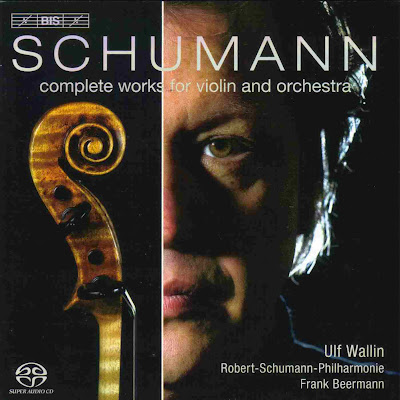
SCHUMANN 
Works for Violin & Orchestra
ULF WALLIN, Violin
Robert-Schumann-Philharmonic 
Franz Beerman
BIS SACD-1775 / ****1/2


Did Robert Schumann really compose three violin concertos, as this album has us believe? The one most listeners know of is the D minor concerto (1853), his last orchestral work. Suppressed by his widow Clara, it was not heard until 1937. It is a somewhat rambling 32-minute work with pleasant if not totally memorable themes, closing with a slow but stately polonaise-like finale. The only violin concertante work he heard in his lifetime was the Fantasy in C major (Op.131) of 1853, adopting the slow-fast two part form that displays both lyricism and virtuosity to equal degree.

The best music is however reserved for Schumann’s own violin version of his 1850 Cello Concerto in A minor (Op.129), premiered as recently as 1987. It is a bona fide original violin concerto, not to be confused with Shostakovich’s orchestration of the same work. With its own share of thrills and spills, one hardly misses the original cello solo itself. Swedish violinist Ulf Wallin extracts every last ounce of its bittersweet melodies, contrasting the emotional peaks and troughs with great alacrity. Well supported by the Chemnitz orchestra renamed after the composer, this is a persuasive case for an often overlooked genius.


ECHOES
Seattle Symphony / GERARD SCHWARZ
Naxos 8.559679 / ****1/2


The progress of modern music has mostly been in incremental steps, founded upon tried and tested past models. This anthology of new American orchestral works revisits older examples, seen and heard through the prism of time and changing musical tastes. At its simplest, Bright Sheng’s Black Swan is a lush transcription of Brahms’s Intermezzo in A major for piano (Op.118 No.2), with no new harmonies offered. Aaron Jay Kernis’s Musica Celestis is an amplification of a pre-existing movement from his own First String Quartet, having the same moving effect as works by Vaughan Williams and Barber.

Venturing further afield, David Stock’s Horn Of Plenty plays with motifs from Jeremiah Clarke’s popular Trumpet Voluntary before finally quoting the famous march it its entirety. David Schiff’s Infernal turns the Danse Infernal from Stravinsky’s Firebird into a brassy score in the style of B-grade pulp movie music. John Harbison’s Rubies is a fantasia on Thelonious Monk’s standard Ruby, My Dear, and the final result is a luxuriant wallow. Conductor Schwarz himself takes on Handel’s three concerto grosso movements for a Concerto for brass quintet, a virtuoso vehicle that is guaranteed to be heard regularly. Performed with polish and much spirit, this is recommended listening.

Monday, 25 January 2010

SSO Concert: Buried Treasure / Review

BURIED TREASURE
Singapore Symphony Orchestra
Esplanade Concert Hall
Friday (22 January 2010)

This review was published in The Straits Times on 25 January 2010.

This year marks the bicentenary of the German composer Robert Schumann (1810-1856), as good as any reason for the Singapore Symphony Orchestra to embark on a Schumann symphony cycle. Beginning with chronologically his last symphony, the “Rhenish” in E flat major, the orchestra generated an aura of pomp and majesty right from the outset.

Under the direction of the eminent American conductor Gerard Schwarz, it was easy to be swept away by the broad waves of sound that poured forth. But listening more attentively, one could discern a wealth of detail, not least in the intricate counterpoint weaved into the 2nd movement’s melody or the gentle rhythmic nuances of the intermezzo-like middle movement.

Most of all it was the force of personality of the music and interpretation that impressed. While Schumann’s musical vision of Cologne Cathedral in the slow movement was awe-inspiring, the performance captured the feeling of grandeur and magnificent antiquity, with sheer elation following in the closing pages.

The concert had however opened on a dour note, as Beethoven’s Coriolan Overture was taken at such a deliberate pace as to negate the drama arising from the opposing forces that tore the Roman general apart. Sustaining tension or attention became a tall order as the result.

No such fears surfaced for Shostakovich’s darkly-hewn First Violin Concerto in A minor (Op.99)from the young Belgian-Bulgarian violinist Yossif Ivanov (left). Just only 22, he has both the technical ability and depth of expression to transcend the 40-minute angst-laden score dedicated to the great David Oistrakh.

Projecting a bright, penetrating sound, he illuminated an unerring path through the ruminative Nocturne, and traded high jinks with various instrumental combinations in the Scherzo, a slalom on the razor’s edge with its ciphers and in-jokes. Ivanov came further into his own in the dead-serious Passacaglia, ripping fearlessly into its cadenza before the wild frenzied dance in the Klezmer-styled finale. His encore by Ysaye also proved one thing – here is a bona fide virtuoso equal to the best.

The fact that the concerto was suppressed by the composer for eight years was understandable. That and the discovery of precocious new talent in Ivanov probably go some way in the corny title of this concert: “Buried Treasure”. For classical concerts to be taken seriously, these kooky monikers and whoever is naming them, will just have to stop.

Sunday, 1 March 2009

CD Reviews (The Straits Times, February 2009)

BRITTEN Piano Concerto / Diversions
STEVEN OSBORNE, Piano
BBC Scottish Symphony / Ilan Volkov
Hyperion 67625 / Rating *****


Benjamin Britten’s works for solo piano and orchestra hail from his eclectic youth. Characterised by a vigour of one making his mark yet upholding well-worn traditions, this is very accessible music. The 4-movement Piano Concerto relives Prokofiev’s blend of lyricism and dissonance. Its revised 3rd movement, a passacaglia entitled Impromptu is its spiritual centre and best music, replacing a more diffuse Recitative and Aria, which has been helpfully included. Diversions (for piano left hand) was commissioned by Paul Wittgenstein (who inspired similar creations by Ravel and Prokofiev) and is a marvellously inventive set of variations, while the 7-minute-long Young Apollo is a brilliant fanfare with string accompaniment. Scottish pianist Steven Osborne is fully attuned to this vibrant idiom, and the luxuriant recorded sound supplants those of historic recordings with Sviatoslav Richter and Julius Katchen, conducted by the composer himself. No small feat.


HANS KRASA Brundibar
Northwest Boychoir
Music of Remembrance
GERARD SCHWARZ, Conductor
Naxos 8.570119 / *****


The music on this disc is a reminder lest we forget the evil than men do in the name of ideology or religion. The Czech composer Hans Krasa (1899-1944) was one of many Jewish artists who were murdered during the Second World War. His children’s opera Brundibar received 55 performances in Terezin, the sham “model” concentration camp the Germans built to fool the International Red Cross. Virtually all the performers in the original production died in Nazi gas chambers. The half-hour long opera centres around two children who attempt to buy milk for their ailing mother but are accosted by the villainous organ grinder Brundibar, whose moustache suggests a certain fascist dictator.

The music is highly melodic, simple and folk-like, with the light orchestration built around what instruments were available then. The revised English libretto by Tony Kushner is typically crafted for American audiences. The children and young adult performers in this production are excellent. This disc also includes Krasa’s jazzy Overture and Lori Laitman’s song cycle I Never Saw Another Butterfly for soprano and clarinet, based on children’s poetry from the Holocaust. All this makes for a poignant musical experience.

BRAHMS & JOACHIM Violin Concertos
CHRISTIAN TETZLAFF, Violin
Danish National Symphony Orchestra
THOMAS DAUSGAARD, Conductor
Virgin Classics 5021092 / Rating ****


This paring is a totally apt one as the Hungarian violin virtuoso Joseph Joachim (1831-1907) was one of Johannes Brahms’ closest friends, and for whom the latter’s great Violin Concerto (Op.77) was dedicated. To be completely honest, Joachim’s Concerto in the Hungarian Manner is not in the same class as the Brahms. Predating it by almost 18 years, it runs past the 40 minute mark without saying as much. Its idiom is conservative, in the same vein as Max Bruch’s creations, but makes up with its virtuosity and delicious Hungarian-styled finale. German violinist Christian Tetzlaff has the requisite technique to make the best case possible for the music. His Brahms is very good too, and if this combo piques your interest, go for it.

MUSIC FOR TWO PIANOS
MARTHA ARGERICH & FRIENDS
EMI Classics 2076232 (2 CDs)
Rating *****

For anyone who loves the piano’s sonorities and its orchestral possibilities, this budget-priced set is a no-brainer. One finds Argerich, the Amazon of the keyboard in inspired form partnering a host of talented younger colleagues. The first disc is an all-Russian affair; Rachmaninov’s coruscating Second Suite (with Gabriela Montero) is happily contrasted with his simpler Six Pieces for 4 hands (with Lilya Zilberstein) and Tchaikovsky’s Nutcracker Suite (with Mirabela Dina), transcribed by the late Nicolas Economou. Brahms dominates the second disc. The Sonata in F Minor (with Zilberstein again), better known in its piano quintet guise and the Haydn Variations (with Polina Leschchenko) sound almost as colourful on two pianos. The rarity is Rikuya Terashima’s arrangement of Prokofiev’s Classical Symphony, where Argerich and an equally driven Yefim Bronfman cook up a storm. One simply does not miss the orchestra here.