Showing posts with label Han Lei. Show all posts

Monday, 1 February 2016

RHAPSODIES OF SPRING 2016 / Singapore Chinese Orchestra / Review


RHAPSODIES OF SPRING 2016
Singapore Chinese Orchestra
The Star Theatre
Saturday (30 January 2016)

This review was published in The Straits Times on 1 February 2016

Rhapsodies Of Spring is the Singapore Chinese Orchestra's way of celebrating the Lunar New Year in concert, and for the first time it performed in the massive arena that is The Star Theatre. As with previous editions, the concert took on the form of a variety show, and who better to host it than well-known local television personality Marcus Chin (Chen Jian Bin), emcee of the popular Golden Age Talentime?

He and conductor Yeh Tsung displayed good chemistry in their playful banter in Mandarin, peppered with a few English phrases, which most centred around how busy they were and how young each other looked. There were no skits from radio personalities this year but more music, which began with Li Huan Zhi's Spring Festival Overture.


This familiar work was accompanied by visuals of the orchestra projected on a giant screen behind the stage, which focused on groups of soloists. This was soon overtaken by the entrance of the 9-member ZingO Festival Drum Group which raised a racket that was wholly appropriate for the occasion. Its synchronised drumming in Soar and Xu Chang Jun's Dragon Dance was an impressive show of precision and togetherness.


The first half was otherwise the Marcus Chin show, who had no less than four costume changes and enthralled the aunties with his crooning in the Nostalgic Song Medley (arranged by Tan Kah Yong) and Mix Match Song Medley (Phang Kok Jun). He does not have an operatic voice for songs like Man Chang Fei, Azaleas Bloom, Yue Qin and The Traveller With A Bamboo Pole, but his tenor comfortably scaled the heights with oodles of personality and some epileptic dancing.

The Chinese Folksong Medley curiously included a Russian song, Under The Shimmering Moonlight (but sung in Mandarin) and concluded with Radiant With Joy, rendered in an authentic Sichuan accent. Then the concert took on the feel of a typical episode from Saturday Night Live. With the lights dimmed, the main orchestra dispersed leaving behind the 16-strong SCO Pop Ensemble, which resembled and played like a jazz combo.


TV Golden Medley (arranged by Law Wai Lun) revived melodies like Striving (from the early local serial The Awakening), Good Morning, Sir! and  Kopi O. Suona Principal Jin Shi Yi had a field day with his assorted reeds in the Taiwanese song Tian Hei Hei, alternating between jazzy riffs and Donald Duck imitations. Not to be outdone was Han Lei on guanzi in Beijing jazz pianist Kong Hong Wei's Summer Palace, with a stirring display that brought on loud cheers.


The 2-hour concert concluded with bidding farewell to the Year of the Goat and ushering the Year of the Monkey. Wang Li Ping's Shepherd Song gave way to Xu Jing Qing's Gan Wen Lu Zai He Fang from Journey To The West, which saw Chin imitating the moves of Sun Wu Kong (Monkey God). Joined by four ladies in gaudy red, a motley Chinese version of Solid Gold Dancers, the glittery ensemble got the audience singing and clapping along to Sim Boon Yew's Spring Suite VI.

Has there been that many Chinese New Year songs in circulation? The Singapore Chinese Orchestra under Yeh Tsung has played them all. 


Monday, 7 September 2015

STRUMMING HEARTSTRINGS / Singapore Chinese Orchestra / Review


STRUMMING HEARTSTRINGS
Singapore Chinese Orchestra
Singapore Conference Hall
Saturday (5 September 2015)

This review was published in The Straits Times on 7 September 2015 with the title "From joy of horror to awakening".

On an evening that saw Matthias Goerne singing Schubert's Winterreise and Stephen Hough playing Beethoven piano concertos, the Singapore Chinese Orchestra had a full-house in a blockbuster concert of its own. It shared the stage with three soloists, including pre-eminent Scottish percussionist Dame Evelyn Glennie.


The concert conducted by SCO Music Director Yeh Tsung began with three works by Chinese composer Liu Chang Yuan. In the opening Carnival Dance (2013), Liu celebrated the universality of folk music through diverse sources of inspiration. The dizi and sheng melodies, in their pentatonic glory, shared something common with dances from the British Isles. The huqins then conjured a tune of Central Asian influence, while the slower central section flirted with the tango. The orchestra performed with its usual infectious enthusiasm. 


Receiving its World Premiere was Bright Moon Over The Ocean (2015), a concerto for guanzi commissioned by the SCO. An essay in nostalgia, the rhapsodic work portrayed the emotions of Chinese emigrants leaving their homeland for new pastures in Nanyang. Soloist Han Lei performed brilliantly with three instruments, traversing lament-like themes to animated dances of a more exotic kind. Somewhere he took a diversion into jazz rhythms, as if stumbling into Harlem, before returning to the more chromatic hustle-bustle of Shenton Way.


Arguably the best work of three was Dream Interpretation (2011), an erhu concerto with excellent soloist Yu Hong Mei. In ten linked sections, the erhu emoted with a panoply of moods and expressive devices. The dream began mysteriously, working its way through joy, happiness and  longing to the dissonance of fear and horror, before closing with a sublime awakening. More Straussian than Freudian, the creative metamorphosis of themes makes this work one that will bear multiple hearings.


The concert's second half was devoted to Canadian-Chinese composer Vincent Ho's The Shaman (2011), the percussion concerto that starred Glennie. Sporting waist-long silver locks, she looked the part of its eponymous title as she gracefully glided through her battery of percussion. Its three connected movements was a veritable playground for the barefoot virtuosa, with unpitched percussion (drums, cymbals, bowls and slung metallic strips) beating out complex rhythms, while vying for attention with the more intimate pitched instruments.


It was the quiet and contemplative 2nd movement Fantasia-Nostalgia which saw the marimba and vibraphone come to the fore with much melodic interest. Rapport with the orchestra was closely-knit, and she formed a tight yet sensitive alliance with orchestral timpanist Duan Fei and  pianist Clarence Lee. Exuding sheer exuberance, she easily won over an audience supposedly shy of contemporary music. Their vociferous support earned a well-deserved encore, Ho's Nostalgia, adapted from the concerto's slow movement. Bravissima!


Monday, 26 May 2014

A BRIEF DIARY OF SINGAPORE CHINESE ORCHESTRA'S CHINA TOUR: Part 2


Tourist sightseeing boats at Nanjing's Fuzimiao.

Day 4 (Monday, 19 May 2014)

We decamped and headed north for the old Nationalist capital city of Nanjing. The bus journey took the best part of four hours, but it all seemed a breeze with Jeremy Monteiro busy autographing CDs and nostalgically reliving his days on the road, and I getting briefed by SCO Productions Manager Lee Chun Seng on the orchestra’s history and distinctiveness. As the orchestra got set up at the Zijin Grand Theatre, I visited the tourist hotspot of Fuzimiao, a most picturesque locality where the Confucius Temple meets a branch of the Grand Canal.

Ming Xiao Ling; Mausoleum and final resting place
of the first Ming emperor Zhu Yuan Zhang.

Sun Yatsen's tomb on Zijinshan.

Day 5 (Tuesday, 20 May 2014)

Time for more sightseeing for me. Thus I headed for the verdant hills of Zijinshan, site of the Ming royal tombs and Sun Yatsen mausoleum. My feet ached from all the walking, but there was still some energy left to visit the spectacular Nanjing Museum.

Part of the Porcelain Gate
at the Nanjing Museum.

Erhu virtuoso Zhu Changyao
with the Singapore Chinese Orchestra.

The concert in Nanjing has a more folksy appeal than the contemporary offerings in the Shanghai gig. Appropriately, The Voyage from Law Wai Lun’s Admiral of the Seven Seas opens the evening. It was from the ancient capital of Nanjing that explorer Zheng He set on his maritime expeditions under the auspices of the Ming emperor Yong Le. Nanjing’s esteemed erhu exponent Zhu Changyao, Director of the Jiangsu Arts Centre, was the soloist in his own composition Midnight At The Maple Bridge. His tone and mastery was awe-inspiring in this mellow number, and he was joined by four SCO erhu players Zhu Lin, Zhou Ruo Yu, Shen Qin and Tao Kai Li (all Nanjing natives) in the medley Melodies of Yangzhou for a happy homecoming.    

SCO's guan principal Han Lei
in Zhao Jiping's Silk Road Fantasia.

Jeremy Monteiro and bassist Lee Khiang
in Kelly Tang's jazz piano concerto Montage.

Guan virtuoso Han Lei took centrestage in Zhao Jiping’s Silk Road Fantasia Suite, the three movements sounding ever more exotic in an already exotic evening of Chinese music. To round off, Jeremy Monteiro, bassist Lee Khiang and drummer Tama Goh returned for Kelly Tang’s Montage, which had a more liberated and free-wheeling quality this evening. Buoyed by the vociferous applause, the jazzman threw in his Soliloquy as an encore. Maestro Yeh’s two further encores were also big hit for the excitable and somewhat undisciplined audience. A few of its members were caught blatantly videotaping the concert. Talk about unabashed and unbridled enthusiasm!

Another video for Youtube!
Its legal if you don't get arrested!

Monday, 13 January 2014

RHAPSODIES OF SPRING 2014 / Singapore Chinese Orchestra / Review


RHAPSODIES OF SPRING 2014
Singapore Chinese Orchestra
Singapore Conference Hall
Friday (10 January 2014)

This review was published in The Straits Times on 13 January 2014 with the title "Festive start to spring".

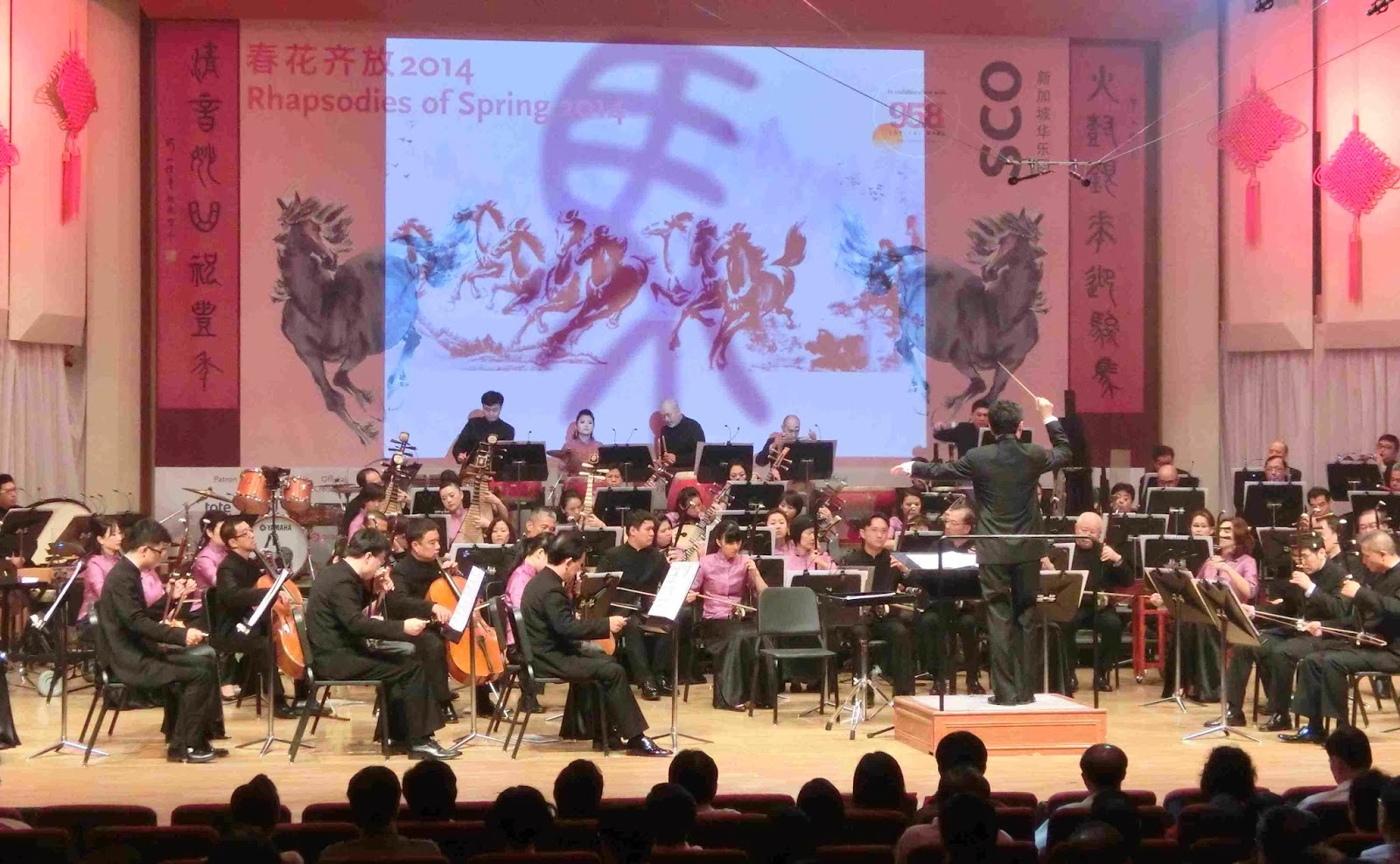
Chinese New Year is a dual celebration of the turn of the lunar calendar and the heralding of spring. Thus the Singapore Chinese Orchestra’s annual New Year Concerts conducted by its Music Director Yeh Tsung shares a similar festive spirit as the Singapore Symphony Orchestra’s Christmas Concerts, with the added flavour of a television variety show.


Li Huan Zhi’s Spring Festival Overture rowdily opened the concert, and before anyone could applaud, went directly into Huang Hai Huai’s Horse Racing. The familiar melody served to greet the Chinese zodiacal “Year of The Horse”, its stampeding hoof-beats and chorus of synchronised neighing providing marked contrasts with the gentle trot and amble of Leroy Anderson’s Horse and Buggy.


Then the show belonged to the disc jockeys of Capital 95.8, the popular Chinese language radio station, who acted out a skit The Swordsman Saga which brought legendary heroes and villains of wuxia or Chinese sword-fighting escapades into the mix. By some quirk of magic, the denizens of folklore arrived in modern-day Singapore and went on air with comical consequences. The accompanying music was arranged by Tan Kah Yong, with a segment quoting Prokofiev’s Montagues and Capulets from the ballet Romeo and Juliet.


The DJs also had a rap of their own, but the second half was distinguished by three soloists. Han Lei (above) demonstrated his versatility on the guanzi, the short reed instrument which revelled in folk-like slides in the Hebei melody Grazing The Burro and a saxophone’s revelry in the infectious Caribbean rhythm of Kong Hong Wei’s Summer Palace.


Vocalist Fan Qiong oozed sultriness and sensuality in the Mongolian folksong Swan Goose and Huang Yi Jun’s Misty Rain. In the latter, she was joined by violinist Qian Zhou whose lyrical obbligato part was equally alluring. There was a folksy lilt in Tang Ni’s The Story of Small Town and dazzling coloratura in the waltz-song Hai Yan (Swallow) by Chen Ge Xin, probably China’s answer to Johann Strauss’s Voices of Spring.


Unlike last month’s mass participation Messiah, this audience is not one for singing, so there was a clap-along instead for Sim Boon Yew’s Spring Festival Suite II, which contains the four most popular and overplayed Chinese New Year anthems of all. The DJs provided a makeshift unison choir, their contribution made all the apparent when soloist Fan finally joined the fray.


With the arrival of a costumed God of Wealth, an Oriental Santa Claus of sorts, their communal message was “Make Prosperous”. There could not be a more propitious Chinese greeting than that. 
 

Concert photographs by the kind courtesy of the Singapore Chinese Orchestra.

Sunday, 4 September 2011

A GLIMPSE OF SINGAPORE / Singapore Chinese Orchestra / Review


A GLIMPSE OF SINGAPORE
Singapore Chinese Orchestra
SCO Concert Hall
Saturday (3 September 2011)


This review was published in The Straits Times on 5 September 2011 with the title "Capturing Geylang Serai through Nanjing Lu".


It is perhaps the very nature of Chinese music to be programmatic or narrative in character. Absolute music or manifestations of the abstract in music are much less encountered, so concerts of programme or descriptive music, such as this, are very much in the norm. Even the title A Glimpse Of Singapore gave a clue that musical travelogue was taking place.

Two movements of Gu Guan Ren’s titular suite on his 1987 visit to the Lion City opened the concert. The Beach had evocative dizi and erhu solos which suggested he had not yet left China, but the raucous percussion parade and Malay-flavoured melodies heard on strummed ruan and sheng made it clear that The Festival was captured somewhere in Kampong Glam or Geylang Serai.

Even the two virtuoso concertos played were inspired by scenery, folklore and legends. Li Bin Yang’s Mountain Deity elaborated on indigenous themes and rhythms, with Han Lei’s guan solo rising above the teeming throng to resonate like a heady saxophone in those Basque fantasies favoured by French composers. His range on the humble reed instrument was astonishing.

Xu Chang Jun’s The Phoenix was equally enthralling, almost a yangqin concerto that Bela Bartok never wrote. The Chinese dulcimer, an Eastern relative of the Hungarian cimbalom, is capable of extremes in dynamics, from soothing placidity to vehement violence, which Qu Jian Qing provided with an extravagance of flair.


Former SCO Deputy Director Qu Chun Quan (left) also conducted two of his own creations, a transcription of the traditional folk tune Dancing In Gossamer and the kitschy Shanghai Capriccio. The latter was eclecticism gone overboard, with Chinese melodies strung on the torso of Gershwin’s An American In Paris and a percussion sequence straight out of Britten’s Young Person’s To The Orchestra. Just remove the taxi horns and substitute the Champs-Elysee with Nanjing Lu, and one gets the idea.

The longest and best work was Rao Yu Yan’s Hymn Of Li Mountain, a symphonic poem inspired by Tang Dynasty poet Tu Fu’s lament. Its four connected segments detailed the poet’s weary climb, his witnessing of a feast of wanton waste – represented by a dance that grows progressively intoxicated – and closing with an orchestral sigh of anguish and resignation. Music can tell stories, and the Chinese orchestra does it most eloquently.

Monday, 8 November 2010

SINGAPORE SUN FESTIVAL 2010: SILK ROAD ODYSSEY / Review

SINGAPORE SUN FESTIVAL 2010
Silk Road Odyssey
Singapore Chinese Orchestra
Esplanade Concert Hall
Saturday (6 November 2010)


This review was published in The Straits Times on 8 November 2010.

At the closing gala of the Singapore Sun Festival, the Singapore Chinese Orchestra led by Yeh Tsung performed a typically East Meets West programme. Bartok’s Romanian Dances opened on a spirited high. Folk music translates well for Chinese instrumentation, with the ruan, dizi and erhu sounding totally idiomatic in their solo passages.

Moving eastward, Zhao Jiping’s Silk Road Fantasia Suite featured an unusual collaboration with Chinese sand artist Ruan Yun Ting, whose work was projected on screen in real-time. From a blizzard of sand, images of a distant fort, gnarled trees, wind-beaten paths and a camel caravan soon came into view.

With gently sprinkles, broad finger strokes and sweep of the hand, visions came and went. A peacock’s plumage was transformed into dancing dervishes, accompanied by music of Central Asian flavour and Han Lei’s superb guanzi, alternating between sounding like a saxophone and Klezmer clarinet.

Less successful was the partnership with young Korean-American violinist Rachel Lee. Despite perfect intonation, her violin projected a small sound, barely registering above the orchestra for Vivaldi’s Spring from The Four Seasons and Saint-Saens’ Introduction & Rondo Capriccioso. The arrangements did not add anything new, although an erhu soloist would have been far more interesting.
A masterstroke of programming paired a Chinese pipa concerto with a Spanish guitar concerto. Tang Jian Ping’s Spring and Autumn was arguably the more interesting work. Percussion outbursts and the pipa’s stormy entry indicated that this was not about the seasons but a turbulent period of Chinese history (Chun Qiu Shi Dai).

Both violent and meditative in turn, SCO Principal Yu Jia’s pipa played both agent provocateur and peaceable mediator, baiting and calming the orchestra at every turn of this colourfully scored masterpiece. It was a pity that the audience was so parsimonious with its applause that it abruptly ended before soloist and conductor left the stage.

More fortunate was Montenegrin guitarist Milos Karadaglic who starred in Joaquin Rodrigo’s popular Concierto de Aranjuez. Sympathetically accompanied, one did not miss the western orchestra and the famous slow movement’s cor anglais solo, now played by the organ-like blown sheng. His complete mastery of the instrument was rewarded with one curtain call and one encore in Tarrega’s Lagrima.

Audiences for Chinese orchestral music could learn to applaud more unreservedly. The artists on stage deserve to know that they are being appreciated.