Tuesday, 23 December 2025
MOZART'S THE MAGIC FLUTE / Singapore Lyric Opera / Review
Wednesday, 21 December 2022
JOHANN STRAUSS JR'S DIE FLEDERMAUS / Singapore Lyric Opera / Review
JOHANN STRAUSS JR’S
DIE FLEDERMAUS
Singapore Lyric Opera
Esplanade Theatre
Saturday 17 December 2022
This review was published in The Straits Times on 21 December 2022 with the title "Soprano Joyce Lee Tung steals show in Singapore Lyric Opera's Die Fledermaus".
This is the season for uncorking champagne bottles and what could be more appropriate than another airing of Johann Strauss the Younger’s evergreen and bubbly-induced operetta Die Fledermaus? Singapore Lyric Opera’s most recent crack at this hoary old chestnut had much to recommend, reminding one and all why we love the festive season plus a few good jokes or two.
Directed by Tang Xinxin and accompanied by the SLO Orchestra conducted by Joshua Tan, an ebullient Overture presenting all the memorable melodies got the show off to a good start. The operetta’s comedic plot was one of mischievous vengeance and the usual farce of mistaken identity, culminating in a New Year’s Eve ball at Prince Orlofsky’s.
All three members of the Eisenstein’s dysfunctional household contrive to attend the high society event with assumed foreign identities, and the deceptions with predictable misunderstandings inevitably take place. Tenor Jonathan Charles Tay’s Eisenstein and soprano Shimona Rose’s Rosalinde were splendid antagonistic twin pillars of the action, their repartee effected under disguise being a very funny aspect of the story.
![]() |
| Eisenstein becomes Marquis de Renard while Rosalinde becomes the Hungarian countess at Orlofsky's ball. |
They were, however, upstaged by soprano Joyce Lee Tung stealing the show as their housemaid Adele, who has aspirations as an actress. Adele’s Laughing Song (Mein Herr Marquis) in the second act acted like the pivot around which all action was built. She nailed the role with striking aplomb.
![]() |
| Adele becomes transformed into a budding actress at Orlofsky's ball. |
The threesome was well supported by baritone Martin Ng (as Falke, who hatched the plot of revenge against Eisenstein), tenor Kee Loi Seng (Alfred, Rosalinde’s hopeful paramour), baritone William Lim (Frank, conniving prison governor) and tenor Leslie Tay (Blind, hapless attorney), the last who could not resist cross-dressing again, this time as a very unvoluptuous Wonder Woman. Ironically, the usual cross-dressing role of Prince Orlofsky, usually by a mezzo-soprano, was instead sung pretty convincingly by countertenor Chan Wei En.
While the First Act, set at the Eisenstein’s domicile, dragged somewhat, everything came to life in the glittering Second Act, with cast, SLO Chorus and dancers at full tilt. Here the operetta’s dizzy heart flowed unabated without contrived and time-consuming setpieces. The blazing Unter Donner und Blitzen (Under Thunder and Lightning) Polka was danced to animated choreography by Andy Benjamin Cai.
Leading into the Third Act saw the non-singing role of inebriated prison attendant Frosch portrayed by Alaric Tay (of The Noose fame). Ten minutes of stand-up comedy was just about right, with references to past inmates being incarcerated for refusing to wear face-masks, and the ongoing football World Cup, particularly the Messi state the gaol was in.
The deliberately uncredited set design was simple and effective, incorporating Wiener Werkstatte (Vienna Workshop) elements into light fixtures and furniture – a nice touch. Overall, this was both a stylish and enjoyable production which reflects the typically excellent yet underrated work undertaken by Singapore’s premier opera company, which labours under a chronic lack of capital. May the coming year ahead see a continuation of similar high standards.
Wednesday, 23 November 2022
TSUNG YEH 20 / Singapore Chinese Orchestra / Review
TSUNG YEH 20
Singapore Chinese Orchestra
Singapore Conference Hall
Saturday (19 November 2022)
This review was published in The Straits Times on 23 November 2022 with the title "Yeh Tsung leads superbly honed charges".
Twenty years may be considered a relatively short stretch of time, but what Yeh Tsung has accomplished with the Singapore Chinese Orchestra as its Music Director since 2002 has been little short of awe-inspiring. During his tenure, he commissioned many new works for the medium of massed traditional Chinese instruments, including establishing a musical genre incorporating Southeast Asian elements now known as Nanyang music.
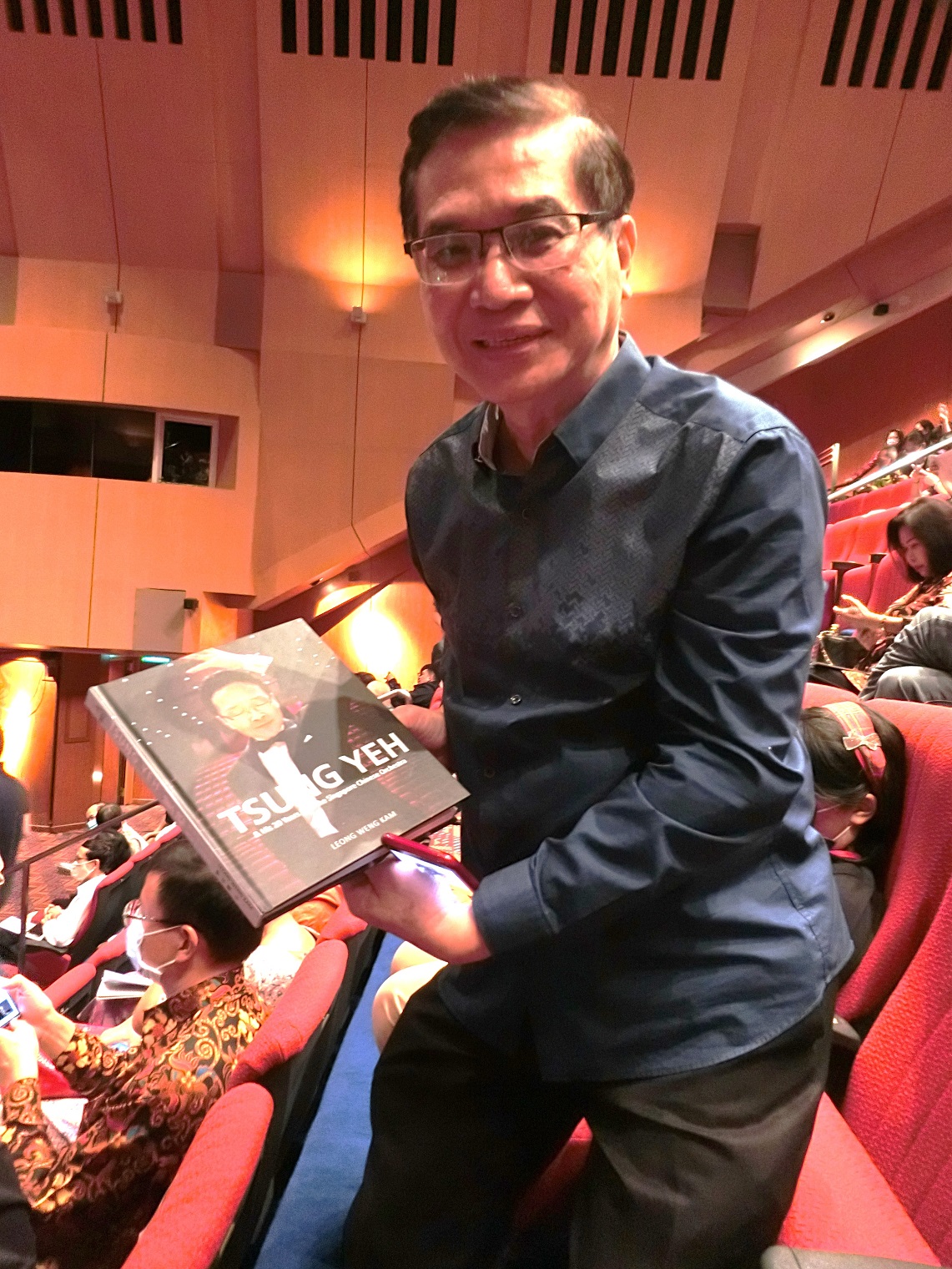
The official launch of the
Tsung Yeh 20 commemorative book.
This concert, commemorating his 20th anniversary at SCO’s helm, had a maritime theme which relived landmark works from his first ten years. Central to its narrative were two explorers of historical times, Zheng He (Cheng Ho) and Marco Polo, alluding to Yeh’s role as an intrepid discoverer of new pathways in Chinese music.
Former SCO Composer-in-Residence Eric Watson’s Sea – The Source of Life, written for the 2007 National Day Parade opened the concert. Its quiet beginning was a beautiful evocation of dawn, leading to a faster section filled with dance rhythms reflecting different cultures and ethnicities. The lively music declared that the sea belonged to everybody, and this feel-good number made for a rousing prelude.
Next were three movements from another former Composer-in-Residence Law Wai Lun’s Zheng He - Admiral Of The Seven Seas, a large-scaled work commissioned for the 2005 Singapore Arts Festival. Its imposing opening, Sea Burial, led by plangent winds and percussion, saw the Hand of Fate deal the Ming dynasty commander an untimely demise. With SYC Ensemble Singers (Chong Wai Lun, Chorus Master) at full tilt, the echoes of O Fortuna from Carl Orff’s Carmina Burana seemed almost appropriate even if the latter had more to do with itinerant Bavarian monks.
For this cantata, there were a key roles for narrator Jeffrey Low and tenor Zhuang Jie, and a cameo for soprano Joyce Lee Tung, who were excellent in fleshing out the romance of Zheng’s humble origins. The Voyage was the performance’s most colourful segment, a quasi-Wagnerian sojourn from Orient to Middle East, a picturesque seascape with birdsong later culminating in a rhapsody of Arabian dance movements. Here the imaginative scoring revealed Chinese orchestral instruments at their fullest potential.
The concert’s second half comprised three movements from Liu Yuan’s Marco Polo and Princess Blue, composed for the Esplanade Opening Festival in 2002. Featuring similar forces and projecting as big sonorities as Zheng He, this was unfortunately the most derivative work of all.
Its story centred on a fictional romance between Venetian explorer Marco Polo and the Kokachin Princess Buluhan, as he escorted the royal from Cathay by sea to her prospective marriage in Persia. As Providence has it, when they reach Eden in the East (guess where?), love blossoms. With every exposure, this music becomes increasingly cringeworthy and embarrassing.
The supposed love music with Italianate flavour (Neapolitan to be said) builds up inexorably, reaching a grand apotheosis with none other than the 1960s song Singapura (Oh Singapura, Sunny Island Set In The Sea)! Its grandiose Mahlerian ending, magnificently delivered by all on stage, nevertheless elicited a standing ovation. Hopefully this was for Maestro Yeh and his superbly honed charges, rather than the music.
| Leong Weng Kam, author of the Tsung Yeh 20 commemorative book. |
Friday, 6 May 2022
LOST DREAMS / Wayfarer Sinfonietta / Review
LOST DREAMS:
MUSIC OF WEBERN, BERG & STRAUSS
Wayfarer Sinfonietta
Victoria Concert Hall
Sunday (3 May 2022)
The Wayfarer Sinfonietta is a chamber orchestra of young professional musicians formed last year by Singaporean conductor Lien Boon Hua. It has been very active, partnering local singers in concerts and opera productions including recent performances of Andre Previn’s Penelope, Benjamin Britten’s Les Illuminations and Rossini’s L’Inganno Felice. Its forte is late Romantic repertoire and 20th century music, evident in its debut with Mahler’s Lieder eines Fahrenden Gesellen (Songs of the Wayfarer) and its most recent concert.
![]() |
| Photo: Moonrise Studio |
The music of the Second Viennese School dominated the concert’s first half, opening with Anton Webern’s Passacaglia Op.1 arranged by Huang Dingchao. This still-tonal work by music’s most notorious serialist was the direct continuation from the passacaglia finale of Brahms’ Fourth Symphony. Had Brahms lived another 11 years, he might have heard it and possibly approved. Played by just 14 musicians (7 strings, 5 winds, piano and percussion), the performance was characterised by clarity and leanness of textures, allowing many individual passages to stand out. Very satisfying.
This brave new world, reliving the austere pioneering spirit of Arnold Schoenberg’s Society for Private Performances in post-war Vienna, continued with Alban Berg’s Seven Early Songs (arr. Paul Leonard Schaffer) sung by soprano Joyce Lee Tung. These short songs (none longer than a few minutes each) carry on from the Lieder of Mahler and Richard Strauss, coming close to breaching the limits of tonality but not crossing the line. Lee’s idiomatic German (texts by Lenau, Rilke, Storm and others), accurate intonation and vocal lustre brought an alluring sensuality to the music.
![]() |
| Photo: Moonrise Studio |
The Richard Strauss half of the concert saw the Sextet and Mondscheinmusik (Moonlight Music, arr. Lee Jinjun) from Capriccio sandwich the scene and duet Ich Danke, Fraulein from Act 1 of Arabella (arr. Jonathan Shin). The operatic roles of two sisters were helmed by Lee (Zdenka) and soprano Teng Xiang Ting (Arabella), in a semi-staged affair (with a large sofa placed front and centre) directed by Tang Xinxin. The chemistry was developed between both singers was palpable, and one unfamiliar with opera’s plot might have suspected a hint of homoeroticism. Transliterations of texts in English were provided in the digital programme (but not a sypnosis), which is why programme notes are so important in relaying the contexts for every opera.
![]() |
| Photo: Moonrise Studio |
The highlight of the evening was the Four Last Songs (arr. James Ledger), sung by Teng. It would seem that Xiang Ting was born to sing this music, its dark autumnal hues eminently suited for her velvety smooth voice. And she knows how to emote the trials of ageing convincingly and with emotional heft. I remember some years ago hearing one young soprano (now better known as a pop and media star in a neighbouring country) singing these in a concert when she was barely ready for its deep emotional content.
The sequence of the songs was that of its 1950 London premiere by Kirsten Flagstad and conducted by Wilhelm Furtwangler, opening with Beim Schlafengehn (When Falling Asleep), supported by concertmaster Edward Tan’s sublime violin solo, followed by the rapturous September. The darker tones of Fruhling (Spring) would give way to the final song Im Abendrot (At Sunset), literally Strauss’ farewell to life itself. Its last line Ist dies etwa der Tod? (Is this perhaps Death?), poignantly voiced by Teng, alongside Strauss’ own theme from his early tone poem Death and Transfiguration showed that music did come a full circle for the German composer.
| Photo: PianoManiac |
It was curious to note that as the works traversed chronologically from 1908 (Webern and Berg) to 1948 (Strauss), the music got progressively more tonal and less dissonant. Such are the pendulum swings of musical trends, where the radicals Berg and Webern (and their guru Schoenberg) could harmoniously co-exist with arch-Romantics like Strauss and Korngold. That a group like the Wayfarer Sinfonietta and Lien Boon Hua would explore this interesting segment of 20th century music really makes concert-going even more exciting these days.
| Photo: PianoManiac |
Wednesday, 9 March 2022
ROSSINI'S L'INGANNO FELICE / Lirica Arts / Review
ROSSINI’S L’INGANNO FELICE
Lirica Arts
Lee Foundation Theatre
Nanyang Academy of Fine Arts
Saturday (5 March 2022)
An edited version of this review was published in The Straits Times on 9 March 2022 with the title "Italian opera sparkles in classical Chinese setting".
It is not a well-known fact that only one of Gioachino Rossini’s 39 operas, The Barber Of Seville, had received performances in Singapore. That all changed when the great Italian composer’s L’Inganno Felice (The Blissful Deception) got its Singapore premiere, a debut outing for newly-formed opera company Lirica Arts.
This 1812 single-act opera was once very popular but later neglected because of its origins as a farsa (or farce), a semi-serious piece that fell between the cracks of comic opera and grand opera. Running at around eighty minutes and involving a small cast of five singers, it was not taken seriously by major opera companies. It is, however, well-suited as a pandemic opera with transmission risks minimised by the chamber forces employed.
Its plot is relatively simple and almost farcical. Isabella (soprano Joyce Lee Tung) is an abandoned wife wrongly accused of infidelity, framed by the villainous Ormondo (baritone William Lim) whose advances she had earlier spurned. Her husband Duke Bertrando (tenor Jonathan Charles Tay) thinks she is dead but having been rescued by Tarabotto (baritone David Tao), she now assumes the role of Tarabotto’s niece. The opera’s action kicks off when Isabella and Bertrando get reunited by chance.
The 20-year-old Rossini’s music provided an early example of the bel canto style, characterised by sumptuous melodic lines dressed with florid ornamentations. In that respect, Lee was an ideal exponent. Her vocal capabilities, established from the opening aria on her lamentable fate, was matched by more than credible acting.
Her highly sympathetic role also stood shoulder to shoulder with four male characters. Tay’s bright and wide-eyed demeanour contrasted well with Tao’s more buffo (comedic) character, both a foil for stage veteran Lim’s menacing malevolence and reluctant henchman Batone (baritone Martin Ng). There were simply no weak links among the five singers.
Director Tang Xinxin’s had moved the setting of the opera from Italy to ancient China, with Dorothy Png’s simple yet effective set and lighting design evoking a garden villa in Suzhou. There was a brief scene where shadows of the reunited lovers were projected, making for a classically Chinese picture-perfect silhouette.
Isabella was the only character donning full Chinese opera make-up, contrasted with the men’s partial face paint, indicating her to be the most fleshed-out character of all. The silk brocades also made a stunning impact, with a possible nod to current global events. It could not be total coincidence that the good guys (and victims) were dressed in combinations of blue and yellow, while the baddies in black had red trimmings.
Accompanying music was provided by the Wayfarer Sinfonietta conducted by Lien Boon Hua, opening with a typically witty overture and sensitively partnering the singers throughout. Despite some foursquare musical sequences, the generally upbeat tone of the proceedings was a hit with the full-house and no longer socially-distanced audience. Their chorus of approval deemed Lirica Arts’ maiden production to be a roaring success.