Showing posts with label Ning Feng. Show all posts

Friday, 17 January 2025

SINGAPORE INTERNATIONAL PIANO COMPETITION 2025: SEMI-FINALS SESSION I


SEMI-FINAL ROUND 
Session I (Thursday, 16 January 2025) 

Because of my work schedule, I got to catch just two of six semi-finalists, and even for that, I had to leave work early. Each of the pianists would perform a solo recital followed by a violin sonata and encore with Chinese violinist Ning Feng. Getting to hear Cesar Franck’s sublime Violin Sonata in A major twice in a single sitting is the stuff of dreams. So no regrets. 


Tiankun Ma (17, China) had earlier impressed in Chopin’s 24 Preludes (Op.28), so there was lots to expect from him in a recital of three sonatas. His Haydn Sonata in C major (Hob.XVI:48) began deliberately but was clear and clean cut in his articulation. The finale had both wit and humour. In Chopin’s Funeral March Sonata in B flat minor (Op.35), described as “his four wildest children under the same roof”, was a combination of vehemence and lyricism. His thunderous response in the first two movements was balanced by the eponymous Funeral March’s gravity and the central section’s stark beauty before the whirlwind of its mysterious finale. 


His view of Prokofiev’s Sonata No.7 in B flat major (Op.83) was one of extreme percussive violence, but he seemed to know what inquieto (disquiet) meant, which was to get under one’s skin. The famous Precipitato finale began steadily but built up a head of steam before finishing strongly. 


Good as his solo recital was, his inexperience showed in the Franck Sonata, where he gelled mostly with the highly experienced Ning Feng but had flubs in the second and fourth movements. It was a rough and ready reading and in the encore, Kreisler’s Liebesleid, his preening and prancing to the waltz rhythm was exaggerated and distracting. Is he accompanying the violinist, or the other way round? 


Leyu Xu (16, China) continued to impress in her solo recital. Mozart’s Sonata in D major (K.311) received a very bright and vibrant performance, which seemed to exhibit Romantic era sensibilities but without its excesses. The touching slow movement wore its heart on the sleeve, while the deceptively difficult Rondo seemed like putty in her hands. In Chopin’s skittish Scherzo No.4 in E major (Op.54), she brought out its elusive wit which is often a closed book to far older players. 


Most impressive, however, was her reading of Henri Dutilleux’s Sonata Op.1 which has to be heard to be believed. The jazz-inflected pages of its first movement flashed through effortlessly, the central Lied an oasis of beatific calm before the Choral et Variations provided the icing on the cake. Pianists double or triple her age will envy the seeming facility of her assured performance. 


Age did not seem an impediment to her performance of the Franck Sonata with Ning Feng. When Ma had earlier struggled, her more organic reading seemed a breeze as she and Ning blended far more naturally. This was a total treat and Elgar’s Salut d’Amour became a most fitting encore with she being the perfect accompanist. Even without hearing the other four pianists, I am convinced she will be one of the finalists.


Watch the semi-final session here.
And more here:


Wednesday, 28 September 2022

STRINGS FANTASY / Singapore Chinese Orchestra / Review


STRINGS FANTASY

Singapore Chinese Orchestra

Singapore Conference Hall

Saturday (24 September 2022)


This review was published in The Straits Times on 28 September 2022 with the title "Night of scintillating strings".


The sound of strings is one of the most evocative sensations known to the human ear. Those who attended the Singapore Symphony Orchestra’s screenings of Alfred Hitchcock’s horror movie Psycho will know exactly what fear feels like by just listening. The Singapore Chinese Orchestra’s latest string concert led by Yeh Tsung did quite the opposite, with sounds that soothed, entertained and excited.


All that, of course, depends on the repertoire performed, and Liu Changyuan’s Memories, opening the concert, did all the these. Conceived in two parts, Warm Memories was a gentle dance with string pizzicatos accompanying melodic lines, while Passionate Memories upped the ante with perpetual motion from the gaohus. Then it went for broke with an abrupt shift to dissonance, harmonics and high pitches, as if to shock one’s innermost emotions. Somehow, violent and tumultuous memories seem to stick most in the mind.


Chinese composer Zhao Jiping, well-known for his movie scores for Farewell, My Concubine and Raise The Red Lantern, was represented by two string concertos. His Violin Concerto No.1 received its premiere in 2017 in Beijing by Chinese violinist Ning Feng, who brought warmth and lyricism to the proceedings. More like a single-movement symphonic poem with violin so, his job involved engaging the orchestra in intimate conversation at its outset, before letting it rip with virtuosic exercises and a recurring big melody.


Resembling the best of film music, the rhapsodic score had moments of tear-jerking melodrama, the obligatory fugal passages and a riproaring cadenza. That big tune first introduced by the guan and accompanied by harp did what was intended, to bring down the house at its apotheosis. Ning’s encore of Massenet’s Meditation from Thais, accompanied by huqins and harp, was a heart-warmer as well.


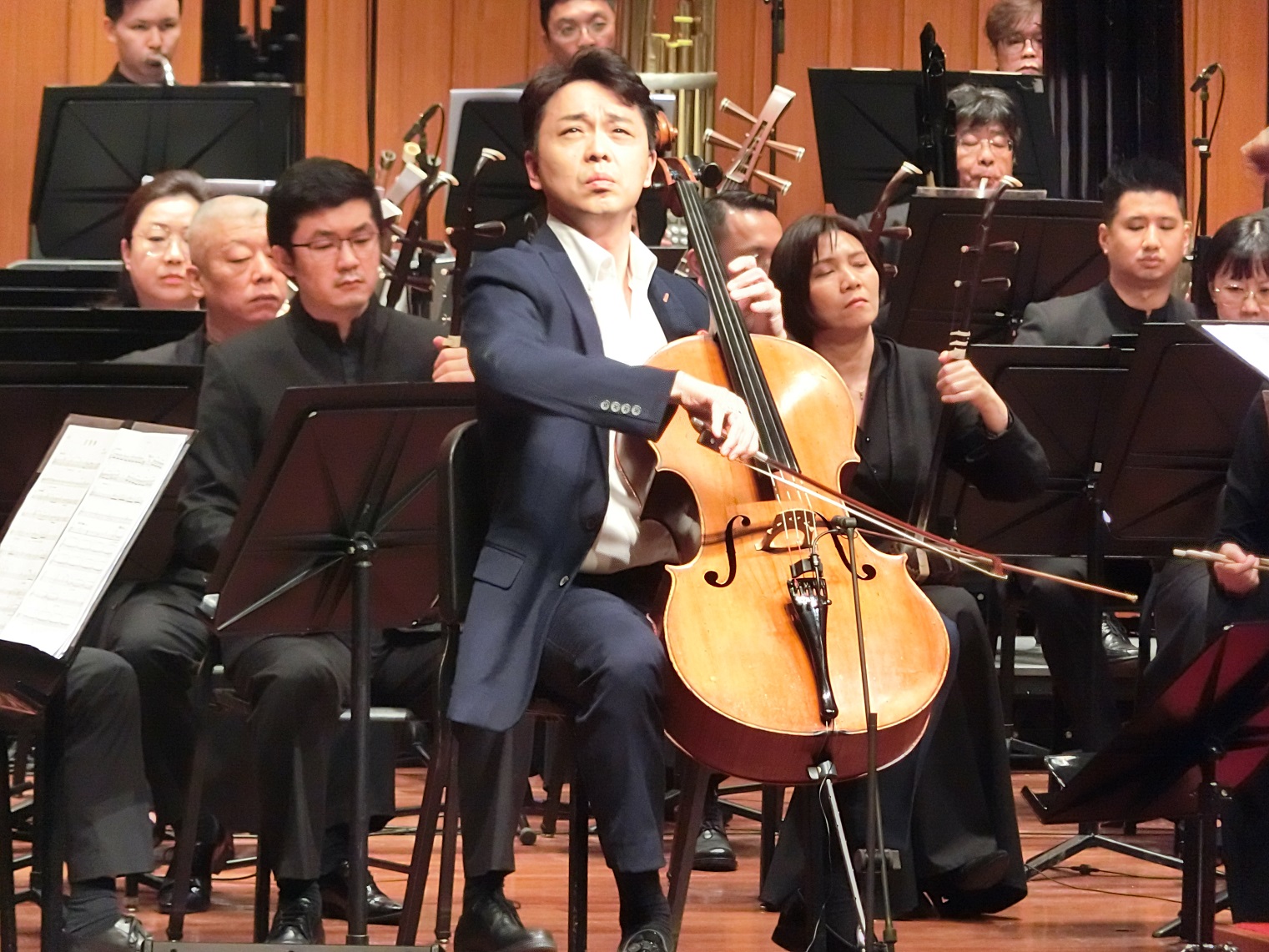
Zhao’s Zhuang Zhou’s Dream was the more subtle concertante work, its long-breathed lyrical lines well suited to Australian-Chinese cellist Qin Li-Wei’s glorious tone production. World weariness was worn heart-on-sleeve, the elegiac mood enhanced by the use of temple bell, singing bowl and drumming. The music did go into full battle mode before retiring to a serene close which embraced tenets of Taoist philosophy. Qin also had an encore of his own: Saint-Saens’ The Swan from Carnival of the Animals accompanied by harpist Nigel Foo.


One would have totally loved to see both Ning and Qin in some sort of double concerto but instead, the audience was treated to Law Wai Lun’s cantata The Celestial Web in its version for chorus and orchestra. Using verses by Tan Swie Hian, this was a paean to universal brotherhood (including sentient and non-sentient beings), a nod to Schiller and Beethoven’s Ode To Joy.


Even its opening in D minor had an obvious debt to the German, but beyond that the music was unremittingly  colourful and joyous, abetted in large part by the well-drilled SYC Ensemble Singers (Chorusmaster: Chong Wai Lun) which sang in Mandarin. It made for a satisfying end to an evening otherwise dominated by strings.


Thursday, 4 May 2017

HONG KONG PHILHARMONIC ORCHESTRA / Review


HONG KONG PHILHARMONIC ORCHESTRA
Esplanade Concert Hall
Monday (1 May 2017)

The Hong Kong Philharmonic Orchestra's third visit to Singapore (the previous occasions were in 1983 and 1999) was part of its tour to mark the 20th anniversary of the former Crown Colony's return to China, where it retains a Special Administrative Region status. The orchestra turned professional in 1973-74, and thus has a five year head start over the Singapore Symphony Orchestra. 

We Singaporeans have a sort of unspoken rivalry with Hongkongers over such things as economy, standard of living, food and shopping, and whether we have a world-class transport system (they do, we don't) et cetera.  In a way, this rivalry even extends to our orchestras, and here was a chance for Hong Kong to parade its musical crown jewel for the first time at the Esplanade.

By the way, Hong Kong's own Cultural Centre in Tsim Sha Tsui, home of the HKPO, came up during the early 1980s, thus establishing yet another head start (this time of some 20 years) over Singapore. Let's not even discuss about international piano competitions, of which HK has held four editions since 2005, to our big fat zero (OK, we do have one really good international violin competition, but just one edition so far). One thing which Singapore does not have, and which the City of New York would soon gain, in 2018 is the HKPO Music Director Jaap van Zweden. He was what made the difference between the HKPO of today and the orchestra that was last heard at Victoria Concert Hall in 1999.


The Esplanade Concert Hall has flattering acoustics but that was not what that made the first work of the HKPO's concert resound with a glittering sheen and glow. Hong Kong composer Fung Lam's Quintessence, composed in 2014 for the orchestra's 40th anniversary, was not one of those atonal nightmares which modern orchestras trot out on occasion and pretend to delight in.

A 10-minute single-movement concerto for orchestra, it provided a display of what each section could achieve – seperately and together - in the most virtuosic manner possible. There were extremes in dynamics, such as high-pitched strings and tingling percussion pitted against growling basses, answered with brassy interjections and chorales. Cor anglais, flute and muted trumpets all had their moments. Never static and always eventful, it kept the ears (and the performers) fully engaged through the mounting tension to its abrupt close.


That was a palate cleanser that led uncharacteristically to Mozart's Violin Concerto No.4, not a typical concert showpiece, which saw a welcome return of Sichuan violinist Ning Feng, former winner of the Paganini International Violin Competition in Genoa. The pared-down forces provided exquisitely sensitive accompaniment to Feng, who wisely chose not to flex his Paganinian prowess, but played along like a consummate chamber musician. He joined the orchestra's strings in the tuttis, and soon beautifully carved a path in his solo role, which was tasteful and fully in the spirit of the music.


His tone was sweet, but never cloying or overpowering. Only in the solo cadenzas did a sense of romanticism come into the picture, but that was never overdone. The slow movement was a delight, the restraint coming naturally rather than forced, and the Rondo finale another show of grace and courtliness, with no little prettiness in the execution. The fire-breathing aspect of Feng's musicianship came in the encore, where he obliged in Paganini's Caprice No.7 in A minor, which was simply dazzling. There seemed to be a palpable sense of relief that his natural instinct of showmanship had not gone unexploited.   

The main work was Mahler's First Symphony, just performed by the Singapore Symphony Orchestra (conducted by Robert Spano) at the same venue just less than two weeks ago. Unfortunately, I was not present and thus no basis of comparison could be made. While the SSO's show was said to be attended by a small house, it was filled to the rafters (including gallery seats sold) for the Hongkongers. They could not possibly disappoint.


Conductor Jaap van Zweden is not a big man by physical stature, and he has an Alberich-like stoop that appears ungainly at first, but in everything else he bestrode the podium like the titan of the symphony's title. The orchestra responded magnificently, with the softest hush in the symphony's opening, a rapt depiction of dawn which gradually unfurled with the nascent sun's rays beaming in. Offstage trumpets were excellent, and so it gradually led to the wayfarer's song of the movement proper. It is the attention to detail, rather than the volume of sound expended, which made this performance something touching and memorable.

The striding Ländler of the second movement was taken at a good lick, and here there was no fear of sounding rustic. All too often, the need to come across as immaculate and polished gets in the way of the heart of the music, but there was no fear of this here. Similarly, in the third movement's Funeral March, the klezmer-like episodes were more unbuttoned, preferable to the spick and span of Rattle's Berlin forces in their view of the same symphony here in 2010.


If one wanted to be swept away by the finale's fury, then consider wish granted. Two taps of the drum led directly into the tumultuous “cry of the wounded heart”, which was as passionate as one could have hoped for. The brass was on top form, not least the 8 French horns and associates who raised their bells at the final stand for a grandstanding finish. That was not all in this 20-minute long movement which had its share of reflective moments, and it were in these that Zweden brought out playing of the greatest definition. When themes for earlier movements were relived, the palpable sense of nostalgia was all pervasive, making the symphony's final triumph all the more poignant.

The standing ovation was overwhelming and spontaneous on the first curtain call, with individuals and sections of the orchestra taking their bows. And the encore, the Ride of the Valkyries from Wagner's Die Walküre, brilliantly delivered, was yet another subtle (or maybe not too subtle) reminder of something that Singapore has yet to accomplish – to mount its own Ring Cycle.

The Hong Kong Philharmonic is a class act, and a repeat visit with Jaap van Zweden is imperative. 


All photographs courtesy of 
Esplanade - Theatres on the Bay.

Thursday, 27 April 2017

EXPERIENCE ONE OF ASIA'S GREAT ORCHESTRAS "LIVE" - THE HONG KONG PHILHARMONIC ORCHESTRA


Photo by Cheung Chi Wai,
Courtesy of Esplanade - Theatres On The Bay

THE HONG KONG 
PHILHARMONIC ORCHESTRA 

Experience one of Asia's great orchestras perform at Esplanade Concert Hall on 1 May 2017. The Hong Kong Philharmonic Orchestra led by its Music Director Jaap van Zweden performs for one night only in its Esplanade Concert Hall debut.

The Hong Kong Philharmonic, formed in the 1970s during the British colonial era, has previously performed in Singapore in concerts at Victoria Concert Hall in 1983 and 1999. The pride of Hong Kong SAR, its reputation has never been greater, boosted by its recent performances of Wagner's Ring Cycle under Dutch maestro Jaap van Zweden.

This concert offers a rare opportunity for concert-goers to face the conductor head-on and observe his directions, with tickets to gallery seats being sold at $35 and $50.  Jaap van Zweden is also the Music Director designate of the New York Philharmonic Orchestra. His last appearance in Esplanade was conducting the Netherlands Radio Philharmonic Orchestra at the Singapore Sun Festival in 2009.

The programme is as follows:

FUNG LAM Quintessence 
  (HKPO commission)
MOZART Violin Concerto No.4
MAHLER Symphony No.1 "Titan"  

The soloist is Chinese violinist Ning Feng, past winner of the Paganini International Violin Competition. 

Monday, 1 May 2017
7.30 pm, Esplanade Concert Hall

Tickets at $35, $50, $75 and $100 are available at all SISTIC outlets and the SISTIC website via the link below:

https://www.esplanade.com/events/2017/hong-kong-philharmonic-orchestra

Photo courtesy of Esplanade - Theatres On The Bay

Do book early to avoid disappointment.

Thursday, 31 January 2013

DUO RECITAL / Qin Li-Wei & Ning Feng / Review


DUO RECITAL
Qin Li-Wei & Ning Feng
Yong Siew Toh Conservatory Concert Hall
Tuesday (29 January 2013)

This review was published in The Straits Times on 31 January 2013 with the title "Feast ahead of chamber music fest".

It is one more day till the official opening of the Singapore Chamber Music Festival at the Conservatory, but no one would have guessed or bothered given the hive of musical activity this evening in the company of cellist Qin Li-Wei and violinist Ning Feng. Their duo recital, a rare occurrence in Singapore for this instrumental combination, was more than just a meeting of mighty musical minds.

It was a feast. The first half alone lasted some 55 minutes, showcasing the two most intense and musically exhausting works in the repertoire. Zoltan Kodaly’s Duo and Maurice Ravel’s Sonata for violin and make for challenging and concentrated listening, but the rewards were bounteous. Both works used pentatonic themes, and given the inflections and nuances that resembled Oriental music, seemed to suit the two Chinese virtuosos to a tee.


It was the interplay between the violin’s higher-pitched impassioned cry and the cello’s deeper and mellow sigh that impressed the most. Though possessing separate voices, they breathed and moved in one accord; one part singing the melody and the other providing the accompaniment. Within a split second, they exchanged roles, so seamlessly and effortlessly that one took the treacherous thorns and myriad intricacies in the score almost for granted.

In the Lent slow movement of the Ravel, the voices were so densely intertwined in its prayer-like countenance that it was nigh impossible to extricate the two penitents. This innate chemistry then diffused into the wild dance-like finales, bristling with not so much gypsy elan, but exuding a raw and lusty earthiness. This performance of the Kodaly has completely effaced memories of the version by Pinchas and Amanda Zukerman at the Singapore Sun Festival in 2007. 


If the first half was decidedly hard core, the second half was positively congenial. Feng and Qin were joined by pianist Albert Tiu, with true singing qualities brought forth in Mendelssohn’s First Piano Trio in D minor. Far from being totally relaxed, the threesome was made to work hard to bring out the Victorian niceties and filigree. Tiu’s scintillating fingers stood out in the extremely tricky yet delicate role, elevating the pretty and precious into some higher plane.

At the music’s stirring conclusion, deafening cheers from the clearly enthused audience was rewarded with further confectionary, a bite-sized titbit by Shostakovich. The plentiful riches of the chamber music festival had begun one day early.


Friday, 30 April 2010

Sichuan Conservatory Orchestra / Review

Sichuan Conservatory Orchestra
Zhu Qi-Yuan, Conductor
Yong Siew Toh Conservatory Concert Hall
Thursday (29 April 2010)

An edited version of this review was published in The Straits Times on 1 May 2010.

China has produced so many top-flight musicians in past decades, thus it was interesting to see how an orchestra from one if its regional conservatories fared. On the evidence of the Chengdu-based Sichuan Conservatory Orchestra, one would say not too shabbily.

The brisk opening chords of Beethoven’s Overture to The Creatures of Prometheus were delivered crisply with clean cut and thrust, signs of discipline and cohesiveness. The ensuing Allegro had Mozartean lightness, balanced by Beethoven’s irrepressible force of will that carried the short curtain-raiser to its emphatic conclusion.

Next were two movements from Chinese composer Ao Chang-Qun’s Life Symphony, written in memory of victims in the 2008 earthquake that devastated Sichuan. As conductor Zhu Qi-Yuan related, the foundations of the Conservatory shook on the Twelfth of May, and many had lost friends and loved ones.

While the gesture was worthy, the music was derivative and cliché-ridden. The slow movement paced like a Russian lament with echoes of Samuel Barber, while the finale’s brass fanfares could have accompanied end credits to some John Williams-scored movie. There was not a hint of Chinese melody whatsoever, but ersatz Copland and Bernstein galore. There was no way that the orchestra could turn lead into gold.
Ning Feng readies himself for an encore.

It did however play sympathetic partner to Chinese violinist Ning Feng, winner of the 2006 Paganini International Violin Competition, in Sibelius’ Violin Concerto in D minor (Op.47). Here is Chinese violin equivalent to match the likes of Lang Lang (piano) and Wang Jian (cello), with a searing intensity and free-wheeling virtuosity that made the fiendish score look and sound like child’s play.

Ning communicates with immediacy, and produces an extraordinary range of dynamics, from delicate pianissimos to slashing fortissimos, all in immaculate intonation and phrasing. A slew of bravos also greeted his dainty encore, a transcription of Tarrega’s Memories of the Alhambra. Paganini lives again!

The second half was devoted to Beethoven’s rollicking Seventh Symphony in A major (Op.92), taken at a breakneck speed and without any break between movements. At this pace, whatever finer points and details to be savoured became a blur. Was this a smokescreen, or merely an opportunity to flex galloping muscles because it can? At any rate, any deficit of subtlety was filled by plenty of heart and guts, which made of an invigorating listen. It wasn’t the prettiest, but it certainly wasn’t boring.

Ning Feng reunites with Singaporean pianist Lim Yan (left).
The duo gave a stupendous performance at the
2007 Huayi Festival @ Esplanade.

The Sichuan Conservatory Orchestra was presented and hosted by the Yong Siew Toh Conservatory.