Showing posts with label School of the Arts. Show all posts

Thursday, 5 November 2026

THE OPERA POT'S LUCIA DI LAMUR EXHIBITION @ SCHOOL OF THE ARTS GALLERY


On the three days (20 October - 1 November 2026) which The Creative Sync's production Lucia di Lamur, a retelling of Gaetano Donizetty's Lucia di Lammermoor, took place at the School of the Arts, it also held an exhibition. This very informative exhibition at SOTA's gallery served as a supplement and walking "programme notes" for the opera production. 


The exhibition was very well-attended,
before the show, during intermission and after.

The historical background to the opera, its inspiration from Scottish history and Sir Walter Scott's book The Bride of Lammermoor, Donizetti's life as bel canto opera composer and his legacy were all discussed in the exhibits. Also interesting was the production's Malay influences, with the Scottish setting transported to 1950s Malaya. The sarongs worn by the cast and the tropical kampong landscape as backdrop were locally inspired. 


Just wait, a pontianak will emerge soon!

An idyllic village Malay landscape
now becomes the backdrop.


Biographies of the artists were also shared, and the interactive aspect included sampling of nyonya kuehs, tropical drinks (roselle and lemongrass) and popular childhood sweets were part of the experience. The final show also included a dialogue between the artists and audience. The Opera Pot, an arm of The Creative Sync, really knew how to engage it audience in more ways than one. All we can say is more of the same!


Post concert meet-and-greet photos:

"Alas, poor Yorick! I knew him..."
says executive producer Hunter Mah,
who also played the village guitarist.
Director Su-Yin Mah and one of her daughters.
Soprano Wendy Woon and poor Arturo,
offed by her on their wedding night.
Truly a mad scene.

Sunday, 4 May 2025

THE CLASS OF 1685 / Mervyn Lee, Yang Tien & Brenda Koh / Review


THE CLASS OF 1685 
Mervyn Lee, Yang Tien & Brenda Koh 
School of the Arts 
Orchestral Rehearsal Studio 
Wednesday (30 April 2025)

This review was published in The Straits Times on 3 May 2025 with the title "Satisfying salute to Bach, Handel & Scarlatti".

Harpsichord recitals are a rarity in Singapore, such that a near full-house turned out in support of a concert by three faculty members of the School of the Arts (SOTA). Two of them, harpsichordist Mervyn Lee and violinist Brenda Koh are founding members of Red Dot Baroque, Singapore’s first professional period music ensemble, while harpsichordist Yang Tien is the Dean of Arts at SOTA. 

Love those wigs!
J.S.Bach, G.F.Handel & D.Scarlatti.

The concert was a salute to three towering figures of baroque music, the Germans Johann Sebastian Bach and Georg Frideric Handel, and the Italian Domenico Scarlatti, all of whom were born in that miracle year of 1685. The music was performed on two instruments by British harpsichord maker Andrew Garlick modelled after a French Goujon instrument of 1749. 


Opening the 90-minute concert was Bach’s Preludium & Fughetta in G major (BWV.902) performed by Lee. The sonority he coaxed from the harpsichord was gentle and clear, played as if improvised on the spot. There was none of the clattery harshness that British conductor Sir Thomas Beecham infamously mocked as “two skeletons copulating on a tin-roof”. The short fughetta (little fugue) would later serve as a model to a more fleshed-out fugue from Book Two of The Well-Tempered Clavier. 


Lee was joined by Koh for Bach’s Sonata for Violin and Continuo in G major (BWV.1021), a four-movement work that followed the slow-fast-slow-fast Sonata di chiesa (church sonata) form. Koh’s intonation and articulation were spot on, her violin possessed with a sweetness of tone. The successive movements were sufficiently contrasted which made the matter of vibrato (or lack of) seemed almost irrelevant. 


Closing the first half were two very different Sonatas in A major by Scarlatti (K.208 and 113) played by Yang. The first, marked Adagio e Cantabile, had an aria-like singing line, as if accompanied by a guitar. The busy second, Allegro, simulated the massed winds and drums of a marching band, delighting with the frequent crossing of hands. 


In the second half, the interloper was contemporary Finnish composer Jukka Tiensuu’s Fantango (1984), providing the shock of the new. A playful cross between the Spanish fandango dance and the more modern tango, the piece utilised microtones which toyed with bending of pitches (hence the second harpsichord) and Yang’s forearm clusters (many contiguous keys played at once) giving a new definition of a smash hit. 


Playing Handel’s Suite No.7 in G major (HWV.432), Lee closed the concert on a satisfying high. This was a collection of dance movements preceded by a French Overture. This movement typically opens with a solemn statement in dotted rhythm, and closes with an elaborate fugue which Lee took care to make out its various voices. 


What follows is a series of contrasted dances – including a slow Sarabande and faster Gigue - before ending with a Passacaille. This series of short variations is already well-known through Norwegian composer Johan Halvorsen’s Passacaglia arranged for violin and cello. Hearing the original was revelatory, and the audience made that known with a warm reception.


All photographs by Huang Ying.

Saturday, 28 January 2023

SINGAPORE INTERNATIONAL PIANO COMPETITION 2023 / Review


SINGAPORE INTERNATIONAL 

PIANO COMPETITION 2023

Grand Final (Professional category)

School of the Arts Concert Hall

Saturday (21 January 2023)


The Singapore International Piano Competition has come and gone, and barely a whimper was raised. Unlike the high profile Singapore International Violin Competition, organised by the Yong Siew Toh Conservatory last year and widely covered in the media, its piano counterpart was unheralded and mostly ignored by the concert-going public. The reason was simple: it was organised by Global International Musicians Association (GIMA) which has no local presence, instead operating remotely from Beijing, China. Despite not being sanctioned by Singapore’s National Arts Council, it nonetheless took place in earnest.  
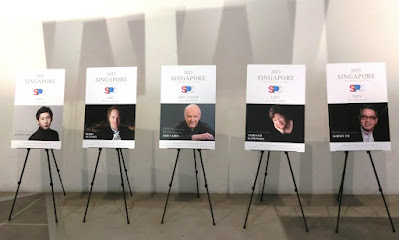

Truly an august bench of jurors.


The competition’s website (sipc.sg) was a shambles with little or no practical information about attending (or the participants), however not everything was negative. The competition had an impressive jury of world-renowned piano pedagogues (Vardi, Kaplinsky, Slutsky, Tiu and Jinsang Lee will be known to competition anoraks even without their first names), and the young pianists taking part were on a whole very proficient if not yet revelatory artists.


There were only two Singaporeans in contention, both in the Junior category of the competition. Toby Tan Kai Rong, just 14, was the standout. In his preliminary round performance, the opening Bach Prelude and Fugue in G sharp minor displayed both clarity and colour, with no need for over-pedalling. In Liszt’s La Campanella, his playing was the very definition of tintinnabulation distinguished with feathery light runs. For the concluding Ravel Jeux d’eau, judicious pedalling became essential for that filigree of fluidity, which capped a satisfyingly nuanced performance. Out of 12 pianists, he would be advanced to the Final concerto round as the youngest finalist.   


The Professional Category would feature eight pianists, and I got to hear just three of them. For the semifinal recital of Alexander Lau (24, Hong Kong), there were only three persons in the audience: a mother, a boy about 8 years old and myself. Never has a competition audience been so severely outnumbered by jurors, hall stewards and competition officials.


Lau gave a very creditable showing in diverse repertoire which included Mozart’s Sonata in E flat (K.282, exhibiting some latitude in ornamentation), Alban Berg’s Sonata (a very coherent reading that communicated some existential crisis), Liszt’s Ballade No.2 (he clearly understands Lisztian virtuosity) and an impressive Scriabin set with a rapturous Sonata No.9 (the Black Mass) and the volatile Vers la flamme as its bookends. Only in the Scriabin Waltz in A flat (Op.38) was there some resort to banging. For his efforts, I was pleased he made the Concerto Final.


Time only permitted me to attend the concerto Final round of the Professional category. One way of ensuring that the fewest number of people come is to hold it on the eve of Chinese New Year. Thus there were no more than three dozen people (mostly overseas visitors) in the audience to witness three pianists performing concertos with the T’ang Quartet (Ng Yu Ying and Ang Chek Meng, violins, Jeremy Chiew, viola & Jamshid Saydikarimov, cello). In the absence of a symphony orchestra, the concertos were restricted to a narrow selection of Mozart, Beethoven and Chopin. So no Liszt, Brahms, Tchaikovsky, Rachmaninov or Prokofiev this time around.


Alexander Lau gave a fluent and well-discipline account of Mozart’s Piano Concerto No.17 in G major (K.453). His entries were clear and incisive, yet allowing fingerwork to “flow like oil”, a favourite expression of Amadeus himself. There were absolutely no technical issues and the short cadenza by Mozart himself sparkled. The slow movement was sensitively handled and the quartet responded alertly to his musings. The chirpy finale, whose main theme was supposedly mimicked by Mozart’s pet starling, was full of vitality and Lau’s very musical account of the variations was ebullience itself. The buffo element of the coda – delivered at a heady velocity - brought the work to an exciting close. Here was a very good start for the final.  


Wu Yifan (17, China), the youngest finalist, sports a nascent afro and looks more mature than his actual age. Exuding a super-confident air, his account of Beethoven’s Piano Concerto No.3 in C minor (Op.37) showed he really meant business. Unafraid to let rip at vital moments, he was subtle enough to know when to pipe down and listen to the “orchestra”. Beethoven’s own cadenza, however, was given a bold and brash bashing about, and one wondered if Wu is drunk on his own virtuosity. The slow movement had its dramatic moments while the Rondo finale was given its due – a very good run and predictably emphatic end to the proceedings.   


Chen Xu (19, China) in Chopin’s Piano Concerto No.2 in F minor (Op.21) was arresting in his solo entry and he kept listeners rivetted from there onwards. His approach even made Chopin sound more modern than the year 1830 suggested, also bringing a heightened level of virtuosity in the first movement’s development. The nocturne-like Larghetto was delivered prettily with ornaments delicately spun with satin smoothness. Unfortunately the finale’s Krakowiak almost came undone, with untidy playing from the strings (most probably under-rehearsed) which also distracted Chen on his final approach. The coda was all messed up, which put paid to an otherwise buoyant account.
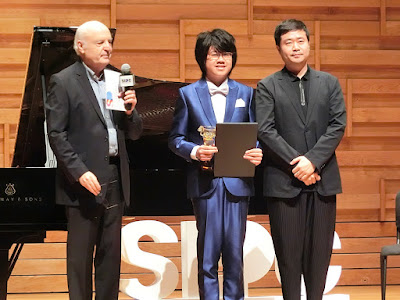


Toby Tan was the only
Singaporean prize-winner.


Jury deliberation did not take long. Toby Tan was awarded the 3rd prize in the Junior category. The Professional category saw Wu Yifan claim top spot, with Chen Xu (2rd) and Alexander Lau (3rd) followed closely behind. All these pianists have bright futures ahead of them, and the big question is to find themselves an audience in this all-too-distracted world of today.


1st Prize-winner Wu Yifan, seen with
Arie Vardi (Jury Chair), May Zhang (CEO, GIMA),
Wang Xiaohan (Artistic Director)
& Poon Chuifun (Executive Director)


The Singapore International Piano Competition has a long, long way to go before it can even come close to the best concours in Australasia, namely Hamamatsu, Sydney and Hong Kong. The city-state of Singapore needs to invest far more in its branding of international events that carries its name. If the violin competition can do it, there is no reason why the piano cannot attain similarly lofty heights.   


Tuesday, 19 May 2015

KAZUNE SHIMIZU Piano Recital / Review


KAZUNE SHIMIZU Piano Recital
School of the Arts Concert Hall
Sunday (17 May 2015)

This review was published in The Straits Times on 19 May 2015 with the title "An evening of pianistic passion".

To celebrate the 100th anniversary of the Japanese Association of Singapore, it was only appropriate that a Japanese artist be invited to grace the occasion. Pianist Kazune Shimizu, 1st prize-winner of the 1981 Marguerite Long International Piano Competition in Paris, presented a programme of popular concert pieces, and proved to be more than equal to the task.

The first half was devoted to two well-known Beethoven piano sonatas. Mastery of pedalling was the secret to conjuring the shimmering sound in the first movement of the Sonata No.14 in C sharp minor (Op.27 No.2), better known as the Moonlight Sonata. This was, of course, not Beethoven's description but that of the publisher Rellstab, who was intent in boosting musical sheet sales.


The pastoral second movement was crisply shaped, leading into the finale's maelstrom which remains one of Beethoven's most violent movements. Shimizu's crystal-clear articulation in its sweeping ascending arpeggios was matched by his big sonorous gestures, which goes to the quintessential heart of Beethoven. Unsurprisingly, this same physical and visceral approach was applied to his Sonata No.23 in F minor (Op.57).

This is the mighty Appassionata Sonata (again, not nicknamed by the composer) where every chord was weighted like a pugilist's punch, with alternating moody brooding and angry outbursts in equal measure. Some respite was provided in the slow movement's variations, merely paved the way for the finale's furious study in perpetual motion. Shimizu's every ounce of reserve was poured into this passionate (hence the nickname) struggle, with the music and its fiery rhetoric coming out tops.

The second half was occupied by Mussorgsky's Pictures at an Exhibition. Concert-goers might be familiar with Ravel's technicolor orchestration, but the Russian composer's original conception is not daubed in mere monochrome. There is much shade and nuance to be found by a creative soul and resourceful pianist. A bell-like resonance was announced in the opening Promenade, and that was the tread to be adopted in Shimizu's flavourful reading.


Each movement was well-characterised, from the grotesque Gnomus with knocked-knees, a soothing troubadour's song by The Old Castle, an elegant rather than fidgety Ballet of the Unhatched Chicks to the hawkish hagglings at the Marketplace In Limoges. Even in the sepulchral Catacombs and Among The Dead In The Dead Language, an acute sense of sonority and awareness of its infinite variety dominated the proceedings.

A fearless headlong dash through Baba Yaga's Hut On Fowl's Legs and the grand carillons of The Great Gate of Kiev all served to confirm this as a masterly reading, rather than a routine or serviceable one. The encore was also by a Russian. Tchaikovsky's lyrical salon favourite Valse Sentimentale was a delightful panacea for the ears after an evening's fill of pianistic passion.


Monday, 11 May 2015

LEGENDS / Christina Tan & Esther Wang Piano Recital / Review


LEGENDS
Christina Tan & Esther Wang, Piano
School of the Arts Orchestral Hall
Friday (8 May 2015)

This review was published in The Straits Times on 11 May 2015 with the title "Charmed by sparkling piano performances".

It has been a long time since Singaporean pianist Christina Tan has given a public performance. Although this concert was billed as a duo recital, the winner of the 1986 Diners Club Pianist of the Year Competition showed that little of that fire and lustre which distinguished her performance of the finale of Prokofiev's Third Piano Concerto with the Singapore Symphony Orchestra had been lost over the years. 


She was joined by the Minnesota-based Chinese pianist Esther Wang in duo repertoire, which began with six of Antonin Dvorak's Legends. Although less popular or familiar than the Czech composer's Slavonic Dances, these pieces are imbued with the same folk spirit and salon charm. Both pianists were well matched in temperament and sensitivity, providing the requisite give and take in its alternating animated and lyrical lines one a single keyboard. The music of mostly fast movements sparked to life in their capable hands.

Then came the ambitious segment for solo piano music. Few early Romantic works are as infused with the same passion as Robert Schumann's Second Sonata in G minor Op.22. Tan launched into its four movements like a woman possessed, impressively conquering the fiery outer movements and taking no prisoners. The first movement famously instructs the pianist to play “as fast as possible”, and than exhorts “faster” before adding the implausible “faster still”. She really took this to heart and the adrenaline flowed; the piano quivered as her flowing locks flew.


To show she was not just adept at playing fast and loud, the slow movement was a model of chaste beauty and pristine purity, with exemplary pedalling that gave the Shigeru Kawai grand piano an organ-like sonority. After the intermission, she offered Maurice Ravel's Alborada del Gracioso (Morning Song of the  Jester), which sparkled with Spanish castanets and flamenco rhythms before a series of sweeping glissandi brought the showpiece to a heady close.


Not to be outdone, Wang offered a rare performance of Francis Poulenc's Les Soirees des Nazelles, a suite of ten short but linked movements. What may have seemed like a randomly scattered hotchpotch of ideas came across more like a personal diary filled with wry observations, fleeting jests and tasty vignettes, all coloured with the Frenchman's uniquely perfumed harmonies and artful witticisms. This was Virgin Mary meets Edith Piaf, and even if she was not note-perfect, Wang brought out its quintessentially anarchic spirit.


Both pianists united once more, now on two pianos, to close with Witold Lutoslawski's well-loved Paganini Variations. This was based on the same theme from Paganini's Caprice No.24, which had been well served by the likes of Liszt, Brahms and Rachmaninov. The Pole's riotous version thrived on harmonic surprises and deliberately placed wrong notes, all to tease and cock a snook at his forebears.

Tan and Wang's performance was more on a cautious side, opting for sturdiness rather than outright unfettered brilliance. Little matter, as the well-filled hall rewarded the duo's efforts with generous applause and a hearty send-off.