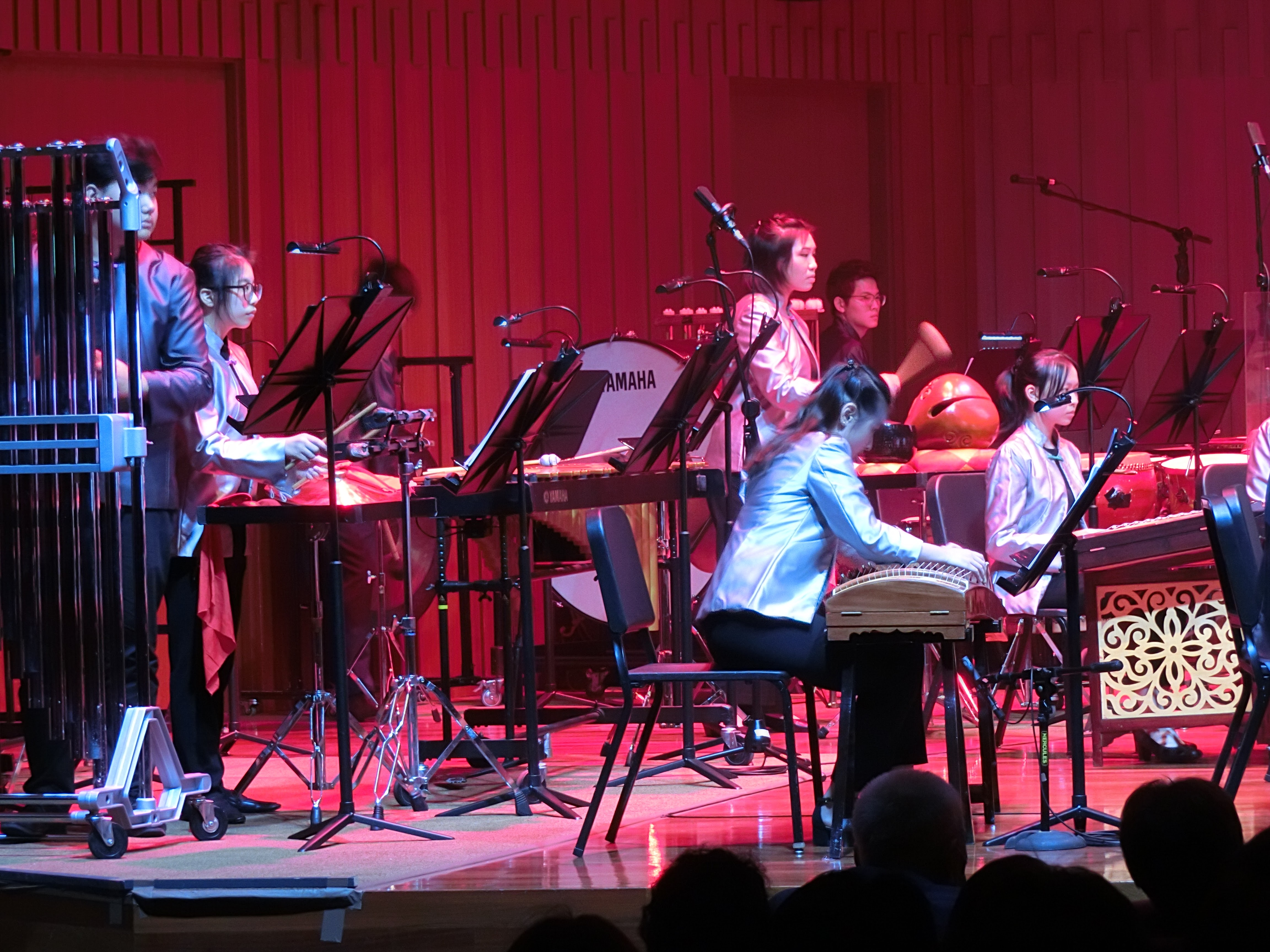
| A reunion of the Kent Ridge Fine Music and Steak Appreciation Club (No vegetarians accepted). |
Tuesday, 25 March 2025
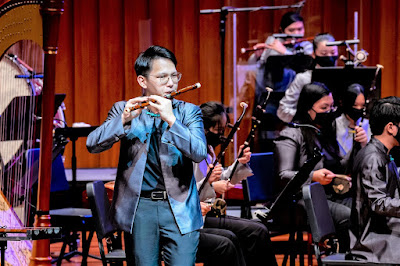
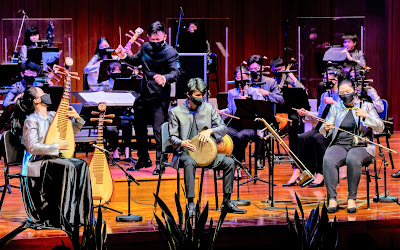
MUSICAL VOYAGE II / WHERE WORLDS CONVERGE: A NIGHT AT THE CROSSROADS / Singapore National Youth Chinese Orchestra / National University of Singapore Symphony Orchestra / Review
Monday, 31 July 2023
LEGACY / Singapore National Youth Chinese Orchestra & Singapore Chinese Orchestra / Review
LEGACY
Singapore National
Youth Chinese Orchestra
Singapore Conference Hall
Saturday (29 July 2023)
This review was published in The Straits Times on 31 July 2023 with the title "Singapore National Youth Chinese Orchestra celebrates 20th anniversary with confidence".
This year marks the 20th year that the Singapore National Youth Chinese Orchestra (SNYCO) has been managed under the auspices of the Singapore Chinese Orchestra (SCO), and what better way than to distinguish the occasion by having a joint concert celebrating both ensembles? Conducted by Moses Gay and Quek Ling Kiong, SNYCO Associate Conductor and Music Director respectively, the 100-minute long concert showcased five works without an intermission.
Wang Danhong’s Ba Yin (Eight Tones) was a evocation of folk festive and ceremonial music from Guangxi province. Opening with plangent solo suona and later prominent dizi solos, the multi-episode work revealed a mastery of orchestral colour, going through a march-like procession, an interlude of lush string passages before climaxing with a rousing close. Conductor Gay brought out the full plethora of sounds from his young charges.
Both concertante works in this concert featured SNYCO players accompanied by the SCO, and what proud moments this must have been for them. In Lu Yun’s The Lord of Western Qin, which lauds Tang dynasty Emperor Xuanzhong’s famed legacy of promoting arts, co-concertmaster Koh Yu Jie’s erhu ran the gamut of emotions from ruminative to outright ecstacy. While the work luxuriated with big and broad melodies, the erhu’s mellifluous voice confidently singing above rhythmic percussion beats was perhaps the most memorable episode.
In Wang Danhong’s Ru Si (As Thus), Sim Kee’s guzheng was similarly animated. The concerto opened with a brilliant cadenza, before orchestral forces were unleashed. Virtuosic as the work sounded, it was the deft scoring that enabled the solo instrument’s rippling and shimmering harp-like effects to shine through the tutti throng. The relentless drive to its conclusion was in a word, breathtaking.
| Photo: Singapore Chinese Orchestra |

Both orchestras then reconvened on a very crowded stage, where the all-black attire of SCO players merged almost imperceptibly with the grey overcoats of their younger counterparts. The last two works were led by conductor Quek, beginning with Chen Si’ang’s five-movement suite Sheng Sheng Bu Xi (Endless). The first four movements were capsule portraits of endangered species, including the river dolphin, crested ibis, panda and Tibetan antelope, sounding like music of a nature documentary. The fifth was of Humankind, the endangering species, which rose to a big crescendo as a plea for conservation and saving the planet.
Peng Xiuwen’s Terracotta Warriors Fantasia was unusually nuanced for a contemporary Chinese orchestral work, not some quasi-heroic paean but about the actual lives of soldiers who served under China’s first emperor Qin Shihuang (Shih Huangdi), later immortalised in graven form in a Xi’an mausoleum. While the music dwelled on subjects of honour, duty and sacrifice of working men, its spare central movement, with its flowing melody punctuated by the desolate sound of wooden clappers, was a representation of homesickness and nostalgia.
The combined orchestra, comprising students and their teachers, gave both works the vitality and attention to detail each deserved. All evidence points to the future of Chinese instrumental music being more than assured.
| Photo: Singapore Chinese Orchestra |
Tuesday, 21 March 2023
FRIENDSHIP / Singapore National Youth Chinese Orchestra / Review
FRIENDSHIP
Singapore National Youth Chinese Orchestra
Singapore Conference Hall
Saturday (18 March 2023)
This review was published in The Straits Times on 20 March 2023 with the title "Friendship, camaraderie at Singapore National Youth Chinese Orchestra's 20th anniversary show".
This concert marked the 20th anniversary of the Singapore National Youth Chinese Orchestra (SNYCO) as a ensemble assembled under the auspices of the Singapore Chinese Orchestra. Its 80-minute programme, featuring five works performed without an interval, was a showcase of how far the group has progressed.
Music Director Quek Ling Kiong, who had been at the helm since inception, was his usual bubbly best, not just as a podium maestro but also cheerleader. Friendship and camaraderie was the concert’s overall theme, also the subject of Liu Xing’s Bian Ba, named after the composer’s close Tibetan friend and colleague. The music was more reflective than exuberant, with solo and grouped erhus (Bian’s own instrument) in lyrical repose before rising to a crescendo, reflecting the blossoming of a friendship.
Its restrained and congenial tones could not have been more contrasted with Wang Danhong’s Strings On Yangko Dance, inspired by rural celebrations in Northern China on the fifteenth day of the first lunar month. This raucous commemoration of the equivalent of our Chap Goh Meh was characterised by the virile play of strings and incessant percussion. Standing tall amid the throng were solo and grouped suonas, resonating like the earthy voices of humanity, providing an orgiastic climax before dissipating to nothingness.
Liu Wenjin’s orchestral fantasy on Molihua (Jasmine) was more traditional, with cellos and basses opening the work and various orchestral groups taking on the popular melody. First it was the dizis, then huqins and later pipas, building up to a drum roll and somewhat overblown apotheosis. When you have a memorable tune, milking it to the max seemed to be the message.
Far more exotic was Xu Jingxin and Chen Dawei’s Fei Tian (Flying Apsaras), inspired by murals in the famous Mogao caves of Dunhuang. Beginning with an air of mystery, the piercing high pitch of the whistle (from a dizi player) was particularly haunting. Its Central Asian feel was heightened with yangqin, guzheng and percussion (wood blocks, cymbals and xylophone) as the dance wound to a high before returning to an idyll of serene whistling.
Law Wai Lun’s tone poem Prince Sang Nila Utama and Singa provided the evening’s only example of Nanyang music, works with distinct Southeast Asia influences and inspiration. The score was a curious blend of impressionistic colour reminiscent of Ravel and Debussy and use of Indonesian scales, giving it a very local flavour. Dizi, suona and guan were used to ear-catching effect, and a stentorian melody at its close represented the prince’s encounter with the lion and the ensuing historical myth-making.
That made for a suitably rowdy close, and with the slightest bit of prompting, the orchestra launched into its encore, Kuan Nai-chung’s Da Gui (Vanquishing Demons) from A Trip To Lhasa, an ear-worm of a piece if any. Cheered on by an audience filled to the rafters, one foresees in these talented young musicians a very bright future ahead for Chinese instrumental music in Singapore.
Wednesday, 21 December 2022
HOMETOWN COMPANIONS. CONTEMPORARY VOICES / Ding Yi Music Company / Review
HOMETOWN COMPANIONS -
CONTEMPORARY VOICES
Ding Yi Music Company
Esplanade Recital Studio
Thursday (15 December 2022)
One of the highlights of the Chinese music calendar is the annual three-day Chinese Chamber Music Festival organised by Ding Yi Music Company, which usually showcases Chinese instrumental groups from the Asia-Pacific region. This year’s offerings were scaled down because of the Covid pandemic, but the trade-off was a chance to feature more local groups. The first evening of the festival did just that by involving musicians from three homegrown ensembles, namely the Singapore National Youth Chinese Orchestra (SNYCO), The Purple Symphony and Ding Yi Music Company itself.
The impressive concert opened with eight musicians from SNYCO with Ding Yi composer-in-residence Phang Kok Jun’s Storytellers on Ann Siang Road. The original version of this fusion piece scored erhu and bansuri (Indian flute) as soloists in a duel of two Asian cultures. This evening’s performance had instead two erhus playing within the ensemble, and while the Indian element was attenuated, the end result was no less lively.
Jiang Ying’s Dunhuang featured nine musicians, with solo dizi in lead role. The Xinjiang-inspired rhapsody, as expected, had a Central Asian flavour which worked itself from a slow plaint to a rigourous fast dance. Another colourful number, Li Bo Chun’s Tea Horse (Cha Ma) also occupied the fast lane, its dynamics portraying trains of tireless stallions plying ancient tea-trading routes.
The Purple Symphony is purportedly Singapore’s largest and most inclusive musical ensemble, with members numbering into the hundreds. The acceptance of special needs, differently-abled and neuro-atypical individuals within its ranks makes this group all the more special as no concessions needed to be made for its performances. 22 players appeared from young local composer Sulwyn Lok’s Neo / Pipa Voices, a very engaging arrangement of film themes with a distinctly popular orientation. Its serene and sentimental opening featured a dizi solo before the entry of the titular pipa.
Phang Kok Jun’s symphonic poem Frosted Bridge (Jie Shuang Qiao) about the now-defunct Sungai Road flea market (popularly known as Thieves’ Market) was conducted by Ding Yi music director Quek Ling Kiong. This work needed a conductor as its opening chords and impressionist textures were difficult to bring out without a leader. The ensemble persevered nonetheless, with a sheng solo being the highlight before the raucous sound effects with mini-tambourines and shaken plastic nettings taking over. Despite the tendency for percussion to dominate, the work drew to a quiet close.
The combined ensemble of both groups joined by Ding Yi Music Company’s soloists numbered well over thirty players. Together, the orchestra (pushing the limits of a chamber group to breaking point) performed well-known Chinese composer Wang Dan Hong’s Heavenly Grassland and Zhang Yi Ma’s Delight. The former saw lovely dizi and erhu solos before erupting into an exuberant dance with much drumming and tambourine-slapping. The latter was a light-hearted, easy-going tune with the quality of a folk ballad.
Judging by the many happy faces among the players, and the encouragement given by conductor Quek and the audience, this was 75-minutes of feel good music well spent. Simply put, Ding Yi has enabled community music-making at its most sincere and heart-rending. Long may this continue.
All photographs by courtesy of
Ding Yi Music Company.
Monday, 20 December 2021
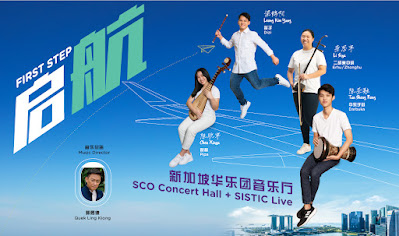
FIRST STEP / Singapore National Youth Chinese Orchestra / Review
FIRST STEP
Singapore National Youth Chinese Orchestra
Singapore Conference Hall
Saturday (18 December 2021)
It has long been a misconception of mine that Chinese classical music, specifically music played on traditional Chinese instruments, is a preserve of the senior demographic. I have often remarked that audiences at Singapore Chinese Orchestra concerts were mostly boomers and older, and more young people needed to come to these concerts lest this hallowed tradition becomes extinct. This evening I heaved a sigh of relief, to find that the Singapore National Youth Chinese Orchestra (SNYCO) is the very antidote to this notion of musical extinction. Encouragingly, more young Singaporeans are learning to play Chinese instruments, and consequently more young composers are writing works for these instruments.
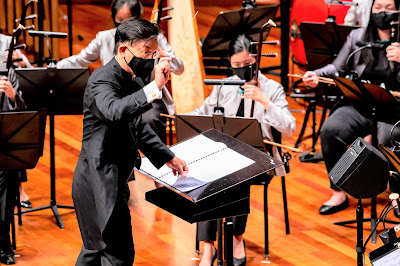
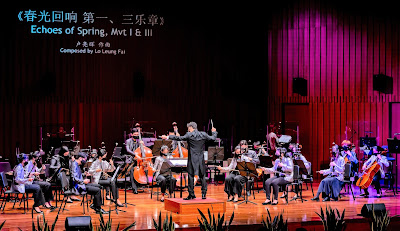
Conducted by Quek Ling Kiong, the SNYCO gave its first concert in almost two years, the hiatus caused by the Covid pandemic’s disruptions. It opened with two movements from Lo Leung Fai’s Echoes of Spring, almost a Chinese version of Rossini’s Sonatas for strings or Mendelssohn’s Symphonies for strings. The bowed strings – huqins with four cellos and two double basses – were in fine form despite not having played for a long while. The prestidigitation achieved in both fast movements was impressive, the opening serving as a warm-up for the furious finale.
A larger mixed ensemble converged for young Singaporean composer Jon Lin Chua’s Princess Miao Shan, a symphonic poem receiving its Singapore premiere. Inspired by the legend of how Guanyin Boddhisatva (the Goddess of Mercy) came to be, it is a colourful melange of sound beginning tumultuously and a suona solo. Despite its modern idiom, there was still room for a big melody evoking the open country and broad landscapes. Percussion provided the dramatics and a poignant dizi solo paved the way for music which portrayed profound sadness and tragedy, representing the ultimate sacrifice the eponymous princess was to make. Ending quietly rather than in the customary blaze of glory gave the work an extra dimension of sobriety it needed.
There were two concertante works, the first being Lo Leung Fai’s Joyful (Xi) with Leong Kim Yang’s dextrous dizi solo. Scherzo-like for most part, this dizi occupied the piccolo register, its timbre and nimbleness suggesting that mischief and pranks were also part of its definition of joy. The virtuoso role included two really demanding cadenzas which Leong nailed most impressively despite his relative youth, having joined the orchestra just two years ago.
Sulwyn Lok’s Sand Mystique was the second concertante work, essentially a concerto grosso for erhu/zhonghu, pipa and darbuka (a Middle-Eastern hand-held drum). Soloists Li Siyu, Chen Xinyu and Tan Sheng Rong stole the show in a work which opened Mahler-like (the pedal-point of his First Symphony) in its rapt evocation of dawn in the desert. The idiom was distinctly Middle-Eastern or Central Asian whichever direction one travelled, with the aromatic flavours of the exotic Silk Road richly relived. The accompanying orchestra also contributed with a spot of rhythmic clapping in this lively dance built upon vigorous ostinatos.
When writing music about outer space and the cosmos, the obvious influences are Holst or Hollywood. Chen Si Ang’s Interstellar went for the latter in a sonorous soundscape accompanied by lighting illuminations that evoked the Milky Way and distant galaxies. The opening was quiet, with dizi solo breaking the silence, then came ostinatos of The X Files variety, leading one on a journey of wonderment. The quote from Oscar Wilde, “We are all in the gutters, but some of us are looking at stars” was ever-present as the odyssey closed with typical bombast that such a title foretold.
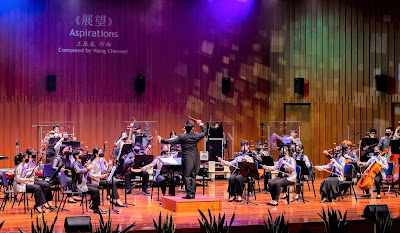
Closing the 75-minute long concert was present Singapore Chinese Orchestra composer-in-residence Wang Chen Wei’s Aspirations, composed as far back as 2008. This is an extended version of its original, which revelled in the cheerful melodies heard in television and film music depicting heartland life. Nothing wrong with that, but as soon as new ideas are wanting, always rely on the trusty fugato. That spot of Bachian counterpoint – with sheng, dizi and zhongruan thrown into the mix - was a welcome departure as the concert wound to a happy and optimistic conclusion.
The Singapore National Youth Chinese Orchestra and its talented young musicians represent the bright future for Chinese instrumental music in Singapore. This bright future is in the best of hands, and long may the enterprise thrive.
All photographs by the kind courtesy of SNYCO/SCO.