Wednesday, 23 April 2025
EARTH: UNHEARD / Ding Yi Music Company / Review
Thursday, 1 September 2022
ASCO IS 5! / Asian Cultural Symphony Orchestra / Review
ACSO IS 5!
Asian Cultural
Symphony Orchestra
Victoria Concert Hall
Tuesday (30 August 2022)
The Asian Cultural Symphony Orchestra (ACSO), founded in 2016, occupies an important niche in Singapore’s music scene by performing works that merge Asian cultures and sensibilities with the western symphony orchestra. By championing music by Singaporean and Asian composers, it has complemented the good work fostered by the Singapore Chinese Orchestra and its Nanyang music projects. It also filled the gaping lacuna left by the Singapore Symphony Orchestra, which had earlier in this century marketed itself as a “destination orchestra by bringing together musical cultures from the East and West”, but quietly dropped that tagline somewhere along the way.
ACSO is led by a team of two conductors, Dedric Wong Deli, well-known as a conductor of the Chinese instrumental chamber group Ding Yi Music Company, and Adrian Chiang, General Manager of re:Sound Collective and conductor of numerous ensembles thus representing the western classical music caucus. They share conducting duties in its concerts, taking turns in leading different works with the programme.
Wong opened the evening with Confluence by Wang Chen Wei (present Composer-in-Residence of the Singapore Chinese Orchestra), a rousing overture-like work that typified the Nanyang sound. Using the pelog scale in its lilting main theme, there is a recognisable Indo-Malayan character to the music, which also benefitted from the use of liberal portamenti and sheer colour of symphonic instruments. To seal this colourful marriage between cultures, a fugue was also thrown into the fray, livening the proceedings besides offering further proof of the composer’s academic credentials.
Following this were four concertante works, more than amply demonstrating the wealth of solo instrumental talent on our shores. The first was Germaine Goh’s Kaleidoscope, a single-movement fantasy for clarinet and orchestra with Ralph Emmanuel Lim as exuberant soloist. Opening with a solo accompanied by harp ostinatos, the music opened dreamily and then came to life with a series of animated dance-like rhythms. Influences from Debussy may be discerned, as well as Copland and Bernstein in the more jazzy bits, but she does not imitate them. Much is attractive and enjoyable in this work, where the demi-mondaine world of smokey speakeasies and Hollywood glamour is not just hinted at but relived.
Chinese composer Wang Dan Hong is a well-known name in Chinese orchestra circles and her guzheng concerto As Thus is as glitzy as they come. Its slow introduction with gentle string accompaniment established soloist Yvonne Tay, in an advanced antenatal state, as a sensitive protagonist. However the amplication of her guzheng was garishly overdone, with distorted sound detracting from her brilliant narrative. As with Wang’s rhapsodic and quasi-cinematic scores, the pacing hastened to an exciting climax, and a faux ending which had the audience applauding prematurely. A true apotheosis and close came later, and the payoff was no less vociferous.
Singapore-based Briton Eric Watson’s Dialogue for tabla and orchestra is a well-travelled work commissioned by the Singapore Chinese Orchestra. Its iteration with western instruments was no less trenchant, held together by the virtuosic drumming of Govin Tan, young tabla virtuoso who comes from a Hindu Chinese family. If one wondered what mileage could be had with a pair of drums which essentially plays single notes, one is prepared to be surprised. For the first half, the tabla provided accompaniment to a series of varied themes from the orchestra (including one resembling a motif from Stravinsky’s Firebird), then it takes a life of its own – a good four minutes or so of solo improvisation. As cadenzas go, this was simply breathtaking.
Edmund Song is better known as the double bassist of Red Dot Baroque and re:Sound. This evening, he took on duo-mantle of composer and conductor, leading the World Premiere of his Triple Concertino entitled Till The End Of Time. A work that employed a mix of Asian scales, the music emanated a variety of aromatic incenses. The soloists Niranjan Pandian (bansuri, North Indian bamboo flute), Jacky Ng (suona) and Azrin Abdullah (oud, Middle Eastern lute) had their moments in the spotlight, and how precious these were. The bansuri was positively haunting, the suona took on cor anglais tones resembling Rodrigo’s Aranjuez, while the oud could have had more air time. Some degree of counterpoint with all three together should have been the end-result but the opportunity was not taken, with heterophony prevailing instead.
It would still have been a totally satisfying experience had the concert ended there, but ACSO possessed several encores up its collective sleeve. Surprise celebrity cameos took the form of busker-of-the-season Jeff Ng in a medley of JJ Lin songs, while legendary songstress and 2021 Cultural Medallion recipient Rahimah Rahim irrepressibly strutted her stuff with two Malay songs and Bob Gaudio’s Can’t Take My Eyes Off You (Frankie Valli and the Four Seasons). That was mere icing on a wonderfully baked cake, and long may the Asian Cultural Symphony Orchestra thrive, and entertain.
Monday, 20 December 2021
FIRST STEP / Singapore National Youth Chinese Orchestra / Review
FIRST STEP
Singapore National Youth Chinese Orchestra
Singapore Conference Hall
Saturday (18 December 2021)
It has long been a misconception of mine that Chinese classical music, specifically music played on traditional Chinese instruments, is a preserve of the senior demographic. I have often remarked that audiences at Singapore Chinese Orchestra concerts were mostly boomers and older, and more young people needed to come to these concerts lest this hallowed tradition becomes extinct. This evening I heaved a sigh of relief, to find that the Singapore National Youth Chinese Orchestra (SNYCO) is the very antidote to this notion of musical extinction. Encouragingly, more young Singaporeans are learning to play Chinese instruments, and consequently more young composers are writing works for these instruments.
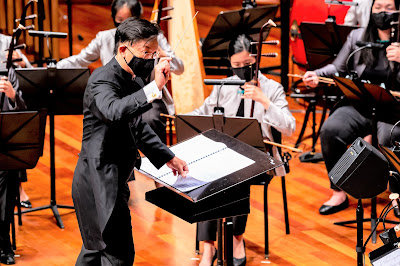
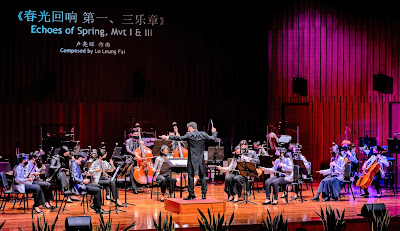
Conducted by Quek Ling Kiong, the SNYCO gave its first concert in almost two years, the hiatus caused by the Covid pandemic’s disruptions. It opened with two movements from Lo Leung Fai’s Echoes of Spring, almost a Chinese version of Rossini’s Sonatas for strings or Mendelssohn’s Symphonies for strings. The bowed strings – huqins with four cellos and two double basses – were in fine form despite not having played for a long while. The prestidigitation achieved in both fast movements was impressive, the opening serving as a warm-up for the furious finale.
A larger mixed ensemble converged for young Singaporean composer Jon Lin Chua’s Princess Miao Shan, a symphonic poem receiving its Singapore premiere. Inspired by the legend of how Guanyin Boddhisatva (the Goddess of Mercy) came to be, it is a colourful melange of sound beginning tumultuously and a suona solo. Despite its modern idiom, there was still room for a big melody evoking the open country and broad landscapes. Percussion provided the dramatics and a poignant dizi solo paved the way for music which portrayed profound sadness and tragedy, representing the ultimate sacrifice the eponymous princess was to make. Ending quietly rather than in the customary blaze of glory gave the work an extra dimension of sobriety it needed.
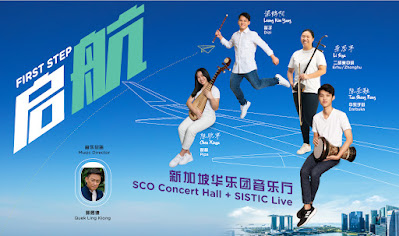
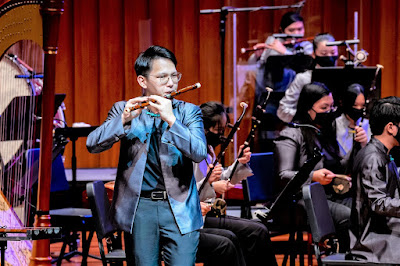
There were two concertante works, the first being Lo Leung Fai’s Joyful (Xi) with Leong Kim Yang’s dextrous dizi solo. Scherzo-like for most part, this dizi occupied the piccolo register, its timbre and nimbleness suggesting that mischief and pranks were also part of its definition of joy. The virtuoso role included two really demanding cadenzas which Leong nailed most impressively despite his relative youth, having joined the orchestra just two years ago.
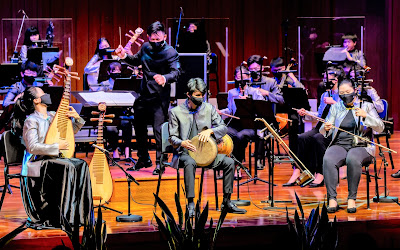
Sulwyn Lok’s Sand Mystique was the second concertante work, essentially a concerto grosso for erhu/zhonghu, pipa and darbuka (a Middle-Eastern hand-held drum). Soloists Li Siyu, Chen Xinyu and Tan Sheng Rong stole the show in a work which opened Mahler-like (the pedal-point of his First Symphony) in its rapt evocation of dawn in the desert. The idiom was distinctly Middle-Eastern or Central Asian whichever direction one travelled, with the aromatic flavours of the exotic Silk Road richly relived. The accompanying orchestra also contributed with a spot of rhythmic clapping in this lively dance built upon vigorous ostinatos.
When writing music about outer space and the cosmos, the obvious influences are Holst or Hollywood. Chen Si Ang’s Interstellar went for the latter in a sonorous soundscape accompanied by lighting illuminations that evoked the Milky Way and distant galaxies. The opening was quiet, with dizi solo breaking the silence, then came ostinatos of The X Files variety, leading one on a journey of wonderment. The quote from Oscar Wilde, “We are all in the gutters, but some of us are looking at stars” was ever-present as the odyssey closed with typical bombast that such a title foretold.
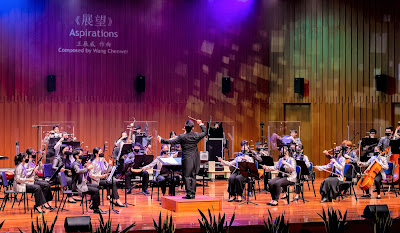
Closing the 75-minute long concert was present Singapore Chinese Orchestra composer-in-residence Wang Chen Wei’s Aspirations, composed as far back as 2008. This is an extended version of its original, which revelled in the cheerful melodies heard in television and film music depicting heartland life. Nothing wrong with that, but as soon as new ideas are wanting, always rely on the trusty fugato. That spot of Bachian counterpoint – with sheng, dizi and zhongruan thrown into the mix - was a welcome departure as the concert wound to a happy and optimistic conclusion.
The Singapore National Youth Chinese Orchestra and its talented young musicians represent the bright future for Chinese instrumental music in Singapore. This bright future is in the best of hands, and long may the enterprise thrive.
All photographs by the kind courtesy of SNYCO/SCO.
Tuesday, 12 October 2021
SCO 25: DAZZLING RHAPSODIES / Singapore Chinese Orchestra / Review
SCO 25: DAZZLING RHAPSODIES
Singapore Chinese Orchestra
Singapore Conference Hall
Saturday 9 October 2021
The second of Singapore Chinese Orchestra’s 25th anniversary concerts was devoted to works composed more recently, specifically during what we know as the Yeh Tsung era. It was the Shanghai-born American-trained conductor (Music Director since 2002) who defined and revolutionised what may be called Chinese orchestral music with Singaporean characteristics. Nanyang music was essentially his brainchild and is what identifies the SCO from other ensembles of Chinese instruments around the world.
The Singapore International Competition for Chinese Orchestral Competition (SICCOC), organised by SCO in 2006, 2011 and 2016, helped establish the landscape for Nanyang music to flourish. Two locally-based composers “discovered” at the first concours have now become recognised names in the Chinese instrumental scene. The first was current SCO composer-in-residence Wang Chen Wei, whose Lion City Rhapsody was given its World Premiere, conducted by Quek Ling Kiong.
This short bustling overture with its kinetic Nanyin theme Trotting Horse employed characteristic instruments and timbres associated with the five Chinese dialect groups in Singapore, namely Hokkien, Teochew, Cantonese, Hakka and Hainanese. These groups of instruments operated like the concertino section of a baroque concerto grosso, distinguished by their piquant and higher-pitched sounds, lending the work a particularly distinctive flavour. Add Teochew percussion and voice-overs in the five dialects (with well wishes to the SCO), this made for a memorable opener.
There was also a nod to sentimental Mandopop with Phang Kok Jun’s Medley of Singapore Chinese Pop, conducted by Moses Gay, which included songs popularised by Kit Chan, Stephanie Sun, Eric Moo, JJ Lin and Crowd Lu. I concede not knowing a single of these hits, but enjoyed the solos on guan (Jin Shiyi), erhu (Zhao Jianhua), sheng (Guo Changsuo) and dizi (Yin Zhiyang), backed by Shen Guoqin’s enthusiastic drum beat.
Yeh Tsung conducted the rest of the concert, including two concertante works. The first was Tang Jianping’s Spring and Autumn, a single movement concerto for pipa featuring principal Yu Jia in all her vermillion sequined splendour. This is a stunning work in a modern idiom which recalled the chunqiu shidai (Spring and Autumn era, circa eighth to fifth century b.c.), a tumultuous period of Chinese history. There are virtuoso cadenzas aplenty, after which a procession of Central Asian flavour took place, leading to a feverish climax where Yu’s pipa stood out above the din. Completing the spectacle was a wild chase, which was breathtaking to say the least.
The other concerto was Liu Xijin’s The Legend of the Merlion, already an established classic. Commissioned by the SCO in 1999, and taken on tour several times, this gaohu concerto is unusual for its slow-fast-slow three-movement form. Forget the programmatic story of a tourist-board created chimera (PR-generated fiction at its most contrived), it still has good thematic material that was well brought out by SCO concertmaster Li Baoshun.
The first movement (Seek Blessings) was meditative and reflective, contrasted by a scherzo-like middle movement (Raging Sea) which closed with the reassuring chimes of tubular bells. The lyrical finale’s (Nanyang’s Affection) broad melody was given an added touch of poignancy with gaohu heard alongside Xu Zhong’s cello - a veritable love duet – before its sublime close. Rare is a Chinese concerto that does not end with a big bang.
Concluding the celebratory concert was Eric Watson’s Tapestries – Time Dances, the winning work of the afore-mentioned composition competition in 2006. Since that triumph, the highly accomplished and eclectic British composer has been the SCO’s composer-in-residence in 2016 to 2018. While Tapestries may not exactly be Nanyang music, it nonetheless possessed Pan-Asian influences including hints of Indonesian gamelan, Southeast Asian dance rhythms and Indian drumming. However it is the Western model of symphonic poems which it most strongly resembles.
The long-held pedal point in D at the rapt beginning is reminiscent of the opening dawn scene from Mahler’s First Symphony, while the pastoral air of Vaughan Williams hangs over the work’s latter half. The point of it all was not trying to imitate Chinese idioms, but the skilful use of Chinese instruments to serve musical ends. The performance itself was energetic and finely detailed, bringing the concert to a suitably spirited close.
I have little doubt that this is the whole ethos of the Singapore Chinese Orchestra, to stimulate and make good music that the general public can identify with and also enjoy. Not for nothing has the SCO been hailed as “The People’s Orchestra”.
Tuesday, 14 August 2018
SSO NATIONAL DAY CONCERT / Singapore Symphony Orchestra / Review
Tuesday, 3 May 2016
SETTS #3 / Southeastern Ensemble for Today's and Tomorrow's Sounds / Review
| Composer Wang Chen Wei arranges a microphone to record the string quartet. |
| The artists and technical crew of UFO Project prepare themselves as an amused audience (including Pearl Samuel and Peter Kellock) look on. |
| Composer Hoh Chung Shih works on his personal composer as a silhouetted Shane Thio performs. |
| All the performers and artists of SETT #3 |