Showing posts with label Yunchan Lim. Show all posts

Tuesday, 2 July 2024

YUNCHAN LIM IN RECITAL / HAYATO SUMINO "CATEEN" IN SINGAPORE / Review


YUNCHAN LIM IN RECITAL 
Esplanade Concert Hall 
Friday (28 June 2024)

HAYATO SUMINO 
“CATEEN” IN SINGAPORE 
Esplanade Concert Hall 
Saturday (29 June 2024) 

This review was published in The Straits Times on 2 July 2024 with the title "Asian pianists strut their stuff".

There was a time when Asian musicians in the world of Western classical music were regarded with suspicion and scepticism. A common criticism was that while technically proficient, they lacked depth and gravitas, not having been brought up or schooled in the original cultures of the West. That myth was partly dispelled when Chinese pianist Fou Ts’ong was awarded the Mazurka Prize at the 1955 Chopin International Piano Competition in Warsaw, and Vietnam’s Dang Thai Son won the first prize outright in 1980, the first Asian to do so. 


Since then, many international music competitions have been dominated by Asians, who outnumber their Western counterparts in the world’s music conservatories. A watershed was the 2009 Van Cliburn International Piano Competition in Texas, where the three top prizes were awarded to Japan’s Nobuyuki Tsujii and China’s Zhang Haochen (Joint Gold), and South Korea’s Yeol Eum Son (Silver). The last two winners of the Chopin were Seong Jin Cho (2015, from South Korea) and Bruce Liu (2021, Canada). All have performed in Singapore to enraptured audiences. 

Photo: Alvin Ho

The advent of social media has also played a part in raising young musicians’ profiles. South Korea’s Yunchan Lim became an instant YouTube sensation at the Cliburn in 2022, with thousands viewing his winning live performance of Rachmaninov’s Third Piano Concerto. The current viewership stands at 3.6 million with over 50 thousand likes. 

His recital, the second here in as many years, showcased why audiences were so taken by him. He stands out from cookie-cutter technicians by embracing a very personal vision of the music he performs. The disappointment that he had dropped all 27 of Chopin’s Etudes was immediately made up the moment he set fingers on Felix Mendelssohn’s Songs Without Words


In two of these miniatures, a silky smooth cantabile tone was the first thing one noticed. He continued directly into Pyotr Tchaikovsky’s The Seasons, each of its 12 movements representing a month of the year. One could dismiss these as salon fluff, but for him, every note seemed to matter. 

Even the lesser-known pieces stood out, such as the busy machinations in Harvest (August), and The Hunt (September) where the stampeding steeds of 1812 Overture were alluded to. The simple waltz of Christmas (December) shared the delightful lilt of The Nutcracker ballet. 

Photo: Alvin Ho

In Modest Mussorgsky’s Pictures at an Exhibition, a piano score originally cast in monochrome, his vistas were delivered in full Technicolor. Liberties were taken from the very first Promenade, then casting tremolos and accents galore in Gnomus, where the definition of grotesque was taken most literally. Purists gasp at the audacity of added notes and extra effects, but was that not how the great Vladimir Horowitz bewitched his audiences? 

Photo: Alvin Ho

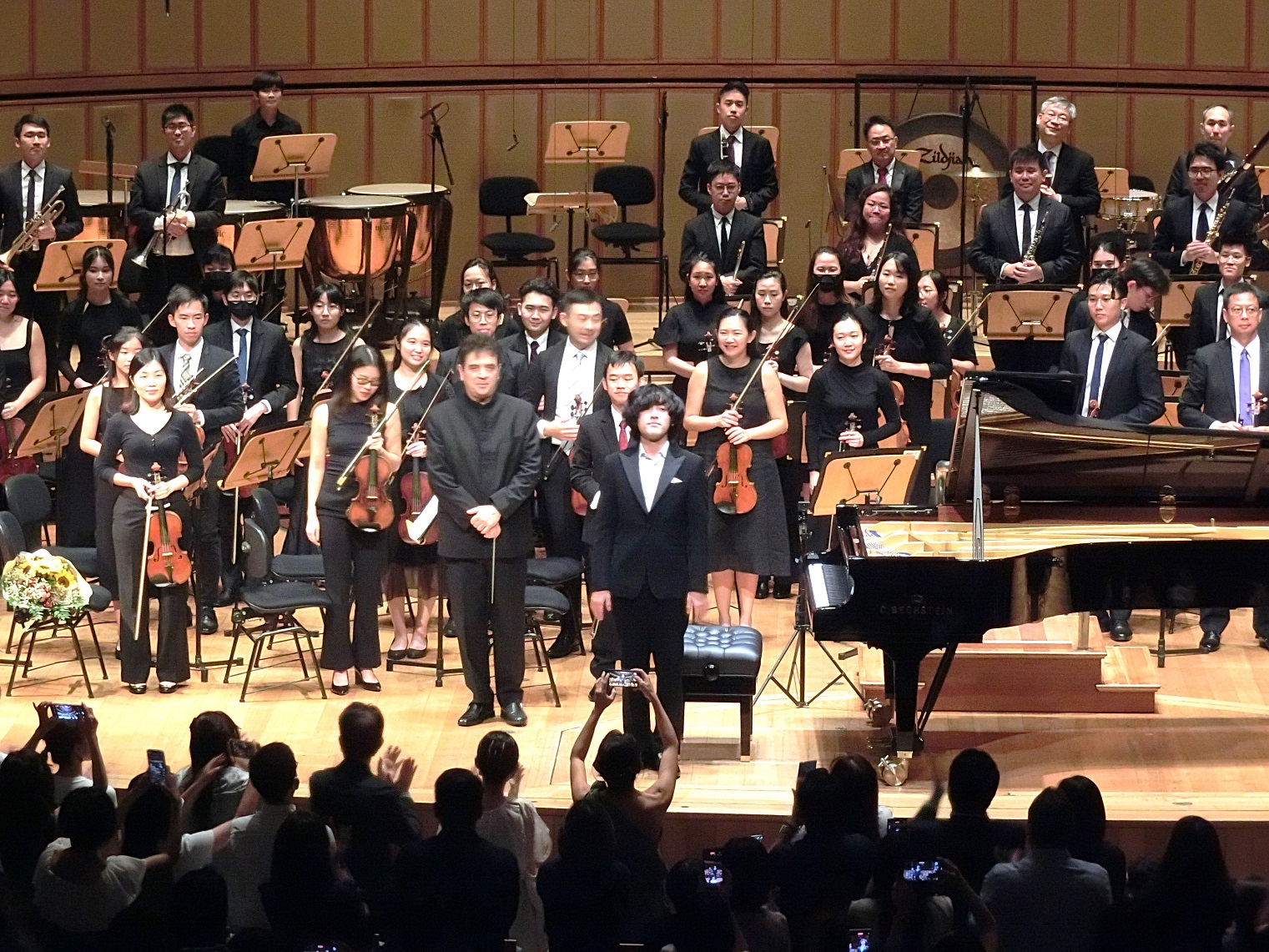
The Steinway grand was long out of tune by the time he launched into Baba Yaga’s Hut, a full-frontal assault that included outlandish glissandi in place of grace notes, and the tolling carillons of The Great Gate of Kiev. Never had there been a more spontaneous standing ovation than this, and Lim took short and quick bows in acknowledgement, his modesty belying outsized talent and charisma. 


Photo: Pianomaniac

While Yunchan remained taciturn throughout 
his recital, Cateen spoke to his audience.

The more personable Japanese pianist Hayato Sumino, nicknamed Cateen, was already well-known as a YouTuber (over 2 million subscribers on various channels) with his cutesy videos of improvisations and popular repertoire. A semi-finals showing at the 2021 Chopin International Piano Competition introduced him into the classical mainstream as a serious musician. 

Photo: Nathaniel Lim

The first parts of his recital were strictly classical, but with a difference. In J.S.Bach’s Italian Concerto he performed on two pianos, a grand and an upright, swivelling between keyboards between movements. In the aria-like slow movement, he played both simultaneously; the right hand’s melody on the brighter grand, with left hand accompaniment on the dampened and mellower upright. 

Photo: Nathaniel Lim

His Chopin was close to unimpeachable in Rondo a la Mazur (Op.5), Second Ballade (Op.38) and Nocturne in C minor (Op.48 No.1). He followed up with two improvisations. Recollection was a dusky reminiscence of both F major pieces (Op.5 & 38), heard sotto voce throughout on the upright. New Birth was an outrageous but entertaining spin-off from Chopin’s arpeggio-laden Etude in C major (Op.10 No.1). 

The late great Ukrainian jazzman Nikolai Kapustin was represented by a selection of five Etudes (from Op.40), with the Intermezzo (No.7) and its honky-tonk lounge inspiration rightly heard on the upright. Sumino’s original compositions Baby’s Breath and Nocturne, and Joe Hisaishi’s Spirited Away Suite, showed a genuine affinity for the pop / sentimental / film music idiom. 

Photo: Nathaniel Lim

His own transcription of Maurice Ravel’s Bolero, with myriad orchestral effects, was played on both pianos and its grandstanding finish bringing down the house. His encores drew another standing ovation, for the second consecutive night. East Asia is where the next revolution of the classical piano, and classical music itself, takes place. Believe it or not, the diverse musical personalities of Yunchan Lim and Hayato Sumino are just the tip of the iceberg. 

Cateen was a smiling presence
throughout his recital

Photo: Pianomaniac


Encores: 

YUNCHAN LIM (28 June)
 
  TCHAIKOVSKY Moment Lyrique 
  LISZT Liebestraume No.3 

HAYATO SUMINO (29 June) 

  CATEEN 7 Levels of Twinkle Twinkle Little Star 
  CHOPIN Polonaise in A flat major Op.53 
  “Heroic

Wednesday, 16 November 2022

MARTHA ARGERICH & FRIENDS: LIVE IN SINGAPORE / Review


MARTHA ARGERICH 

& FRIENDS

LIVE IN SINGAPORE

Esplanade Concert Hall

Monday to Wednesday 

(7-9 November 2022)


This review was published in The Straits Times on 16 November 2022 with the title "Martha Argerich and family thrill in mini music festival".


Presented by Altenburg Arts with the Orchestra of the Music Makers, Argentina-born Martha Argerich, regarded by many to be the world’s greatest living pianist, made a welcome return to Singapore. This time she was joined by two members of her family, eldest daughter violist Lyda Chen Argerich and 14-year-old pianist grandson David Chen. Also in the entourage for the mini-festival were Argentine conductor-pianist Dario Ntaca and South Korean pianist Yunchan Lim, staying on after his splendid solo recital.


Photo: Yong Junyi


The first evening was a peek at chamber music-making in the three-generation Argerich household. Some 67 years separate Martha and David, who opened with Maurice Ravel’s Mother Goose Suite for piano four hands. The teenager cut a confident figure, and egged on by encouraging and kindly looks from his grand-mere, they coaxed a disciplined yet loving reading together.


Both pianists also took turns to accompany Lyda in Clara Schumann’s Three Romances (Op.22). Her viola’s singing tone came through in these lyrical and warm-hearted pieces no matter who was manning the keyboard. It was left for the young man to complete the first half with Chopin’s Fantaisie-Impromptu, impressing with both musicality and restraint.


The second half saw Argerich and Ntaca tackling Rachmaninov’s Symphonic Dances for two pianos. This was a disappointment, sounding under-rehearsed and lacking in tension. There were, however, some pretty moments in the central movement’s waltz, and the Orthodox chant-inspired finale was fitfully exciting. It took the electrifying encore of Debussy’s Fetes (Festivals, as arranged by Ravel) to remind one what four-hands piano playing was about.


Photo: Yong Junyi


The second evening, entitled Romantics, was more satisfying. Young David made his official concerto debut in Beethoven’s First Piano Concerto, once the longest piano concerto in existence. How he kept his composure and concentration over three long movements, making music while overcoming its trickiest bits was a marvel in itself. His playing displayed sincerity and the ability to communicate. He has been taught well, and a bright future beckons.


The main event had to be Schumann’s Piano Concerto in A minor from the Grand Dame herself. Here was vintage Martha, her full-blooded passion bringing the warhorse to life and then some. Cascades of chords opened the work, and lyricism was in full flow from there. Despite the virtuosic spiels from start to finish, this was still ultimately chamber music. Both soloist and orchestra negotiated its complex interplay and rhythmic intricacies with stunning aplomb for a grandstand close. Encores by Schumann and J.S.Bach, tossed off with an easy nonchalance, furthered her legend.


Photo: Yong Junyi


This concert might not have been a great success if not for the excellent partnership provided by the Orchestra of the Music Makers conducted by Dario Ntaca. The ensemble also shined in Wagner’s blazing Prelude to Act 3 of Lohengrin and Brahms’ Tragic Overture which provided the dramatics before each concerto.


The final evening saw the Argerich pianists sit it out as Lyda opened with German composer Paul Hindemith’s Trauermusik (Music for Mourning), written in response to the death of King George V in 1936. Her dusky viola tone was perfectly complemented by just orchestral strings during for brief moments of reflection. The full orchestra then emerged to give a riveting account of Rimsky-Korsakov’s four-movement symphonic suite Scheherazade. Concertmaster Zhao Tian (violin) and Charity Kiew (harp) shone as obbligato soloists, and there were many standout moments for massed strings, winds and brass as well.


Mother and daughter having a
heart-to-heart talk during the intermission.


Photo: Yong Junyi

The festival concluded with South Korean pianist Yunchan Lim, most recent Cliburn Competition winner, in Beethoven’s Fifth Piano Concerto, or the Emperor Concerto. High expectations raised by his solo recital were fully realised in a clean-cut reading that did not stint on bluster or outright fireworks. Amid the incessant heroics called for in outer movements, that he found a wellspring of poetry for the slow movement remained this performance’s abiding memory.


One thing was certain over three evenings of passionate music-making: virtuosity means little if it does not have heart.


Encores performed:


7 November 2022

Debussy Fetes from Trois Nocturnes (arr.Ravel)


8 November 2022

Schumann Von fremden Landen und menschen 

(Of foreigns lands and people) from Kinderszenen Op.15

J.S.Bach Gavotte I & II 

from English Suite No.3 in G minor


9 November 2022

Bach-Kempff Siciliano


Watch Martha Argerich's performance of Schumann's Piano Concerto with OMM here:


Wednesday, 9 November 2022

KUN WOO PAIK & YUNCHAN LIM PIANO RECITALS / Review


KUN WOO PAIK Piano Recital

YUNCHAN LIM Piano Recital

Victoria Concert Hall

Friday & Sunday (4 & 6 November 2022)


This review was published in The Straits Times on 9 November 2022 with the title "South Korean pianists raise the roof".


Presented by Altenburg Arts, two South Korean pianists from extreme ends of their performing careers showed that age mattered little in terms of artistry. Kun Woo Paik, now 76, is a concert veteran, having  multiple appearances in Singapore since the 1990s. Making his debut here is Yunchan Lim, whom at 18 became the youngest winner of the Van Cliburn International Piano Competition held earlier this year.


Despite their common cultural heritage, both presented very different yet utterly valid vistas of piano playing. Paik’s programme, centred on the theme of love and death, had long been determined before last weekend’s Halloween tragedy at Itaewon, Seoul, where over 150 people lost their lives. As if serving as a requiem, it opened with Frenchman Maurice Ravel’s Le Tombeau de Couperin, six movements dedicated to friends who died in the First World War.


Each movement was a dance inspired by the French Baroque, beginning with a swift flowing Prelude and academic Fugue. Paik did not treat these as mincing miniatures of antiquity but rather like monuments, carved out with big-boned bravura. Whether it was a fancy Forlane, rousing Rigaudon or merry Minuet, each sounded epic, rounded up with a rumbling Toccata that threatened to raise the roof.


Photo: PianoManiac


Similarly writ large was Spanish composer Enrique Granados’ Goyescas, six essays based on by paintings of youthful gentry by Francisco Goya. Despite its courtly subjects, there ran undertones of seriousness throughout. One can be young and in love, but mortality has the final say. While the first three pieces, based on dances, sounded loud and brash, it was the famous Maiden and the Nightingale which tugged on the heartstrings.


Most impressive was the Lisztian Balada, El Amor y La Muerte (Love And Death), which had an expressive power that swept all that had come before. Paik played like his life depended on it, before closing with the ghostly Serenade To A Spectre. Instead of ending quietly on a downer, a built-in encore, El Pelele (The Strawman), was a coruscating dance that drew a standing ovation.    


Photo: PianoManiac


Much was expected from Yunchan Lim following his Cliburn triumph. The sober first half, beginning with Brahms’ Four Ballades (Op.10), had the reverential quality of a communion service. In this anti-virtuoso music, he exhibited a rare maturity and depth associated with artists far older. This continued into the deeply reflective Mendelssohn Fantasy in F sharp minor (Op.28) with its hymn-like countenance before letting rip in the finale’s prestidigitations.


Lim has developed a reputation as a supreme Liszt player, and he did not disappoint in the Two Legends, which exploited extreme ends of the keyboard. St Francis Of Assisi’s Sermon To The Birds revelled in trills and twitterings in high registers while St Francis of Paul Walking On The Waves stormed with roulades of raging octaves and massive chords.


Photo: PianoManiac

The sheer sonorities Lim achieved without recourse to banging was awe-inspiring, further realised in the Dante Sonata, a harrowing journey into the Inferno of the Italian poet’s Divine Comedy. Often hammered to death in piano competitions, he made it sound fresh and unhackneyed, even finding new textures from depths of the abyss.    


The resulting applause and cheers were deafening, as if the Victoria Concert Hall faithful had morphed into screaming K-pop fans. His two gentle encores made this recital even more special. Leopold Godowsky’s transcription of Saint-Saens’ The Swan has never sounded this seductive since the late great Shura Cherkassky’s take in 1994, while Alfred Cortot’s Arioso (after J.S. Bach) provided the perfect benediction to take home with. 


Photo: PianoManiac

All photographs by Ung Ruey Loon unless otherwise specified.