Showing posts with label Astor Piazzolla. Show all posts

Monday, 14 March 2022

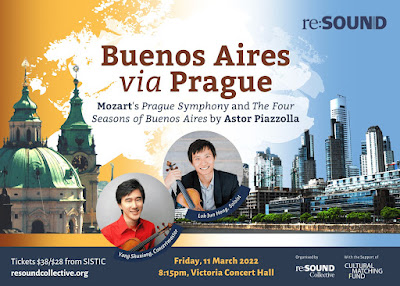
BUENOS AIRES VIA PRAGUE / re:Sound with Loh Jun Hong / Review


BUENOS AIRES VIA PRAGUE

re:Sound with Loh Jun Hong, Violin

Victoria Concert Hall

Friday (11 March 2022)


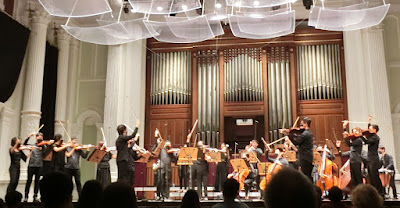
If there were a concert that confirmed the collective prowess of a professional chamber orchestra in Singapore, that would have been this evening’s chalk and cheese programme of Mozart and Piazzolla by re:Sound. In two diametrically different musical idioms, Singapore’s elite chamber ensemble showed that it could not just cope with the music well, but also shine and excel.


Photo: Joel Chew


Opening the evening was Mozart’s Symphony No.38 in D major (K.504), known as the Prague Symphony because it had its 1787 premiere in the Czech city. Led by concertmaster Yang Shuxiang, the players launched into the long-held opening note with one accord, incisively and without fear. These moments often determine the direction and tenor of the performance, and one was in no doubt it was going to be an exciting one. The elaborate slow introduction and build-up was well handled, and the ensuing Allegro movement proper simply took off. Although this was not a period instrument group, swiftness and lithe textures from the strings gave it the buoyancy and lightness that resembled one. With a clear and homogeneous sound, with all fat trimmed off, lean and mean was the way to go.
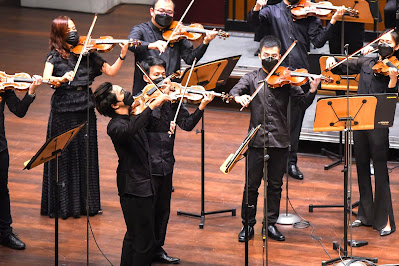

Photo: Joel Chew


The extended slow movement oozed elegance and fine control. So persuasive it was that one does not even doubt that its second subject could actually be the “Enigma” theme from Elgar’s famous set of variations. This three-movement symphony lacks the customary Minuet and Trio movement, in its place was a Presto finale taken at a searing pace. The ensemble’s togetherness at such an implausibly fast speed was a testament to its capabilities. A chill factor was also provided by the flutes of Cheryl Lim and Rachel Ho which cut to the bony core. To say this was an exhilarating performance would be an understatement.
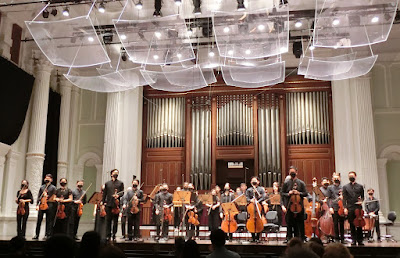
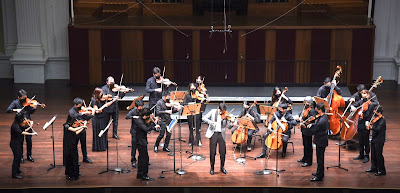
 
Photo: Joel Chew

As it turned out, this day (11 March) marked the 101st birthday of Argentine tango composer Astor Piazzolla (1921-1992). The programming of his Cuatro Estaciones Porteñas (Four Seasons of Buenos Aires) was likely no coincidence. The work, modelled after Vivaldi’s Four Seasons, has become a staple of orchestras around the world, thanks to Ukraine-born Leonid Desyatnikov’s arrangement for violin and strings which was recorded and popularised by Gidon Kremer and Kremerata Baltica. It was also the ideal vehicle for young Singaporean violinist Loh Jun Hong’s exuberance and virtuosity. He possesses a gorgeous tone and the free-wheeling spirit to make everything sound as if freshly improvised.


Supported by the 21 string players of re:Sound, the performance was total treat. In Otoño Porteño (Autumn), its unique sound world was established; brash and resonant, with the regular use of sul ponticello (bowing near the bridge) with its raspy metallic timbre, very heady stuff indeed. Principal cellist Lin Juan’s solo were also excellent, a perfect foil for Loh’s showboating. This music is never coy, and all the players gamely brought out its oozing sex appeal. Invierno Porteño (Winter) is the mellowest piece of the four, its melancholic melody bringing out a chill. Desyatnikov’s arrangement is also interesting as short quotes from the original Vivaldi are slyly inserted into the musical fabric, like an echo and distant reminiscence.


It was back to more high jinx in Primavera Porteña (Spring), with a fugal treatment of its main theme, and the clarity of the playing becomes even more apparent. Loh’s animated moves, with his gravity-defying back-arching maneuvers reminded one of a latter-day Paganini, once rumoured to have some connective tissue disorder that allowed him an envious flexibility that no other possessed. Closing with Verano Porteño (Summer), its infectious rhythms and outrageous glissandi brought down the house.
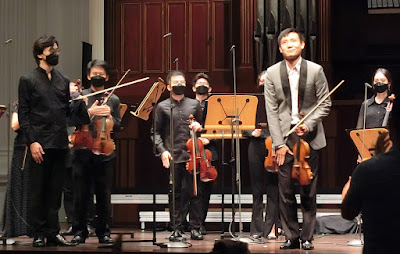


Seldom has there been a more spontaneous standing ovation seen at a chamber concert, and the delicious encore was served up by Loh and leader Yang, the mischievous duo violin arrangemenent of La Cucaracha by that master of music comedy himself, Aleksey Igudesman.


Photo: Joel Chew


Thursday, 13 September 2012

PIAZZOLLA FOREVER SEPTET 20TH ANNIVERSARY TOUR / RICHARD GALLIANO et al / Review


PIAZZOLLA FOREVER SEPTET
20TH ANNIVERSARY TOUR
Richard Galliano, Accordion
Esplanade Concert Hall
Tuesday (11 September 2012)

This review was published in The Straits Times on 13 September 2012 with the title "Playing Piazzolla with Pizzazz".

The tangos of Argentine bandoneon player and composer Astor Piazzolla (1921-1992, below) have travelled so far and wide that the music is now available in every conceivable instrumental arrangement thought possible. Every classical artist or ensemble is thought cool and progressive if Piazzolla featured in their repertoire. His revolutionary Tango Nuevo (literally New Tango) was however conceived for quintet or octet, led by the bandoneon (Argentine folk accordion).


French accordion virtuoso Richard Galliano’s Piazzolla Forever Septet, assembled for the 20th anniversary of Piazzolla’s death, comes closest to the original conception. Galliano was himself mentored by Piazzolla and offered an instinctual view of this infectiously rhythmic and often raunchy music.


The 90-minute concert, played without break, began with the little Chiquilin de Bachin, played on a harmonica-like instrument, its tiny sonorous pipes powered by lungs rather than pulled bellows. This short prelude ushered in the group’s seven members, and Galliano brought out the accordion for his Tango for Claude, which established the general tenor of adrenaline-pumped exuberance of the evening.

The main work was the popular Four Seasons of Buenos Aires, beginning with Spring and Summer, the unmistakeable ostinatos and whooping portamentos (slides) making these favourites instantly recognisable. From deep within, a fount of melody - usually melancholic by contrast - comes to the fore. One soon realises that tango is not just a dance or art form, but an unspoken language, even a way of life. Galliano’s passionate and deeply involved artistry was proof of that.


He then swapped the heavy accordion for the more diminutive bandoneon (above), which resembles a concertina, resting it on his upheld thigh as he played. With its more intimate and sustained tones, soulful numbers like Milonga del Angel, Oblivion, Michelangelo 70 and Soledad found their true voice. Violinists Sebastian Surel and Bertrand Cervera, and cellist Eric Levionnois all found themselves in the spotlight for a spot of improvisation.

The Seasons were completed with Autumn and Winter, the latter being the only slow movement of the four, and with good reason. As folks go indoors and nature hibernates, the music darkens but not without a fanciful cadenza from pianist Dimitri Naïditch.

Galliano’s own music, including Heavy Tango and New York Tango, were essentially tributes to the master. The latter was particularly frenetic, with a startling sequence where the strings in sequence simulated the inimitable inner city wail of sirens.    

There were three generous encores, including Matos Rodriguez’s La Cumparsita and Piazzolla’s highly energised Libertango, the latter seeing Galliano as a veritable one-man-band. There could not have been anything else but a standing ovation after that. 

There was no programme booklet provided for this concert, so I'm very grateful to Esplanade for providing me with this concert listing of works performed.

Thursday, 21 April 2011

TURN! TURN! TURN!... by re:mix / An Interview with FOO SAY MING


TURN! TURN! TURN!... 
The Twelve Seasons
By re:mix / FOO SAY MING, Violin
1 May 2011, 
Esplanade Concert Hall, 7.30 pm

This very interesting concert by re:mix, Singapore’s hippest chamber orchestra presents The Four Seasons by Antonio Vivaldi, Four Seasons of Buenos Aires by Astor Piazzolla and four new Seasons by Singaporean composers. PianoMania catches up with violinist FOO SAY MING, leader of re:mix for his thoughts on his latest musical escapade.

Q: Your chamber ensemble re:mix has developed quite a reputation in exploring new vistas of classical and popular music, and literally remixing them together. How did a classical violinist such as yourself arrive at this state of affairs?

re: mix has been asked this many times before, and the replies have always been surprising and often hilarious, such as: “We’re an outrageous group with exuberance and wild ideas... " and "Being fun-loving musicians, it is only natural that we have super fun in our concerts..."

There is just so much great music out there. The biggest limitation for any musician who loves good music is to play just one instrument. We ask ourselves: Why does good music have to be confined to the instrumentation it was originally conceived? Would such music still be great if presented in any other form?

In a nut-shell, we want to explore music within the chamber orchestra genre, and even exude the energy of a rock concert in the concert hall! We hope to continue to having fun, and have our audience join us in sharing this fun.

Do tell us what the pop song Turn! Turn! Turn!... has to do with The Four Seasons of Antonio Vivaldi (left).

Back in the 60's, singer-songwriter Pete Seeger adapted verses from Chapter 3 of Ecclesiastes as the lyric of the hit-song "Turn, Turn, Turn". The whole chapter is summed up by its first verse: "To everything, there is a season". While Vivaldi's almost programmatic Four Seasons may not find resonance with these verses, we can see some common ground. Vivaldi’s Seasons graphically describes scenes of the Italian seasons from about 300 years ago, such as dances of love, harvest, festivities, solitude, mourning and rejoicing. Through this thought, we find a musical thread that in life, there is a time for everything.

Now you’ve done the Gidon Kremer thing by combining Vivaldi’s Four Seasons with Astor Piazzolla’s Four Seasons of Buenos Aires (left), and you’ve added four more Singaporean seasons to this mix. Will this sound like some kind of rojak?

If it does turn out to be one, we hope that it would be a good rojak, after all, it still is a signature Singaporean dish! Jokes aside, what re: mix hopes to achieve and convey in this very exciting programme is that life has its rhythm and a line, and for some, a line that has no end. What better way to present this concept with a Singaporean angle, by featuring Singaporean composers expressing their thoughts through music. In the four new works, we hope to invite our audience to ponder about the ups and downs of life’s journey. Hence, "To everything, there is a season".

Who are these Singaporean composers, and what can they offer our listeners?

At the helm of this project is veteran composer Kelly Tang, who is also advisor for this re:mix special commission. The works of four composers are combined into one uniquely Singaporean canvas. We are excited to feature three rising Singaporean composers: Chen Zhang Yi, Denise Lee, and Derek Lim. Excellent in their own right, they are as diverse in their styles as their strengths! We "assigned" various movements and ideas to each in hope that these may become a vessel for their best composing skills, character and temperament. Their scores are trickling in, and we are already impressed and excited about performing these works. Our listeners can expect to experience an incredible palette of emotions and creativity!

How has working on these Twelve Seasons with re:mix enriched your life? Why should the audience come?

On a musical level, the pieces have a strong resonance with us performers. While the melodies in the Vivaldi Seasons have become evergreens, they nonetheless still evoke very universal emotions such as joy, love, and fear. Piazzolla's tangos are beloved because of the palpable beat and raunchy dance steps, but the music is laced with sorrow and frustration.

The Singapore "Seasons" boast the best of Singapore's young composers, and their style is nothing shy of intense and diverse. The concert will be a roller-coaster of emotions, intensities and colours, for both performers and listeners.

There is a season for everything. And on Labour Day, we invite all to lend an ear and supporting hand for some of Singapore's talented composers. And also to spend a relaxing evening with re:mix in some of the most beautiful music written for the string orchestra.


This interview was first published in SMA News (March 2011).