Showing posts with label Butterfly Lovers Violin Concerto. Show all posts

Thursday, 11 November 2021

THE BUTTERFLY LOVERS / Singapore Symphony Orchestra / Review


THE BUTTERFLY LOVERS

Singapore Symphony Orchestra

Esplanade Concert Hall

Thursday (5 November 2021)


This review was published by The Straits Times on 10 November 2021 with the title "Love story tugs at heartstrings".


It is not often that the Singapore Symphony Orchestra performs concerts entirely devoted to 20th century and contemporary Asian music. These are notable events, especially when works by two Singaporean composers were also receiving SSO premieres.
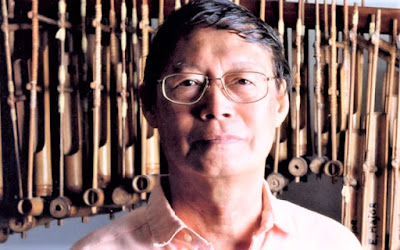
 

Singaporean composer Leong Yoon Pin
was a student of Nadia Boulanger.


SSO’s first Composer-in-Residence and Cultural Medallion recipient Leong Yoon Pin’s Largo and Vivace for strings (1982) opened the evening on a sombre note. While not strictly atonal, his idiom was astringent, reminiscent of twentieth century greats Bartok and Shostakovich. Conductor Joshua Tan skillfully guided the ensemble, with string textures coming through with leanness and clarity. If the Largo were a portrait of depression, the brief ensuing Vivace projected an agitated face of neurosis.


Chen Gang and He Zhan Hao’s evergreen Butterfly Lovers Concerto (1958) was the obvious box-office draw, which saw award-winning Singaporean violinist Loh Jun Hong helming the solo part. His voluminous tone was the highlight in this programmatic fantasy, more a tone poem than concerto, about the ill-fated lovers of Chinese folklore.


Unafraid to bare heart on sleeve, he pulled out all stops in this tear-jerker, also exercising wide portamenti or slides which relived Chinese opera-singing and weeping erhus. His duet with orchestral cellist Yu Jing provided moments of genuine intimacy in a work where vivid story-telling and sentimentality were strong suits.

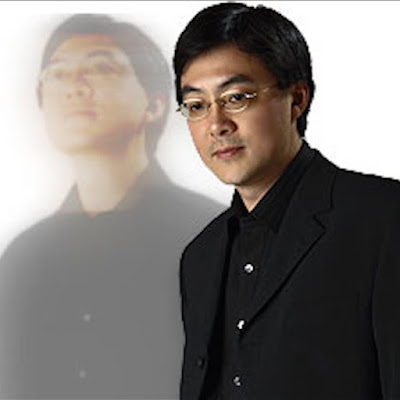


Singaporean composer Ho Chee Kong
is the Interim Dean of Yong Siew Toh Conservatory.


Ho Chee Kong’s double concerto for violin and cello entitled There And Back (2019) has no such programmatic pretensions. Before it began, SSO Principal Cellist Ng Pei-Sian dedicated the performance to his recently departed first cello teacher Barbara Yelland. Violinist Chan Yoong Han opened with an impassioned solo, followed by Ng himself with no less intensity, both accompanied by Mark Suter’s slow and ominous beat on bass drum.


The funereal pace strongly suggested a requiem in procession. The tempo then picked up with both soloists engaged in a neck-and-neck race, the music now resembling a cinematic score depicting broad vistas and the vast outback. The alternating slow and fast sections proved both unsettling yet exciting, and the duel between instruments absorbing and exhausting.


That had to end sometime, doing so with the orchestra silenced, and both violin and cello in quiet beatific unison. With bass drum taps remaining an idée fixe, the work may be considered a metaphorical epic journey of life itself. Ending as it began, with ups and downs in between, it represented a perpetual cycle from “ashes to ashes, and dust to dust”.


First performed by violinist Siow Lee-Chin and cellist Qin Li-Wei with the Singapore Chinese Orchestra led by Yeh Tsung, it made an instant impact and named best new work of 2019 in the pages of Life! This evening’s take was no less moving.


All three of the evening’s soloists were united for an encore designed to cheer up the audience. That turned out to be Alexander Oon’s arrangement of Astor Piazzolla’s Oblivion, the Argentine composer’s most melancholic tango of all. Ironically, it made for a truly fitting send-off. 


Monday, 3 September 2018

BUTTERFLY LOVERS / Joshua Bell and Singapore Chinese Orchestra / Review


BUTTERFLY LOVERS
Joshua Bell and 
Singapore Chinese Orchestra
Singapore Conference Hall
Friday (31 August 2018)

This review was published in The Straits Times on 3 September 2018 with the title "A flight of beauty with Bell".

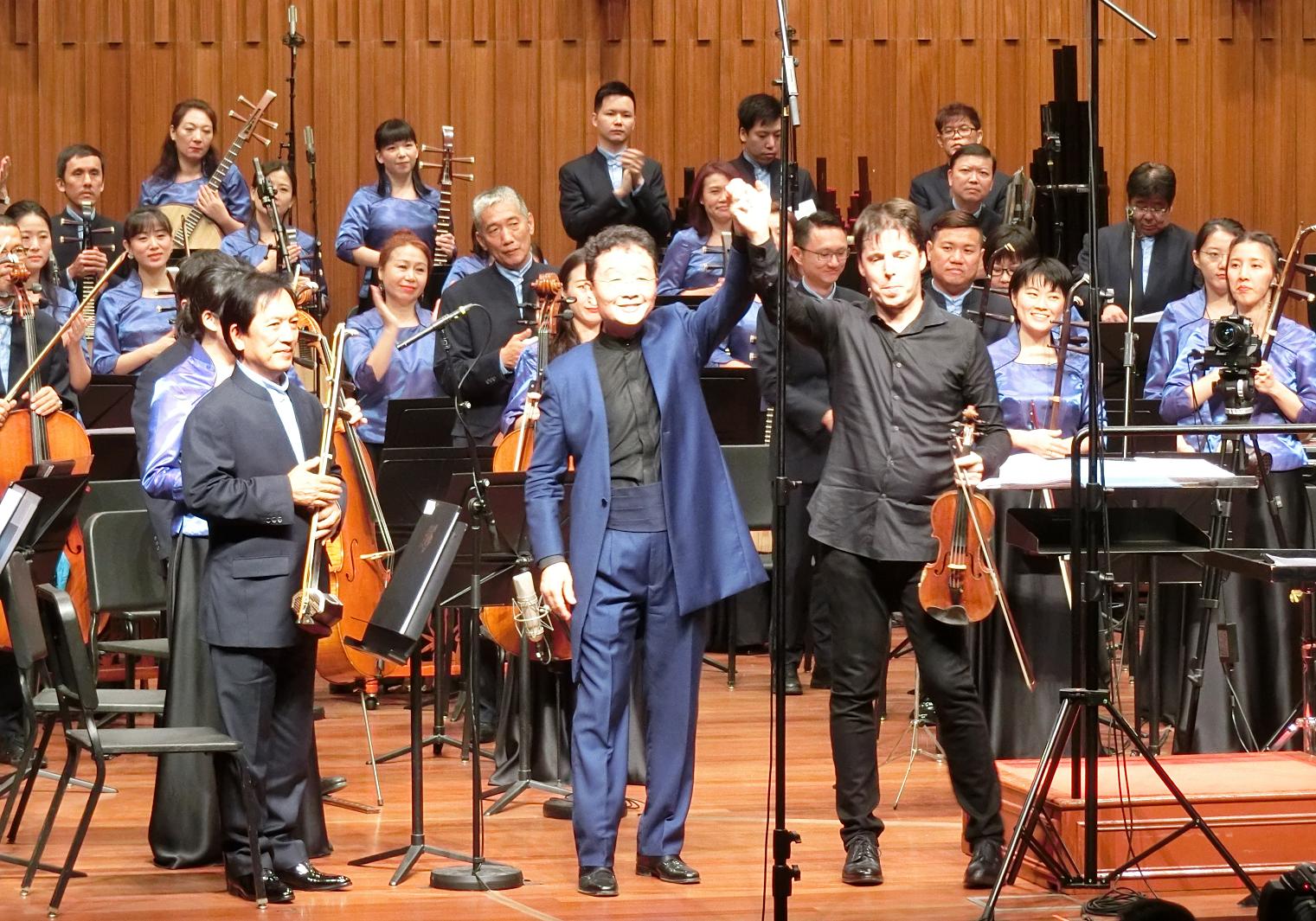
Superstar American violinist Joshua Bell’s much awaited return to Singapore culminated with two performances of Chen Gang and He Zhanhao’s evergreen Butterfly Lovers Violin Concerto partnering the Singapore Chinese Orchestra conducted by Yeh Tsung. Two separate audiences got to witness the spectacle, in Esplanade Concert Hall last Thursday and Singapore Conference Hall the evening after.


That he truly mastered the work, technically and idiomatically, was not unexpected. After all, the concerto was originally conceived for the Western violin and symphony orchestra in an attempt to create a piece that resembled Romantic era violin concertos audiences so yearn for. Although popular melodies from Beijing Opera were the basis of its themes, billions of listeners have enjoyed it as a Western-styled showpiece with Chinese characteristics.


Bell was not even the first non-Asian violinist to attempt it here. Another American, Gil Shaham and the Singapore Symphony Orchestra (directed by Shui Lan), recorded it more than a decade ago, with the coupling of Tchaikovsky’s Violin Concerto. The only difference here is the use of Chinese instruments as orchestral backing, in an arrangement by Yan Hui Chang and Ku Lap Man.


What stood out immediately was the beauty of Bell’s tone, gorgeously crafted and sonorously projected, contrasted against a backdrop of accompanying huqins. Every phrase was immaculately voiced and the feeling of fuzzy warmth, so typical in musical Romanticism, was gratefully lapped up. One can also be thankful that the temptation for excessive portamenti, or slides often heard or erhus in imitation of the opera voice, was resisted.


He even played in the tuttis, blending in with the orchestra, and the accompaniment was always discreet, allowing his voice to shine. In the tender duets with cellist Xu Zhong, there was much sympathy and synchronicity. A spontaneous standing ovation was the result, and an encore of Western art imitating the East in Fritz Kreisler’s tongue-in-cheek Tambourin Chinois.


Bell was made to work hard earlier in the evening, with commanding solos in Saint-Saens’ Introduction and Rondo Capriccioso and Sarasate’s Gypsy Airs, all staples in a virtuoso violinist’s repertoire. What truly touched the heart was a seamlessly gilded reading of Massenet’s Meditation from Thaïs, accompanied by strings, light winds and harp.


Bringing this memorable concert to the two-hour mark were purely orchestral works which began each half. Three movements from Tan Dun’s Yellow Earth were a joyous but raucous celebration of the inhabitants from the Huangtu Plateau with percussion, solo suona, suona chorus and vocalisations from orchestral members leading the way. In Guo Wen Jing’s Ava Mountain from Dianxi Folk Tunes, a vigorous tribal beat from China’s Southwest ethnic minorities dominated, with the piquancy of zhonghus and dizis spicing up the mix.


Although the audience had been reminded that a live recording was taking place, there remained an inconsiderate minority who ignored the need to stifle coughs, and noisily unwrapping sweet wrappers to boot. One hopes that the Sony Classical album that results will have only sweet music, not noise.


Wednesday, 19 August 2015

CD Reviews (The Straits Times, August 2015)


J.S.BACH Concertos for 2 Harpsichords
MASAAKI & MASATO SUZUKI
Bach Collegium Japan
BIS 2051 / *****

Johann Sebastian Bach (1685-1750) left the world with just three concertos for two keyboards (all dating from 1736), which seems like a real pity. These are some of his most enjoyable concertos, not just because of its melodic content or digital virtuosity but also its immaculate play of counterpoint. No autograph scores exist, but two of these - both in the key of C minor - will be familiar to listeners in other guises. The best known is BWV.1062, which has the same music as the famous Double Violin Concerto in D minor (BWV.1043). The work sounds slightly different now, with the busyness of both harpsichords replacing the more pared-down violin textures.

The other, BWV.1060, is more regularly heard as the Concerto for Violin and Oboe, distinguished by one of Bach's most beautiful slow movements. The Concerto in C major (BWV.1061) is his most cheerful and extroverted keyboard concerto by far. The father and son combo of Masaaki and Masato Suzuki on two harpsichords are ideally matched, and the balance struck with the accompanying string players is close to perfection. The bonus is Masato's transcription for 2 keyboards of Bach's Orchestral Suite No.1, conceived idiomatically as if the master wrote it himself. A delightful disc all round.     

BOOK IT:
MASAAKI & MASATO SUZUKI
with the Singapore Symphony Orchestra
Victoria Concert Hall
27 & 28 August 2015 at 7.30 pm
Tickets available at SISTIC


THE BUTTERFLY LOVERS
LU SIQING, Violin
Taipei Chinese Orchestra 
Chung Yiu-Kwong (Conductor)
BIS  2104 / ****1/2

Given China's inexorable rise as economic power and cultural giant, Chen Gang and He Zhanhao's Butterfly Lovers Concerto sitting pretty alongside with violin repertoire favourites has become inevitable. Gil Shaham had previously coupled Butterfly Lovers with Tchaikovsky's Violin Concerto (with the SSO), but this new recording is wholly accompanied by Chinese instruments. Chinese violinist Lu Siqing cements his place as one of the work's most persuasive advocates with this moving account which also boasts of the best sound on CD.

The traditional instruments of the Taipei Chinese Orchestra, in the arrangement by its conductor Chung Yiu-Kwong, also lend a touch of the authentic. Does the evocative introduction not sound better with dizi than the modern flute? At its climaxes, the piercing sound of suonas add to the pathos of the music. Its fillers include Chen's Sunshine On Taxkorgan, Ma Sicong's Nostalgia (from Inner Mongolian Suite), Kreisler's Tambourin Chinois (now sounding even better with Chinese percussion), Tchaikovsky's Melodie (from Souvenir D'un Lieu Cher), Sarasate's Gypsy Airs and Wieniawski's Legende. The last receives an idiomatic arrangement by award-winning young Singaporean composer Wang Chenwei. That's globalisation for you.

Tuesday, 25 June 2013

YOUR SMILING FACE / re:mix / Review


YOUR SMILING FACE
re:mix
Esplanade Recital Studio
Sunday (23 June 2013)

This review was published in The Straits Times on 25 June 2013 with the title "Modern re:mix of vintage tunes".

It is little secret that the chic local string ensemble re:mix is the master of nostalgia. After all, its music director Foo Say Ming, artist advisor Phan Ming Yen and leader Lim Shue Churn belong to a generation pushing middle age, people who remember when RTS (Radio Television Singapore) programmes were in black and white and transmission closed on the stroke of midnight.  

Its programmes relish in old music and vintage movies. Your Smiling Face (Huan Yan) was an iconic 1970s Taiwanese romance film that starred Sibelle Hu, with music sung by Chyi Yu, beloved largely by Chinese-speakers of a certain age.  Do forgive a younger generation of Singaporeans brought up on Korean soaps and K-Pop, which rising young composer Chen Zhangyi belongs to.

Despite his youth, Chen is an old soul in disguise, or at least he sounds like that. His musical arrangements of the oldies songs, have a retro feel despite coming across as modern. The three part suite that opened the concert, comprising Everlasting Love (Bu Liao Qing), Sands of Sorrow and New Everlasting Love, resembled a pastiche of three–movement concerto grosso from the baroque.

Soloists who comprised pianist Beatrice Lin, violist Lim Chun and violinist Foo were set apart from the main body of strings. Their concertino roles included an opening flourish and cadenza on the piano and generous helpings of melodic interest. The ripieno strings were not just mere accompanists, but provided a richly textured and layered support over which the soloists were allowed to shine.

In the same vein was Drei Gesänge der Chyi Yu (Three Songs of Chyi Yu), a triptych based on the afore-mentioned movie. The first movement Walking in the Rain revelled in a Bachian fugue, while the central Olive Tree was a sort of pizzicato polka. In the finale Your Smiling Face, the Prelude from Bach’s Third Violin Partita was cleverly weaved as counterpoint into the main theme. Much more sophisticated and less contrived than those “Beatles Concertos” of old.


The final chunk of the 70-minute concert was the Singapore premiere of a chamber version of the indestructible Butterfly Lovers Concerto. Woodwinds, French horn, harp and piano were co-opted for this - love it or hate it - rather effective showpiece that draws upon the same tear-jerking emotions that had come before.

Its success was also due in large part of Foo’s passionate solo playing, that incorporated flying hair, foot stamping and animated bodily movements. His sensitive partnership with cellist Kenneth Lee in the Liang Shanbo and Zhu Yingtai duets also provided touching moments. Although this was the seventh live performance of Butterfly Lovers to be heard within the last three months, its appeal does not seem to be waning in the least. Foo’s forthcoming CD recording with re:mix should be worth waiting for.         
  

Monday, 22 April 2013

BUTTERFLY LOVERS / Singapore Chinese Orchestra / Review


BUTTERFLY LOVERS
Singapore Chinese Orchestra
Singapore Conference Hall
Saturday (20 April 2013)

This review was published in The Straits Times on 22 April 2013 with the title "A tale of two concertos".

The Butterfly Lovers by Chen Gang and He Zhanhao has to be the most popular concerto in Singapore, even beating off the likes of those by Chopin, Tchaikovsky and Rachmaninov. Tickets for the Singapore Chinese Orchestra’s two evening concerts with famous Chinese violinist Lu Si Qing were sold out so quickly that a matinee performance had to be added. He was also the fourth violinist to play this Chinese evergreen here within the space of six weeks.

Despite the virtuoso violin part, it is not a concerto in the strictest of senses. It is more a programmatic symphonic poem in sonata form, as compositional theorists might point out. Its appeal comes from the sheer melodic charm of its first subject, an exciting development and a nostalgic recapitulation with all the tear-jerking melodrama. The tragi-romantic storyline also provides much scope for imagination.


To this end, Lu’s offered a wondrous sense of the narrative. His seemingly casual demeanour was that of a wizened story-teller spinning a yarn to wide-eyed children, belying an impeccable and faultless technique. His liberal use of portamenti (sliding pitches) at the beginning may have verged on the sentimental, but that was a deliberate attempt to mimic the operatic human voice with all its inflexions and nuances.

Needless to say, he received the most prolonged applause, yielding two encores, but that was only part of the story. The other part belonged to erhu soloist Song Fei, who was no less prodigious or vivid in Kuan Nai-chung’s Centennial Memory of Xinhai, composed in 2011 to commemorate the 100th anniversary of the Chinese revolution that overthrew the Manchu dynasty.

A bona fide erhu concerto written in the form of a 4-movement programme symphony, there were parts that suggested the composer to be an acolyte of Shostakovich and Beethoven. Pitting Kenneth Lun’s big trumpet obbligato part with Song’s delicate erhu in counterpoint, with Beethoven’s Fate motif (from the Fifth Symphony) hovering in the wings was a device employed to good effect in the opening movement Awakening.


Less good was the idea for the lugubrious third movement Nation Sacrifice to appropriate the corresponding funeral march movement of Mahler’s First Symphony, and to quote from Tchaikovsky’s Pathetique Symphony at the end. If that was an act of homage to the great masters, it was not very subtly employed.

The true star, however, was Song who portrayed the full gamut of emotions that a sobbing erhu might achieve. As rumination turned to agitation, and mourning into celebration, the final movement A Century’s perpetual motion was the tour de force of her imperious showing. The erhu’s big statement of the original trumpet theme was also Sun Yat Sen’s ideals of revolution coming to fruition, as the listener is led to believe.

The Singapore Chinese Orchestra conducted by Yeh Tsung also performed Xu Jian Qiang’s Dreams Of The Red Chamber Suite, based on themes from the Yue Opera, and Stephen Yip’s prizewinning contemporary composition Nine Actors. Substantial fillers those were, but it was left for the two big string concertos to hog all the glory.   


Photographs courtesy of Singapore Chinese Orchestra.

Saturday, 13 April 2013

A HAKKA CELEBRATION OF MUSIC / Xiamen Philharmonic Orchestra / Review


A HAKKA CELEBRATION OF MUSIC
Xiamen Philharmonic Orchestra
Esplanade Concert Hall
Thursday (11 April 2013)

This review was published in The Straits Times on 13 April 2013 with the title "Similarities in Celebration".

The Xiamen Philharmonic Orchestra was founded in 1998, which is surprisingly young given that the Chinese coastal city in Fujian has a long history of dealings with the West. It looks and sounds like a young orchestra, raw-sounding at times but making up with lots of spirit and enthusiasm. A large part of this comes from its Music Director Zheng Xiaoying, doyenne of Chinese conductors, who possesses verve and vitality that belies her 84 years.

The concert began with Tchaikovsky’s Capriccio Italien, which despite a confident opening trumpet solo, had the brass section sounding exposed and anaemic in colour. The orchestra overcame initial nerves with vertiginous turns in the tarantella and romped home with suitably brazen bluster.

It seems the birth right of every Chinese orchestra (including the Chinese-dominated Singapore Symphony) to tour with The Butterfly Lovers violin concerto. For not a few reasons, the audiences love it. It was even more likeable when played with the pristine precision and elegance of Huang Bin, winner of the 1994 Paganini International Violin Competition.

Her resolute tone and unwavering intonation came across naturally and unforced, backed up to the hilt by the clearly enlivened orchestra. The love duet sequence with the solo cellist was also a thing of beauty without resorting to cloying sentimentality. All on stage were in their element for this ageless and unflappable warhorse.

Maestra Zheng Xiaoying makes it a mission of hers
to speak to the audience before every piece of music.

This orchestra specialises in works marrying the Chinese aesthete with Western compositional techniques. Liu Yuan’s The Echoes of Hakka Earth Buildings, a 40-minute 5-movement programme symphony, was an example of this even if it was derivative, sometimes maddeningly so.

The work introduced a theme based on just two notes played by solo trombone, an idee fixe representing toil and labour of the Hakkas that reappeared in all its movements. Conductor Zheng, herself a Khek, broke the ice by speaking to the audience before each movement, introducing its themes and ideas, and even reciting poetry. It was in eventuality a good idea, because unlike Beethoven or Brahms, continuous listening could have been tiresome.

Enter the leaf blower, Zhan Jingjing

Projected images of the Hakka tulou, circular walled dwellings and UNESCO-listed heritage sites, helped quell the disbelief when encountering music that borrowed so heavily from Debussy’s La Mer and Respighi’s Fountains of Rome that plagiarism could readily be cited. Short appearances by ethnic singer Zhang Dongmei with her bewitching voice, and Zhan Jingjing, a “leaf-artist” who created an otherworldly sonority by blowing on a tight membrane created by a single leaf however gave the work a semblance of authenticity.

The maestra in her element, conducting the audience.

Excellent solo woodwind playing from the flutes, cor anglais and oboe distinguished the nocturne-like third movement, but the march-like finale joined by a 160-strong choir (formed by eight choral groups from Singapore and one from Penang) singing a catchy shan ge (hill song) proclaiming unity and solidarity was another rousing banality. This time, the Pines of The Appian Way, also by Respighi, was being ripped off.

This was however greatly enjoyed by the audience which heartily clapped along with the music, and was rewarded with its reprise and the popular Molihua, in turn appropriated by Puccini for his opera Turandot. An Italian lifting a Chinese tune, and a Chinese apeing an Italian; so let us call it fair game and a draw. 


As with all Chinese concerts, all the soloists appear at the end to take a collective bow. (From L) Violinist Huang Bin, "leaf artist" Zhan Jingjing, Hakka folk singer Zhang Dongmei and conductor Zheng Xiaoying.

The Xiamen Philharmonic Orchestra performs another concert THE YOUTHFUL MELODIES, a concert of Chinese and Western classics, on Saturday (13 April 2013) in the Yong Siew Toh Conservatory Concert Hall at 4 pm. ADMISSION IS FREE!