Showing posts with label Jacob Cheng. Show all posts

Thursday, 29 January 2026

TIME OUT WITH FRIENDS / Jacob Cheng, Aidan Yeong & Casey Li Piano Trio / Review


TIME OUT WITH FRIENDS
Jacob Cheng (Violin), 
Aidan Yeong (Cello) 
& Casey Li (Piano)
Esplanade Recital Studio
Wednesday (28 January 2026)


Ever wondered at any concert how classical musicians get to be the masters of their art? Clue: they start playing at a very young age, and get to be very good early in the game. Through inspired guidance and counsel from their teachers, they become technically adroit, improve in leaps and bounds, and generally hang around other similarly talented young people. Then they form groups to play together. Some years ago, I saw ARTrio (violinist Jacob Cheng, cellist Timothy Chua and pianist Asher Seow) perform and was suitably impressed. With his friends overseas, Jacob now has a new and as yet unnamed trio, working with cellist Aidan Yeong and pianist Casey Li.


Their concert together was very well subscribed, and it is safe to say that nobody was disappointed with their performance of highly demanding works, which even most adults shy away. The evening opened with Aiden and Casey in the first two movements of Shostakovich’s Cello Sonata in D minor (Op.40). This one of the Soviet dissident composer’s more lyrical and approachable works, yet requires maturity and no little technical nous to pull off.


Aiden impressed with a big tone, one unafraid flex bowing muscles, yet allied with nimbleness of articulation. You can hear the cello sing, a baritone that displays both tenderness and gruffness in short order. Casey’s pianism was alert and very accurate, a close to perfect partner in the proceedings. The freewheeling Scherzo was handled with boldness and with no little irony, with pizzicatos and glissandi flying off the bat, and bringing back fond memories of Mstislav Rostropovich’s unforgettable performance in Singapore in 1992.


It was now Jacob’s turn with a full-length work, Poulenc’s Violin Sonata (1942-43) with pianist Cherie Khor Shang Jin as partner. He has the full measure of its bittersweet humour, his wiry and slightly acidic tone well suited for its Stravinskyan shifts in dynamics and dance rhythms. Lyricism was never in short supply, coming to full fruition in the languorous slow central movement. 


Even when the madcap antics of the opening returned for the finale, it came with an off-switch, the closing pages now tempered with bitterness and grief, a memorial to the death of Spanish poet Federico Garcia Lorca. For someone as young as Jacob, how he was able to grasp the inspiration and idiom behind the music was simply stunning.


Casey was all on her own in Prokofiev’s Four Etudes Op.2, which is competition fodder in many worldwide concours. The young Russian was an enfant terrible from the “Age of Steel”, represented by the relentless diesel-powered mechanistic poundings of the keyboard. All four pieces worked on various areas of technical prowess. 


She got all the notes with consummate (and enviable) ease, but also much of the hidden nuances beyond the black and white. No.3 in C minor was the most Russian of these, combining foreboding and tragedy with the fatalist treadmill of running thirds and grinding chords. Evgeny Kissin famously encored this in his 1990 Carnegie Hall debut, and I dare say Casey was every bit as prodigious.


The concert’s second half was devoted to just one work, Brahms’ Piano Trio No.1 in B major (Op.8), in its revised and more commonly performed version. This was the acid test of what soloists face when working in tandem with others, and all three musicians surpassed themselves. The opening’s gorgeous melody was lovingly voiced, and from there the movement’s development blossomed into one big love-in. The Scherzo’s skittishness and lightness of rhythms was well handled, and before another big melody joined the fray.


The slow movement was spare in texture and motion, but necessitated all the faculties of close concentration between all three musicians. This was where listening to each other became paramount, and nobody missed a beat in this exploration of the stillness of the soul. The finale returned to the earlier hustle-bustle, and with renewed vigour, the work closed on a stirring and spirited high. Heartist congratulations go to all three players, and their teachers whom I will name: Loh Junhong (Jacob), Leslie Tan (Aidan) and Benjamin Loh (Casey). They have all reason to be proud of the musical achievements of mere 16 and 17-year-olds.


Now, let’s hope this trio signs up to perform, polish their craft, and gain more insight about chamber music at this year’s Singapore Chamber Music Festival. At this rate, they will soon be going places.


Friday, 22 March 2024

DARK STORIES - THE DEBUT RECITAL / PRODIGIOUS: TROUT QUINTET & FOUR SEASONS / Jessie M. Piano Recital / re:Sound Collective / Review


DARK STORIES – 
THE DEBUT RECITAL 
Jessie M. Piano Recital 
Victoria Concert Hall 
Tuesday (19 March 2024) 

PRODIGIOUS: 
THE TROUT & FOUR SEASONS 
re:Sound Collective 
Victoria Concert Hall 
Wednesday (20 March 2024) 

This review was published in The Straits Times on 21 March 2024 with the title "Young Singapore talents rule at two recitals".

Fact: there are more young musical virtuosos in Singapore now than any other time in history. Two consecutive concerts at Victoria Concert Hall were all the proof one needed. 


Jessie M. sounds like one of the Spice Girls, but is the stage name of 17-year-old Jessie Meng YiRuiXue, Singapore’s latest and youngest Young Steinway Artist. Winner of multiple age-group piano competitions, her debut recital showed what the fuss was about. 


In two Transcendental Etudes by Franz Liszt, she demonstrated an astonishing adroitness coupled with nuanced responses to technically demanding music. Fast, furious octaves and outsized chords in Wilde Jagd (Wild Hunt), and stampeding runs of Mazeppa seemed like child’s play. Poetry and lyricism were never in short supply, evident in the “simple” measures of Liszt’s Consolation No.2 and melancholic Russian song of Mily Balakirev’s highly-filigreed transcription of Mikhail Glinka’s The Lark


Two modern American composers provided more display of her versatility. William Bolcom’s ragtime novelties showcased graceful insouciance in Last Rag and terminal velocity in The Serpent’s Kiss, the latter including foot stomps, knuckles rapping on the piano’s fallboard, tongue-clicking and even a spot of whistling. For two of Lowell Liebermann’s Gargoyles, she delighted in haunting music-box effects and relentless percussiveness. 


Best of all was M’s hair-raising account of Maurice Ravel’s La Valse, an intoxicating celebration of the Viennese waltz built upon seemingly unending waves of vertiginous whirling. Here was high stakes risk-taking with a true sense of danger courted at every turn. Cataclysm being averted, there could only be final triumph, which the encore of Jack Fina’s Bumble Boogie – in her own edition with multitudes of added notes – duly confirmed. 

Jessie M. with her parents, teacher
Winnie Tay and Steinway Gallery's Celine Goh

@Joelcaptures / re:Sound

Some 16 years older but still young is Berlin-based Shaun Choo who joined members of the Concordia Quartet – violinist Edward Tan, violist Martin Peh, cellist Lin Juan – with bassist Julian Li in a sparkling performance of Franz Schubert’s Piano Quintet in A major, popularly known as the Trout Quintet

@Joelcaptures / re:Sound


This is Hausmusik, music for domestic consumption, usually shared by close friends over hearty meals and imbibed spirits. The camaraderie developed by the players all through its five movements was infectious, best exemplified in the fourth movement’s variations on the song Die Forelle (The Trout, hence its nickname). It was just fun to see the ever-busy Choo slaving away on the keyboard while his string partners took turns to luxuriate in the melody. 

All this congeniality scarcely prepared one for Antonio Vivaldi’s perennial favourite The Four Seasons performed by re:Sound featuring mere children as soloists. One wondered whether child labour laws applied when youngsters do adults’ work with equal authority and conviction. 


Spring was the domain of Yuto Lim (12 years old), whose confident demeanour suggested he was the boss, but he blended perfectly with leader Yang Shuxiang and Kim Kyu Ri’s violins for the birdcalls. Sophia Fang (11) was a little self-conscious in the opening of Summer, but once the Allegro got underway, she became a total natural. Helming the music’s portrayal of a pelting rainstorm, she mastered arguably the most demanding season of all. 


@Joelcaptures / re:Sound

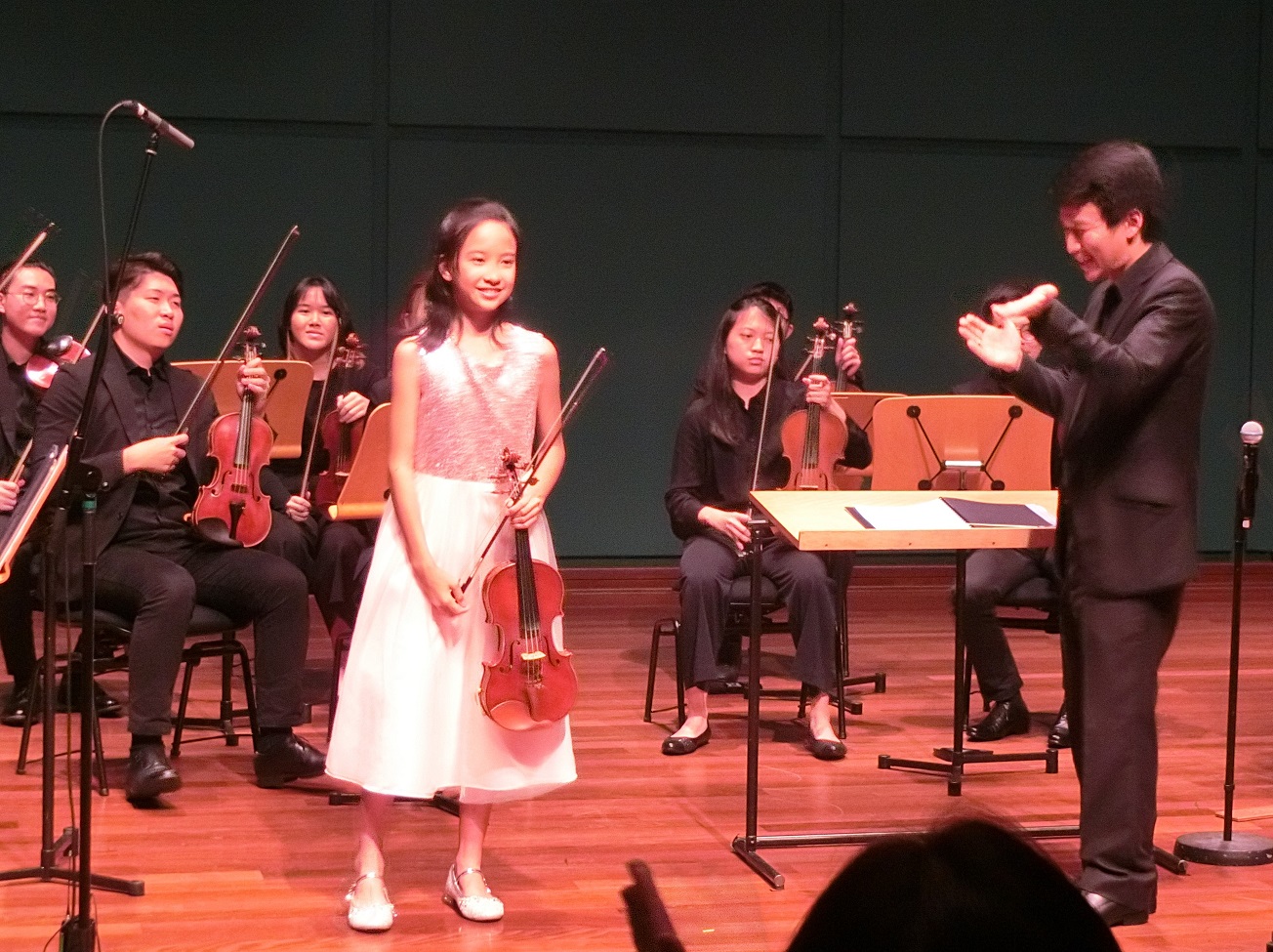
Autumn saw the most mature soloist in Jacob Cheng (15), who physically towered over the others. His was the most personal of performances, showing individuality but worked very well with cellist Lin. The most diminutive performer was Mark Chia (11), who gave the edgiest performance of all in Winter, contrasting an icy chill with the warmth of a fireplace. 

@Joelcaptures / re:Sound

Shut your eyes, and one imagined both concerts being helmed by performing adults. That mere babes accomplished the same was just a frightening thought.

@Joelcaptures / re:Sound

Friday, 2 June 2023

MUSICAL INTERLUDES / The ARTrio / Review


MUSICAL INTERLUDES

The ARTrio

Library @ Esplanade

Wednesday (31 May 2023)


Talented young musicians abound here where the number of would-be virtuosos will soon become a dime a dozen. It is, however, always refreshing to see youngsters coming to make chamber music together. Where musical rivalries can easily form, it takes something special for talents to pool efforts and expertise in order to collaborate. The newly formed ARTtrio, comprising violinist Jacob Cheng (15 years old), cellist Timothy Chua (13) and pianist Asher Seow (14), made its debut as a piano trio in a chamber concert showcasing both individual and collective talents.


The 45-minute recital opened with Timothy performing two movements from J.S.Bach’s unaccompanied Cello Suite No.4 in E flat major. One is first struck by the seriousness in which he approached the Allemande and Courante. He did not strive for a big sonorous tone, instead went for lightness and accuracy of intonation, something more in the spirit of the period instrument movement. The result was both fresh and satisfying.  


Next came Asher in Robert Schumann’s extremely tricky Abegg Variations (Op.1), an early work over-flowing with filigreed passages typical of early Romantic piano writing. On the technical front, he came off very well, confidently skipping through all sorts of harrowing hoops while maintaining a steady rhythmic keel. Finding poetry amid the machinations will be his calling as he grows with this work.


Arguably the veteran of the threesome was Jacob, who performed the finale of Mendelssohn’s popular Violin Concerto in E minor with Cherie Khor as piano accompanist. Its fairy-winged lightness and playfulness found a joyous fulfilment in Jacob’s interpretation, which was a spirited romp from start to end. Now this makes one yearn to hear him in the full concerto, and that will happen in time to come.


Both Jacob and Timothy came together for the well-known Handel-Halvorsen Passacaglia, a showpiece formed by a tight series of short variations. That the duo got all the notes was a given. More importantly, one senses that both players are actually listening to each other and responding in kind. Subtle cues and nuances were picked up on the spur of the moment and then assimilated into the performance. This is the true essence of chamber music.


All three players were united in Beethoven’s early Piano Trio in B flat major Op.11, also called the Gassenhauer (a nickname alluding to something sung on the streets or gasse) because of its finale’s eminently hummable melody. Serious intent was established in the opening movement, stamping the unison passages with some authority before going on their separate paths. It is clear that effort was made to come together, with each member sublimating their solo parts to become part of a whole.


The slow movement had a lyrical quality well exploited by both string players, attentively accompanied by piano, while the finale’s infectiously tuneful variations (based on the song Pria ch’io l’impegno by one Joseph Weigl) captured a joie de vivre that is all too rare among young people these days. Sometimes it is a serious business to have fun. Despite their youth and relative inexperience, this first effort by the ARTrio was a very promising one, and one looks forward to more music-making of this kind from Jacob, Timothy and Asher.


This concert also marks a closing chapter for Library @ Esplanade, which has been a mecca for all things artistic since 2002 when Esplanade first opened its doors. I have many fond memories of this space, having given pre-concert talks, hosted interviews and recitals, and even occasionally performed on its Cristofori grand piano. A legacy of sorts has come to an end, but the good vibes remain.  


The ARTrio with their younger colleagues,
violinists YooJun Curtis Lee and Yuto Lim. 

Wednesday, 22 March 2023

YOUNG VIRTUOSI 2023 / Musicians Initiative / Review


YOUNG VIRTUOSI 2023

Musicians Initiative

Esplanade Recital Studio

Tuesday (21 March 2023)


Ever wondered how the likes of violinist Chloe Chua or pianist Toby Tan came about? Musical child prodigies are rare miracles of nature and nurture, but given the right environment, education, guidance and encouragement, many children can aspire to great heights. It is a matter of time that their talents are revealed, and there are many more prodigies than one suspects. Chloe and Toby, winners of international music competitions, are the only the tip of a giant iceberg.


It repays to discover how big this talent pool is, and this special concert for young soloists presented by Musicians Initiative (now in its second edition), was a big step in the right direction. Six string players played concerto movements and showpieces with the string ensemble from Musicians Initiative led by conductor Edward Tan, better-known as the concertmaster of re:Sound and first violinist of Concordia Quartet.


The 80-minute concert opened with Timothy Chua (12 years old) performing the first movement from Haydn’s Cello Concerto in D major. A picture of confidence, his healthy and robust tone served the music well, including a technically demanding cadenza by Steven Isserlis. Despite a short segment of desynchronisation between soloist and orchestra, he shrugged it off without batting an eyelid and continued to complete his task at hand. Composure is not something easily acquired or grasped, but he has it in shovels.


Despite 10-year-old Korean boy YooJun Curtis Lee being the tiniest of the six, he exhibited the heart of a lion. So natural he was in the first movement of Mozart’s Violin Concerto No.3 in G major (K.216) that it seemed as normal as breathing. Totally unfazed by the double stopping in the cadenza that might have unnerved older players, his reading was one of total control and confidence.


Alyssa Anne Low (11) was perhaps over-ambitious to have chosen Sarasate’s very tricky Zigeunerweisen (Gypsy Airs), but she launched into it with steely determination. She produced a voluminous tone but had intonation issues in the most technically demanding parts. While the slow movement sang prettily, the romping finale came across as a little messy. With the passage of time and more practice, she will certainly grow into this showpiece.   


The surname Qin is almost synonymous with the cello in Singapore, Australia and China, so it was not a total surprise to see Jayden Qin (11) appear in the first movement of Haydn’s Cello Concerto in C major. His was a very nuanced and thoughtful reading, displaying good tone and an understated kind of virtuosity. He is certainly a chip off the old block (and apologies for calling Li-Wei an old block!).


Yuto Lim, despite being just 11, already appears like a seasoned veteran. In Winter from Vivaldi’s Four Seasons, he started playing as if a member of the orchestra, and his solo that emerged from the throng was distinguished by clarity of articulation and tone. His was a no-holds-barred reading, unafraid to let rip in the fiery outer movements yet maintaining a reassuring warmth and glow at its core. He might just be the one to emulate the world-beating feats of Chloe Chua.


Jacob Cheng (14) was the most mature of the six talents, and his view of Ravel’s gypsy rhapsody Tzigane had the requisite virtuosity demanded from an adult performer. His opening unaccompanied solo was spell-binding and the ensuing ride being a thrilling show of swaggering pyrotechnics. Most alertly accompanied by the orchestra, as with the other works, this brought the concert to a stunning close.  


All six young virtuosi returned to perform an encore: the first movement of Vivaldi’s popular Concerto in B minor for four violins. This was an absolute blast, simply because each player had already completed their individual projects and was now enjoying the company of the others. The audience was just as enchanted, erupting with a big communal cheer, the best encouragement the soloists could possibly get. It was the best way of saying,“We want to hear you play again!”