![]() |
| See the resemblance, sort of? |
![]() |
| Photo: @ Joelcaptures |
![]() |
| Photo: @ Joelcaptures |
Share in the musings and memories of Chang Tou Liang, possibly Singapore's most rabid pianophile and pianomaniac.
![]() |
| See the resemblance, sort of? |
![]() |
| Photo: @ Joelcaptures |
![]() |
| Photo: @ Joelcaptures |
YOUNG VIRTUOSI 2023
Musicians Initiative
Esplanade Recital Studio
Tuesday (21 March 2023)
Ever wondered how the likes of violinist Chloe Chua or pianist Toby Tan came about? Musical child prodigies are rare miracles of nature and nurture, but given the right environment, education, guidance and encouragement, many children can aspire to great heights. It is a matter of time that their talents are revealed, and there are many more prodigies than one suspects. Chloe and Toby, winners of international music competitions, are the only the tip of a giant iceberg.
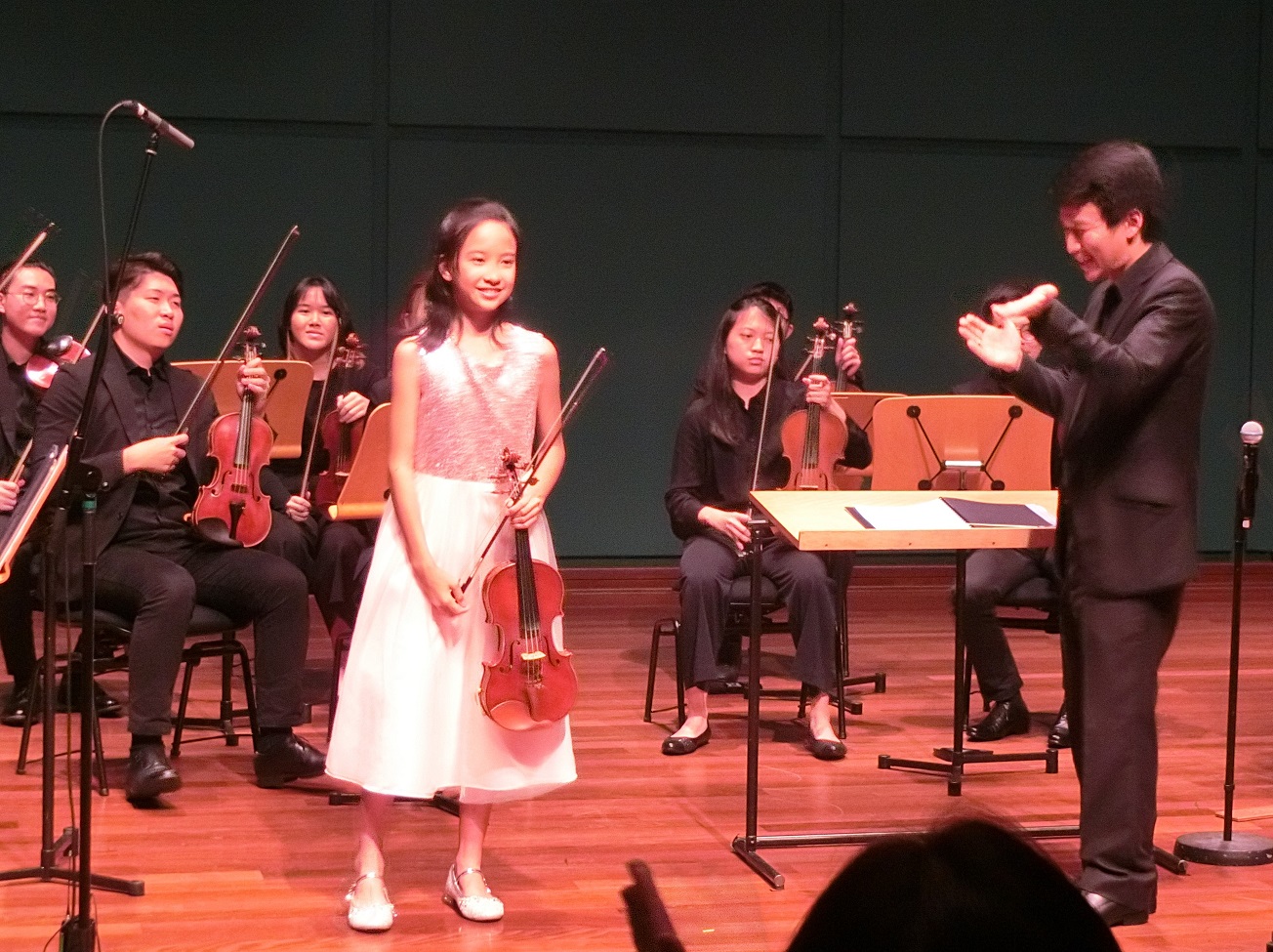
It repays to discover how big this talent pool is, and this special concert for young soloists presented by Musicians Initiative (now in its second edition), was a big step in the right direction. Six string players played concerto movements and showpieces with the string ensemble from Musicians Initiative led by conductor Edward Tan, better-known as the concertmaster of re:Sound and first violinist of Concordia Quartet.
The 80-minute concert opened with Timothy Chua (12 years old) performing the first movement from Haydn’s Cello Concerto in D major. A picture of confidence, his healthy and robust tone served the music well, including a technically demanding cadenza by Steven Isserlis. Despite a short segment of desynchronisation between soloist and orchestra, he shrugged it off without batting an eyelid and continued to complete his task at hand. Composure is not something easily acquired or grasped, but he has it in shovels.
Despite 10-year-old Korean boy YooJun Curtis Lee being the tiniest of the six, he exhibited the heart of a lion. So natural he was in the first movement of Mozart’s Violin Concerto No.3 in G major (K.216) that it seemed as normal as breathing. Totally unfazed by the double stopping in the cadenza that might have unnerved older players, his reading was one of total control and confidence.
Alyssa Anne Low (11) was perhaps over-ambitious to have chosen Sarasate’s very tricky Zigeunerweisen (Gypsy Airs), but she launched into it with steely determination. She produced a voluminous tone but had intonation issues in the most technically demanding parts. While the slow movement sang prettily, the romping finale came across as a little messy. With the passage of time and more practice, she will certainly grow into this showpiece.
The surname Qin is almost synonymous with the cello in Singapore, Australia and China, so it was not a total surprise to see Jayden Qin (11) appear in the first movement of Haydn’s Cello Concerto in C major. His was a very nuanced and thoughtful reading, displaying good tone and an understated kind of virtuosity. He is certainly a chip off the old block (and apologies for calling Li-Wei an old block!).
Yuto Lim, despite being just 11, already appears like a seasoned veteran. In Winter from Vivaldi’s Four Seasons, he started playing as if a member of the orchestra, and his solo that emerged from the throng was distinguished by clarity of articulation and tone. His was a no-holds-barred reading, unafraid to let rip in the fiery outer movements yet maintaining a reassuring warmth and glow at its core. He might just be the one to emulate the world-beating feats of Chloe Chua.
Jacob Cheng (14) was the most mature of the six talents, and his view of Ravel’s gypsy rhapsody Tzigane had the requisite virtuosity demanded from an adult performer. His opening unaccompanied solo was spell-binding and the ensuing ride being a thrilling show of swaggering pyrotechnics. Most alertly accompanied by the orchestra, as with the other works, this brought the concert to a stunning close.
All six young virtuosi returned to perform an encore: the first movement of Vivaldi’s popular Concerto in B minor for four violins. This was an absolute blast, simply because each player had already completed their individual projects and was now enjoying the company of the others. The audience was just as enchanted, erupting with a big communal cheer, the best encouragement the soloists could possibly get. It was the best way of saying,“We want to hear you play again!”
WOODS, STREAMS & SUN-KISSED HILLS
Concordia Quartet
Ngee Ann Kongsi Theatre @ Funan
Saturday (30 July 2022)
It may be said that Concordia Quartet, only Singapore’s second full-time professional string quartet, has had a rough time. Formed by hand-picked members from its mother ensemble, re:Sound Collective, it gave its inaugural concert at Funan Centre’s Ngee Ann Kongsi Theatre in February 2020. The Covid pandemic arrived in Singapore one month later, thus totally disrupting its concert schedule and nascent ambitions. The quartet however persevered by producing a digital concert – a first of its kind - with all four socially distanced members playing from own living rooms, viewed via the Internet. Even before the group could establish itself, two of its original members had retired from quartet playing.
It however got a break, being selected as a quartet-in-residence at the PRISMA (Pacific Region International Summer Music Association) Festival at Powell River, British Columbia in July. Upon their return, violinists Edward Tan and Kim Kyu Ri, violist Martin Peh and cellist Lin Juan were greeted by a small but enthusiastic audience in this concert, performing works the foursome had studied and played in Canada.
Haydn’s String Quartet in C major (Op.33 No.3) opened the evening, with first violinist Edward Tan mimicking the repetitious bird call in the opening movement which gave the quartet its nickname “The Bird”. Such published nicknames, which helped listeners differentiate between Haydn’s 68 quartets, do not add much to the understanding of the music. It was thus down to the ensemble’s narrative ability to guide the listener, and here Concordia succeeded by being clear-headed and tautly exacting in its delivery.
Cohesiveness was most apparent in the faster sections of the first movement, and communications between both violinists in the minuet-like subject of the second movement was spot on. Kyu Ri’s regular and frequent glances at Edward provided a key, which continued through the rest of the quartet and the concert itself. The slow movement provided contrasts by shifting between major and minor keys, before the repeated C major triads of the finale brought the work on a playful and humorous close.
The Ngee Ann Kongsi Theatre is modelled along the lines of Shakepeare’s Globe Theatre (on the south bank of the Thames) with the stage surrounded on three sides by three tiers of seating. There appears no listener seated further than ten to fifteen metres from centrestage, which lends the venue an intimacy almost ideal for chamber performances. Dryish acoustics notwithstanding, the quartet coped very well, bringing its performances a resonance usually associated with more reverberant venues.
Anton Webern’s Langsamer Satz (Slow Movement), possibly Romanticism’s anguished final cry, came across very well here. Again, the playing was tightly knit, the aching Mahlerian melody finding full bloom through denser harmonies, and even Martin Peh’s viola was afforded full voice, followed by Lin Juan’s cello. The warm and fuzzy gemutlich atmosphere got the audience buzzing for the duration of the intermission.
Tchaikovsky’s String Quartet No.1 in D major (Op.11), a relatively youthful work closed the concert on a high. Loosely founded on Russian folk elements, an opening drone established the mood of genteel rusticity, from which further themes were organically developed. This apparent simplicity was not lost to the quartet, which gradually built upon its foundation to reach loftier heights. The well-loved slow movement Andante Cantabile needs little introduction, and the quartet did well to avoid the mushy sentimentality frequently associated with popular tunes.
Warmth of tone was again key in the playing, which continued into the syncopated chords of a slightly tense Scherzo and the more light-hearted finale. When outright virtuosity was called for, the quartet delivered in spades. Where razor-sharp reflexes and split-second synchronisation determines whether a work stands or falls, good training and experience of ensemble becomes paramount, and Concordia Quartet did not fall short. With no concessions given to its youth, this quartet will go far and become like the well-established T’ang Quartet, a beloved permanent fixture of the Singapore musical scene.
FOR FRIENDS AND LOVERS
Concordia Piano Quartet
Victoria Concert Hall
Saturday (21 May 2022)
The Concordia chamber group, part of re:Sound Collective, has returned but in the form of a piano quartet. Of the original string quartet, second violinist Kim Kyu Ri had resumed her Masters studies overseas, while cellist Theophilus Tan retired. First violinist Edward Tan and violist Mathias Oestringer were joined by new cellist Lin Juan and pianist Jonathan Shin to form the Concordia Piano Quartet. This group’s first concert together was nothing less than a musical triumph.
Pandemic disruptions had done little to dent the players’ abilities and yearning to put on a good show. The concert opened with Mozart’s Piano Quartet No.1 in G minor (K.478), the first important work written for this medium, essentially a string trio augmented by a piano. The unison of strings and piano at its outset delivered the music’s sturm und drang (storm and stress) without apology, and the alternating between minor and major modes kept the narrative interesting. Shin’s pianism was crisp and tidy, and with the string players formed a cohesive unit. The central slow movement was a model of lyrical grace, contrasted with the chirpy Rondo finale, filled with the same light-heartedness of the finale from Piano Concerto No.17 (K.453), also in the same key. This was a reading of true joie de vivre.
Prolific composer Jonathan Shin’s Four Pictures of Mid-Winter Boston for piano trio was composed in 2017 while snowbound in his New England apartment. Its four movements used simple themes, occasionally modal in nature and sometimes resembling impressionist hues of Debussy and Co. While the opening movement’s piano introduction and string harmonics evoked mystery, the scherzo-like second movement was a playful snow fight between friends, the swift tempo later upped into the little storm of piano flurries in the brief third movement. Edward Tan’s violin’s dominated the final movement, recalling Vaughan Williams’ The Lark Ascending with its pentatonic melody before unleashing a series of Paganinian arpeggios. With short piano chords and a whisper from the cello, the contemplative dream was over.
The concert concluded with Fauré’s Piano Quartet No.1 in C minor (Op.15), the Frenchman’s early masterpiece now considered one of the great piano quartets alongside those of Schumann and Brahms. The opening with unison strings echoed that of the earlier Mozart quartet, filled with passion and fervour. The tact taken by the foursome was more gentle, less hectic than those heard in recordings, but its escalation to full steam sounded all the more thrilling. That the ensuing Scherzo seemed lots of fun, with string pizzicatos accompanied by piano arabesques, led to premature applause. This was a sign that the IAB (inappropriate applause brigade) is back in force, which is no bad thing, since concerts desperately need audiences including newbies alongside concert hall veterans.
The slow movement was what Lin Juan described as the angst and pain Fauré had experienced in while falling in and out of love. Its opening voice was provided by his cello, and the movement stood out with its austerity of harmonic language, more often associated with his later and rarefied chamber works. This was beautifully crafted before the energised finale’s romp which reprised the opening movement’s passion.
Twenty years ago, excellent performances as witnessed this evening could only come from full-time musicians of the Singapore Symphony Orchestra. That non-SSO musicians could now achieve standards that equalled or surpassed those concerts of the past speaks well of how our music scene has progressed over the years.
| This was what viewers got to see at home. |
