Showing posts with label Joshua Bell. Show all posts

Monday, 3 September 2018

BUTTERFLY LOVERS / Joshua Bell and Singapore Chinese Orchestra / Review


BUTTERFLY LOVERS
Joshua Bell and 
Singapore Chinese Orchestra
Singapore Conference Hall
Friday (31 August 2018)

This review was published in The Straits Times on 3 September 2018 with the title "A flight of beauty with Bell".

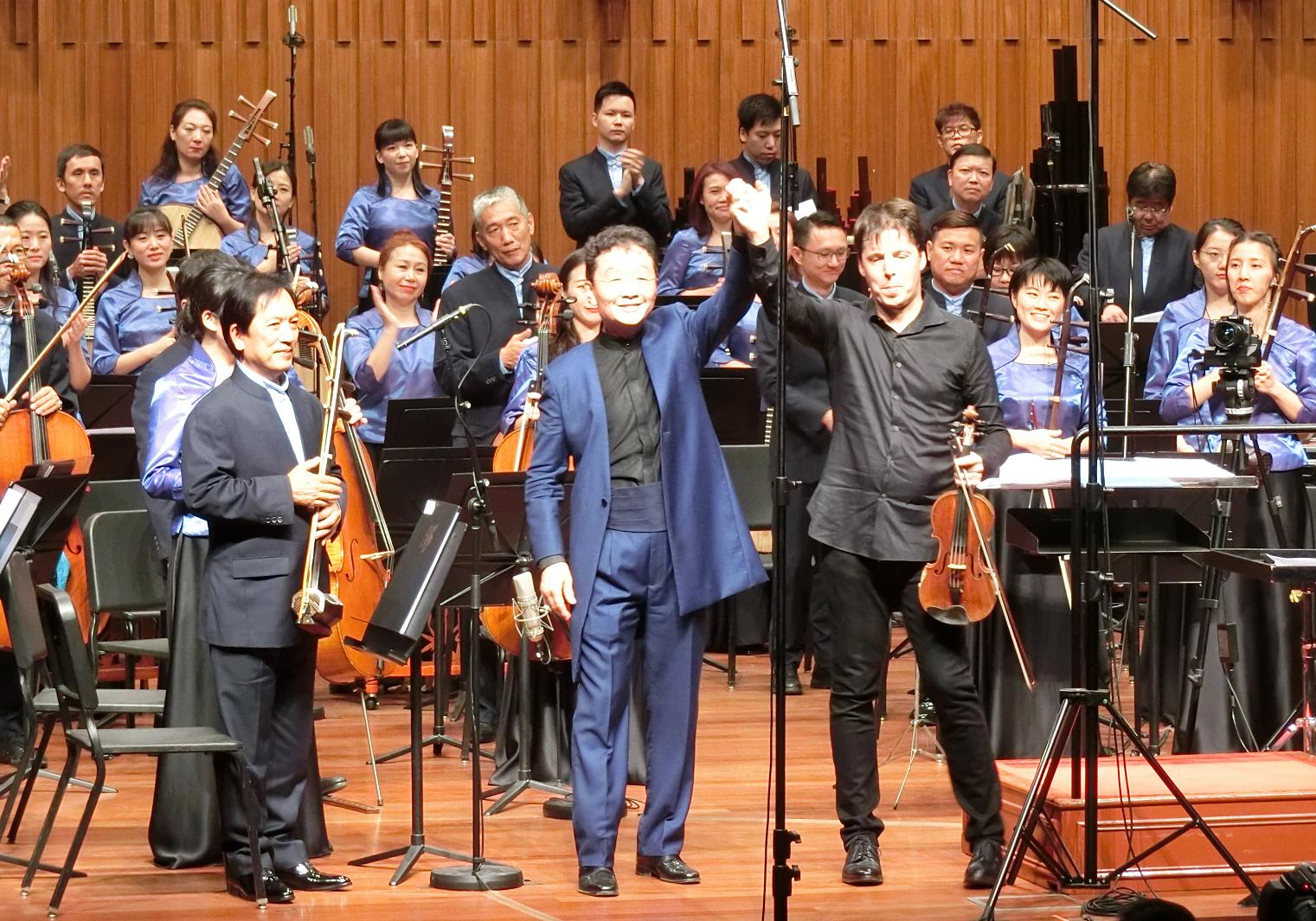
Superstar American violinist Joshua Bell’s much awaited return to Singapore culminated with two performances of Chen Gang and He Zhanhao’s evergreen Butterfly Lovers Violin Concerto partnering the Singapore Chinese Orchestra conducted by Yeh Tsung. Two separate audiences got to witness the spectacle, in Esplanade Concert Hall last Thursday and Singapore Conference Hall the evening after.


That he truly mastered the work, technically and idiomatically, was not unexpected. After all, the concerto was originally conceived for the Western violin and symphony orchestra in an attempt to create a piece that resembled Romantic era violin concertos audiences so yearn for. Although popular melodies from Beijing Opera were the basis of its themes, billions of listeners have enjoyed it as a Western-styled showpiece with Chinese characteristics.


Bell was not even the first non-Asian violinist to attempt it here. Another American, Gil Shaham and the Singapore Symphony Orchestra (directed by Shui Lan), recorded it more than a decade ago, with the coupling of Tchaikovsky’s Violin Concerto. The only difference here is the use of Chinese instruments as orchestral backing, in an arrangement by Yan Hui Chang and Ku Lap Man.


What stood out immediately was the beauty of Bell’s tone, gorgeously crafted and sonorously projected, contrasted against a backdrop of accompanying huqins. Every phrase was immaculately voiced and the feeling of fuzzy warmth, so typical in musical Romanticism, was gratefully lapped up. One can also be thankful that the temptation for excessive portamenti, or slides often heard or erhus in imitation of the opera voice, was resisted.


He even played in the tuttis, blending in with the orchestra, and the accompaniment was always discreet, allowing his voice to shine. In the tender duets with cellist Xu Zhong, there was much sympathy and synchronicity. A spontaneous standing ovation was the result, and an encore of Western art imitating the East in Fritz Kreisler’s tongue-in-cheek Tambourin Chinois.


Bell was made to work hard earlier in the evening, with commanding solos in Saint-Saens’ Introduction and Rondo Capriccioso and Sarasate’s Gypsy Airs, all staples in a virtuoso violinist’s repertoire. What truly touched the heart was a seamlessly gilded reading of Massenet’s Meditation from Thaïs, accompanied by strings, light winds and harp.


Bringing this memorable concert to the two-hour mark were purely orchestral works which began each half. Three movements from Tan Dun’s Yellow Earth were a joyous but raucous celebration of the inhabitants from the Huangtu Plateau with percussion, solo suona, suona chorus and vocalisations from orchestral members leading the way. In Guo Wen Jing’s Ava Mountain from Dianxi Folk Tunes, a vigorous tribal beat from China’s Southwest ethnic minorities dominated, with the piquancy of zhonghus and dizis spicing up the mix.


Although the audience had been reminded that a live recording was taking place, there remained an inconsiderate minority who ignored the need to stifle coughs, and noisily unwrapping sweet wrappers to boot. One hopes that the Sony Classical album that results will have only sweet music, not noise.


Wednesday, 9 August 2017

CD Reviews (The Straits Times, August 2017)


BRAHMS Symphonies Nos.3 & 4
NDR Elbphilharmonie 
Thomas Hengelbrock (Conductor)
Sony Classical  88985405082  / ****1/2

FOR THE LOVE OF BRAHMS
Joshua Bell, Steven Isserlis & Jeremy Denk
Academy of St Martin In The Fields
Sony Classical  88985321792 / *****

Hamburg's iconic new concert hall, the Elbphilharmonie, opened its doors in January after a seven year delay and costing 500 million Euros over the initial budget. The first recording made in the hall by its resident orchestra the NDR Elbphilharmonie features the Third and Fourth Symphonies of Johannes Brahms, Hamburg's most famous native composer. 

The Fourth is heard first, and includes a four-bar introduction before the actual 1st movement begins. This was Brahms' original idea before eventually dropping it, so the listener gets to hear a “new beginning”, thus symbolic of this new recording in a new venue. The recorded sound for both symphonies is excellent. 

The new recording of Brahms' Double Concerto in A minor from violinist Joshua Bell and cellist Steven Isserlis also stands out for its warmth, and closeness of communication between the two soloists and the Academy of St Martin in the Fields. 

The fillers are also very apt. First is the slow movement from Schumann's late Violin Concerto in D minor, essentially a violin and cello duo, with Benjamin Britten's edition of its closing. 

Next is the original 1854 version of Brahms' Piano Trio No.1 in B major Op.8, which is longer and substantially different from the more familiar revised version heard in concert halls today. The duo joined by American pianist Jeremy Denk makes the strongest possible case for this rarity. 

Monday, 11 April 2016

JOSHUA BELL WITH SCO / Singapore Chinese Orchestra / Review


JOSHUA BELL WITH SCO
Singapore Chinese Orchestra
Esplanade Concert Hall
Saturday (9 April 2016)

This review was published in The Straits Times on 11 April 2016 with the title "Brilliant musical blend".

One of the major fixtures of the Singapore Chinese Orchestra's 20th Anniversary celebrations was this Gala Concert with renowned American violinist Joshua Bell as soloist. Getting him to Singapore was a coup in itself, but the question that ran through the minds of many was how he would fare in a first-ever collaboration with an orchestra of Chinese instruments.


This would be non sequitur, as Bell just needed to be his usual virtuosic self in standard fare like Vivaldi, Saint-Saëns and Sarasate. So the more pertinent question would be how the SCO led by Music Director Yeh Tsung does in repertoire that was the reserve of the Singapore Symphony Orchestra. The results could be summed up as thus: very well indeed.


This was helped by very sympathetic arrangements by Eric Watson, Phoon Yew Tien and Law Wai Lun. Take Watson's take on Vivaldi's Spring from The Four Seasons with a much reduced ensemble for example. The accompanying huqins were exemplary in lightness and transparency of textures, while Xu Zhong's cello and Qu Jian Qing's yangqin (Chinese dulcimer) served perfectly as modified basso continuo.

Equally idiomatic was Phoon's transcription of Saint-Saëns' Introduction & Rondo Capriccioso. Bell's effortless playing and sumptuous tone were, of course, the highlights, and yangqin and harp were up there with him in the slow section. But who would have thought the sheng running away with the melody with Bell's violin spinning arpeggios at full tilt in the brilliant conclusion?


The concert also presented several non-concertante works, which was a veritable showcase of the orchestra's strengths. Ruan Kun Shen's Da Ge opened the evening with an impressive parade of percussion, climaxing in Jin Shi Yi's pungent suona cadenza. Liu Xing's Invisible Sword simulated the digital dexterity of electronic music with chirpy dizis colouring the jovial mood in this scherzo-like piece.


After the interval, Wu Hou Yuan's Yu Tang Chun skilfully melded Beijing opera themes with the Western prelude and fugue, with plucked strings (pipas, liuqins and ruans), yangqins and percussion as the protagonists. Liu Tian Hua's Song of Birds in a Desolate Mountain presented bowed huqins with an open season for the mimicry of birdsong.


Bell returned with an authentic Chinese work, Mao Yuan's Xin Chun Le (A Joyous New Year) in an arrangement by Chuan Joon Hee, and how he captured its festive feeling with a spirited spiel complete with portamentos truly resounded with the audience. The applause rang louder, after which the orchestra reciprocated by playing Western music, in Watson's highland-inspired The Ceilidh, which has folksong O Waly Waly (sometimes sung as The Water is Wide) as its centrepiece.   


The concert concluded with Sarasate's Zigeunerweisen (Gypsy Airs) in Law's orchestration. Again Bell's mastery of this warhorse was unquestionable, with the orchestra supporting his every note and phrase to the hilt.


A standing ovation was the immediate response, and although Bell came for his curtain call sans violin at the first instance, he had to return for an encore. “Derived from American music,” he announced to chortles from the audience, and that turned out to be Variations on Yankee Doodle (his version of Henri Vieuxtemps' Souvenir d'Amérique) which brought down the house.  


Monday, 14 June 2010

SINGAPORE ARTS FESTIVAL: Joshua Bell and Academy of St Martin in the Fields

Singapore Arts Festival

Academy of St. Martin in the Fields

JOSHUA BELL, Violin & Director

Esplanade Concert Hall

Saturday (12 June 2010)

This review was published in The Straits Times on 14 June 2010.

The programme offered by the celebrated Academy of St. Martin in the Fields at this year’s Singapore Arts Festival was safe, predictable and ultimately boring. Fortunately, the playing by the much-recorded orchestra and its director-on-tour, the American violinist Joshua Bell, was none of the above.


In the opening Coriolan Overture by Beethoven, the chamber-sized ensemble produced a buoyant and transparent sound, such that much of the details were not submerged by the force of delivery. Never lacking in intensity, its tragic vistas were well realised in this vivid reading led by Bell sitting in the concertmaster’s chair.


Taking the spotlight, Bell’s urgent yet sensitive solo reading in Mendelssohn’s Violin Concerto in E minor (Op.64) showed he knew the true meaning of appassionato. A bright, sugary tone served its lyrical pages like a dream, and when push came to shove, his ardent manner and unmannered virtuosity lit up the stage.


Never showy for its own sake, the music benefited from his commitment. The minor exception was Bell’s own dazzling cadenza for the first movement – spotlessly delivered – which sounded a tad overdone for Mendelssohn’s more intimate style. The slow movement was loveliness itself and the ebullient finale sparkled like champagne.


Bell’s stunning solo encore – a cunning set of variations on Yankee Doodle (after the example by Vieuxtemps) - cued enormous cheers from the audience.


Beethoven’s Seventh Symphony in A major (Op.92) continued where the overture left off, another fleet-footed performance that did not come across as lightweight. The music was a sure winner in itself, its four movements bounding with pulse and kinetic energy. Superbly judged by Bell and his charges, the performance flowed unimpeded and shone from start to finish. The standing ovation accorded was well deserved.


The slow movement, in particular, was a showcase of sublimity. Gently pulsing like a vital heartbeat, it unfolded with a glorious sense of inevitability. The seamless clarinet solos from Matthew Hunt lingered long in the mind after the music had ceased. Heaven-storming climaxes aside, surely this is a sign of musical greatness.

Sunday, 13 June 2010

CD Reviews (The Straits Times, May - June 2010)

JOSHUA BELL

At Home With Friends

Sony Classical 88697554362

****1/2

When you’re a superstar, as gifted and good looking as American violinist Joshua Bell, it isn’t hard to find many friends. This crossover collection sees Bell’s sumptuous violin partner a disparate assortment of artists (including Chris Botti, Kristin Chenoweth, Marvin Hamlisch and Dave Grusin among others) in an attic-full of musical styles. Is it still classical music when Sting sings John Dowland’s Come Again to Bell’s accompaniment? Or should purists gripe when sitarist Anoushka Shankar duets with Bell in her father’s Variant Moods? The two tracks that are strictly classical involve Sergei Rachmaninov, the romance O Cease Thy Singing (sung in English by baritone Nathan Gunn) and a 1928 recording of the great Russian pianist-composer in the slow movement of Edvard Grieg’s Third Violin Sonata in C minor. Modern recording technology has scrubbed off poor Fritz Kreisler (one of Rachmaninov’s most celebrated musical partners) and installed Bell in his place! Is that cheating? Breaking down ethnic, cultural and artistic barriers is what trans-genre collaboration is about, a sign of the times. So music lovers should not get too sniffy especially when the results are as enjoyable as this.


MUSSORGSKY Pictures at an Exhibition

SCHUMANN Scenes from Childhood

LEIF OVE ANDSNES, Piano

EMI Classics 6983602

****1/2

Pianists who survey Russian composer Modest Mussorgsky’s piano masterpiece Pictures at an Exhibition have two options: either play it straight as it was written, or embellish and amplify with carefully chosen extra notes. Like Vladimir Horowitz and Mikhail Pletnev before him, Norwegian pianist Leif Ove Andsnes opts for the latter, and is mostly successful. That is because Mussorgsky’s musical portrayal of his late friend Viktor Hartmann’s quirky sketches and designs – of gnomes, witches, glowing skulls and unhatched chicks - are never compromised. The additional chords, octave doublings and decorative touches by Andsnes are tasteful and do not bring attention to themselves, while the composer’s own monochrome visions retain their bleakness. Four shorter character pieces by Mussorgsky are included but the main filler is Schumann’s Kinderszenen (Scenes from Childhood), a suitable pairing by way of 13 miniatures, including the famous Traumerei (Dreaming). Here, there are no personal contributions, just the musical representation of innocence and a simpler existence. Whether barnstorming or simply musing, Andsnes’ technique is impeccable, and this album is thoroughly recommendable.


SAMUEL BARBER

100th Anniversary

EMI Classics 6872862 (2CDs)

****1/2

In an age of rampant and unapologetic modernism, the American Samuel Barber (1910-1981) remained a steadfast upholder of tonality and the Romantic spirit. Little wonder that his compositions regularly turn up in concert programmes today. His No.1 hit is the Adagio for Strings, performed here with polish and conviction by the Berlin Philharmonic under Sir Simon Rattle. It is also fascinatingly heard within its original context, in the String Quartet (Op.11), played by the Endellion Quartet. His No.2 hit: the lyrical Violin Concerto, unusual because of its two slow movements followed by a brief quicksilver finale. American violinist Elmar Oliveira and the Saint Louis Symphony (conducted by Leonard Slatkin) do the honours. His No.3 hit: a tie between the rugged Piano Sonata, with British pianist Leon McCawley in fine form, and the gritty orchestral showpiece that is Medea’s Meditation & Dance Of Vengeance. A second disc includes his songs, instrumental and chamber music. Scratching beneath the surface, Barber’s music has far more to offer than mere melodies.


MENDELSSOHN Piano Trios

ITZHAK PERLMAN, Violin

YO-YO MA, Cello

EMANUEL AX, Piano

Sony Classical 88697 52192 2

*****

It is not hard to enjoy the two piano trios of Felix Mendelssohn (1809-1847). All the hallmarks of the Anglophilic German composer are here – flowing melody, literally “songs without words”, witty scherzos and scintillating piano passages that are floridly decorative. The First Trio in D minor (Op.49) is by far the more popular, but the Second Trio in C minor (Op.66) has much to offer. It is more melancholic and imbued with darker hues, which ultimately give way in the finale to the bright sunshine of the Old Hundredth Psalm, regularly sung in Protestant churches as the Doxology. Curiously, this is the first time that violin great Itzhak Perlman has collaborated in recording with the celebrated duo of Yo-Yo Ma and Emanuel Ax. The results are as congenial as a meeting of old friends, with the requisite give and take that make chamber music exciting. Can we hope for more from this "million dollar trio"?