Showing posts with label Law Wai Lun. Show all posts

Monday, 18 August 2025

THE RIVER REMEMBERS / Ding Yi Music Company / Review


THE RIVER REMEMBERS
Ding Yi Music Company
Drama Centre Theatre
Saturday (16 August 2025)

This review was published in The Straits Times on 18 August 2025 with the title "The River Remembers an ambitious if patchy SG60 project".


The River Remembers is Ding Yi Music Company’s big SG60 project, a multi-genre tribute to the history and legacy of Singapore River, and the nation as well. With music by Cultural Medallion recipient Law Wai Lun, playwrighting and stage direction by Goh Boon Teck, it sought to capture the essence and significance of Singapore’s iconic waterway within a compact 70-minute duration.

The artistic team of Goh Boon Teck (Director),
Law Wai Lun (Composer),
Cai Shiqi (Choreographer)
& Dedric Wong (Conductor).

It, however, did so in fits and starts. The premise was familiar as this was an expansion of Ding Yi’s 2019 River of Life production, also with Law’s music, which had the coherent feel of a documentary and show-and-tell session. The River Remembers took the path of a series of choreographed tableaux narrating the story of an orphaned baby-boomer Everyman from a humble 1950s childhood to the present of glorious fruition, and everything else in between.


Conducted by Dedric Wong, who also served as co-narrator in Chinese, the music was pleasant and fully-engaged with the narrative. The main-storyteller was Paris-based Singaporean actress and media personality Sharon Au, the personification of Mother River, possessed with divine and mythical qualities. Everyman adores and worships the River, who in turn may or may not grant him his wishes.


There were four chapters, chronologically traversing through Singapore’s history. The pivotal year 1965 saw Scotland The Brave blared out by suona in place of bagpipes. Independence from Malaysia had somehow been confused with Scottish self-determination. Otherwise, the Chinese instruments projected an overriding Sinocentric feel as this was clearly a history as viewed through Chinese perspectives.


The dancers from Dance Ensemble Singapore (Choreographer: Cai Shiqi) were excellent, their moves distinguished with balletic grace and athleticism. Had the large flag unfurled and waved in the second chapter’s The Prosperous River been red instead of blue, memories of Chinese communism would have been revived.


Chapter three’s The River Symphony closed with a melange of voices – all spouting Chinese dialects - to accompany silhouettes of river coolies at work. The little orphan boy, pluckily danced by Kok Jun Kang, also turned out to be unequivocally Chinese based on his pugilistic stances. According to the story, he grows up to become some Sim Wong Hoo-like big tech entrepreneur, surviving into old age to inspire younger minds. All thanks to the River.


In its final chapter River Reflections, Lee Kuan Yew’s name had to be invoked sometime, hailed as the river’s saviour for ordering its eventual clean-up. For ridding the water of its filth and bacteria, this viewer would have been better pleased had senior civil servants Lee Ek Tieng and Tan Gee Paw been credited as well.


The inevitable had to come, a quote from Zubir Said’s Majulah Singapura and finally an apotheosis with Van Moring’s Singapura, Sunny Island to complete the story. Once the lifeblood of Singapore’s economy, the Singapore River has now morphed to become a glitzy tourist attraction.


Ding Yi Music Company’s efforts in highlighting Singaporean history and heritage have been most laudable, but this ambitious production came across as less than the sum of its parts.

Photography by Andrew Bi Photography.

Monday, 8 July 2024

CONFLUENCE / Singapore Chinese Orchestra / Review


CONFLUENCE 
Singapore Chinese Orchestra 
Singapore Conference Hall 
Saturday (6 July 2024)

This review was published in The Straits Times on 8 July 2024 with the title "SCO's China tour programme celebrates Nusantara heritage".

When an orchestra goes on tour, it usually performs the chosen repertoire as a test run before embarking overseas. The Singapore Chinese Orchestra (SCO) did the opposite by having a homecoming concert instead, recounting its three-city China tour which took place in March and April. Led by conductor emeritus Yeh Tsung, it was a case of better late than never. 


What can an orchestra of Chinese instrumentalists from Singapore perform in China without “carrying coals to Newcastle” or “selling sand to the Saudis”? Very astutely, it was the repertoire that mattered most. By playing contemporary Chinese works and Nanyang music, the SCO could count itself unique among Chinese orchestras in Asia. 


Both the Chinese works were large-scaled concertante pieces involving virtuoso soloists. SCO concertmaster Li Baoshun performed on three huqins (gaohu, erhu and zhonghu) in Oscar-winning composer Tan Dun’s Fire Ritual, a half-hour of what has been described as “orchestral theatre”. Part orchestral showpiece, part religious ceremony, the music also involved vocalisations from the shaman-like Yeh and orchestral members, as well as extra-instrumental sounds like paper rustling. 


Offstage wind players strategically placed around the hall provided antiphonal effects, enveloping the hall with a temple of sonorities. The wails of suonas and guans, usually associated with funerary music, stood out. Adapted from Tan’s film score Nanjing 1937, the full ensemble memorialised victims of war, and did so with stunning and dramatic impact. 

Photo: Singapore Chinese Orchestra

Perhaps even more riveting was Luo Maishuo’s Stairway To Heaven with SCO pipa principal Yu Jia, cladded in silvery tinselled finery, as trenchant soloist. She simply stole the show, opening with an imposing cadenza, then revelling in dance-like moves and a meditative slow movement for contrast. 


The work which included a prelude, five movements and finale was inspired by the Sanxingdui tree of Chinese mythology, adorned with animals including a golden crow and dragon. The link between human and spiritual realms closed kinetically charged, where rhythmic exuberance and violence became all but indistinguishable. 


Nanyang music, works which included Southeast Asian influences, came from two former SCO composers-in-residence who have long been residents here. The concert opened with Eric Watson’s Tapestries – Time Dances, which was awarded the top prize at the First International Competition for Chinese Instrumental Compositions in 2006. 


There were influences from Gustav Mahler and perhaps Ralph Vaughan Williams heard in the orchestration but percussive and gamelan-like textures placed this work right smack in the Indo-Malayan archipelago. Speaking of the Straits of Malacca, Law Wai Lun’s Zheng He – Admiral of the Seven Seas, adapted as a three-movement symphony, was a tour de force of programmatic writing and orchestral textures.


In Wandering Spirits, The Voyage and Sea Destiny, the last movement a heady marriage of Chinese and Nusantaran musical cultures, SCO’s Chinese audiences would have gotten the full sonic experience of Nanyang. The concert closed with an encore, the merry strains of Hua Hao Yue Yuan (Blooming Flowers and Full Moon) with a hearty clap-along.


Wednesday, 23 November 2022

TSUNG YEH 20 / Singapore Chinese Orchestra / Review


TSUNG YEH 20

Singapore Chinese Orchestra

Singapore Conference Hall

Saturday (19 November 2022) 


This review was published in The Straits Times on 23 November 2022 with the title "Yeh Tsung leads superbly honed charges".


Twenty years may be considered a relatively short stretch of time, but what Yeh Tsung has accomplished with the Singapore Chinese Orchestra as its Music Director since 2002 has been little short of awe-inspiring. During his tenure, he commissioned many new works for the medium of massed traditional Chinese instruments, including establishing a musical genre incorporating Southeast Asian elements now known as Nanyang music.


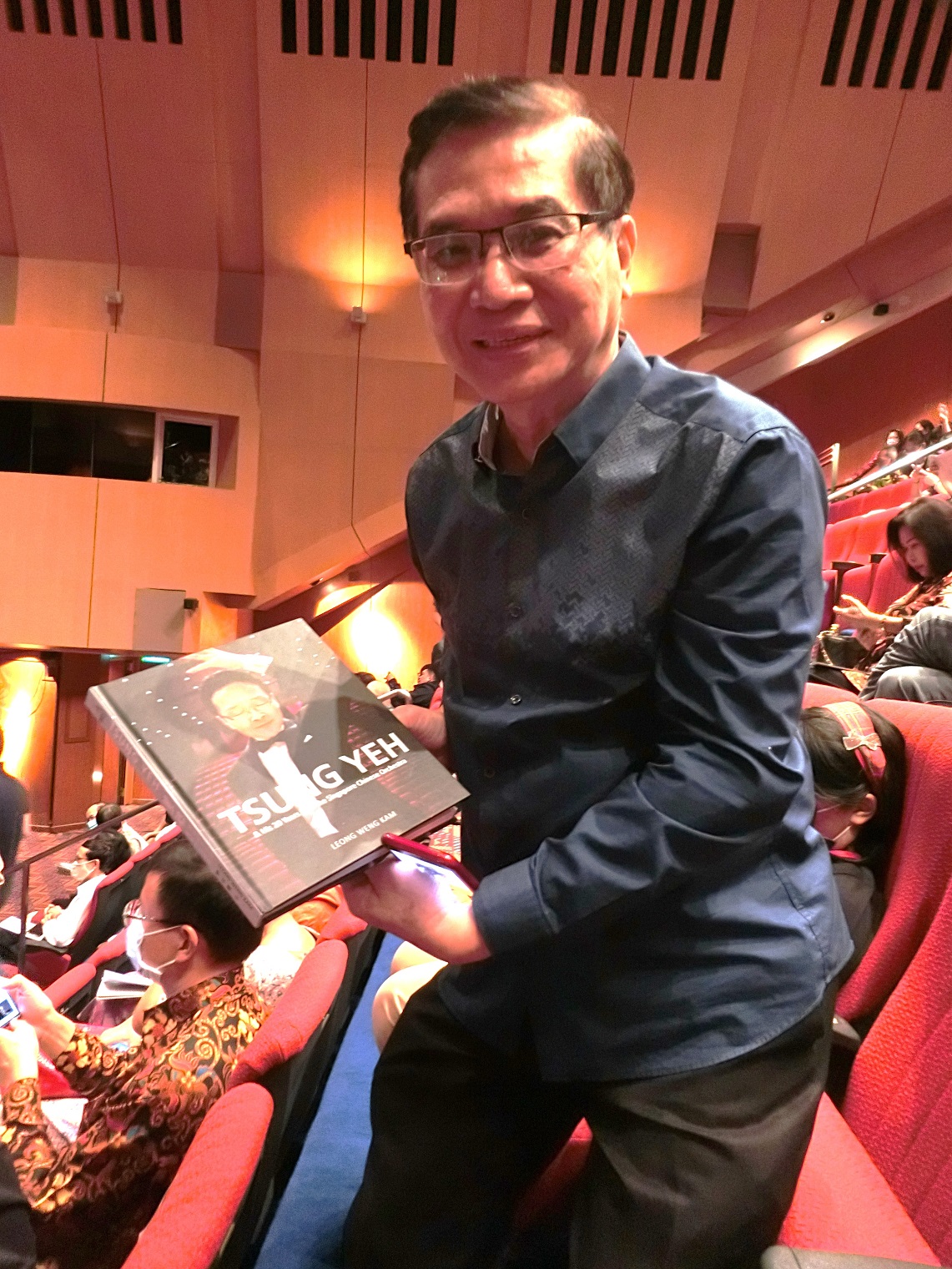
The official launch of the
Tsung Yeh 20 commemorative book.


This concert, commemorating his 20th anniversary at SCO’s helm, had a maritime theme which relived landmark works from his first ten years. Central to its narrative were two explorers of historical times, Zheng He (Cheng Ho) and Marco Polo, alluding to Yeh’s role as an intrepid discoverer of new pathways in Chinese music.    


Former SCO Composer-in-Residence Eric Watson’s Sea – The Source of Life, written for the 2007 National Day Parade opened the concert. Its quiet beginning was a beautiful evocation of dawn, leading to a faster section filled with dance rhythms reflecting different cultures and ethnicities. The lively music declared that the sea belonged to everybody, and this feel-good number made for a rousing prelude.   


Next were three movements from another former Composer-in-Residence Law Wai Lun’s Zheng He - Admiral Of The Seven Seas, a large-scaled work commissioned for the 2005 Singapore Arts Festival. Its imposing opening, Sea Burial, led by plangent winds and percussion, saw the Hand of Fate deal the Ming dynasty commander an untimely demise. With SYC Ensemble Singers (Chong Wai Lun, Chorus Master) at full tilt, the echoes of O Fortuna from Carl Orff’s Carmina Burana seemed almost appropriate even if the latter had more to do with itinerant Bavarian monks.


For this cantata, there were a key roles for narrator Jeffrey Low and tenor Zhuang Jie, and a cameo for soprano Joyce Lee Tung, who were excellent in fleshing out the romance of Zheng’s humble origins. The Voyage was the performance’s most colourful segment, a quasi-Wagnerian sojourn from Orient to Middle East, a picturesque seascape with birdsong later culminating in a rhapsody of Arabian dance movements. Here the imaginative scoring revealed Chinese orchestral instruments at their fullest potential.        


The concert’s second half comprised three movements from Liu Yuan’s Marco Polo and Princess Blue, composed for the Esplanade Opening Festival in 2002. Featuring similar forces and projecting as big sonorities as Zheng He, this was unfortunately the most derivative work of all.   


Its story centred on a fictional romance between Venetian explorer Marco Polo and the Kokachin Princess Buluhan, as he escorted the royal from Cathay by sea to her prospective marriage in Persia. As Providence has it, when they reach Eden in the East (guess where?), love blossoms. With every exposure, this music becomes increasingly cringeworthy and embarrassing.


The supposed love music with Italianate flavour (Neapolitan to be said) builds up inexorably, reaching a grand apotheosis with none other than the 1960s song Singapura (Oh Singapura, Sunny Island Set In The Sea)! Its grandiose Mahlerian ending, magnificently delivered by all on stage, nevertheless elicited a standing ovation. Hopefully this was for Maestro Yeh and his superbly honed charges, rather than the music. 


Leong Weng Kam, author of the
Tsung Yeh 20 commemorative book.

Tuesday, 15 September 2020

ESSENCE OF SCO / Singapore Chinese Orchestra / Review


ESSENCE OF SCO

Singapore Chinese Orchestra

Singapore Conference Hall

Friday (11 September 2020)

This review was published in The Straits Times on 15 September 2020 with the title "Joyful symphonic fantasy marks orchestra's triumphant return".


The date September 11 will be remembered for historical reasons, but in Singapore this year it marked the return of concert life after six months in the wilderness. The global Covid-19 pandemic is still with us, but traces of the old normality are returning as the Singapore Chinese Orchestra (SCO) became the first musical group to present a live concert before a live audience.


Greeted by warm and appreciative applause, a pared-down 23-person chamber orchestra led by music director Yeh Tsung performed an hour-long concert for a socially distanced audience limited to just 50 persons. The first thought that came to mind: what a pleasure it was to witness music first hand rather than from a screen and through a pair of headphones.


Zhao Jiping’s rousing Celebration Overture opened the concert. Although its first pages were a blatant rip-off from Glinka’s Ruslan And Ludmilla Overture, there was still enough original material to sustain interest. The big erhu melody, later heard on concertmaster Li Baoshun’s jinghu, was memorable, as was Jin Shiyi’s suona solo that rose above the throng at its apotheosis.


Conductor Yeh compared the evening’s programme to a four-movement symphony. Thus legendary blind erhu player Hua Yanjun aka Abing’s Reflection Of The Moon On Erquan served as its slow second movement. Orchestrated for bowed strings by Wu Zhuqiang and Moses Gay, the ensemble played liked an expanded string quartet, with the melodic interest sustained by gaohus and erhus.



Some have compared this with Barber’s Adagio For Strings, but these works are actually very different. Abing’s Moon is atmospheric and meditative but not weepy, its evocation being nostalgia rather than tragedy or outright grief. The overall effect created was particularly beautiful.  


Still on popular melodies, Molihua (Jasmine) was relived in a form of a symphonic fantasy by master orchestrator Liu Wenjin. The highly recognisable tune was heard at the the outlet, and subject to a fine series of variations. Among the solo instruments highlighted were the dizi and Jin’s suona which became its most prominent voice.


The concert’s final movement was an abridged 10-minute version of Law Wai Lun’s The Celestial Web, a large-scaled work commissioned by the Singapore Arts Festival and premiered by the SCO in 2003. Gone however were the recitations, chorus and Tan Swie Hian’s words which hailed the universality of man, but Schiller’s Ode To Joy message came through in the music which opened with deliberate quotes from Beethoven’s Ninth Symphony.


Eclectic as this music was, with influences from Ravel, Gershwin and film music, it did not outstay its welcome. The opportunity to enjoy its intricate instrumentation, Zhao Jianhua’s erhu solo and a sentimental wallow towards the end was well worth the time. The general feeling of optimism continued into the celebratory encore Hua Hao Yue Yuan (Blooming Flowers, Full Moon) with a customary clap-along. What was there not to enjoy?