Showing posts with label Kam Ning. Show all posts

Tuesday, 10 October 2023

KAM-HARWOOD-LIM TRIO / Review


KAM-HARWOOD-LIM TRIO

Yong Siew Toh Conservatory Concert Hall

Friday (6 October 2023)


This review was published in The Straits Times on 10 October 2023 with the title "From death to sunshine in a night".


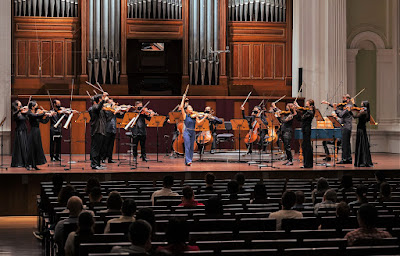
Lovers of chamber music have never had it so good. In recent months, they were treated to excellent concerts by the T’ang and Concordia Quartets, More Than Music duo and Yong Siew Toh Conservatory’s “million dollar” piano quintet. Now meet the piano trio formed by London-based Singaporean violinist Kam Ning, British cellist Richard Harwood and Britain-trained Singaporean pianist Lim Yan in a programme that traced the history of the piano trio medium.


Joseph Haydn was the “father of the piano trio”, having composed as many as 45 piano trios. Of these, only one is performed with any frequency, his Piano Trio in G major (Hob.XV:25) published in 1795. Opening the concert, a more congenial work would be hard to find, one oozing salon charm from every pore. As with such early trios, the keyboardist was the acknowledged leader, with string players providing the accompaniment.  


While Kam’s violin had some pretty melodies to mull over, spare a thought for Harwood’s cello, whose role was to play the perfect sidekick to his partners. Even in the Rondo all’Ongarese, popularly known as the Gypsy Rondo, it was Lim’s piano which dominated, overseeing the abrupt shifts in tempos and modes which made for an enjoyable ride.


All this was turned upon its head in Shostakovich’s Piano Trio No.2 in E minor (Op.67), where Harwood was obliged to open with harmonics, effecting tinnitus in excruciating high registers. This wartime work, premiered in 1944, made for uneasy listening because of its grim countenance. Grating dissonances, bare octaves and insistently hammering rhythms were par for the course, the aural equivalent of treading barefooted on broken glass.


Photo: Michael Huang


The piano was now an instrument of percussion, content with issuing beats over which strings ran riot, culminating in the second movement’s demented fast waltz. The slow third movement was typical Shostakovich, a passacaglia with long-held piano chords establishing a funereal and plodding pace for short variations to unfold.


Photo: Michael Huang


This led into the finale’s infamous “dance of death”, centered on a Jewish tune which once heard, would be an earworm for the ages. A vision of the Holocaust, with Jews led to their graves by a village band, is the chilling and abiding memory evoked by this music.


The trio gave a take-no-prisoners performance, and the audience held its breath for a few moments after its subdued close before erupting in loud applause. They had been compelled to understand what the music meant.


As dark and sobering as the first half closed, the second half was lit by the sunshine of Mendelssohn’s Piano Trio No.1 in D minor (Op.49), likely the most performed of piano trios in Singapore. Its sheer likeability has to do with the Biedermeier years of 1839, where a cult of beauty was prized over mundane reality.


The Kam-Harwood-Lim trio made every movement a veritable song without words, besides letting rip with the early Romantic era’s trademarked prestidigitation. This chamber concert with marked contrasts had to close on a cheerful and optimistic note.  


It is chilling to think that just one day after this concert, the Jews of Israel were subject to a second Holocaust by the Palestinian terrorists of Hamas. Hundreds of innocents attending a peace concert in Israel were marched to their deaths and slaughtered, and many others murdered in their homes. It appears that "people who forget the past are doomed to repeat it" (George Santayana).

Wednesday, 3 November 2021

KAM NING. THE ARTISTRY OF STRINGS / THE GOLDBERG VARIATIONS. CHIYAN WONG IN RECITAL / Review


KAM NING – THE ARTISTRY OF STRINGS

Singapore Symphony Orchestra

Victoria Concert Hall

Wednesday (27 October 2021)


THE GOLDBERG VARIATIONS

Chiyan Wong, Piano Recital

Esplanade Concert Hall

Sunday (31 October 2021)


This review was published in The Straits Times on 3 November 2021 with the title "Violinist excites, pianist tricks and treats".


The opening of travel lanes for overseas artists to perform here has invigorated the musical scene, not least London-based Singapore violinist Kam Ning’s two week residency with the Singapore Symphony Orchestra. She capped last week’s two performances of Mendelssohn’s E Minor Violin Concerto with a splendid chamber concert leading the orchestra’s strings.


Photo: Nathaniel Lim


Haydn’s underrated Violin Concerto No.1 in C major saw her projecting a rich and healthy tone, alternating between solos and joining the general ensemble in the tuttis. While the outer movements buzzed with fervent activity, it was in the central slow movement where she was allowed to truly shine. Her seamless aria-like solo line radiated an unmatched beauty while accompanied by gentle pizzicato strings.  


Photo: Nathaniel Lim 


An unbridled sense of exhilaration possessed the finale, which continued into the hour-long concert’s second work, the dissonantly exciting Divertimento by 20th century Hungarian composer Bela Bartok. The refinement of Haydn was now replaced by rough-hewn and earthy textures, and this made for fascinating contrasts.


Photo: Nathaniel Lim


Kam’s leadership kept the ensemble on a fine razor’s edge throughout, capable of switching from rapt pianissimos to loud slashing discords within a matter of seconds. While a gypsy fiddler’s insouciance defined her solos, it was her joie de vivre that proved to be most infectious. For want of a better word, she and her charges went headlong on a uninhibited romp in its final passages. The encore, Leroy Anderson’s pizzicato paradise, Plink, Plank, Plunk!, was no less enthusiastically received.


Photo: Ung Ruey Loon


Also making a welcome return was Berlin-based Hong Kong pianist Chiyan Wong, presented by Altenburg Arts. In recent years, Wong has made a name for himself as a Liszt and Busoni specialist, with a penchant for unusually eclectic programmes. His recital began neo-baroque with two movements from Ravel’s Le Tombeau de Couperin, displaying limpid and crystal clear articulation aided by judicious and subtle pedalling.


Photo: Ung Ruey Loon


In Wong’s take on Italian pianist-composer Ferruccio Busoni’s edition of J.S.Bach’s Goldberg Variations, tricks and treats came aplenty on Halloween night. This performing version omitted all repeats, removed several variations, introduced surprising ear-catching new voices and dabbled in octave doublings. Purists will recoil at these revisions, but Wong’s missionary zeal aided with no little delicacy and outright virtuosity made this a compelling listen. Running under 34 minutes, this was a right Goldberg for people in a hurry.      


Chopin’s brief Mazurka in C sharp minor (Op.63 No.3), ravishingly voiced, was the prelude to Busoni’s Nine Variations on a Chopin Prélude. The subject was none other than the famous chord-laden Prélude in C minor (Op.28 No.20), and the modernist phantasmagorical set of variations held a 20th century distorting mirror to the earlier Bach.


Wong’s love for the offbeat also extended to his encore, Busoni’s Elegy No.4 or Turandots Frauengemach (Turandot’s Boudoir), which turned out to be the most outrageous transcription thought possible of Greensleeves. Naughty but nice.


Monday, 2 September 2019

SINGAPORE CHINESE ORCHESTRA ON TOUR Berlin Concert / Review


SINGAPORE CHINESE ORCHESTRA ON TOUR
Berlin Konzerthaus Gendarmenmarkt
Saturday (31 August 2019)

This review was published by The Straits Times on 2 September 2019 with the title "Singapore Chinese Orchestra's European tour de force".

Almost 19 years ago, the Singapore Symphony Orchestra made its Berlin debut at the historic Konzerthaus Gendarmenmarkt. This year was the turn of the Singapore Chinese Orchestra (SCO) conducted by Yeh Tsung, in the first concert of its four-city European tour. On its programme included four works representing the unique sound world that is Chinese and Nanyang music.


Nanyang music was a genre promulgated by the SCO and Music Director Yeh, conceived to encompass specific subjects, flavours and idioms of Southeast Asia. Opening the concert was the symphonic poem Krakatoa by Wong Kahchun, presently the Chief Conductor of the Nuremberg Symphony Orchestra.

Originally written for wind band, its sound textures translated very well on Chinese instruments. Dizis and percussion playing a modal tune conjured the tranquil mood of Javanese slumber before the violence of volcanic eruption, generating abrupt and startling contrasts. Suonas strategically placed high up at the back of the circle also created the effect of stereophony, contributing to the work’s raw and tumultuous impact.


Winner of the 2015 Singapore International Competition for Chinese Orchestral Composition, Hong Kong composer Gordon Fung Dic-Lun’s Arise, You Lion Of Glory provided another vista to Nanyang music. Its subject was the life cycle of the lion dance of local Chinese celebrations. Splendidly coiffed SCO pipa principal Yu Jia was at her extroverted best, portraying the lion’s stirring, passionate moves aided and abetted by rhythmic percussion, all the way to its eventual demise. The quiet and spiritual close of the work was accompanied by tinkling sounds of Tibetan prayer bowls. 


More familiar was Chen Gang and He Zhanhao’s Butterfly Lovers Violin Concerto, undoubtedly China’s greatest compositional export. London-based Singaporean violinist Kam Ning wrung out all the pathos possible from the rhapsodic tale of Liang Zhu, the Chinese version of Romeo and Juliet. Her duet with cellist Xu Zhong provided tender moments which tugged on the heart strings. The encore was Fritz Kreisler’s Tambourin Chinois, typical Viennese chinoiserie but made to sound totally charming.

The fourth major work was Yellow Earth, an early work by Tan Dun, arguably the most famous living Chinese composer today. Its four movements depicted the parched, rugged landscapes and raucous celebrations of the Chinese outback. Exploiting the full range of instrumental capabilities, the orchestra provided a tour de force of virtuosic and cohesive playing.


As if to further showcase the orchestra’s wide-ranging versatility, it also took on the music of J.S.Bach. The famous Air On G String sounded quaintly idiomatic with yangqin replacing the harpsichord, and the melody tenderly carried on sheng, gaohu and dizi.


Chatty and engaging, Yeh clearly had the audience eating from his hands. Two encores of Dvorak’s Slavonic Dance in G minor (Op.46 No.8) and the Gavotte from Bach’s Suite No.3 had listeners in raptures and on their feet. Judging from the response, this concert was both a musical and cross-cultural triumph. SCO continues on its tour with further concerts in Prague, Imola (Italy) and Athens.

A Berlin standing ovation for the 
Singapore Symphony Orchestra.

A proud moment for Singapore.
SCO musicians with Chairman Mr Ng
& Deputy Chairman Mr Wu post concert.
SCO musicians Foong Chui San (zhongruan),
Tang Jia (cello), Huang Ting-Yu (cello)
& Cheng Tzu Ting (zhongruan).

Tuesday, 14 August 2018

SSO NATIONAL DAY CONCERT / Singapore Symphony Orchestra / Review


SSO NATIONAL DAY CONCERT
Singapore Symphony Orchestra
Esplanade Concert Hall
Saturday (11 August 2018)

This review was published in The Straits Times on 14 August 2018 with the title "Something for everyone in concert of Singaporean music".

What is Singaporean music? That question was partially answered in a first-ever National Day Concert by the Singapore Symphony Orchestra, led by Singaporean conductor Darrell Ang. In premiering new works and reliving popular tunes, there seemed to be something for everyone this evening. 


Cultural Medallion recipient Kelly Tang's two suites on popular local melodies began each half of the concert. The Symphonic Suite On A Set Of Local Tunes had Home, Chan Mali Chan, Bunga Sayang and Singapore Heartbeat as main themes, with Beethoven's Ninth Symphony and Elmer Bernstein's Magnificent Seven as clever cameos. His Sketches Of Singapore did service to Stand Up For Singapore, Rasa Sayang, Where I Belong and Di Tanjong Katong in the flag-waving Americanised style of John Williams.


It was feel good all the way in the original works, beginning with Syafiqah 'Adha Sallehin's Bidasari, a short work based on the pan-Malayan legend of Syair Bidasari. An orchestration of the main theme from her 2016 choreographed work Ikan Girl, atmospheric piccolo and flute solos backed by lush orchestration suggested this to be the Prelude To The Afternoon Of The Fish.


The Malay and marine setting also dominated Wang Chen Wei The Sisters' Islands, based on another legend. This work sounded even more Indo-Malay with the use of the pelog scale, and had solos from a blown conch shell and ocarina as part of its storytelling. The Vienna-trained Wang's Wagnerian orchestration brought echoes of the Rhine to the Straits of Singapore. 


The longest work was Chen Zhangyi 17-minute-long Violin Concerto entitled Vanda, a tribute to the national flower (Vanda Miss Joachim) and our Garden City. The soloist was London-based Kam Ning who mastered its three movements with her usual easy-going aplomb. The first two botanically-inspired movements were slow, and the fast finale, titled A Renaissance, included a virtuosic jazz-inflected cadenza by Kam herself. Her encore relived the raucous sounds of Chinatown, a Paganinian movement from her father Kam Kee Yong's 1976 sonata Huai Ku.


Xinyao (1980s Singaporean mandarin pop) had a look in with Liang Wern Fook's This Is Singapore Medley orchestrated by Samuel Tan, Its big band arrangement that found an apotheosis in his best-known song Xi Shui Chang Liu. The legacy of Sing Singapore and NDP was revived in Phoon Yew Tien's arrangements of Zubir Said's Semoga Bahagia (May You Achieve Happiness, better known as The Children's Day Song) and S.Jesudassan's Tamil favourite Munnaeru Vaalibaa (Come Forward, Youths!), now joined by the 100-strong combined choirs of the Singapore Symphony group.


It would not be a National Day Concert without Dick Lee's ubiquitous Home, arranged by Tang, and the audience stood up for the national anthem Majulah Singapura by Zubir Said. One senses that this concert has merely scratched the surface of Singaporean music. It is imperative that there will be many more National Day Concerts by the SSO to come in the future. 

Friday, 29 December 2017

CLASSICAL MUSIC'S BEST & WORST OF 2018


Its that time of the year again to relive the landmark classical concerts in Singapore and recordings which I had reviewed for the pages of The Straits Times Life! section. 

Here are the best and the worst. Thankfully, all the concerts I had attended this year were mostly good, and I had no recourse to single out any bad one. So I have decided to focus on a pet peeve of mine: terrible concert etiquette, which were sadly evident on more than one occasion. 

BEST CONCERTS


MESSIAEN TURANGALILA
Singapore Symphony Orchestra
Esplanade Concert Hall, 1 April 2017

It took the Singapore Symphony Orchestra some 23 years to perform again Olivier Messiaen’s massive 10-movement, 75-minute long Turangalila Symphony, but it was well worth the wait. The French composer’s grand conception of universal love, encompassing sacred, profane and carnal varieties, with Andreas Haefliger (piano), Cynthia Millar (Ondes Martenot), and over 100 musicians (including 10 percussionist) led by Shui Lan proved to be the year’s most impressive sonic spectacular.


DREAMS OF HOMELAND
Singapore Chinese Orchestra
Victoria Concert Hall, 21 May 2017

Seldom has a visiting soloist so dominated a concert than Chinese dizi exponent Zhang Weiliang with the Singapore Chinese Orchestra conducted by Yeh Tsung. Other than the purely orchestral overture, he played in every work of the 2-hour long concert, including his own composition Tears Of Flowers and the world premiere of Cui Quan’s Southern Wind. Showcasing the full gamut of dizi and shakuhachi technique with consummate mastery and effortless ease, the audience could be excused for feeling breathless on his behalf.


JOHN WILLIAMS. THE MUSIC MAKERS
Orchestra of the Music Makers
Esplanade Concert Hall, 12 August 2017

Edward Elgar’s cantata The Music Makers was given its Singapore premiere by the appropriately named Orchestra of the Music Makers led by Chan Tze Law. Movers and shakers of the independent orchestral scene, the young ensemble got its name from this work’s title, which appears in the first line of Arthur O’Shaughnessy’s Ode. Joined by 200 singers from Singapore and Taiwan, the spine-tingling performance had the strong sense of living out its credo, that is to “carry on dreaming”.


WORST CONCERTS
because of concert etiquette befitting the Stone Age.

A blatant case of videotaping a performance,
an activity that is commonplace in PRC.

7 January 2017, Lee Foundation Theatre
Children misbehaving themselves in clear view of the audience and their shameless parents. Only numbskulls will bring kids to a concert of George Crumb and Bela Bartok.

14 January 2017, Lee Foundation Theatre
More children misbehaving including bouncing up and down the seats, with parents being blithely ignorant. How do you say STFU in Mandarin?

13 April 2017, Esplanade Concert Hall
Latecomers spoiling the slow movement of Barber's Cello Concerto by nonchalantly making their way to their seats while the music is playing, not helped by inept ushers who should have known better than to let them in.

4 May 2017, Victoria Concert Hall
A toddler screamed "I wanna go home!" in the front row while Angela Hewitt was playing a Bach partita, and had to be dragged out. Go home and stay home! 

18 July 2017, Victoria Concert Hall
The noisiest concert in living memory was Yao Xiao Yun's otherwise marvellous piano recital. You name it, the audience did it: excessive coughing, dropping of objects, fidgeting children, inappropriate applause, eating, drinking and videotaping with a cellphone.

29 December 2017, Esplanade Concert Hall
Another noisy kid being dragged out, within the very first minute of Melvyn Tan's recital. When will this kiasu madness end?

To make it clear, these concerts were in no way poor, but its takes only a few members of the audience to behave poorly and inconsiderately, thus marring the enjoyment of the moral majority. Young children, in particular, were most culpable but we must lay the blame on their clueless parents who should know better than to bring toddlers to attend concerts of serious music. They deserve to get the "Hamroll of the Year" award (an unenviable accolade created by Troopz of Arsenal Fan TV). End of rant. 


BEST CD RECORDINGS


DEBUSSY Jeux, Khamma
& La Boite A Joujoux
Singapore Symphony Orchestra / Lan Shui
BIS 2162

The Singapore Symphony Orchestra’s second Debussy disc is an even greater success that its first. All three works are ballets not often heard in concerts or recordings, coming from the French impressionist composer’s later years. Jeux contains some of Debussy’s finest music, while the orchestrations of La Boite A Joujoux (The Toybox) and Khamma by Andre Caplet and Charles Koechlin respectively are masterful. Conductor Shui Lan and the orchestra’s close attention to detail and nuance is brilliantly captured in this breathtaking recording.


SALVADOR BROTONS
Complete Works for Flute Vol.1
Roberto Alvarez (Flute) et al
Centaur 3554

The Singapore Symphony Orchestra’s principal piccolo player Roberto Alvarez is the ideal interpreter of Catalan composer-conductor Salvador Brotons’ flute music. Fully attuned to his idiom and mastering myriad technical challenges, the performances of his two flute sonatas and chamber music with flute (Coloured Skies, Fantasia Concertante, Three Divertimenti and El Port De La Selva) play like a dream. He is ably partnered by a Who’s Who of Singapore music, including Beatrice Lin (piano), Katryna Tan (harp), Kevin Loh (guitar) and Eugene Toh (percussion).


WORKS FOR VIOLIN & PIANO
KAM NING (Violin) &
Liebrecht Vanbeckevoort (Piano)
Etcetera 1582

The Dutch label Etcetera has found a winner in Singaporean violinist Kam Ning who displays incisive and sensitive playing, and her lovely string tone, in this wonderfully contrasted recital disc of music by Mendelssohn (Sonata in F major), Stravinsky (Suite Italienne) and Prokofiev (Sonata No.2). All three works have a common factor, namely a fond look back at past musical traditions, which are well-served by Kam’s vision of conceptual simplicity coupled with outsized virtuosity. A joy to listen.    


WORST CD RECORDING


BEST LISZT 100
Warner Classics 837942

Some bright spark had the idea of cramming 100 tracks of music by Hungarian pianist-composer Franz Liszt into six compact discs for this compilation box-set. This was achieved by sub-dividing his two piano concertos into 10 separate tracks, and allotting the Sonata in B minor some 7 tracks. Also reliving the acts of Procrustes, a number of works, such as Les Preludes, Totentanz and Hungarian Fantasy, had been truncated to fit the confines of each disc’s time limit. There are neither programme notes nor a biography of Liszt, so one wonders to whom this exercise of dumbing down was targeted.     

Friday, 7 July 2017

THE RED VIOLIN with KAM NING / re:Sound / Review


THE RED VIOLIN
WITH KAM NING
re:Sound
Victoria Concert Hall
Sunday (2 July 2017)

When it comes to string music, Singapore’s first professional chamber ensemble re:Sound are the people to go to. Its fourth concert, which featured only strings and led by London-based Singaporean ace violinist Kam Ning, showed exactly what the fuss was all about.


Benjamin Britten’s Simple Symphony, comprising four neo-baroque movements crafted from his childhood compositions, opened the evening. From its outset, one is struck by the tautness of ensemble and homogeneity of its sound. Whether in the faster outer movements (Boisterous Bourée and Frolicsome Finale) or the nimble Playful Pizzicato, there was this togetherness that impressed. However it was in the Sentimental Sarabande with its more sustained lines where the richness of sonority became even more apparent.


The ensemble played standing throughout with Kam Ning in the lead violinist’s role. She took centrestage in the titular The Red Violin Suite, an extended “chaconne” crafted from the Oscar-winning score of the movie The Red Violin by John Corigliano. Her solo part was frighteningly virtuosic, requiring a Paganinian technique to surmount its myriad variations. This she accomplished with much poise, maintaining a nervous edge throughout the 25-minute-long piece.


Behind her, the backing strings were no mere accompanists, but equal partners in the mostly darkly-coloured and brooding endeavour. The opening was chilling, with strings capable of sounding both ethereal and eerie at the same time. There was also a battery of percussion which provided the desired startling effect to break the silences or as the tension mounted. 


The highly effective music, which accompanied the story of a centuries-old violin (painted red with the blood of the luthier’s late wife) through its turbulent history, was given the immediacy and violence it needed. In that respect, a “live” performance such as this one readily scores higher than any recording.


The second half had far more cheerful music, in the form of Richard Tognetti’s arrangement of Edvard Grieg’s First String Quartet in G minor. Again, Kam’s livewire and ebullient personality translated into a performance of energy and vigour. Playing for almost 35 minutes, it is filled with much of the folk and dance music associated with Grieg’s Norway. If the bounding second theme in the 1st movement sounded familiar, that is because it also appears in his better-known Piano Concerto.


A “quartet within a quartet” featured in the delightfully rustic central movements, with Kam joined by violinist Loh Jun Hong, violist Jonathan Lee and cellist Robert Choi. Their folksy and playful repartee added much colour and charm to the proceedings. The finale was a fast saltarello, an Italian dance not too dissimilar with a tarantella, taken at a devil-may-care speed. The right impulse was to surge ahead, yet there was never a doubt that Kam and her charges were fully in control.


The exhilarating finish was capped by a sublime encore, The Last Spring from Grieg’s Two Elegiac Melodies, played with tenderness and poignancy. re:Sound’s next concert on 18 October (with Melvyn Tan) will be keenly awaited.