Wednesday, 22 January 2025
FOLKLORE & ROOTS / Roberto Alvarez & Hunter Mah / Review
Tuesday, 12 November 2024
FRENCH CINEMATIC ICONS: BOLLING AND BEYOND / Roberto Alvarez & Friends / Review
Tuesday, 31 May 2022
THE WHIRLWIND WITHIN / Roberto Alvarez & Kseniia Vokhmianina / Review
THE WHIRLWIND WITHIN
Roberto Alvarez, Flute
Kseniia Vokhmianina, Piano
Odradek Records ODRCD247 / TT: 66’13”
What does contemporary flute music sound like? According to the Singapore-based duo of Spanish flautist Roberto Alvarez and Ukrainian pianist Kseniia Vokhmianina, it is very approachable, a heady mix of 20th and 21st styles eclectically influenced by pop, folk, jazz and dance elements. Their Odradek debut album was a Covid pandemic project, when both musicians were stranded in the tiny island-state with limited performance opportunities and no overseas tours. The unexpected happy outcome was the world premiere recordings of flute and piano works by seven composers from Europe (pre-Brexit UK included), Central and South America, composed between 1991 and 2020.
The delightful programme is bookended by works by two Britons. James Rae’s three-movement Sonatina (2007) and Mike Mower’s four-movement Flute Sonata No.3 (2003) share the common quality of being totally accessible. The spirit of Claude Bolling channeled by James Galway resides in Rae’s little gem, with movements titled Aquarelle, Nocturne and Fire Dance, the last cast in exuberant tarantella rhythm. Mower, himself a flautist, gives the initial impression of emotion distance, but his music soon breaks into different popular styles. Cuban and Afro-Caribbean pop, boogie woogie, jazz and blues vibes later dominate the movements and never dissipate.
Spaniard Daniel Sanchez Velasco’s Dance Preludes (2020) uses folk melodies and dance rhythms in a very engaging manner. A rhythm to be found in Beethoven’s Seventh Symphony opens the first of these. Another almost breaks out into Faure’s Sicilienne (from Pelleas et Melisande) but resists the temptation, and elsewhere the Romanticism of Granados and Rachmaninov may be sensed. Gonzalo Casielles Camblor (1931-2020) was Alvarez’s longtime teacher in Asturias, Spain. His El Vals de la Fortuna (2014, Fortune Waltz) is based on the notes D#-E-B-C-A, devised from the numbers of a winning lottery ticket. Just under two minutes, it is an earworm of a melody not unlike that of Tarrega’s Gran Vals (that Nokia ringtone!).
The Mexican Jose Elizondo’s Limoncello (2018) expresses Mediterranean warmth and openness, akin to the lime liqueur of of its title. With the Argentine Pablo Aguirre, references to Ginastera and Piazzolla are almost unavoidable. Many of their enduring traits are to be found in three pieces; fast bounding rhythms in La Fuga (1997, The Escape), the nostalgic and slow milonga of Distancias (2002, Distant) and sheer exuberance of Pasion Ensordecedero (1991, Deafening Passion).
The Catalan composer Elisenda Fabregas’s Sonata No.1 (1995) is perhaps the most dissonant and modernistic work in the disc. Displaying the greatest range of moods and emotions, from sadness and grief to anger and fury, the music ran a gamut of unease and agitation, borne of a sublimated inner strife and rage. None of it is atonal or serialist, hence eminently listenable. Its four movements could easily be summated by the album’s title Within The Whirlwind. This amiable anthology, distinguished by an understated and free-wheeling virtuosity from both performers, is already on my shortlist of the year’s best albums.
You may buy the physical CD / download tracks here:
The Whirlwind Within - Odradek Records: ODRCD427 - CD or download | Presto Music
Tuesday, 17 May 2022
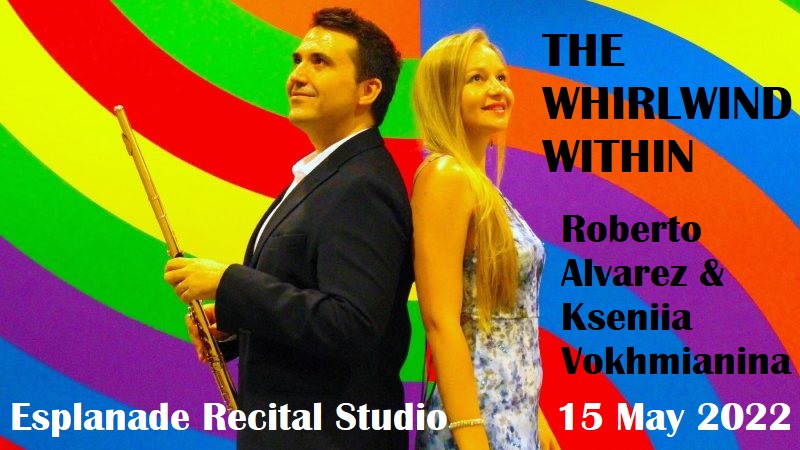
THE WHIRLWIND WITHIN / Roberto Alvarez & Kseniia Vokhmianina / Review
THE WHIRLWIND WITHIN
Roberto Alvarez, Flute
Kseniia Vokhmianina, Piano
Esplanade Recital Studio
Sunday (15 May 2022)
The Whirlwind Within was a recording project by Spanish flautist Roberto Alvarez and Ukrainian pianist Kseniia Vokhmianina, both resident in Singapore, during the fallow months of the Covid pandemic. Both musicians coincidentally arrived in Singapore about 14 years ago, and are presently colleagues at the School of The Arts. Roberto had taken up the assistant principal piccolo desk at the Singapore Symphony while Kseniia came as a teenaged piano student to the Nanyang Academy of Fine Arts. That both have established themselves as vital figures in Singapore musical life speaks volumes of their good work and the welcoming milieu which accepted them as our very own.
This 70-minute-long concert was the launch of their debut CD recording on the artist-led Odradek label and a prelude to their concert tour to Europe in June. Those wary of 20th and 21st century music had absolutely nothing to fear as the programme was 100% tonal, much of it as approachable as late Romantic repertoire, but infused with popular, folk, jazz and dance elements.
The Sonatina (2007) by Englishman James Rae opened the concert with a bang. The sheer exuberance and syncopations of its rhythmic outer movements (Aquarelle and Fire Dance) contrasted well with the lyrical legato lines of the central Nocturne. This vein of easy accessibility continued into Spaniard Daniel Sanchez Velasco’s Dance Preludes (2020), which claimed multiple references including Beethoven’s Seventh Symphony in the opening bars of the Allegro. Elsewhere, one might also sense the spirits of Faure, Granados and Rachmaninov looming nearby.
There was initially a fear that the mostly Romantic piano writing might overwhelm the flute but both instrumentalists soon found a common ground which continued through the whole concert. Roberto’s rich and mellifluous tone, allied with perfect intonation were a constant, matched by Kseniia’s always alert responses and sensitive piano accompaniment.
Gonzalo Casielles Camblor (1931-2020) was Roberto’s longtime music teacher in Asturias, and his El Vals De La Fortuna (2014) or Fortune Waltz was based on the simple five notes (D#-E-B-C-A) from the numbers of a winning lottery ticket. This was a charming little piece with an earworm of a melody not too distant from the once ubiquitous Tarrega Gran Vals (that darned Nokia ringtone!).
The four short movements of Elisenda Fabregas Flute Sonata No.1 (1995) formed the most substantial work on the programme. Relative to the others, it had the most dissonance while also displaying the greatest range of moods and emotions, from sadness and grief to anger and fury. Was it just me, or did anyone else think that the long opening flute trill reminded one of the beginning of Lalo Schifrin’s Mission Impossible Theme? Through its 15-minute course, the music ran a gamut of unease and agitation, as if borne of a sublimated inner rage and strife. If there were a work that is accurately summed up by the album’s title The Whirlwind Within, this would pretty much be it.
The concert proper closed as passionately as it began with three pieces by the Argentine Pablo Aguirre. La Fuga (The Escape, 1997) had that heady Astor Piazzolla feel with fast tango rhythms, contrasted with the nostalgic milonga-like melody of Distancias (Distant, 2002), a classic and beautiful slow movement. In Pasion Ensordecedora (Deafening Passion, 1991), the extroverted music veered into exultant Gershwin and Bolling territory before closing on a spirited high.
The sole encore was dedicated to the courageous people of Ukraine, a heartfelt rendering of Melody by Myroslav Skoryk (1938-2020). It had a plaintive quality with a motif resembling the one from Charlie Chaplin’s Limelight. With the recent liberation of Kseniia’s hometown of Kharkiv from the Russians, there was a sense of satisfaction and relief to be had all around. The audience was just as enthused, resulting in a long queue to purchase the CD and get the virtuosos’ autographs.
Saturday, 8 January 2022
I MOLINISTI by ROBERTO ALVAREZ & KEVIN LOH / Review
I MOLINISTI
FRANCESCO MOLINO
Complete Works for Flute & Guitar
ROBERTO ALVAREZ, Flute
KEVIN LOH, Guitar
Centaur CRC 3850
It will come as no surprise that Italian composer and conductor Francesco Molino (1768-1847), born near Turin, is all but unknown outside of guitar-fancying circles. He was a virtuoso guitarist who made his name and settled in Paris from the 1820s to his death. His dates have him as a contemporary of Beethoven, but his musical style, embracing the lyricism of bel canto traditions, aligns him more closely to the likes of Paganini and Rossini.
This album, produced in Singapore, conveniently houses Molino’s complete works specifically conceived for flute and guitar. He also composed works for violin (interchangeable with the flute) and guitar, but are not included here. There are nine such works, six Duos (Op.16 and 61) and three Nocturnes (Op.37, 38 and 39). All comprise two movements, a slow movement followed by a faster dance-like conclusion. That latter movements usually take the form of a rondo, and in the Op.61 duos, include a Polonaise and Eccosais (Scottish dance).
Each work lasts between three to eight minutes, and not given to longeurs or florid elaborations, the full excesses of Romanticism having yet gained a foothold. If not for their titles, works seem indistinguishable from each other. So why listen to them at all? The secrets lie in a penchant for songfulness and mellifluousness. To this end, flautist Roberto Alvarez (Assistant Principal Piccolo of the Singapore Symphony Orchestra) delights with his silky tone and seamless phrasing, aided by guitarist Kevin Loh’s excellent accompaniment. While these works are unlikely to appear as main events in chamber concerts, they make high class background entertainment.
Fernandino Carulli (1770-1841) may be a name known to non-guitarists, as one might regard Mauro Giuliani or Fernando Sor. The Neapolitan Carulli also settled in Paris, where he developed a rivalry with his close contemporary Molino, their respective students clashing over differences in guitar technique! The album’s “bonus” is Carulli’s Concerto in G major for flute and guitar, a full-length three-movement work no less than 23 minutes.
The “orchestra” is a string quintet formed by members from the Singapore Symphony, who are fully in the spirit of the music. The first movement culminates with a properly discursive cadenza for both solo instruments, making it a second cousin to Mozart’s Concerto for Flute and Harp. Make no mistake, this is the outrightly virtuosic work of the album and its crowning achievement. Molino versus Carulli? Carulli wins but the music of both Italians deserve to be heard.
Thursday, 14 March 2019
CD Review (The Straits Times, March 2019)
Monday, 28 May 2018
A TALE OF TWO CITIES / By Candlelight Series / Review
| Composers and performers (L to R): Low Shao Suan, Low Shao Ying, Chen Zhangyi, Roberto Alvarez, Katryna Tan & Kseniia Vokhmianina. |
Tuesday, 27 February 2018
CIRCULO / TO Ensemble / Review
| Both Tze and Roberto shared freely in the post-concert discussion. |
![]() |
| A new take on the programme's cover! |