Showing posts with label L'arietta. Show all posts

Wednesday, 6 July 2022

SPEED DATING TONIGHT! / L'arietta / Review


SPEED DATING TONIGHT!

L’arietta

Black Box, Stamford Arts Centre

Friday (1 July 2022)


This review was published in The Straits Times on 6 July 2022 with the title "Speed dating opera relevant and topical".


American composer and librettist Michael Ching’s 2013 opera Speed Dating Tonight! might just be the most relevant and topical opera of our times. Its Asian premiere last weekend, a production undertaken by local opera company L’arietta, was a minor miracle in itself.


Originally slated for May 2020, its initial run had been postponed by the pandemic. During the lean months for singers socially-distanced by law, All Dressed Up (No Place To Go) – a 9-part prequel to the opera – made its debut as an online entity, also produced by L’arietta. The first night of the actual opera had to be cancelled after three cast members were diagnosed with Covid-19. They were replaced by three singers and one dancer, who learnt their parts within 24 hours.
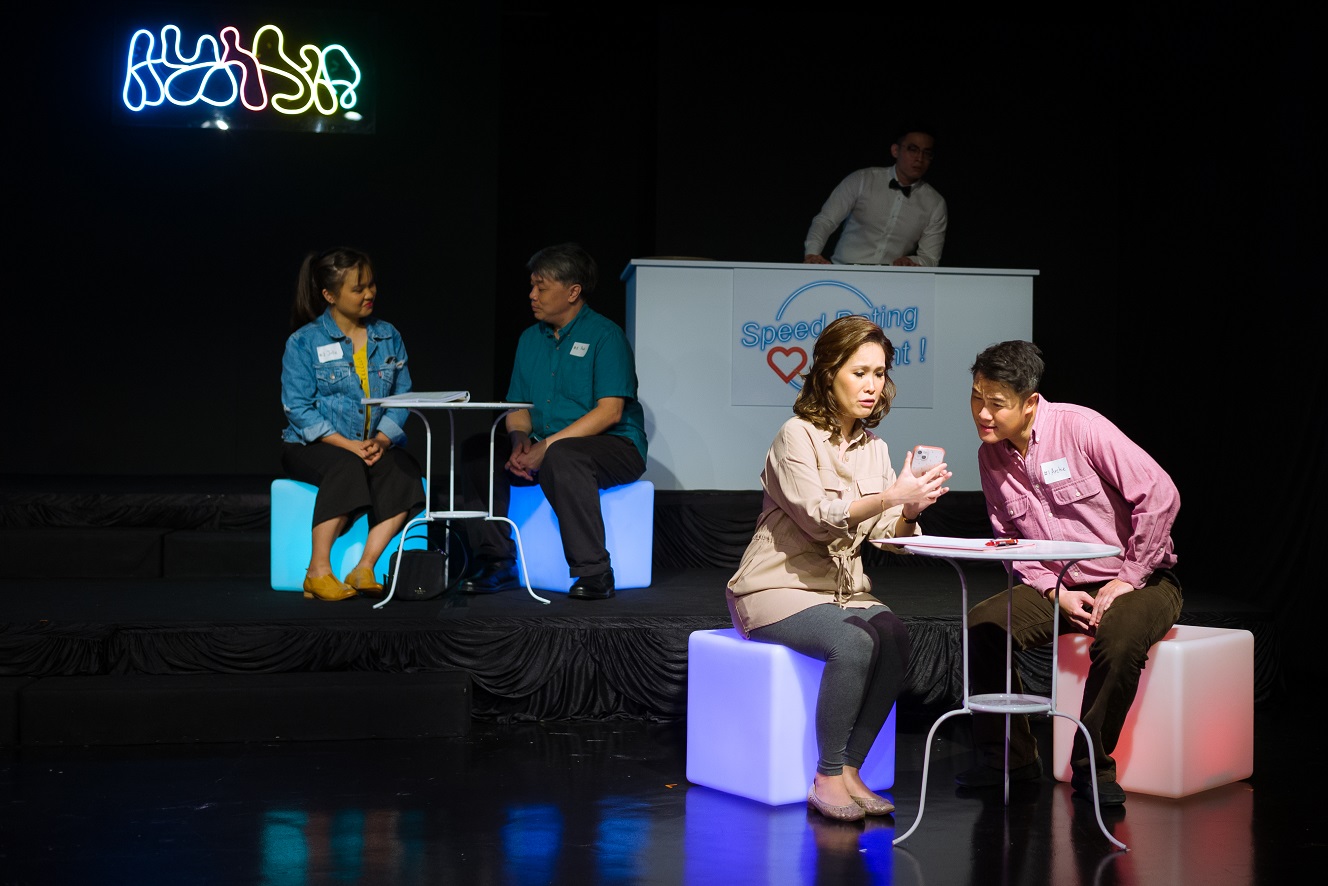


Improvisation was the name of the game, as is the role-playing seen in speed dating. A mostly 21st century phenomenon, speed dating brings many people together within a short space of time in a hope that mutually beneficial interactions take place. The opera, directed by Eleanor Tan, is set in a bar with tables for two, where hopefuls meet to share their likes, loves and lives.     


Christina The as Kaylee, Dating Coordinator.


Flexibility was given to cast size, and ten artists accompanied by pianist Aloysius Foong seemed the right number to make the narrative flow for its interrupted 75 minutes. Other than the Dating Coordinator Kaylee (sung by Christina The), Bartender Quinn (Samuel Ng), waitress Stephanie (Ng Jingyun and Chloe Chua) and Busboy Marc (Ted Ngoo), the number of daters and their profiles were variable.


Dan (Preston Lim) receives a singing birthday card.


Awkwardness and anxieties were revealed by daters Pat (Reuben Lai) and Julie (Natasha Michella Da Costa) in their short arias, while Deborah (Akiko Otao), Archie (Leslie Tay) and Dan (Preston Lim) all displayed quirks and foibles. There were several stereotypes, including cat-fancying, cellphone addiction, bassoon-playing, or being a liaison of the governmental Covid taskforce. Personnel and scenarios are interchangeable, but with varying results. Some meetings lead to possible promise but with real doubts, a few strike gold while others just fall flat.


Deborah (Akiko Otao) and Pat (Reuben Lai),
co-founders of L'arietta
find a certain chemistry.


Genuine chemistry was displayed in the duet by Lai and Otao, both co-founders of L’arietta, and the audience could be excused for having a warm and fuzzy feeling for their characters together. But as life and fate would have it, Deborah and Julie later waltz off into the sunset, leaving Pat perplexed and back in square one. This is an opera unafraid to tackle LGBTQ issues face-on, delivering it with forthrightness and humour.


Deborah and Julie (Natasha Michella Da Costa)
find themselves and love it!


The music employed was gratifyingly tonal, a comfortable cross between artsong, operetta and American musical theatre. There were no pretentions to grand opera, although two duets took liberties of setting modern English words to melodies from Bizet’s Carmen and Mozart’s The Magic Flute. The latter, Papageno and Papagena’s duet, was rather apt given “birds of the same feather” got to find each other in the end.
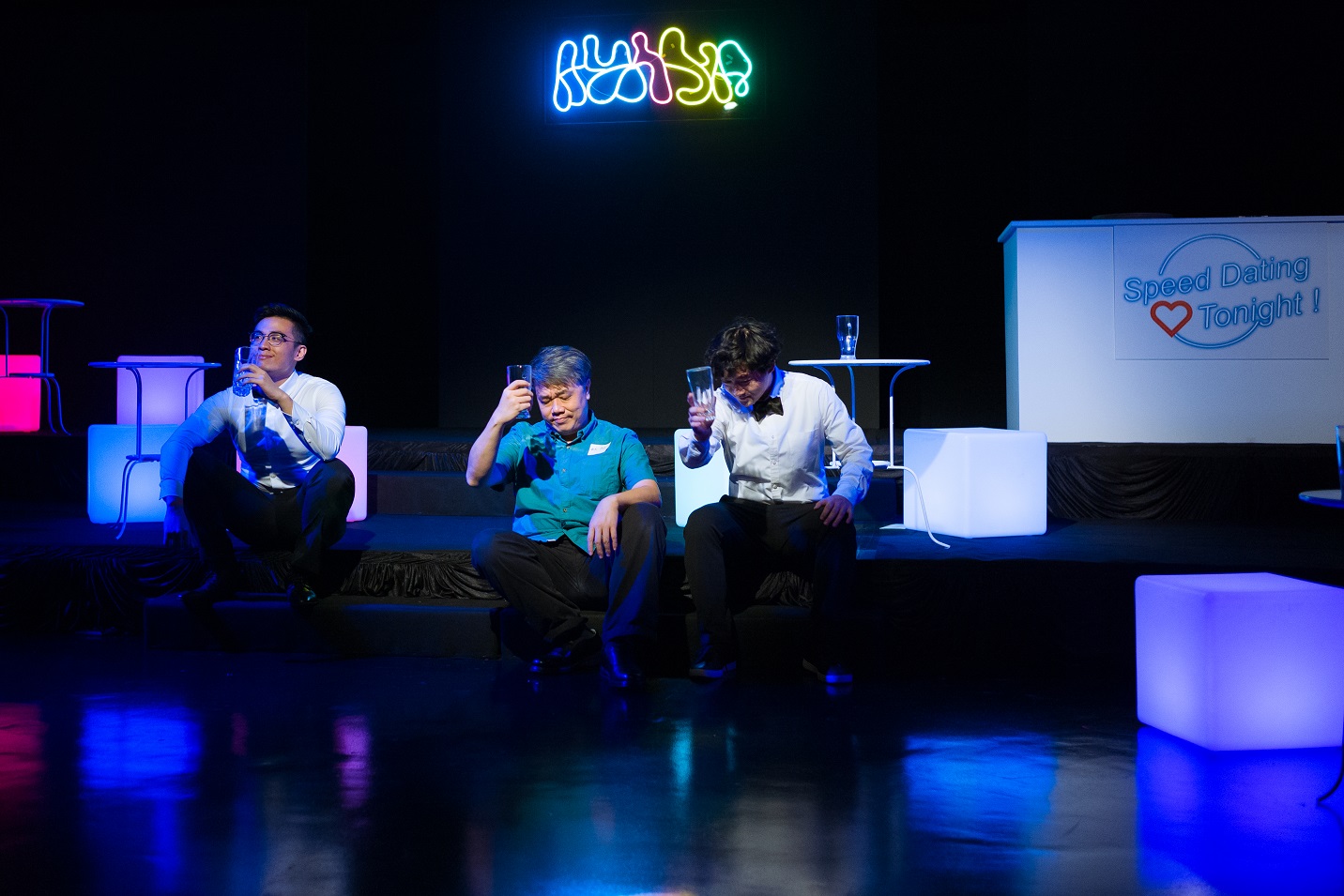
 

Pat is alone again,
and looks forward to another 
evening of Speed Dating.


Judging by the warm reception by the sold-out audience, one foresees this opera as having a long shelf-life, with new characters and fresh material updated for uncertain times ahead. 


All photos by Jamie Chan, courtesy of L'arietta Productions.

Monday, 15 October 2018

A SINGAPORE TRILOGY / L'arietta / Review


A SINGAPORE TRILOGY
L’arietta
The Arts House
Friday (12 October 2018)

This review was published in The Straits Times on 15 October 2018 with the title "Realising the dream of Singaporean opera".

In opera parlance, Il Trittico refers to three one-act operas by the Italian Giacomo Puccini, namely Il Tabarro, Suor Angelica and Gianni Schicchi. Singapore has been bestowed a Trittico of her own by young composer Chen Zhangyi and librettist Jack Lin, whose A Singapore Trilogy was performed complete for the first time in a single sitting at a single venue.

Composer Chen Zhangyi and
librettist Jack Lin (inset)

All three operas, sung in English and directed by veteran thespian Nora Samosir, had typically Singaporean settings with characters and inter-personal relationships one would readily identify with. Opera company L’arietta spared little effort in creating an immersive experience by staging the performances simultaneously in two different spaces within The Arts House, with the audience up close and featuring some of the local vocal scene’s finest voices.


Receiving its world premiere in The Blue Room was Kopi For One (2018), centred on an estranged father-daughter relationship within a neighbourhood kopitiam. Soprano Akiko Otao and tenor Jonathan Charles Tay played protagonists who seemed remote despite the familial connection. Their disparate personalities were brought together by the levity of soprano Yee Ee-Ping’s cleaning auntie, she of unabashed Singlish and spouted colloquialisms.    


This emotional distance, although initially jarring, was well-founded. It was in the opera’s final minutes when the twist was only revealed: the father we saw and heard was a ghost. The music was modern yet tonal, accompanied by an ensemble of violin, cello, flute, clarinet and piano, conducted by the composer himself. As if to complete the experience, the audience was also treated to coffee, tea, Milo and a selection of nyonya kueh during the intermission.  


They were later ushered to The Living Room for the far more light-hearted Laksa Cantata (2013), a Singaporean update on the story in J.S.Bach’s Coffee Cantata. Soon-to-wed Stephen (tenor Samuel Ng) and Leah (soprano Ng Jingyun) fuss over whether laksa lemak should be served at their nuptials. What appeared to be sure recipe for a split soon resolved in a steaming hot bowl of compromise. Here the dreamy Stephen and feisty Leah were well-characterised by both Ngs, helped by witty dialogue, and their final waltz of blissful truce eventually sealed the deal.

  
Finally, reminiscence and reflection dominated Window Shopping (2014), where sopranos Felicia Teo and Phoebe Chee held sway. Engaging in a favourite local pastime, both ladies elicit different reactions after stepping into a high end shoe boutique. The wistfulness of Teo’s older woman contrasted starkly with Chee’s ecstatic young girl, but both were essentially the same person separated by the passage of time. Youthful exuberance of youth gives way to wizened experience, with the unifying factor being Chen’s jazz-inflected score played by the same instrumental combination led by Aloysius Foong. 


Two decades ago, Singaporean opera seemed a distant dream. Today, it has become par for the course. With this excellent trilogy, Chen Zhangyi should no longer be referred to as a composer of promise, but one of stature.  

Thursday, 2 November 2017

PURGATORY / L'arietta / Review


Namiko Chan Takahashi's portrait of
Reuben Lai as The Old Man
formed the cover of this production

PURGATORY
L'arietta
54 Waterloo Street
Tuesday (31 October 2017)

This review was published in The Straits Times on 2 November 2017 with the title "Creepy enough for Halloween".

Halloween night was an apt occasion to witness local opera company L'arietta's production of Gordon Crosse's one-act opera Purgatory (1966), a musical setting to W.B.Yeats' disturbing play of the same title from 1938. Unlike last year's macabre barrel of laughs that was Operacalypse Now!, Purgatory was deadly serious, but made topical by director Eleanor Tan's transforming an Irish saga of familial decline and degeneration into a Peranakan one. 

The hour-long opera benefitted from the “immersive experience” offered to its audience, by means of acting, dance and portraiture in addition to purely musical values. Before the actual opera began, listeners were ushered into a Straits Chinese decorated ante-room where the back-story was played out. Well-heeled Nonya girl has an affair with a lowly commoner, but dies after giving birth to a son, who grows up to become the troubled Old Man in the opera. 


Singaporean tenor Reuben Lai must have gained a headful of white hair singing the Old Man, for this was the most exacting and convincing portrays of descent into psychosis even winessed on the local operatic stage. Jack Nicholson in Kubrick's cult horror movie The Shining readily comes to mind.


Opposite him, Malaysian tenor Peter Ong was the blase and not-so-innocent Boy, whose Oedipal antagonism with his father was clearly palpable. This uneasy chemistry between both stage veterans was excellent. The only female presence was provided by a 6-member women's chorus, representing the Old Man's dead mother and spirits of the dead who observed, reacted and commented on goings-on like some spectral Greek chorus.


Crosse's music was tonal but dissonant, much in the manner of Benjamin Britten. The chamber orchestra led by Aloysius Foong comprised cello, flute, keyboards and percussion, the latter providing ominous hoof-beats which spelt doom besides ratcheting up the ante to heart-stopping highs.

The set design by Grace Lin was darkly evocative, dominated by an arc of wooden slats from a burnt-down house under the shade of a haunted banyan tree, which revealed a hung skeleton during the latter stages. Only the taped Balinese music that accompanied random village scenes before the opera came across as misplaced.

It is said that the sins of the father are visited upon the children, and it was the premise of the Old Man (who as a 16-year-old had killed his own father) to stop that endless cycle of death and free his mother's soul from purgatory. The purging of his emotions and downward spiral, so vividly played by Lai, would lead to another death in his hand, but could two wrongs ever make a right?


Short as this opera was, there was no shortage of dramatic tension and one was led on a noose to its bitter denouement. This was so effective that one individual in the front row was seen to make convulsive stabbing motions all through to the end. If that does not give one the Halloween creeps, nothing else will.  

Purgatory plays till Sunday 
at 54 Waterloo Street. 

Monday, 4 April 2016

HONESTLY! 3 OPERAS, 1 HOUR / L'arietta / Review


HONESTLY! 3 OPERAS, ONE HOUR
L'arietta
10 Square, Orchard Central
Saturday (2 April 2016)

This review was published in The Straits Times on 4 April 2016 with the title "Tapestry of life revealed in mini operas".

Say hello to L'arietta, Singapore's newest opera company. L'arietta, which means “little song” in Italian, was formed by local tenor Reuben Lai and Japanese soprano Akiko Otao to promote the niche genre of chamber opera. Both profess that opera is relevant to today's cultures and mores even in its most diminutive form, far removed from the grand spectacles of Wagner and Verdi. Its debut production showcased three such mini-operas in a single sitting, each refreshingly different and moving in their own way.


British composer Joseph Horovitz's The Gentleman's Island was a dark comedy about two stuffy Englishmen stranded on a desert island. They are initially distant because they have not been previously introduced, but readily bond when they know of a mutual friend Robinson. Jameson Soh's eloquent and effective stage direction had the gentleman marooned on separate wooden blocks but joined by a physical and metaphorical umbilical cord.


Tenor Lai and baritone Brent Allcock were excellent in their characterisations of self-consciousness and overriding pride. Their clear dulcet tones meant that the audience could catch their every single word and nuance. Even when rescue arrives in the form of Robinson, they reject him because he comes in a convict ship. The folly of death by pride is their ultimate comeuppance.


The second opera was Singaporean Chen Zhangyi's Window Shopping, about diametrically opposing reactions of two women when they enter a high-end shoe shop. Mezzo-soprano Angela Hodgins' older lady sings of regret and soured memories while soprano Otao's young waif is ecstatic on the choice of heels available to her.


Chen's score cleverly used a ground bass, which represented plodding footsteps people make when they go shopping, also symbolic of the trudges in life itself. While Hodgins' part was elegiac, Otao's was whimsical and jazzy. Ultimately both come to the realisation that life was not about acquiring assets (such as new shoes replacing old ones) but how to look after them.


The final opera brought back all four singers in Samuel Barber's A Hand of Bridge. What lurks in the minds of those who pit their wits in a game of small stakes? The scenario of failed marriages and dysfunctional characters revealing their innermost desires and fears were neatly encapsulated in four ariettas.

Angela longs for a hat of peacock feathers, while Reuben lusts after an extramarital affair. Akiko frets on her mother's frail health, and Brent craves for power and riches. Such is the flawed fabric and tapestry of life, where each individual has to come to terms with his or her own foibles and realities.


Accompanying this production was young pianist Wayne Teo, who more than coped with the disparate styles and complexities thrown at him. That the filled-to-capacity audience, with many children in attendance, sat in quiet and rapt attention throughout was ample testimony to the performers.

Clock watchers might like to note the durations of each opera: 28 minutes (Horovitz) + 21 minutes (Chen) + 10 minutes (Barber) = 59 minutes. Three operas in one hour? Mission accomplished.
