Showing posts with label Reuben Lai. Show all posts

Tuesday, 16 December 2025

NOWELL, NOWELL! / Red Dot Baroque / Review


NOWELL, NOWELL!
Red Dot Baroque
The Arts House Chamber
Sunday (14 December 2025)

This review was published in The Straits Times on 16 December 2025 with the title "Red Dot Baroque ushers in Christmas with joyous concert".


It was a wet and soggy Sunday afternoon, and it almost seemed a chore to haul oneself away from the comforts of home to attend a concert. However, this was not any concert, but a celebration of Christmas by Red Dot Baroque (RDB), Singapore’s only professional period instrument group. The much-needed tonic for one nursing a cold, its infectious high spirits instantly drove away the blues.

Photo: Yong Junyi

Opening with the distant wail of Law Chi Yan’s bagpipes, the tenor voice of Reuben Lai followed by Teng Xiang Ting’s soprano began this uncommon procession, a Yuletide offering from the British Isles not previously encountered in sunny Singapore. RDB knows how to put on a show and its 75 minutes were a treat from start to end.


With music from the Emerald Isle, this was a programme built around the legendary blind harper Turlough O’Carolan (1670-1738), considered Ireland’s national composer. His Welcome was the perfect greeting for the dances – which sounded familiar by the Celtic fiddling – in Cup and Favourite Jig to come.

Photo: Yong Junyi

After RDB founder and leader Alan Choo made his entry, the floor of the Old Parliament’s chamber was transformed into some country barn. Joined by fellow fiddlers - Brenda Koh, Placida Ho and Gabriel Lee – they begun to make merry. Their free-wheeling moves abetted by foot-stamping by the audience made for an enjoyable musical spectacle.

Photo: Yong Junyi


The famous Wexford Carol, shared by Teng and Lai, well and truly ushered in the spirit of Christmas atmosphere. Crossing the Irish Sea to England, Pastime With Good Compayne by King Henry VIII, the infamous monarch with six wives, brought in more cheer.


Other RDB’s instrumentalists, Gerald Lim on electronic keyboard substituting for harpsichord and Christopher Clarke on archlute accounted for more intimate music by William Byrd and John Dowland. The alternation between instrumental and sung pieces worked very well, with the English segment closing with Nowell, Tidings True and Masters of this Hall, adapted from Frenchman Marin Marais’ music.


Climbing over Hadrian’s Wall into Scotland, there was more intoxicating fiddling in On the Wings of Skorie and Old Grey Cat. The soothing Skye Boat Song was sung by Lai with a distinct Celtic accent, while the witty and bawdy verses of Henry Purcell’s Twas Within a Furlong of Edinburgh Town were perfectly captured by Teng.


Returning to Eire, O’Carolan’s final work before his passing, Farewell To Music, made for some poignant moments before the jigs Apples In Winter and The Mason’s Apron closed the show with a proper hurrah. RDB’s splendid ensemble was completed by Leslie Tan on cello / gamba, Cheryl Lim on flutes and whistles, and percussionist Govin Tan who left his tablas at home.

Cheryl Lim
Leslie Tan
Govin Tan
Photo: Yong Junyi


The audience singalong was suitably rousing with seasonal hymns ironically by two German composers, Felix Mendelssohn’s Hark, The Herald Angels Sing and George Frideric Handel’s Joy To The World. With the current turmoil and violence, the world could do with more of Red Dot Baroque’s joyous message of goodwill and peace.

Photo: Yong Junyi

Photo: Yong Junyi


More photos from the concert 
may be found here:

Wednesday, 6 July 2022

SPEED DATING TONIGHT! / L'arietta / Review


SPEED DATING TONIGHT!

L’arietta

Black Box, Stamford Arts Centre

Friday (1 July 2022)


This review was published in The Straits Times on 6 July 2022 with the title "Speed dating opera relevant and topical".


American composer and librettist Michael Ching’s 2013 opera Speed Dating Tonight! might just be the most relevant and topical opera of our times. Its Asian premiere last weekend, a production undertaken by local opera company L’arietta, was a minor miracle in itself.


Originally slated for May 2020, its initial run had been postponed by the pandemic. During the lean months for singers socially-distanced by law, All Dressed Up (No Place To Go) – a 9-part prequel to the opera – made its debut as an online entity, also produced by L’arietta. The first night of the actual opera had to be cancelled after three cast members were diagnosed with Covid-19. They were replaced by three singers and one dancer, who learnt their parts within 24 hours.


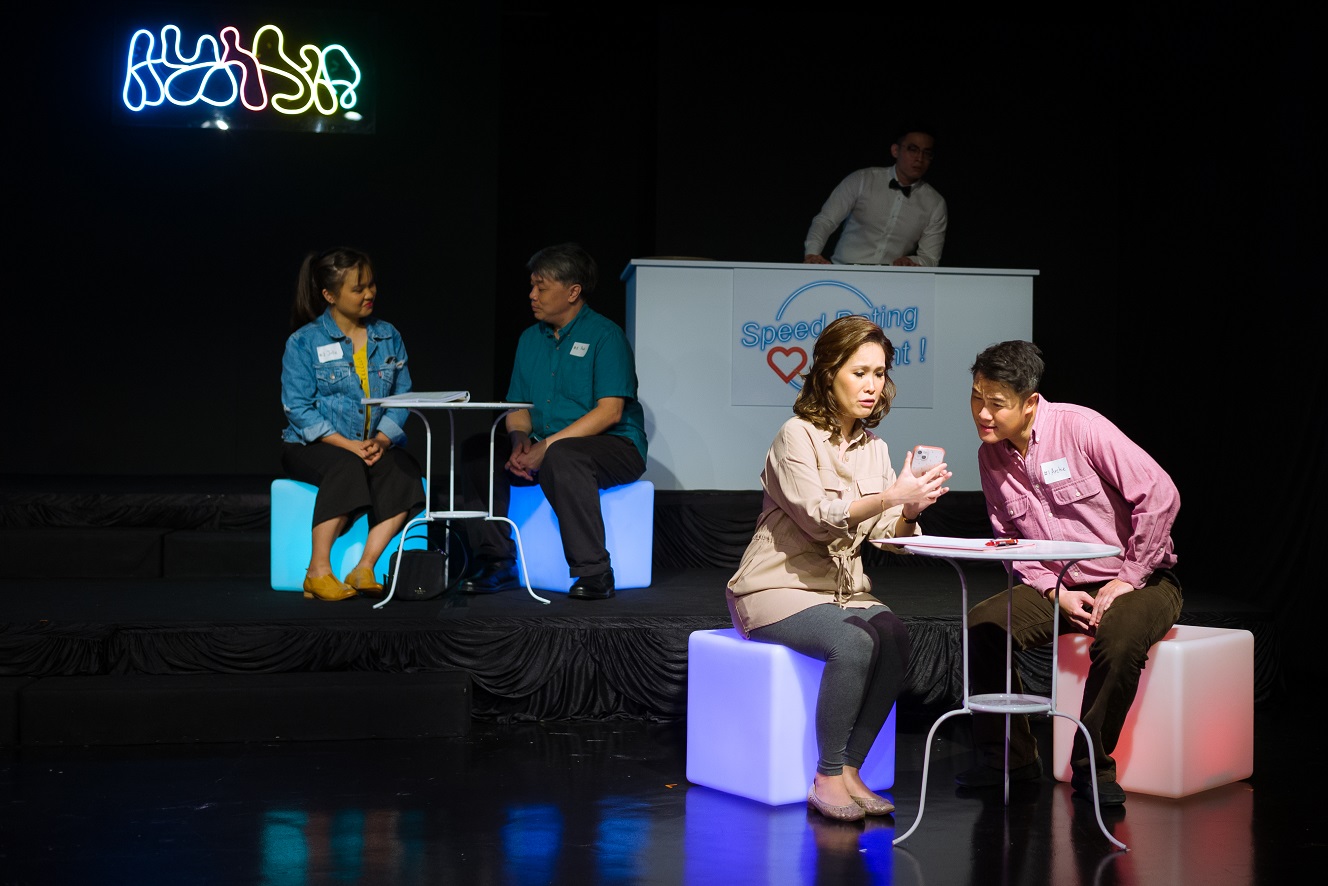
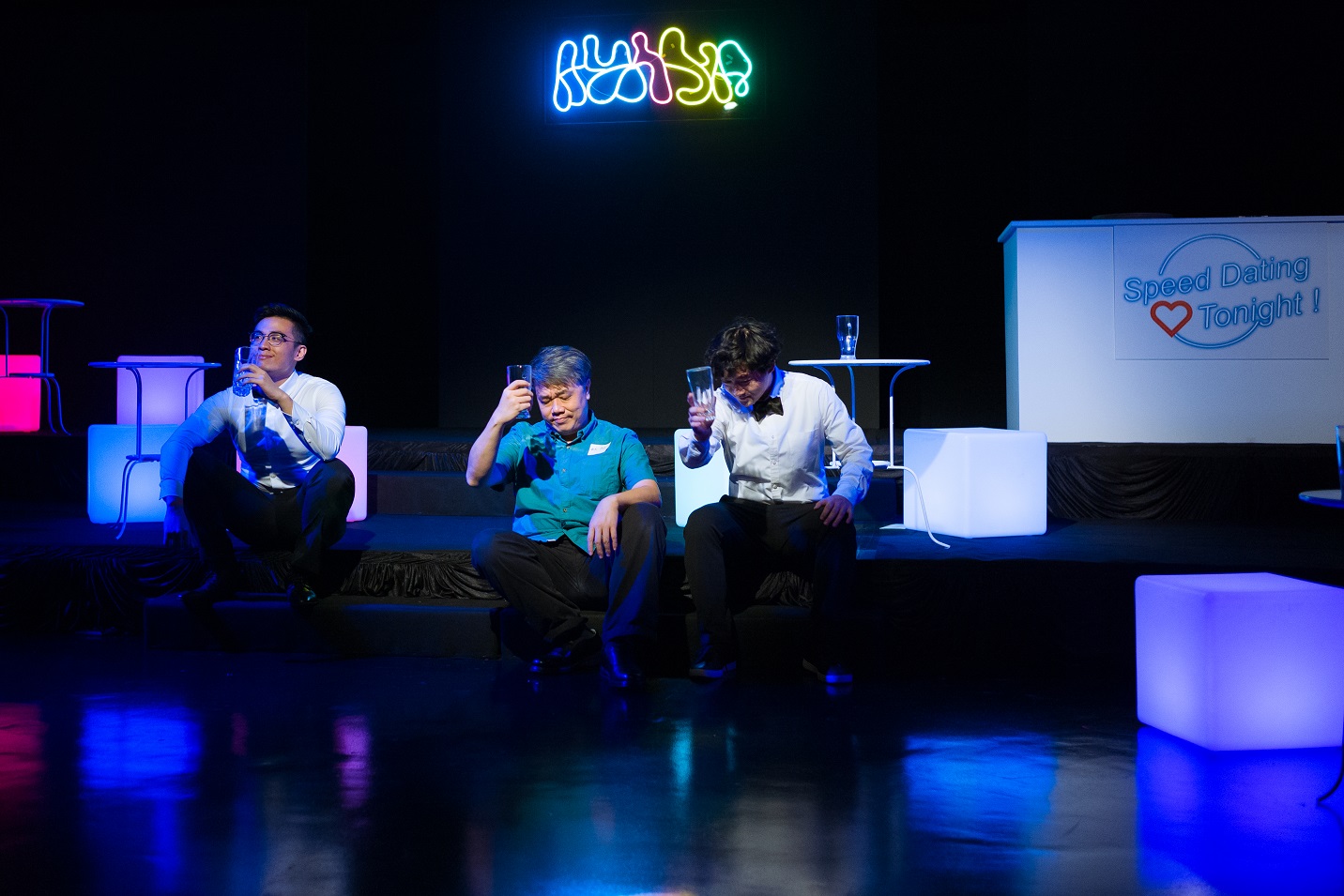
Improvisation was the name of the game, as is the role-playing seen in speed dating. A mostly 21st century phenomenon, speed dating brings many people together within a short space of time in a hope that mutually beneficial interactions take place. The opera, directed by Eleanor Tan, is set in a bar with tables for two, where hopefuls meet to share their likes, loves and lives.     


Christina The as Kaylee, Dating Coordinator.


Flexibility was given to cast size, and ten artists accompanied by pianist Aloysius Foong seemed the right number to make the narrative flow for its interrupted 75 minutes. Other than the Dating Coordinator Kaylee (sung by Christina The), Bartender Quinn (Samuel Ng), waitress Stephanie (Ng Jingyun and Chloe Chua) and Busboy Marc (Ted Ngoo), the number of daters and their profiles were variable.


Dan (Preston Lim) receives a singing birthday card.


Awkwardness and anxieties were revealed by daters Pat (Reuben Lai) and Julie (Natasha Michella Da Costa) in their short arias, while Deborah (Akiko Otao), Archie (Leslie Tay) and Dan (Preston Lim) all displayed quirks and foibles. There were several stereotypes, including cat-fancying, cellphone addiction, bassoon-playing, or being a liaison of the governmental Covid taskforce. Personnel and scenarios are interchangeable, but with varying results. Some meetings lead to possible promise but with real doubts, a few strike gold while others just fall flat.


Deborah (Akiko Otao) and Pat (Reuben Lai),
co-founders of L'arietta
find a certain chemistry.


Genuine chemistry was displayed in the duet by Lai and Otao, both co-founders of L’arietta, and the audience could be excused for having a warm and fuzzy feeling for their characters together. But as life and fate would have it, Deborah and Julie later waltz off into the sunset, leaving Pat perplexed and back in square one. This is an opera unafraid to tackle LGBTQ issues face-on, delivering it with forthrightness and humour.


Deborah and Julie (Natasha Michella Da Costa)
find themselves and love it!


The music employed was gratifyingly tonal, a comfortable cross between artsong, operetta and American musical theatre. There were no pretentions to grand opera, although two duets took liberties of setting modern English words to melodies from Bizet’s Carmen and Mozart’s The Magic Flute. The latter, Papageno and Papagena’s duet, was rather apt given “birds of the same feather” got to find each other in the end.


Pat is alone again,
and looks forward to another 
evening of Speed Dating.


Judging by the warm reception by the sold-out audience, one foresees this opera as having a long shelf-life, with new characters and fresh material updated for uncertain times ahead. 


All photos by Jamie Chan, courtesy of L'arietta Productions.

Thursday, 2 November 2017

PURGATORY / L'arietta / Review


Namiko Chan Takahashi's portrait of
Reuben Lai as The Old Man
formed the cover of this production

PURGATORY
L'arietta
54 Waterloo Street
Tuesday (31 October 2017)

This review was published in The Straits Times on 2 November 2017 with the title "Creepy enough for Halloween".

Halloween night was an apt occasion to witness local opera company L'arietta's production of Gordon Crosse's one-act opera Purgatory (1966), a musical setting to W.B.Yeats' disturbing play of the same title from 1938. Unlike last year's macabre barrel of laughs that was Operacalypse Now!, Purgatory was deadly serious, but made topical by director Eleanor Tan's transforming an Irish saga of familial decline and degeneration into a Peranakan one. 

The hour-long opera benefitted from the “immersive experience” offered to its audience, by means of acting, dance and portraiture in addition to purely musical values. Before the actual opera began, listeners were ushered into a Straits Chinese decorated ante-room where the back-story was played out. Well-heeled Nonya girl has an affair with a lowly commoner, but dies after giving birth to a son, who grows up to become the troubled Old Man in the opera. 


Singaporean tenor Reuben Lai must have gained a headful of white hair singing the Old Man, for this was the most exacting and convincing portrays of descent into psychosis even winessed on the local operatic stage. Jack Nicholson in Kubrick's cult horror movie The Shining readily comes to mind.


Opposite him, Malaysian tenor Peter Ong was the blase and not-so-innocent Boy, whose Oedipal antagonism with his father was clearly palpable. This uneasy chemistry between both stage veterans was excellent. The only female presence was provided by a 6-member women's chorus, representing the Old Man's dead mother and spirits of the dead who observed, reacted and commented on goings-on like some spectral Greek chorus.


Crosse's music was tonal but dissonant, much in the manner of Benjamin Britten. The chamber orchestra led by Aloysius Foong comprised cello, flute, keyboards and percussion, the latter providing ominous hoof-beats which spelt doom besides ratcheting up the ante to heart-stopping highs.

The set design by Grace Lin was darkly evocative, dominated by an arc of wooden slats from a burnt-down house under the shade of a haunted banyan tree, which revealed a hung skeleton during the latter stages. Only the taped Balinese music that accompanied random village scenes before the opera came across as misplaced.

It is said that the sins of the father are visited upon the children, and it was the premise of the Old Man (who as a 16-year-old had killed his own father) to stop that endless cycle of death and free his mother's soul from purgatory. The purging of his emotions and downward spiral, so vividly played by Lai, would lead to another death in his hand, but could two wrongs ever make a right?


Short as this opera was, there was no shortage of dramatic tension and one was led on a noose to its bitter denouement. This was so effective that one individual in the front row was seen to make convulsive stabbing motions all through to the end. If that does not give one the Halloween creeps, nothing else will.  

Purgatory plays till Sunday 
at 54 Waterloo Street. 

Monday, 4 April 2016

HONESTLY! 3 OPERAS, 1 HOUR / L'arietta / Review


HONESTLY! 3 OPERAS, ONE HOUR
L'arietta
10 Square, Orchard Central
Saturday (2 April 2016)

This review was published in The Straits Times on 4 April 2016 with the title "Tapestry of life revealed in mini operas".

Say hello to L'arietta, Singapore's newest opera company. L'arietta, which means “little song” in Italian, was formed by local tenor Reuben Lai and Japanese soprano Akiko Otao to promote the niche genre of chamber opera. Both profess that opera is relevant to today's cultures and mores even in its most diminutive form, far removed from the grand spectacles of Wagner and Verdi. Its debut production showcased three such mini-operas in a single sitting, each refreshingly different and moving in their own way.


British composer Joseph Horovitz's The Gentleman's Island was a dark comedy about two stuffy Englishmen stranded on a desert island. They are initially distant because they have not been previously introduced, but readily bond when they know of a mutual friend Robinson. Jameson Soh's eloquent and effective stage direction had the gentleman marooned on separate wooden blocks but joined by a physical and metaphorical umbilical cord.


Tenor Lai and baritone Brent Allcock were excellent in their characterisations of self-consciousness and overriding pride. Their clear dulcet tones meant that the audience could catch their every single word and nuance. Even when rescue arrives in the form of Robinson, they reject him because he comes in a convict ship. The folly of death by pride is their ultimate comeuppance.


The second opera was Singaporean Chen Zhangyi's Window Shopping, about diametrically opposing reactions of two women when they enter a high-end shoe shop. Mezzo-soprano Angela Hodgins' older lady sings of regret and soured memories while soprano Otao's young waif is ecstatic on the choice of heels available to her.


Chen's score cleverly used a ground bass, which represented plodding footsteps people make when they go shopping, also symbolic of the trudges in life itself. While Hodgins' part was elegiac, Otao's was whimsical and jazzy. Ultimately both come to the realisation that life was not about acquiring assets (such as new shoes replacing old ones) but how to look after them.


The final opera brought back all four singers in Samuel Barber's A Hand of Bridge. What lurks in the minds of those who pit their wits in a game of small stakes? The scenario of failed marriages and dysfunctional characters revealing their innermost desires and fears were neatly encapsulated in four ariettas.

Angela longs for a hat of peacock feathers, while Reuben lusts after an extramarital affair. Akiko frets on her mother's frail health, and Brent craves for power and riches. Such is the flawed fabric and tapestry of life, where each individual has to come to terms with his or her own foibles and realities.


Accompanying this production was young pianist Wayne Teo, who more than coped with the disparate styles and complexities thrown at him. That the filled-to-capacity audience, with many children in attendance, sat in quiet and rapt attention throughout was ample testimony to the performers.

Clock watchers might like to note the durations of each opera: 28 minutes (Horovitz) + 21 minutes (Chen) + 10 minutes (Barber) = 59 minutes. Three operas in one hour? Mission accomplished.    


Monday, 6 October 2014

LETTER TO JULIET / Bellepoque / Review


LETTER TO JULIET
Bellepoque
The Chamber @ The Arts House
Friday (3 October 2014)

This review was published in The Straits Times on 6 October 2014 with the title "Moving musical tribute to Shakespeare's women".

Letter To Juliet is a 80-minute play produced by local light musical theatre group Bellepoque in commemoration of William Shakespeare’s 450th birth anniversary. It is in effect a tribute to the multi-faceted women who made the Bard’s plays so true-to-life and ultimately memorable.

The setting scripted and directed by Hemang Yadav involves literature teacher Hermione (played by Sherilyn Tan) who has a troubled relationship with her ambitious and insensitive husband Leo (Darren Guo), and writes Agony Aunt letters to Juliet Capulet of Verona, the Shakespearean heroine  who has been receiving such letters for centuries.


She addresses the issues of contemporary women and relates these with Shakespeare’s women as she lectures her class of students, which was the audience. Each letter introduces groups of operatic arias and duets, with a cast of five singers very capably accompanied by Vincent Chen on the piano.

It was perhaps unfortunate that the first heroine was Juliet herself, as young soprano Angela Cortez was overmatched by the waltz-song Je veux vivre from Gounod’s Romeo et Juliette. Just getting around the coloratura notes was not quite enough, as it also needed to sound seemingly effortless, which was not the case.


Opposite her was a more believable Romeo, with Ah, leve toi soleil sung by tenor Melvin Tan, one of the land’s best bleeding heart tenors, who made every note and gesture count. Their duet O, Nuit Divine! was better balanced than anticipated and the mismatch much less obvious.  


The character of Lady Macbeth, love or loathe her, was all about ruthlessness and overarching ambition. She found a perfect protagonist in soprano Satsuki Nagatome, whose sheer depth of tone and emotion swept the field in Verdi’s Nel di della vittoria (from Macbeth) as she eyed the Scottish throne with her next nefarious plan. A woman’s hysteria provides an added dimension to the cold brutality already perfected by man. 

In two arias from Purcell’s The Fairy-Queen, adapted from A Midsummer Night’s Dream, it was tenor Reuben Lai who stole the show as a smarmy, domineering male, towering over soprano Sabrina Zuber’s bit-part in the slender If Love’s a Sweet Passion. The aria from Handel’s Giulio Cesare, V’adoro, pupille, ably sung by Cortez, ironically had nothing to do with Shakespeare’s play on the same Roman emperor.


A Shakespearean heroine who evoked most sympathy was Desdemona, and this production telescoped scenes from Otello by both Rossini and Verdi. Verdi’s version is by far the better known, with its tender Ave Maria, here sung with much feeling by Nagatome. The final duet and murder scene with Lai’s Otello brandishing a dagger provided the most gripping moments of the evening.

To close Hermione ponders her next step with her wayward hubby, and drawing from the strengths of all the Shakespearean heroines, she does the unexpected. Forgiving the arrogant Leo would seem like a cop out in the age of women’s liberation, but her magnanimity is the quality that makes true love transcendent. It is all there in The Winter’s Tale. Shakespeare truly understood the hearts of men, and women. 


Photographs by the kind permission of Bellepoque.

Tuesday, 24 December 2013

SING MESSIAH! / Review


SING MESSIAH!
Celebration Chorus, Messiah Singers
Braddell Heights Symphony Orchestra
Esplanade Concert Hall  
Sunday (22 December 2013)                                           

This review was published in The Straits Times on 24 December 2013 with title "Sing-along success of Yuletide season".

The performance of Handel’s oratorio Messiah has been synonymous with the Yuletide season such that the Christian celebration seems incomplete without it. It had been a staple of the Singapore Symphony Orchestra and its choruses, but the ritual was taken up this year by the Braddell Heights Symphony Orchestra, Celebration Chorus and Messiah Singers led by charismatic young conductor Adrian Tan (below).

Another difference was the element of mass audience participation in the spirit of those sing-along Messiahs so popular in England and USA. But are reticent Singaporean audiences ready for such an undertaking?

It helped that hopefuls were primed weeks before with rehearsals led by Greg Petersen and Tom Anderson, with the help of downloadable scores. On the day, audience members in the stalls were armed with choral albums, tablets and iPads to do their part. Conductor Tan cajoled with good humoured needling and the stage was set.

A complete Messiah would have taken two and a half hours, so selections of arias and choruses from all three parts made up a quite digestible 90 minutes for the capacity house. In the less familiar and more difficult fugal choruses like And He Shall Purify, the audience was predictably quiet, but it warmed up considerably for the popular For Unto Us A Child Is Born.

The large chorus on stage projected strength in numbers even if it does not match the finesse of the much smaller Singapore Symphony Chorus which has made a habit of performing from memory. The orchestral accompaniment was more than acceptable even when perfection in cues and execution could be found wanting at times.

The soloists was an A-list of Singaporean (no foreign talents here) singers led by soprano Yee Ee-Ping whose aria Rejoice was an imperious show of coloratura prowess. Mezzo-soprano Rebecca Chellappah projected gravitas in He Was Despised while baritone William Lim was rock-like and unshakeable in the dramatic Why Do The Nations. Tenor Reuben Lai had a pleasant ring to his voice but struggled to hit the highest notes in Comfort Ye and Ev’ry Valley.

The perennial question as to whether one should stand for the Hallelujah Chorus was unequivocally decided by the conductor. Like King George II who did so more than 270 years ago, there were to be no sitters and the effect was quite stunning. Not only did the audience erupt in full voice, the visual spectacle of seeing Esplanaders on their feet was one not easily forgotten.

The ploy was a canny one, as after the final choruses Worthy Is The Lamb and Amen were concluded, there was a spontaneous standing ovation. Whether this was self-congratulatory or not is debatable, but there looks like more D-I-Y Messiahs to come in the near future.