Showing posts with label Mario Venzago. Show all posts

Monday, 23 December 2024

STEVEN ISSERLIS & MARIO VENZAGO / Singapore Symphony Orchestra / Review


STEVEN ISSERLIS & MARIO VENZAGO
Singapore Symphony Orchestra
Victoria Concert Hall 
Friday (20 December 2024) 

This review was first published in Bachtrack.com on 23 December 2024 with the title "Singapore witnesses Mario Venzago’s completion of Schubert’s Unfinished". 

The final Singapore Symphony Orchestra event of this year was not a Christmas concert but one with unusual couplings that worked despite its oddities. Led by Swiss guest conductor Mario Venzago, it began fairly predictably with Carl Maria von Weber’s Overture to Der Freischütz


Unison strings and a French horn chorale acquitted themselves well before leading to the Allegro which thrilled with a high speed romp. This standalone orchestral excerpt was an extension of Rossini’s overtures, but Weber in 1821 was already looking ahead to Wagner’s epics to come. 


Receiving its Singapore premiere was Dmitri Kabalevsky’s Cello Concerto No.2 in C minor (Op.77) with British cellist Steven Isserlis as soloist. Kabalevsky is often regarded as a poor man’s Prokofiev or Shostakovich. He avoided the 1948 Zhdanov-led purges by toeing the party line and writing mostly uncontroversial music, much of which for young people. He only trod the path after his more illustrious colleagues had cleared the minefield. 


Despite that, the concerto was a good undemanding listen, with Isserlis a very persuasive advocate (having recorded it on Virgin Classics in 1988) by wringing out drama and pathos through its conjoint three movements. The slow-fast-slow form gave much room for introspection, opening with solo pizzicatos, followed by elegiac musings and the occasional outburst. 


The fast central movement had the surprise of an alto saxophone solo, extrovertedly helmed by Samuel Phua. Isserlis’ solo cadenzas which linked the movements were predictably heart-rending, and animated as his Rattlesque silver locks flew in the air. The ending was quiet and retiring, but clearly moved the audience to applaud vociferously. 


Isserlis reciprocated with two Russian encores in the keys of C, Prokofiev’s March for Children (Op.65 No.10) and Kabalevsky’s Study in Major in Minor (Op.68 No.3) 


Isserlis and his cello
take a bow together.

Watch this video of the Kabalevsky concerto
and both the encores:


Also for the first time, the Singapore audience got to witness the completion of Schubert’s “UnfinishedSymphony (D.759), in a four-movement edition by Venzago. The final two movements, he claimed, had been “lost” by his predecessor at the Graz Philhamonic, one Anselm Hüttenbrenner. With the reconstructed movements appended, the playing time is distended to some 46 minutes, thus comparable in scope with Schubert’s “GreatSymphony in C major (D.944). 

Mario Venzago waxes lyrical
about his reconstruction of Schubert's Unfinished.

Performances of the familiar opening movements tend to be expansive, sometimes protracted, but Venzago took them at a more than usual brisk pace. The B minor introduction from cellos and basses was suitably sombre, but the broad main melody in G major ran the risk of sounding harried or impatient. He however provided the impetus that made the music sound coherent, including a pacier Andante con moto in E major which in a paradigm shift, was no longer the symphony’s final movement. Also gone was the notion this was to be some solemn requiem. 


The Scherzo, back in the home key of B minor, was reconstructed from 30 fully orchestrated bars and a short-score. The music was decidedly jocular, consistent with Schubertian scherzi, and a lovely surprise came in the Trio in G major, which most listeners will remember as the Ballet Music No.1 from the incidental music for Rosamunde


The finale was also a case of reverse engineering, incorporating much of the martial music from Entracte No.1 from Rosamunde. But Venzago had a little trick up his sleeve towards the end, a reprise of the sombre first movement introduction now sounding like a distant echo, before closing in a blaze of triumph. An interesting experiment, and the audience liked it. But was it faithful or convincing? Only time will tell.

This review as published on Bachtrack.com:
 

Star Rating: ****

Monday, 4 September 2023

CHLOE CHUA PLAYS PAGANINI / Singapore Symphony Orchestra / Review


CHLOE CHUA PLAYS PAGANINI

Singapore Symphony Orchestra

Esplanade Concert Hall

Saturday (2 September 2023)


This review was published in The Straits Times on 4 September 2023 with the title "Chloe Chua plays Paganini with stunning aplomb".


This concert was marketed with Chloe Chua Plays Paganini as its unique selling point but was in reality far more than that. In many ways, it felt like two separate concerts with vastly contrasted repertoire welded together at the hip, with a festive feel reminiscent of London’s BBC Proms.


The first half was early Romantic with a strong bel canto flavour about it. Rossini’s Overture to Il Viaggio A Reims (The Journey To Reims), his last opera in Italian, opened with a serious tone but soon lapsed into comedy. Lovely solos from cor anglais and flute, with excellent woodwind ensemble and an exciting series of patented Rossini crescendos ensured its success under visiting Swiss conductor Mario Venzago’s direction.


Paganini’s Violin Concerto No.1 with SSO artist in residence Chloe Chua was the ostensible reason why the hall was packed to the brim. She did not disappoint, comfortably mastering the fiendishly difficult solo part with seeming effortlessness and impeccable intonation. Even the inordinately long cadenza by Emil Sauret, lasting almost a quarter of the first movement, was overcome with stunning aplomb.


The reduced orchestration with all percussion (timpani, drum, cymbals and triangle) excluded certainly rendered the accompaniment more transparent. The slow movement basked in the lyricism of bel canto, an all too brief respite from earlier acrobatics that would also consume the finale’s Rondo.


Photo: Chris P. Lim


Paganini as innovator of technical devices such as the infamous double-stopped harmonics came to the fore, but that did little to faze Chua’s command and control as the work romped to an imperious high to close. With no encore from her forthcoming, the appreciative audience had to make do with her winning winsome smile instead.


Watch this video of Chloe Chua in Paganini:
 

The second half shifted to the late 19th and early 20th century with a moving performance of Debussy’s Three Nocturnes. More like vivid visions of musical imagery than actual night pieces, the opening Nuages (Clouds) could have done with a little more mystery but the cor anglais solo stood out with its plaintiveness. The far more lively Fêtes (Festivals) was delivered with a lean incisiveness, with a pair of muted trumpets driving its quite thrilling processional march.


Breathtaking in a different way was the seductive beauty evoked by the wordless women’s voices from the Singapore Symphony Chorus and Youth Choir (Chorus master: Eudenice Palaruan) in the closing Sirenes (Sirens). Homogeneous and haunting, this made for the work’s quiet and peaceable end.


English composer Ralph Vaughan Williams’ Toward The Unknown Region, with words by the American Walt Whitman, received its Singapore premiere. Euphemistically described as “a song for chorus and orchestra”, this 12-minute mini-masterpiece was a paean to the spirit of discovery and adventure. Now joined by men voices, the chorus of 67 members generated a bigger sound than thought possible, and with the help of Joanna Paul’s pipe organ, built up to a massive climax and valedictory conclusion. 


Chorusmaster Eudenice Palaruan
gets the plaudits with Mario Venzago
and everyone who performed.


A review of the same concert published in Bachtrack:

Watch this video of 
Vaughan Williams' Toward the Unknown Region:


Some post-concert shots, taken on a short walk from Esplanade along Elizabeth Walk to Victoria Concert Hall:


Tuesday, 29 August 2023

BLISS - MOZART'S CLARINET CONCERTO / Singapore Symphony Orchestra / Review


BLISS - MOZART'S CLARINET CONCERTO

Singapore Symphony Orchestra

Victoria Concert Hall

25 August 2023 (Saturday)


This review was first published in Bachtrack on 29 August 2023 with the title "Mozart and Haydn get top billing in Singapore's Victoria Concert Hall".


The Singapore Symphony Orchestra performs concerts in two iconic venues, Esplanade Concert Hall for orchestral blockbusters such as Mahler and Bruckner symphonies, and Victoria Concert Hall for chamber-sized works. The latter, a historical Edwardian edifice and former town-hall completed in 1905, underwent multiple renovations and has now become the orchestra’s de facto home for Haydn, Mozart and Beethoven symphonies.


Seating 673 persons, it is capacious yet intimate, and there is no space too far away from the action. It was thus no surprise to have Rossini’s Overture to Semiramide come full flush in the face. Its opening bars were unusually urgent, heralding a quartet of French horns for the chorale-like first theme. Excellent intonation and ensemble from the foursome set the tone for the rest of the work. With each trademarked Rossinian crescendo whipped up to successive highs, the orchestra responded well to Swiss guest conductor Mario Venzago’s taut control.


The ensemble also provided sensitive partnership to young British clarinettist Julian Bliss in Mozart’s final orchestral work, the Clarinet Concerto in A major. Its ritornello opening was taken at a goodly pace, plain Allegro and without gilded adjectives. Bliss, only in his early mid-thirties, has the composure and wit of an old soul, allied with an articulate and nimble technique. Creamy and mellow was his timbre, as Mozart’s singing lines flowed with fluency and clarity.


The familiar Adagio slow movement, with its lingering seamless melody, looked forward to the operatic voice of bel canto. Bliss held its narrative with gentle suppleness, allowing the music to breathe in a manner that felt most natural. Breathtaking in a different way were the Rondo’s dance-like moves, and when virtuosity was called, he obliged as a matter of course. The approving audience yearned for some encore, and was left somewhat disappointed when Bliss emerged from the wing to take his bows sans clarinet.


One could be forgiven for getting Joseph Haydn’s 104 symphonies confused, so the nicknames appended to many of them have been a helpful aide-memoire. Symphony No.100 in G major has the moniker Military for obvious reasons, which were not initially apparent. After a slow introduction, high woodwinds (flute and two oboes), mimicking the piping of fifes, provided the first hints. The ceremonial posture of the first movement’s sonata form was well brought out by Venzago and his charges.


There was no true slow movement, with the Allegretto’s martial strains setting the pace for the battery of percussion - triangles, cymbals, bass-drum and timpani – to enter. This was the Turkish influence that was once all the rage in Viennese circles (Mozart and Beethoven fell for it too), while the solo trumpet’s call near its close would have been echoed by Mendelssohn and Mahler decades later. One wondered whether the nickname Janissary might have been appropriate as well.


After a vigorous Menuet contrasted with a graceful Trio, the quicksilver Presto finale showcased slick and athletic playing with strings taking the lead. Haydn keeps one guessing if and when the Janissary band would return. And it did so with a vengeance, which was well worth the wait. There was a time when Mozart and Haydn symphonies were performed as an after-thought, but judging by this and recent performances at the Vic, these have become the very thought itself.


Star Rating: ****

Wednesday, 18 May 2022

RODERICK WILLIAMS IN RECITAL / BEETHOVEN 5 & WUTHERING HEIGHTS / Singapore Symphony Orchestra / Review


RODERICK WILLIAMS IN RECITAL

Victoria Concert Hall

Tuesday (10 May 2022)


BEETHOVEN’S FIFTH

& WUTHERING HEIGHTS

Singapore Symphony Orchestra

Esplanade Concert Hall

Wednesday (13 May 2022)


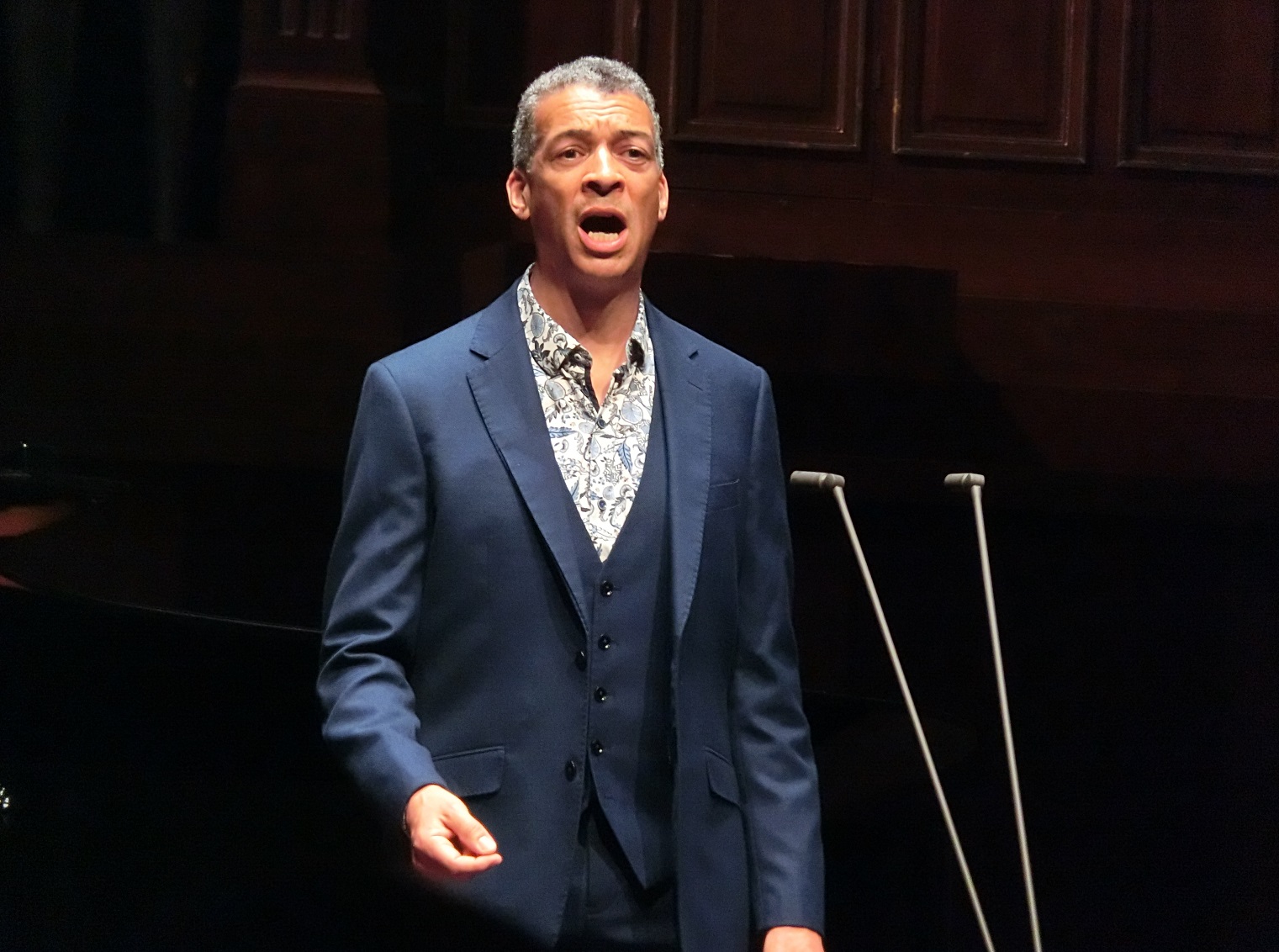
Longtime followers of the Singapore Symphony Orchestra may remember its Music and Literature series from the early-1990s, which presented works inspired by literary sources including Shakespeare, Byron, Cervantes and Tang dynasty poets. The past week saw two concerts sharing similar aspirations, a vocal recital and an operatic setting of a well-known novel, both featuring eminent British baritone Roderick Williams.


Photo: Aloysius Lim / SSO


The words of German poet Wilhelm Muller and English writer Alfred Edward Housman have found immortality in a number of musical settings. Selections from Schubert’s song cycle Die Schone Mullerin (Fair Maid Of The Mill) opened and closed Williams’ splendid two-hour long recital. From its opening song Das Wandern (Wandering), the richness and expressive quality of his delivery shone through. This natural ability to make words come alive and tell a story continued in six of Housman’s poems from A Shropshire Lad, best remembered in George Butterworth’s cycle of the same title.


The sixth song Is My Team Ploughing left perhaps the most indelible mark, one about a dead soldier whose sweetheart is consoled in the arms of his best friend. The recital also showcased songs by Schumann, Rebecca Clarke, Vaughan Williams and C.W.Orr, sensitively partnered by German pianist Paul Cibis, who added short solos by Chopin and Schumann which preluded groups of songs. In these, themes of youth, love unrequited, despair, depression and premature death were explored in the most eloquent ways possible.


Three evenings later, Williams sang the role of Heathcliff in a specially adapted Suite On Wuthering Heights, based on Emily Bronte’s novel and the only opera by the American Bernard Herrmann. Herrmann is best known as film composer for Alfred Hitchcock’s movies Psycho and North By Northwest, and Martin Scorsese’s Taxi Driver. This hour-long Suite, devised by SSO’s Director of Orchestral Planning Hans Sorensen, received its world premiere led by Swiss conductor Mario Venzago.


Photo: Jack Yam / SSO


Essential themes and arias from the three-hour-long opera were telescoped into fourteen short chapters, accompanied by sumptuously atmospheric music that idiomatically merged Wagnerian melodrama, 20th century modernism and Hollywood film music. Timpani and snarling brass heralded the Prologue, where Heathcliff calls for his tormented beloved Cathy from the gallery. British soprano Keri Fuge as Cathy was that close-to-perfect foil, her beautiful melismata equal to Williams’ unbridled passion.


While big climaxes showcased the orchestra’s vast timbral range, there were also tender moments which approached the intimacy of chamber music, with Ng Pei-Sian’s cello and concertmaster Stanislav Pronin’s violin providing exquisite solo passages. One only wished for the inclusion of projected texts which would have made this operatic suite an even more absorbing experience.


Photo: Jack Yam / SSO


The balance of the concert was provided by Beethoven’s Fifth Symphony, famous for its “Fate knocking on the door” motif. This began with an expansive and more soft-edged approach but eventually caught fire in the finale, which went for the jugular with all guns blazing. In both symphony and opera, passionate responses was what truly mattered.  


Monday, 9 May 2022

ELGAR CELLO CONCERTO & NEW WORLD SYMPHONY / Singapore Symphony Orchestra / Review


ELGAR CELLO CONCERTO

& NEW WORLD SYMPHONY

Singapore Symphony Orchestra

Esplanade Concert Hall

Friday (6 May 2022)


Pandemic precautions have been scaled down, and audiences returning to concert halls in droves is a good sign that normality has returned. This feel-good feeling was no more evident as the Singapore Symphony Orchestra rolled out its most populist programme for a long while. Almost a familiar favourites concert, even the gallery seats behind the orchestra was filled to brimming. Business as usual has resumed.


Photo: PianoManiac


Led by visiting Swiss conductor Mario Venzago, the concert opened with the brassy growls of Sibelius’ tone poem Finlandia. Taken at a broader and expansive tempo, the grandeur of the music was better revealed, none more than the glorious central hymn (Finland Awakes), which became a patriotic song associated with freedom. Now an universal anthem of sorts, this was a rousing performance to get spirits and blood churning.


The sorrow of war was relived as German cellist Daniel Müller-Schott emerged to perform Elgar’s Cello Concerto. Written in 1919 as a response to the human carnage of the First World War, this work of deeply-felt pathos has become all the more relevant at this time of worldwide upheaval. From the moment of the cello’s entry, essentially a sighing lament taken in a single breath, one knew this was going to be a moving account. Müller-Schott’s tone is voluminous but not overpoweringly so, his voice speaking plainly of pain and tribulation. Just as trenchant was his mercurial approach in the scherzo-like second movement, before the pathos-inducing oration of that famous slow movement. This is surprisingly short-winded for all its hype (Jackie du Pre’s heroics notwithstanding), but he got it just right without making it a sob-fest of sorts.


Photo: PianoManiac


If anything, the finale became even more impassioned. The orchestra was party to the music’s gripping narrative, not least with a earth-shattering return of the concerto’s opening sigh. That, truly conveyed the music’s sense of tragedy. Humans cannot be relied to learn from past mistakes of history, and will repeat the wars that will eventually consume mankind. The applause greeted both soloist and orchestra was tumultuous, and two contrasted encores from Müller-Schott further confirmed his immense artistry. The Gigue from Bach’s Suite No.3 in C major revelled in dance-like moves while the cello’s full voice came to bear in Ernest Bloch’s Prayer, which sounds even more penitential without accompaniment.


Photo: PianoMania


Nobody was going to forego a performance of Dvorak’s popular Symphony No.9, which just everyone knows as the New World Symphony. The audience’s faith was repaid with a vigorous yet nuanced reading of a warhorse that risked over-popularity. Given what the pandemic had wreaked on concert-going over the last two years, there was not going to be that contempt associated with familiarity. Instead, one would listen with new ears. Has anybody paid attention to its quiet introduction, just before Christian Schioler’s timpani outburst and the iconic first movement French horn theme? Here every detail came to the fore, and what could have seemed hackneyed sounded fresh instead.


After the opening movement’s exertions came the famous Largo, and Elaine Yeo’s cor anglais solo could not have be a more welcome proposition. The brass, underused during much of the pandemic, rejoiced in their chorales, and who could blame the audience for prematurely applauding after this slow movement? The third movement’s Slavonic dance bristled with energy leading to the finale’s joyous machinations. Music is back, and so has the inappropriate applauding brigade, but this was not greeted condescendingly but gratefully. And there was none of the bronchial coughs between movements, the audience having also returned in a healthier state.


Seldom has the orchestra and guest conductor been with accorded such a spontanous and prolonged audience reception by way of prolonged and loud applause. There is much gratitude to be had with genuine artistry and sincere efforts in music-making, little wonder Venzago was grinning from ear to ear when acknowledging the accolades. Long may that continue.  


Photo: PianoManiac

Photographs by Jack Yam (unless otherwise stated), 
by courtesy of the Singapore Symphony Orchestra.