Showing posts with label Orchestra of the Music Maker. Show all posts

Thursday, 17 June 2021

OMM RESTARTS! / FRENCH IMPRESSIONS / Review


OMM RESTARTS!

FRENCH IMPRESSIONS

Esplanade Concert Hall

Recorded in January 2021

YouTube: https://youtu.be/1cPx8g16Mic 


Orchestral concerts are not back to what it was pre-Covid, and no thanks to the recent heightened measures taken in May-June, further concerts had to be cancelled. Online concerts have become a new normal, and no less than the Singapore Symphony Orchestra has relied on this platform to share its art. The Orchestra of the Music Makers (OMM) has done the same, employing the same recording specialists (msm-productions and Dancing Legs Productions) to do its bidding, and the results have been just as spectacular.


Viewing this latest concert video of mostly-French music (https://youtu.be/1cPx8g16Mic), and one will be challenged to decide which is the national orchestra and which is the independent youth orchestra formed by students, free-lancers, working non-musical professionals, and a handful of SSO players. Even the OMM’s programming has been one of sophistication, combining popular with less heralded works, as well as commissioning young local composers for orchestral transcriptions.


Conducted by Seow Yibin, the concert began with Debussy’s Reverie (originally a piano work) orchestrated by Lee Jinjun, who also played the trumpet in this concert (but not in this piece). This made for a calm and atmospheric prelude, with Vincent Goh’s solo clarinet providing the opening melody before the theme being passed around. Ethereal strings (with occasional use of harmonics) and the ever-evocative harp lent the performance an other-wordly feel it deserved.     


Lee Jinjun playing the trumpet in Ravel


The four orchestrated movements of Ravel’s piano suite La Tombeau de Couperin (excepting the Fugue and Toccata) followed, opening with a flowing Prélude which saw solo woodwinds negotiating multiple tricky turns with great aplomb. This was pretty much a woodwind masterclass, continuing into the bouncily syncopated Forlane, and the Menuet where solo oboist Tay Kai Tze  had the choicest of plum parts. His excellence also shone through in the slow central section of the rollicking Rigaudon, which closed the suite on a high.


Prokofiev’s only Flute Sonata, orchestrated by Jonathan Shin, has become Prokofiev’s Flute Concerto, now receiving its world premiere. This has the same music as the Russian’s Second Violin Sonata, which had been for reconfigured for David Oistrakh from its flute origins. One wonders why it did not become a third violin concerto as well. At any rate, Shin’s is a totally idiomatic and faithful transcription, one which gave soloist Cheryl Lim full rein to express her virtuosity.


Hers has never been one of outward flashiness, instead she is completely assured and totally musical. Her tone is gorgeous and limpid, well suited for the work’s broad vistas of sheer lyricism in the opening and Andante third movements. Even in the thorniest passages of the Scherzo, she remained unfazed, leaping over hurdles and through hoops with seeming comfort and ease. For the  jocular finale, the was overarching spirit was one of unremitting joy, bringing to a close a performance of utmost satisfaction. When can we get to hear the violin version of this concerto, from the likes of Alan Choo or Yang Shuxiang?     


Francis Poulenc’s four-movement Sinfonietta (1947) is too modestly titled. Running over 30 minutes, it is actually a fully fledged symphony, longer than all of Mozart’s symphonies and at least three Beethoven symphonies. It is scandalously neglected and I do not remember the SSO ever programming it, so kudos to OMM for possibly giving its Singapore premiere.


It contains all of the Frenchman’s grace, charm, sumptuous melodies and good humour, and the same uplifting spirit as his better-known ballet Les Biches (1924). Poulenc was no modernist, but one will detect influences of Stravinsky from his neo-classical phase, the infectiously chugging rhythms of the fast outer movements and svelte strings (think Apollon Musagetes) of the slow third movement.


While one might marvel at the typically comedic high jinks regularly offered up, it was the slower lingering passages, such as midway in the first movement and finale, which showed the ensemble at its subtle and sublime best. This was a very fine performance with much to be proud of, distinguished by very confident woodwind and brass playing and a general cohesiveness from conductor Seow’s firm yet flexible control from start to finish. It was so good I had to rewatch the whole Sinfonietta and pinch myself about the quality of the music and its playing. Perhaps OMM might also want to look at Prokofiev’s Sinfonietta as well.  


Highly pleasurable concerts such as this should be enjoyed by a full-house Esplanade Concert Hall, and one simply cannot wait for audiences to return. It is a big hope, but that is what will buoy us through these troubled times.


Watch it here:

https://youtu.be/1cPx8g16Mic

and its free of charge, 

thanks to the National Arts Council.

Monday, 23 January 2017

RACHMANINOFF 3 / Orchestra of the Music Makers / Review


RACHMANINOFF 3
Orchestra of the Music Makers
Esplanade Concert Hall
Friday (20 January 2017)

This review was published in The Straits Times on 23 January 2017 with the title "A night of guilty pleasures".

If listeners were asked which classical composers were sources of their most guilty pleasures, chances are Sergei Rachmaninoff and Camille Saint-Saëns would crop up. Both the Russian and Frenchman wrote some of the classical repertoire's most unabashedly tuneful scores, the sort music snobs (particularly lovers of Bach and Schoenberg) turn up their noses to.

There was a heavy dose of Rachmaninoff and Saint-Saëns in the Orchestra of the Music Makers' latest concert, directed by young conductor Seow Yibin. First heard were World Premieres of four Rachmaninoff piano Préludes, in orchestrations by three young composers. Alexander Oon was responsible for two of these, Op.32 No.3 and Op.23 No.5, with martial character transformed into something more festive and dancelike.


Darren Sng's take on the lugubrious Op.23 No.1 deftly incorporated clarinet, oboe and flute solos, taking on an impressionist hue. Phoon Yu's vision of Op.23 No.3 was gavotte-like, cleverly utilising strings and woodwinds, even giving concertmaster Chan Yoong Han's violin an exquisite solo. These imaginative efforts follow in the illustrious tradition of Respighi and Stokowski in transcribing Rachmaninoff.

Watch Alexander Oon's orchestral transcription of Rachmaninov's Prelude Op.23 No.5 here:


Rachmaninoff's mighty Third Piano Concerto was next, with 18-year-old former child prodigy Tengku Irfan, previously described in these pages as the “Malaysian Mozart”, as soloist. To say that the Juilliard undergraduate conquered and vanquished the “Everest of piano concertos” would be mere understatement.


Beginning quietly and steadily, the performance grew in character and stature over its rapturous journey of over 40 minutes, Without any hint of narcissicism or self-indulgence, his apparent coolness while generating white heat in playing must be the most enviable trait in this profession.


The massive 1st movement cadenza, the Adagio's climax and skittish waltz, and the finale's mercurial free-wheeling were among moments to savour. A standing ovation greeted this outing, which stands proudly alongside the work's best performances by the Singapore Symphony Orchestra (with pianists Sergio Tiempo and Alexei Volodin) in recent years.


Orchestra and conductor played a major part in its success, and the good work continued in Saint-Saens' Third Symphony, also known as the “Organ Symphony”. Hushed strings and an opening oboe solo set a mood of mystique before escalating to the movement proper's nervous tension. Flexibility of ensemble ensured that the work's ebbs and flows was kept on a heightened edge.


Joanna Paul's organ entry in the slow movement was memorable for its subtlety. Her part here was mainly to provide a bed of soft harmonies over which the tender music floated. The big moment came in the dramatic finale, and her huge striding chords did not disappoint. There was a brief stretch when both orchestra and soloist threatened to go off the rails, but cools heads prevailed for that most glorious and reassuring of C major chords to close.


As an encore, the orchestra conjured a somewhat belated tribute to actress Carrie Fisher, with Princess Leia's Theme from John Williams' Star Wars soundtrack. That was another guilty pleasure few would regret.  

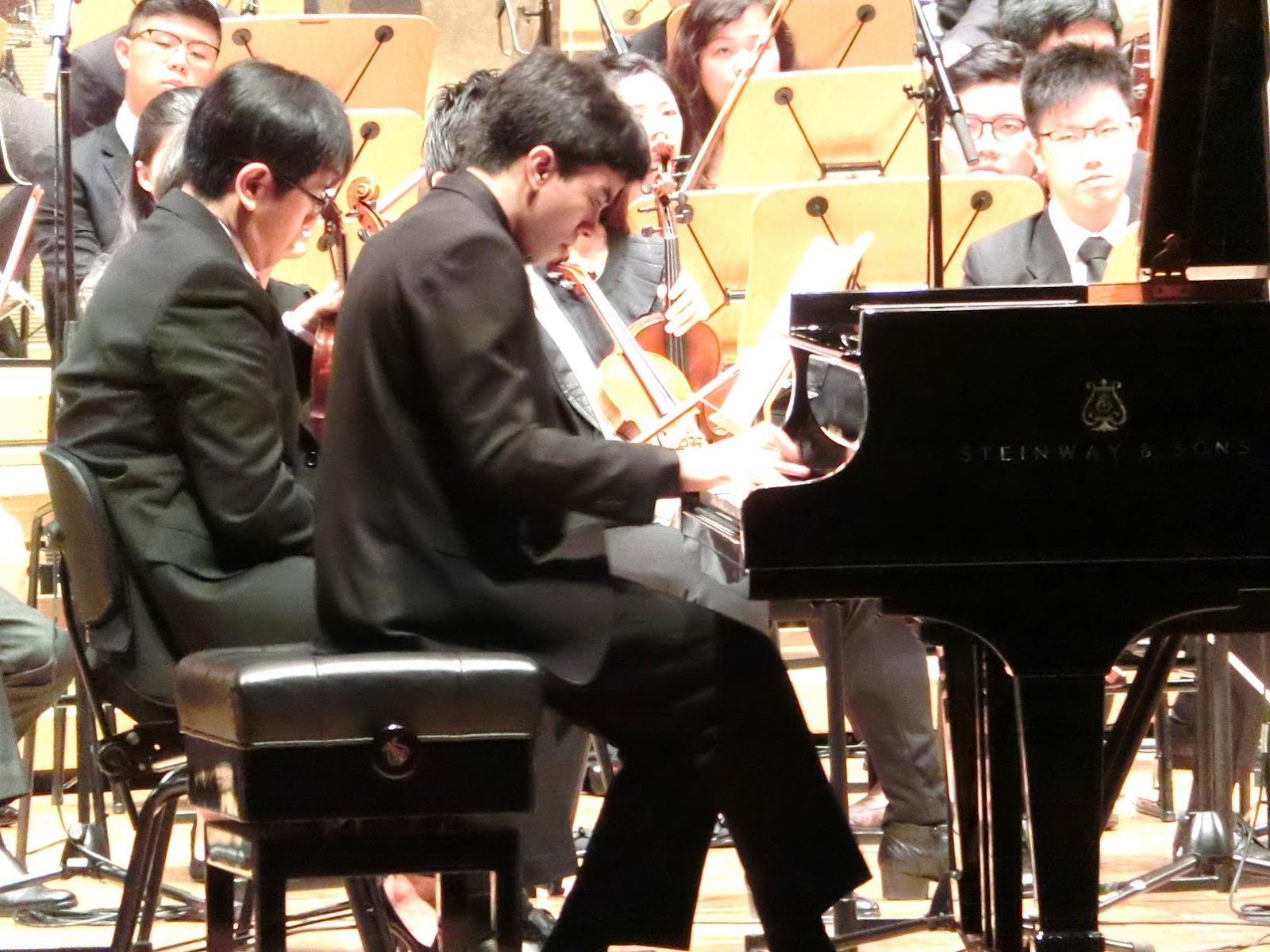
Pianist Tengku Irfan with
OMM Music Director Chan Tze Law.


Watch Tengku Irfan perform the finale of Rach 3 with OMM here: 


Thursday, 21 January 2016

IS IT POSSIBLE TO ATTEND THREE CONCERTS IN A DAY?


IS IT POSSIBLE TO ATTEND THREE CONCERTS IN A DAY?

In a word, YES. Way back in October 1989, on a fine London Sunday, I first went to Steven Isserlis's late morning cello recital at Wigmore Hall, then made it to Barbican Hall for Pinchas Zukerman's violin recital in the afternoon, and finally to Royal Festival Hall to hear Esa-Pekka Salonen conduct The Philharmonia.

That was London, but what about Singapore today? Last Sunday (17 January 2016) provided the rare opportunity to do just that, and even cram all the concerts in an even shorter space of time! This was what transpired:


3 pm. Yong Siew Toh Conservatory, for a cello-cum-chamber recital by the Canadian cellist Gary Hoffman. A fairly large audience was in attendance for a treat of Slavic chamber music, which included Janacek's Pohadka, Arensky's Piano Trio No.1 and Rachmaninov's Cello Sonata. My review for The Straits Times may be found in a post below.

With the listening done and autographs collected, I zipped off to Esplanade Concert Hall to attend the OMM Prom entitled Phantasia. Having a car helps cut through the commuting, but if you choose to park at the Parliament House Car Park ($2 per entry) instead of the Esplanade Car Park (an usurious $9, if one includes the 60+ minutes before 6pm), there is a chance of turning up late.


5 pm. Esplanade Concert Hall, ...and that was what happened. So I missed the first piece performed by the Orchestra of the Music Makers directed by Chan Tze Law, which was an innocuous suite of melodies from Puccini's La Boheme. The main work was Andrew Lloyd Webber's Phantasia, a 45 minute conflation of melodies from his musical The Phantom of the Opera


The pleasure was in witnessing SSO Concertmaster Igor Yuzefovich and SSO Principal Cellist Ng Pei-Sian as guest soloists tackle the virtuosic solo parts as if it were Brahms's Double Concerto. They sportingly blended into the ranks of the orchestra to play the final work, the Rosenkavalier Suite from Richard Strauss's opera. SSO had recently performed this, and it could be said that the young musicians of OMM matched their seniors every bit in terms of passion if not technique.


Equally heartwarming was its encore, Sunset from Ferde Grofe's Grand Canyon Suite, which was followed by a reprise of the final waltz from the Strauss suite. Several members of the full-house audience were placed within the ranks of the orchestra to experience what it was like to be inside an orchestra. It must have been overwhelming, at least none of them were caught falling asleep!


7.30 pm. Victoria Concert Hall. A quick dinner at an Esplanade eatery before rushing off to attend a Chinese New Year Concert by the Kids Philharmonic Orchestra conducted by the dynamic young maestro Tan Kah Chun. The Kids Philharmonic is where people from six to eighteen get a chance to play, and its string section is filled with children, but the winds, brass and percussion were all adults, which sort of diminishes the overall youthful look of the group. 


It is about three weeks to go to the Lunar New Year, so it was not too early to wallow in melodies like Zhu Xin Nian, Gongxi Gongxi Ni, Da Di Hui Chun and the one that goes Yahohei (not Yohotoho!), which were performed in a rightly celebratory spirit. 


The choral contribution was provided by the SYC Ensemble Singers and SMU Choir, but the ones who stole the show was the excellent Chinese-speaking emcee Li Rong De and the 84-year-old singer Chong Sit Fong (Take that, Birgit Nilsson!), who crooned the way to the hearts of the audience in Tian Mi Mi. 


If the procession of Chinese songs did not sound lacklustre, it had to be because all the arrangements were written by no less than Cultural Medallion recipient Phoon Yew Tien.

The audience down in the stalls was, however, appalling. There are people (whom I'll disrespectfully refer to as lao tou er, or old farts) who think nothing of talking and commenting on the proceedings while the music is being played. Little wonder the wonderful emcee pleaded with the audience to be considerate (“qian wan bu yao shuo hua”) after the interval.


So that was three concerts in a day in Singapore. Can there be such a thing as too much music for one's good? In a word, NO.

Saturday, 11 July 2015

LATEST: Photographs from OMM's MAHLER 8: A GIFT TO THE ENTIRE NATION

Veni Creator Spiritus,
the imposing opening of the symphony.

There's one more evening to go, but the Orchestra of the Music Makers' performances of Mahler's Eighth Symphony, or the "Symphony of a Thousand", will go down in the annals of Singapore music history as the most ambitious project ever undertaken by a youth orchestra. Forget the youth part, the first evening on 10 July 2015 would have made any professional orchestra in the world proud.

As Singaporeans, we are proud that the State has so whole-heartedly supported the performance of classical music that these performances in the wonderful Esplanade Concert Hall were even possible. Forget the self pats on the back, and just enjoy the photographs!  

A climax in the first part is reached.

The magical Chorus Mysticus
brings the symphony to a spiritual close.

Applause all round for the 350 performers.

Each and every performer was
acknowledged by name in the
giant screens high above the stage.

Conductor Chan Tze Law introduces
Zubir Said's City Council Song and
how Majulah Singapura came to being.

Now we have a thousand performers
for the National Anthem, Majulah Singapura.

Soprano Janani Sridhar leads in the
singing of Majulah Singapura.
It was a breathtaking evening.
Thank you, OMM for the
greatest musical gift to the entire nation!

All photographs by the kind permission of the Orchestra of the Music Makers.

Now watch the performance of the symphony: