Showing posts with label Seow Yibin. Show all posts

Wednesday, 6 October 2021

MUSIC UNMASKED / Orchestra of the Music Makers / Review


MUSIC UNMASKED

Orchestra of the Music Makers

Esplanade Concert Hall

Friday (1 October 2021)


It was a cold, wet and drippy evening, when one rather snuggles with a good book and warm mug of cocoa at home as the rain poured outside, than venturing out to the Esplanade. However, some events have to be attended. There have been no concerts with wind instruments for an eternity (or since Covid struck our shores), and the prospect of a new symphony being premiered.


Seow Yibin
Photo: Chan Chen


The strings of the Orchestra of the Music Makers (OMM) have had their say, and now it was the turn of the woodwinds, brass and percussion to have moments under the spotlight. The wait was worth it when Associate Conductor Seow Yibin stepped up to lead Richard Strauss’ Rosenkavalier Harmoniemusik as arranged by Nigel Shore. Harmoniemusik is a very Mittel-European concept, essentially wind transcriptions of popular operatic melodies, played and enjoyed by village bandsmen over schnapps and pretzels. Mozart’s operas were popularised by such arrangements, and the luscious melodies of Richard Strauss’ Der Rosenkavalier are no exception.


Photo: Yong Junyi


Despite having just sixteen players (11 woodwinds + 5 French horns) on stage, the ensemble generated a  big sound for its opening, with the horns lapping up those coital whoops which Strauss had so delighted in. Articulation of phrases was excellent and intonation secure, and one just wallowed in the big melodies. The problem with this suite was its length. With multiple parts and running over 40 minutes, it felt much longer. (The Rodzinski suite for full orchestra plays for a fraction of this time, and said everything that was needed to say.) One waited for sequences of waltzes to appear but that seemed in vain. And with the players at the end of their tether, a merciful close arrived.


The main event was a shorter work, the World Premiere of young composer Lee Jinjun’s Symphony for Brass and Percussion, also entitled “The Times Have Changed”, conducted by OMM Music Director Chan Tze Law. Cast in four movements, playing for some 27 minutes, this was a real and bona fide symphony in every respect.


Chan Tze Law
Photo: Yong Junyi


More significantly, this appears to be the first symphony by a Singaporean composer to be heard in a long time. None of Tan Chan Boon’s five symphonies have been performed here. Tsao Chieh’s Singapore Suite, a symphony in all but name, was premiered by the Singapore Symphony in 1986, and only performed again in 2000. There have been performances of symphonies by Robert Casteels and John Sharpley (both long-time residents here) but none from Singaporean voices. Just silence... but a gaping void was filled this evening.


Lee Jinjun played the trumpet
in the world premiere of his symphony.


Although the detailed booklet notes indicate a programme of the pandemic striking the city-state and heroes rising to meet the challenge, this symphony works well as absolute music. The first movement may be discerned as been written in sonata form. After a portentous introduction, two themes are introduced in the ensuing allegro, the first in syncopated rhythm contrasted by a second, which is flowing and lyrical. The trumpet gets a prominent solo, while the snare-drum provides the feel of an ominous threat looming overhead.


The second movement’s scherzo is percussion-driven, alternating between menace and playful mischief. One senses a Waltonian spirit of con malizia (with malice) in these pages, contrasted by a more reassuring central chorale which may be described as Bernsteinesque, while a John Williams’ Star Wars vibe is never far, far away.


Photo: Yong Junyi


In the slow third movement, also the symphony’s longest, one gets to the heart and soul of the work. A warm Beethovenian theme dominates, involving flugelhorn, Wagner tubas, piccolo trumpet or a combination of these, building to a crushing climax suggesting tragedy on an epic scale. The warm Hero’s theme is restated, and there is an attacca (without break) into the galloping chase-like finale.


One might have wished this to be longer and further developed, like a Brucknerian “hunting horn rondo”, but spare a thought for the 16 brass and 5 percussion players who would have been pretty exhausted by now. The close was an emphatic one, possessed with the vigour and vehemence that permeates action movie music scores.  


Make no mistake, what I witnessed is a magnificent symphony, performed with the requisite virtuosity one has come to expect from the young musicians of OMM. One hopes this symphony will be heard again with some frequency, especially from Singapore’s many wind bands, but first they must get their hands on those Wagner tubas. By the time I left the Esplanade, the rain had abated, and there was still time for that good book and mug of cocoa.    


Thursday, 17 June 2021

OMM RESTARTS! / FRENCH IMPRESSIONS / Review


OMM RESTARTS!

FRENCH IMPRESSIONS

Esplanade Concert Hall

Recorded in January 2021

YouTube: https://youtu.be/1cPx8g16Mic 


Orchestral concerts are not back to what it was pre-Covid, and no thanks to the recent heightened measures taken in May-June, further concerts had to be cancelled. Online concerts have become a new normal, and no less than the Singapore Symphony Orchestra has relied on this platform to share its art. The Orchestra of the Music Makers (OMM) has done the same, employing the same recording specialists (msm-productions and Dancing Legs Productions) to do its bidding, and the results have been just as spectacular.


Viewing this latest concert video of mostly-French music (https://youtu.be/1cPx8g16Mic), and one will be challenged to decide which is the national orchestra and which is the independent youth orchestra formed by students, free-lancers, working non-musical professionals, and a handful of SSO players. Even the OMM’s programming has been one of sophistication, combining popular with less heralded works, as well as commissioning young local composers for orchestral transcriptions.


Conducted by Seow Yibin, the concert began with Debussy’s Reverie (originally a piano work) orchestrated by Lee Jinjun, who also played the trumpet in this concert (but not in this piece). This made for a calm and atmospheric prelude, with Vincent Goh’s solo clarinet providing the opening melody before the theme being passed around. Ethereal strings (with occasional use of harmonics) and the ever-evocative harp lent the performance an other-wordly feel it deserved.     


Lee Jinjun playing the trumpet in Ravel


The four orchestrated movements of Ravel’s piano suite La Tombeau de Couperin (excepting the Fugue and Toccata) followed, opening with a flowing Prélude which saw solo woodwinds negotiating multiple tricky turns with great aplomb. This was pretty much a woodwind masterclass, continuing into the bouncily syncopated Forlane, and the Menuet where solo oboist Tay Kai Tze  had the choicest of plum parts. His excellence also shone through in the slow central section of the rollicking Rigaudon, which closed the suite on a high.


Prokofiev’s only Flute Sonata, orchestrated by Jonathan Shin, has become Prokofiev’s Flute Concerto, now receiving its world premiere. This has the same music as the Russian’s Second Violin Sonata, which had been for reconfigured for David Oistrakh from its flute origins. One wonders why it did not become a third violin concerto as well. At any rate, Shin’s is a totally idiomatic and faithful transcription, one which gave soloist Cheryl Lim full rein to express her virtuosity.


Hers has never been one of outward flashiness, instead she is completely assured and totally musical. Her tone is gorgeous and limpid, well suited for the work’s broad vistas of sheer lyricism in the opening and Andante third movements. Even in the thorniest passages of the Scherzo, she remained unfazed, leaping over hurdles and through hoops with seeming comfort and ease. For the  jocular finale, the was overarching spirit was one of unremitting joy, bringing to a close a performance of utmost satisfaction. When can we get to hear the violin version of this concerto, from the likes of Alan Choo or Yang Shuxiang?     


Francis Poulenc’s four-movement Sinfonietta (1947) is too modestly titled. Running over 30 minutes, it is actually a fully fledged symphony, longer than all of Mozart’s symphonies and at least three Beethoven symphonies. It is scandalously neglected and I do not remember the SSO ever programming it, so kudos to OMM for possibly giving its Singapore premiere.


It contains all of the Frenchman’s grace, charm, sumptuous melodies and good humour, and the same uplifting spirit as his better-known ballet Les Biches (1924). Poulenc was no modernist, but one will detect influences of Stravinsky from his neo-classical phase, the infectiously chugging rhythms of the fast outer movements and svelte strings (think Apollon Musagetes) of the slow third movement.


While one might marvel at the typically comedic high jinks regularly offered up, it was the slower lingering passages, such as midway in the first movement and finale, which showed the ensemble at its subtle and sublime best. This was a very fine performance with much to be proud of, distinguished by very confident woodwind and brass playing and a general cohesiveness from conductor Seow’s firm yet flexible control from start to finish. It was so good I had to rewatch the whole Sinfonietta and pinch myself about the quality of the music and its playing. Perhaps OMM might also want to look at Prokofiev’s Sinfonietta as well.  


Highly pleasurable concerts such as this should be enjoyed by a full-house Esplanade Concert Hall, and one simply cannot wait for audiences to return. It is a big hope, but that is what will buoy us through these troubled times.


Watch it here:

https://youtu.be/1cPx8g16Mic

and its free of charge, 

thanks to the National Arts Council.

Wednesday, 5 May 2021

MAHLER 4 LIVE! / Orchestra of the Music Makers / Review


MAHLER 4 LIVE!

Orchestra of the Music Makers

Esplanade Concert Hall


An edited version of this review was published in The Straits Times on 5 May 2021 with the title "A message of hope for an uncertain time".


It has been several years time since audiences in Singapore witnessed a performance of a Gustav Mahler symphony, the last being Singapore Symphony Orchestra’s rendition of the Second Symphony led by Shui Lan in January 2019. The Covid pandemic and circuit breaker has not helped, given the Austrian composer’s propensity for celestial lengths and large orchestras. But trust the Orchestra of Music Makers (OMM), Mahler specialist among local ensembles, to wangle three performances of his Fourth Symphony this weekend.


The Fourth is Mahler’s shortest and most lightly orchestrated symphony but does one really care? This is still Mahler, and any performance represented pandemic gold. And what about social distancing measures that limited groups to a maximum of 30 onstage performers? Not a problem, since German conductor Klaus Simon’s 2007 chamber arrangement of the symphony just required 23 players led by young  conductor Seow Yibin to accomplish.   


It was with these constraints that this mini-miracle transpired, much in the 1920s Viennese spirit of Arnold Schoenberg’s Society for Private Musical Performances, which undertook chamber readings of large orchestral works in intimate settings. Simon’s economical orchestration unusually included the accordion (played by Syafiqah ‘Adha Sallehin) and piano (Michael Huang) to support a small group of strings, winds (one person to a part) and two percussionists. Instead of being overawed, these forces worked like a charm.


Tinkling of sleigh bells opened the symphony with feathery lightness, and smooth strings later took over in establishing the first movement’s thematic and melodic interest. It was to conductor Seow’s credit that the pacing did not lag, and there were pivotal moments which piqued the ears, such as Miao Kaiwen’s clarinet solo which quoted the funereal trumpet call of Mahler’s next symphony, the tumultuous Fifth.


It was concertmaster Zhao Tian who starred in the second movement by alternating between two violins. One was tuned a tone higher to suggest “Death playing the fiddle”, thus provided an unnerving and somewhat macabre vibe to a seemingly innocuous Scherzo. The slow movement was the symphony’s heart, characterised by an ebb and flow of emotion that was truly moving. Again, it was the strings that did the heavy tugging.


The icing on the cake came when soprano Teng Xiang Ting, dressed in a blood red gown, emerged onstage to sing the finale’s strophic song Das Himmlischer Leben (The Heavenly Life). Its words, from Des Knaben Wunderhorn (The Youth’s Magic Horn) by Arnim and Brentano, paint a child’s innocent vision of paradise. Her German was idiomatic and the depth of feeling engendered real and unforced, providing a blissful close to the symphony’s mere 55 minutes.


There were two rather apt vocal encores, first the satirical and comedic song Lob Des Hohen Verstandes (Praise Of Lofty Intellect), another Mahler setting on Wunderhorn songs, also quoted in his Fifth Symphony. Next, Richard Strauss’ Morgen! (Tomorrow!), revealed pure beauty in both concertmaster Zhao’s solo violin introduction and Teng’s entreaties. Its words, “Tomorrow the sun will shine again... and the stillness of happiness will sink upon us,” provide comfort and hope for an uncertain future.  


Monday, 23 January 2017

RACHMANINOFF 3 / Orchestra of the Music Makers / Review


RACHMANINOFF 3
Orchestra of the Music Makers
Esplanade Concert Hall
Friday (20 January 2017)

This review was published in The Straits Times on 23 January 2017 with the title "A night of guilty pleasures".

If listeners were asked which classical composers were sources of their most guilty pleasures, chances are Sergei Rachmaninoff and Camille Saint-Saëns would crop up. Both the Russian and Frenchman wrote some of the classical repertoire's most unabashedly tuneful scores, the sort music snobs (particularly lovers of Bach and Schoenberg) turn up their noses to.

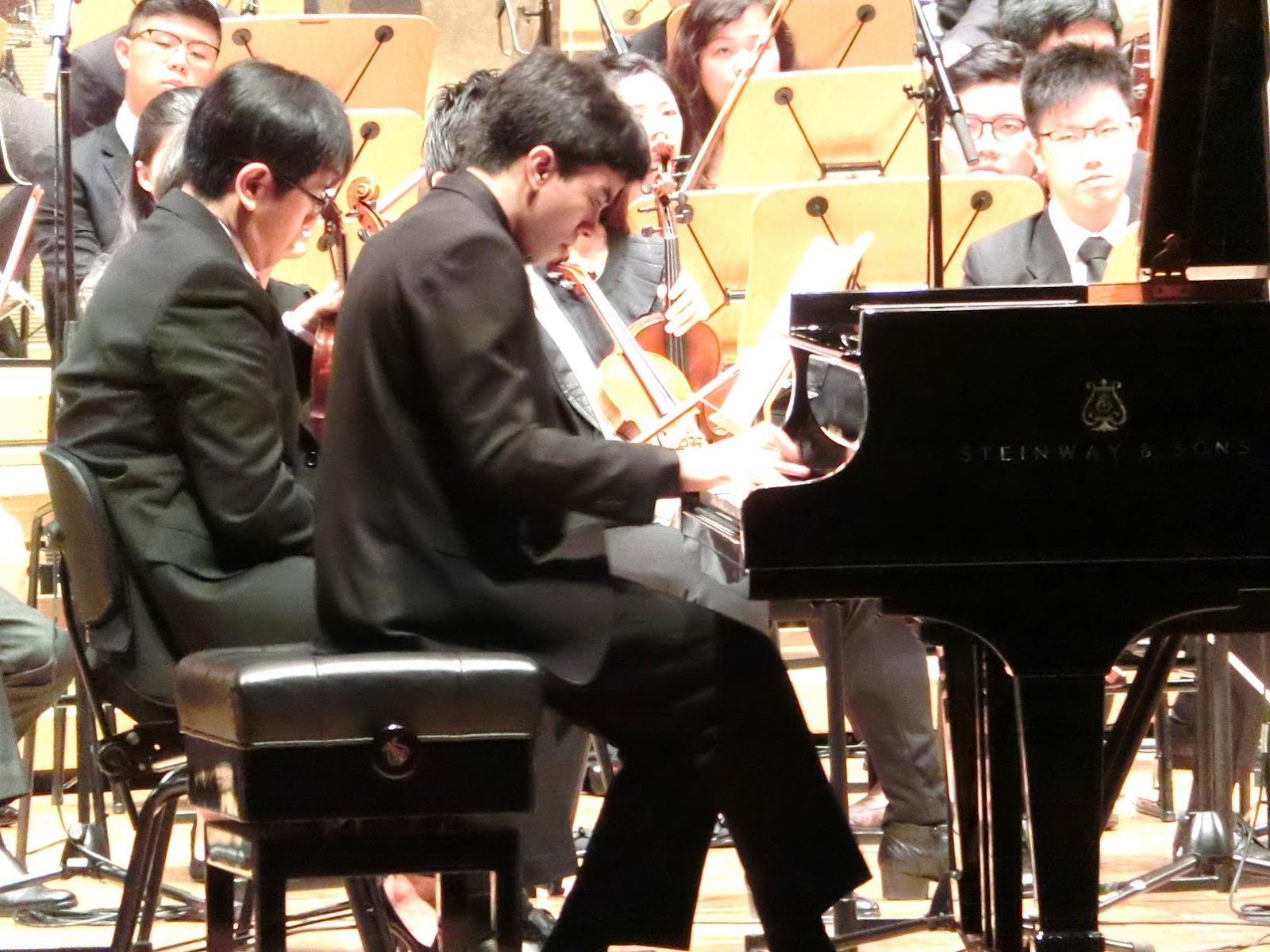
There was a heavy dose of Rachmaninoff and Saint-Saëns in the Orchestra of the Music Makers' latest concert, directed by young conductor Seow Yibin. First heard were World Premieres of four Rachmaninoff piano Préludes, in orchestrations by three young composers. Alexander Oon was responsible for two of these, Op.32 No.3 and Op.23 No.5, with martial character transformed into something more festive and dancelike.


Darren Sng's take on the lugubrious Op.23 No.1 deftly incorporated clarinet, oboe and flute solos, taking on an impressionist hue. Phoon Yu's vision of Op.23 No.3 was gavotte-like, cleverly utilising strings and woodwinds, even giving concertmaster Chan Yoong Han's violin an exquisite solo. These imaginative efforts follow in the illustrious tradition of Respighi and Stokowski in transcribing Rachmaninoff.

Watch Alexander Oon's orchestral transcription of Rachmaninov's Prelude Op.23 No.5 here:


Rachmaninoff's mighty Third Piano Concerto was next, with 18-year-old former child prodigy Tengku Irfan, previously described in these pages as the “Malaysian Mozart”, as soloist. To say that the Juilliard undergraduate conquered and vanquished the “Everest of piano concertos” would be mere understatement.


Beginning quietly and steadily, the performance grew in character and stature over its rapturous journey of over 40 minutes, Without any hint of narcissicism or self-indulgence, his apparent coolness while generating white heat in playing must be the most enviable trait in this profession.


The massive 1st movement cadenza, the Adagio's climax and skittish waltz, and the finale's mercurial free-wheeling were among moments to savour. A standing ovation greeted this outing, which stands proudly alongside the work's best performances by the Singapore Symphony Orchestra (with pianists Sergio Tiempo and Alexei Volodin) in recent years.


Orchestra and conductor played a major part in its success, and the good work continued in Saint-Saens' Third Symphony, also known as the “Organ Symphony”. Hushed strings and an opening oboe solo set a mood of mystique before escalating to the movement proper's nervous tension. Flexibility of ensemble ensured that the work's ebbs and flows was kept on a heightened edge.


Joanna Paul's organ entry in the slow movement was memorable for its subtlety. Her part here was mainly to provide a bed of soft harmonies over which the tender music floated. The big moment came in the dramatic finale, and her huge striding chords did not disappoint. There was a brief stretch when both orchestra and soloist threatened to go off the rails, but cools heads prevailed for that most glorious and reassuring of C major chords to close.


As an encore, the orchestra conjured a somewhat belated tribute to actress Carrie Fisher, with Princess Leia's Theme from John Williams' Star Wars soundtrack. That was another guilty pleasure few would regret.  

Pianist Tengku Irfan with
OMM Music Director Chan Tze Law.


Watch Tengku Irfan perform the finale of Rach 3 with OMM here: 


Tuesday, 12 January 2016

STRAVINSKY IN FRANCE / N.E.O.Ensemble / Review


STRAVINSKY IN FRANCE
N.E.O. Ensemble
Esplanade Recital Studio
Sunday (10 January 2015)

This review was published in The Straits Times on 12 January 2016 with the title "Shining Stravinsky".

The N.E.O. (New Epoch Orchestral) Ensemble is the newest local orchestra to unveil its talents in a land well populated by musical groups. Formed by some of the nation's finest young professional musicians and conducted by Seow Yibin, it debuted with an all-Stravinsky programme. This concert covered the Russian composer's neoclassical phase, which spanned the 1920s and 30s when he lived in France.

Four works were performed, all using chamber-sized forces, a conscious paring down from his large and opulent ballet scores like The Firebird, Petrushka and The Rite of Spring. Such a diminution was obvious in the Octet for Winds (1923), for flute, clarinet, two of each of bassoons, trombones and trumpets.


The clear delineation of its parts was well handled by the players, each one a virtuoso in his or her own right, and the overall balance was generally excellent. The 2nd movement's Theme and Variations saw an admirable ability to cope with the music's twists and turns matched with pin-point playing.

Conductor Seow spoke briefly about the composer, but his impromptu spiel was poorly prepared. Referencing musicologist Richard Taruskin, “Wagner symphonies” (he did not write any significant ones) and “machine-like French music” (really?), it all came across as incoherent. Thankfully his conducting was much better defined, as were Natalie Ng's well-researched programme notes. 


Pianist Lim Yan was soloist in a rare performance of the Concerto for Piano & Winds (1923-24), a neo-Baroque creation in three movements that demanded utmost precision and concentration. A veteran at handling the thorniest of scores, Lim's mastery of its irregular rhythms and syncopations made it an enthralling outing.

The piano's metallic clangour ensured he was not submerged by a larger group of woodwinds and brass, and there were spots for subtlety and sensitivity, notably in the slow movement's aria-like lyricism. The busily raucous finale trundled on industriously before its abrupt and emphatic close which caught the audience almost by surprise.


By the time the Symphonies for Wind Instruments (1920) concluded, the ensemble had warmed up and the playing was even more assured. The tandem of flautist Cheryl Lim and clarinettist Desmond Chow had significant parts, and they were nigh inseparable. The title made use of the Greek meaning of “symphony”, which was to “sound together” rather than the compositional form, and that was exactly what the the group delivered.


The final work, Dumbarton Oaks Concerto (1937), a deliberate homage by Stravinsky to Bach's Brandenburg Concertos, saw strings outnumber the winds. Now there were three violins, three violas, two cellists and two basses alongside flute, clarinet, bassoon and two horns. Textures were therefore lighter, and the ensemble adjusted its sound accordingly.

The outer movements were thick with counterpoint, bookending a slow movement that was a graceful gavotte-like dance with typically Stravinskian harmonic quirks. As with the preceding pieces, the reading shone with its highly responsive playing and vivacity. Live performances like these bring out the spirit of the music and the composer far better than the umpteenth canned recording for sale.