6TH STEINWAY
YOUTH PIANO COMPETITION
Professional & Amateur Division Finals
Steinway Production Gallery
Saturday & Sunday (18 & 19 June 2022)
The Steinway Youth Piano Competition is now in its sixth edition, and has become as much a landmark as the biannual National Piano & Violin Competition. In certain ways, it is more prestigious as the grand winner gets to represent Singapore in the regional finals (covering all of Southeast Asia, Taiwan and South Korea), and hopefully win a spot to perform at the Steinway Festival in Hamburg, Germany. Due to Covid restrictions still in place, this year’s edition was held live (for a limited audience) and via online streaming.
 |
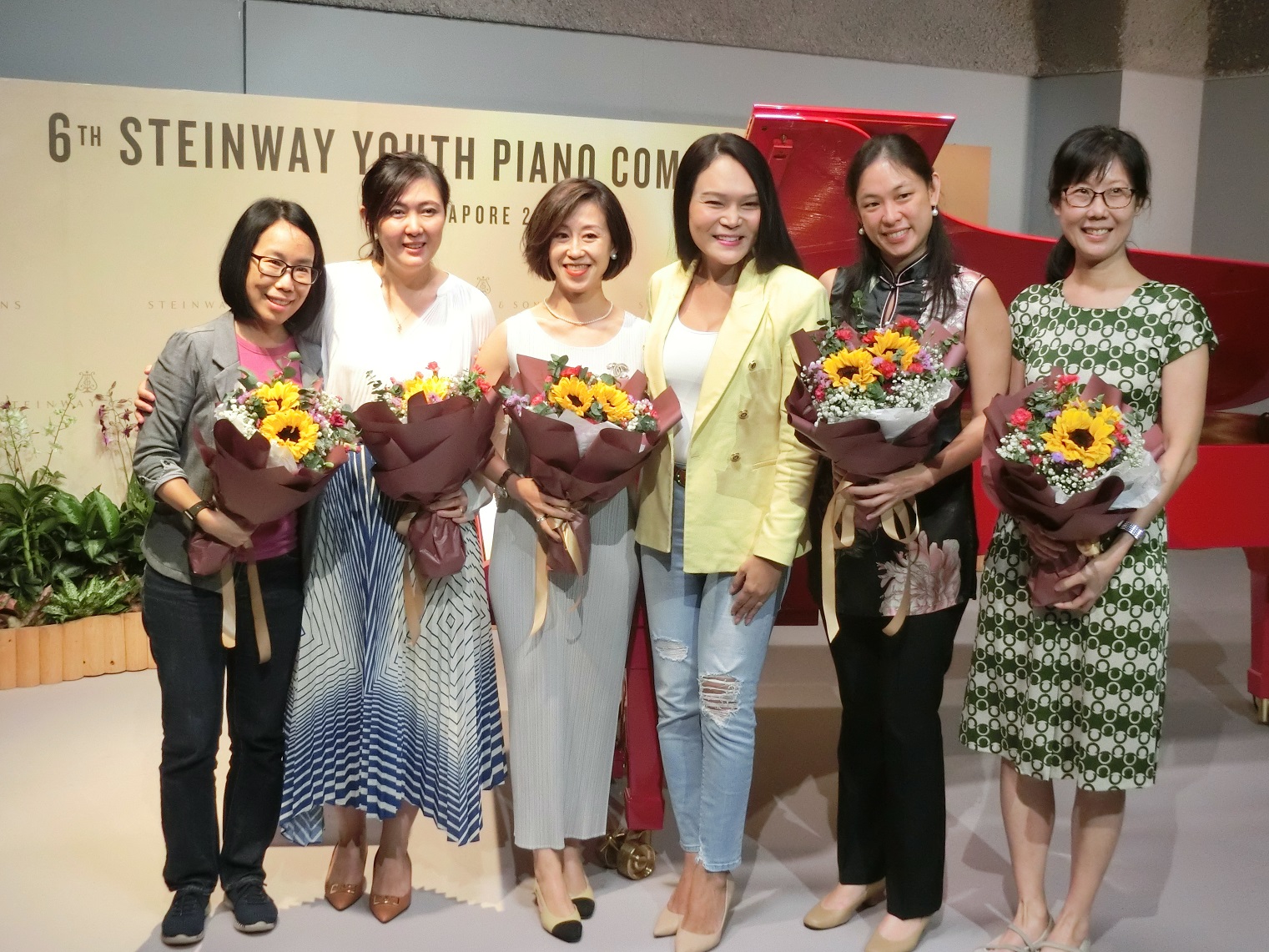
Jury for the Professional division finals,
the A team of local piano pedagogy & performance:
Benjamin Loh, Albert Tiu, Kseniia Vokhmianina,
Lena Ching and Lim Yan, with Celine Goh. |
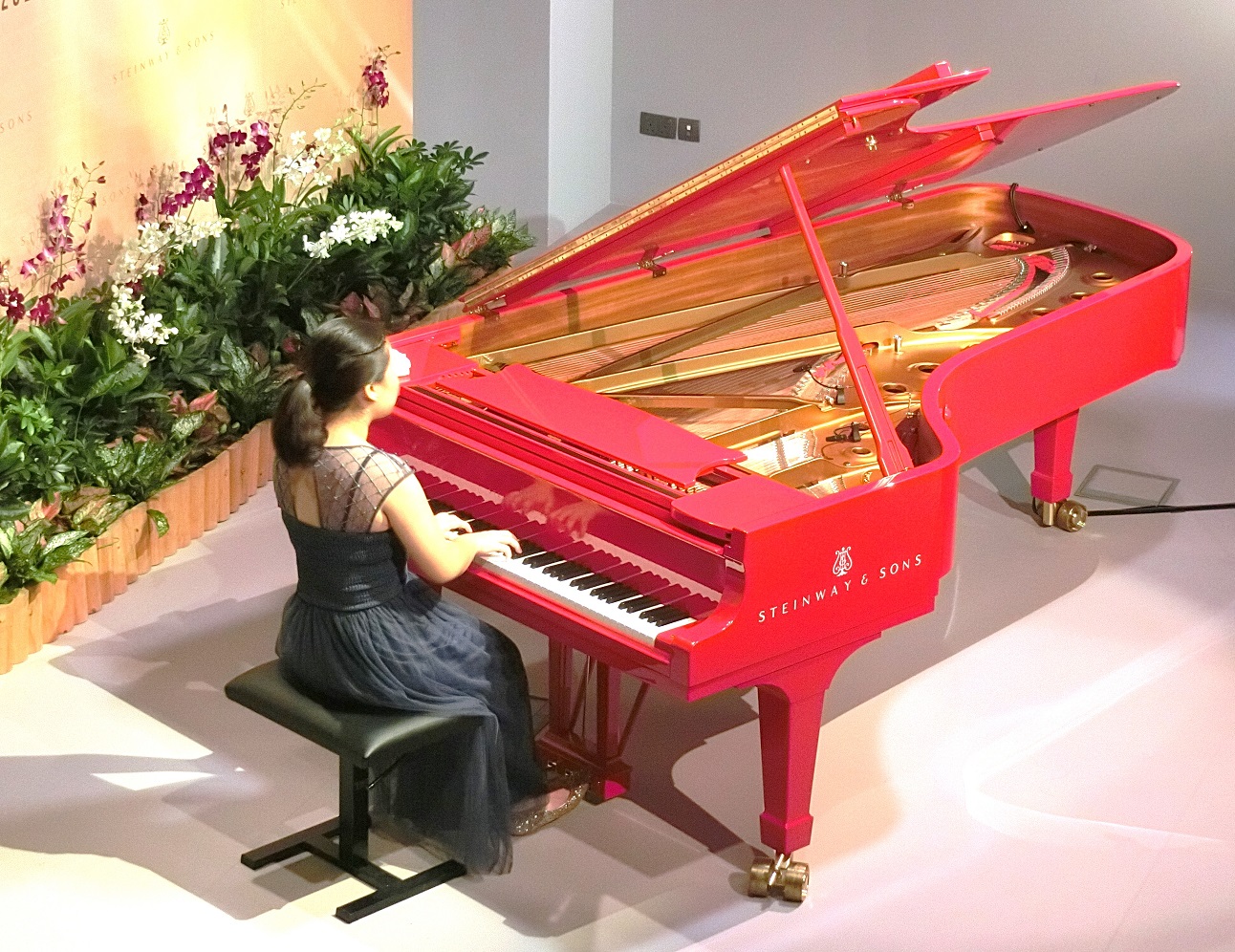
For the finals of both its Professional and Amateur divisions, the fire engine red Steinway D (famously played by Lang Lang at the SG50 celebratory concert) was trotted out for 33 pianists over two afternoons last weekend. Cash prizes, trophies, certificates and professional video recordings were a big draw, but the Grand Prize winner will perform at the regional finals in some exotic foreign location yet to be determined. To underscore the rigour of the judging process, the performances were scrutinised by no less than 20 jury members drawn from the piano performance, pedagogical and review (ahem) circles of the local community.
 |
Calmly awaiting their turn
are the Cat 1 finalists and parents. |
Professional Division
(Saturday, 18 June 2022)
 |
| Luther Ong |
The Professional division finals showcased 10 pianists in three age categories. Category 1 (11 years and below) got off to a roaring start with the National Piano & Violin Competition’s latest winner (Junior Category) Luther Ong in fine form. His detailed reading of Beethoven’s elusive Sonata in F sharp (Op.78) was most admirable, then luxuriated in the smouldering lyricism of Cecile Chaminade’s Automne (most recently heard from one Shaun Choo) before closing with Ravel’s rhythmically charged Alborada del Gracioso. Nobody at this age has the right to play with such confidence and verve.
 |
Charissa Ooi's graceful playing
matched her outfit! |
Charissa Ooi was at her most convincing in Glinka’s Variations on the Nightingale, filled with colour and nuance. Crispness and precision defined her view of Haydn’s Sonata in F major while Berkovich’s Variations on Paganini’s ubiquitous Caprice No.24 did little to faze her. Some day she will do the Brahms and Liszt versions. Newman Tong's Haydn (the same sonata) was no less vivid, and he displayed good right hand filigree in Schubert's well known Impromptu (Op.90 No.4). As for the first movement of Kabalevsky’s Third Sonata, all the children who play it begin to sound like young versions of Horowitz, and that is a good thing.
 |
| Newman Tong |
 |
| Tristen Ng |
It was just as good with the three youths in Category 2 (12 to 14 years). Tristen Ng opened impressively with Kabalevsky’s Rondo in A minor, composed for the 1958 Tchaikovsky International Piano Competition won by Van Cliburn. The percussiveness continued for Beethoven’s Sonata in A (Op.2 No.2) but cantabile was thankfully restored in Chopin’s D flat major Nocturne (Op.27 No.2).
 |
| Casey Li |
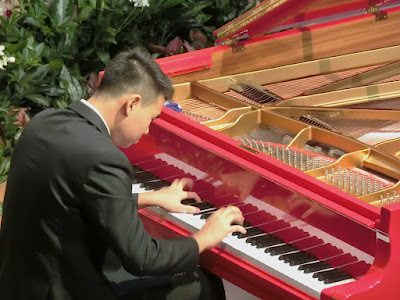
Casey Li gave a good shot at Liszt’s Ricordanza (No.9 of the twelve Transcendental Etudes), which has yet to sound fully-formed, but the singing tone achieved was an improvement over her earlier Mozart (K.281). Best, however, was a luminous reading of Debussy’s prelude Les collines d’Anacapri, which had examplary pedalling. Kate Isabelle Ong's peak performance was in Chopin's Fantaisie-Impromptu, a scintillating reading. Her Beethoven Sonata (Op.10 No.1) was hard driven while the Kabalevsky Rondo (second performance within an hour!) was slower and less brilliant than Tristen’s.
 |
| Kate Isabelle Ng |
 |
| Xu Ruojin |
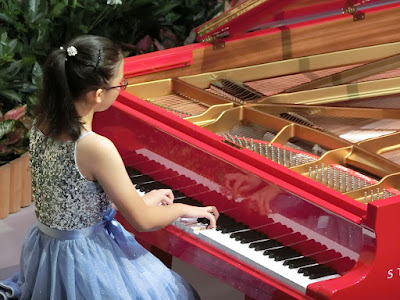
According to reliable sources, the competition in Category 3 (15 to 17 years) was so stiff that four finalists had to be selected instead of three. Xu Ruojin could not completely avoid percussiveness in Beethoven’s Sonata (Op.10 No.3), but his Chopin Scherzo No.2 was suitably brilliant, possibly the best performance of the afternoon. This was topped with Debussy’s final prelude Feux d’artifice, which became a veritable etude in his capable hands. Yu Jingwen captured the turbulent spirit of Beethoven’s Les Adieux Sonata (Op.81a) well, later contrasting this with a dreamy and seamless Chopin Nocturne in D flat (Op.27 No.2 again) and a wild rumble on the pampas with Ginastera’s Argentinian Dance No.3.
 |
| Yu Jingwen |
 |
| Jaden Tan |
Jaden Tan is capable of musical responses, but must Beethoven’s later Sonata in E minor (Op.90) be pummelled so mercilessly? The choice of two of Lowell Liebermann’s Gargoyles was interesting, although the lack of irony displayed less so, as was his thunderous reading of Liszt’s Tarantella (from Venezia e Napoli). Fast fingers are enviable, but other faculties need catch up. Justin Low provided the programme with the greatest range, a thoughtful Beethoven Sonata (Op.109) despite some missed notes, a very evocative and even mysterious Ravel Jeux d’eau before the barrel of laughs that is Grainger’s cakewalk smasher In Dahomey. He clearly enjoys the music!
 |
| Justin Low |
Prodigiousness was in rich supply, and technical achievement seemed to trump more musical values. In this respect, sonatas by Mozart and Beethoven were particularly afflicted. It seemed difficult to make their music less like coming from a sewing machine or jack-hammer. Was it the piano, the ambient acoustics, the pianists themselves, their teaching, or a combination of all these factors? Perhaps one might get a different result if Bach or Scarlatti (surprisingly under-represented at this competition) were mandatory choices for inclusion.
Amateur Division (Sunday, 19 June 2022)
 |
The Youth-At-Heart finalists:
Chika Sonada, Candy Tan & Cynthia Goh. |
The Youth-At-Heart category opened with Amateur Division finals with three ladies mature enough to be mothers of everybody else who took part. And they were totally impressive, given their dedication to the art of piano playing amid the chores of mothercraft not to mention full-time careers. Candy Tan got just about all the notes in Liszt’s fearsome Mazeppa (the fourth of twelve Transcendental Etudes), which was no mean feat. Perhaps that was over-pedalled, smudging much of the lines, but that was more appropriate in Rachmaninov’s nocturne-like Prelude in D (Op.23 No.4), which sang out quite beautifully.
 |
| Cynthia Goh |
Chika Sonoda gave a measured but ultimately passionate reading of Chopin’s Nocturne in C minor (Op.48 No.1), followed by Debussy L’Isle Joyeuse, opening cautiously but luxuriated in its big melody and super-charged high octane closing. Cynthia Goh provided a gloss to Chopin’s Nocturne in D flat (Op.27 No.2), with the melodic line seamlessly crafted and ornamentations delicately delivered. Similarly the lyrical centre was the highlight of Rachmaninov Prelude in G minor (Op.23 No.5). There was little to separate all three artists, who have much to be proud of.
 |
| Elfie Tong |
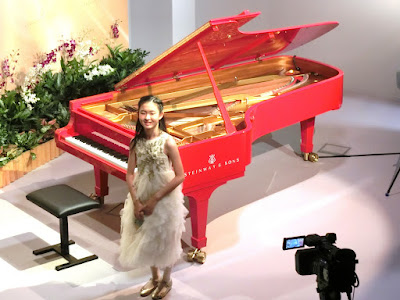
Category 1 (under 6 years, also known as the Ultra-Cute category) saw five youngsters who had personal pedal extensions (and an Ikea step-up device in one case) provided. The stand-outs were Elfie Tong, Lucia Lek and Shalom Ng who not just played the notes but gave extra nuances and dimensions to the short pieces they offered. If there were a prize for best costume, Shalom’s fiery red gown with train which matched the piano shade for shade wins hands down.
 |
Shalom Ng's gown was perfectly
matched for this grand piano! |
 |
| Earnest Ng |
Category 2 (7 to 10 years) saw a marked rise in standard, with a wider selection of pieces on displayed. It was interesting to note how Soviet pedagogical pieces by the likes of Kabalevsky and Maykapar begin to figure more prominently from this age group onwards. These are easy enough for young learners to accomplish yet sound difficult and impressive on first encounter. Quite outstanding were Jacques Ibert’s Le Petit Ane Blanc (Little White Donkey) from the spiffily attired Earnest Ng (with three-piece suit), Averil Chua's Grieg and Kabalevsky, and whatever Foo Ming En put her fingers, hands and mind to, namely Scarlatti, MacDowell and the earliest version of Liszt’s etude Mazeppa.
 |
| Foo Ming En |
 |
| Koh Jae Ann |
In Category 3 (11 to 14 years), one pianist was put at a serious disadvantage by having to perform live on an upright from home via Zoom (a consequence of Covid?), with all the intendant audio distortions. Those who made it to the studio were much better off. Tong Yong Kang put a brave show with Mozart and two movements from Prokofiev’s Romeo and Juliet – Friar Laurence and Mercutio, which were very musical. Isabelle Kuan also impressed with Glinka’s Variations on The Nightingale and Bartok’s Rondo on Hungarian Folk Tunes, offering a plethora of nuances in these varied works. Koh Jae Ann's choice of three very different Shostakovich Preludes (from Op.34) was excellent, and her Mozart movement (K.570) was achieved without banging, a first! Louis Xie brought out some humour from Haydn’s Sonata in D major despite its sewing machine tendencies and mastered Khachaturian’s Toccata with the same kind of dogged determination.
 |
| Louis Xie |
By the time one reached Category 4 (15 to 17 years), it may be said that the difference between the Amateur and Professional divisions was mighty slender. At this age, what is to decide who is going to be a professional musician in the future or merely a music lover who plays for the sheer heck of it? I believe this dichotomy to be a false and illusory one.
Estelle Goh’s nuanced readings of Adolf von Henselt’s etude Si oiseau j’etais (If I Were A Bird, famously recorded by Rachmaninov himself) and Granados’ Allegro de Concierto were so accomplished and well projected, equal or better than the best of the Professional Division. Likewise, Xian Ruofei made fairly easy work of the vertiginous fingering in the finale of Mozart’s Sonata in F (K.332), Chopin’s Etude in C (Op.10 No.1), missing a few notes along the way, and Debussy L’Isle Joyeuse, which was rapturous to say the least.
 |
| Estelle Goh |
 |
| Olivier Lim |
Wee Kai Xuan meant every note of her smouldering Chopin Nocturne in D flat (Op.27 No.2), then revelled in the free-wheeling liberties of Earl Wild’s transcription of Gershwin’s I Got Rhythm (including forearm clusters to close), thus erasing the memory of a somewhat aggressive Mozart A minor Sonata (K.311). Olivier Lim's view of Beethoven's Sonata in D (Op.10 No.3) was appropriately clangorous, and it got even better in Prokofiev’s Third Sonata, which had just the right mix of percussiveness and lyricism. To close the finals on a high was Michelle Harianto, whose Chopin Rondo in C minor (Op.1), a rarity, was confidently and idiomatically handled, before a luminous Ravel Jeux d’eau swept the board. Who is to say that none of these fine artists should not represent Singapore at the regional finals just because they played in the Amateur division?
 |
| Michelle Harianto |
I will not display my own predictions of the final results, suffice to say it might be quite different from the judging panel’s. For the record, Luther Ong (Category 1, Professional Division) was awarded the coveted Grand Prize. The full results may be caught here: (20+) Steinway Gallery Singapore | Facebook
 |
The jury for the Amateur division finals:
Low Shao Ying, Wu Yang, Ou Yang Lei Lei,
Lee Pei Ming & Tang Wern Ning, with Celine Goh. |
 |
The man behind the running of
the Steinway Youth Piano Competition is
Phan Ming Yen, himself a fine piano player. |
The listening experience over two afternoons had been a very satisfying one, boding well for piano playing and classical music in the republic for years to come. It does not matter if any of these young people turn professional or not, it is however more important that they remain music lovers for life (like those Youth-At-Heart ladies), spread the gospel of good music, and encourage their friends and family to follow suit. In short, piano playing and classical music must become more contagious than Covid!