Showing posts with label Yap Sin Yee. Show all posts

Wednesday, 15 August 2018

PIANO RECITALS / See Ning Hui, Yap Sin Yee & Clarisse Teo / Reviews


SOLO PIANO RECITALS by
See Ning Hui (Tuesday, 7 August 2018)
Yap Sin Yee (Wednesday, 8 August 2018)
Clarisse Teo (Sunday, 12 August 2018)
Esplanade Recital Studio

An edited version of this review was published in The Straits Times on 15 August 2018 with the title "Different moods from a trio of pianists".

It seems an astonishing fact that all of this summer's solo piano recitals featuring local pianists were given by young women. This should come as no big surprise since some of history's great pianists were from the fairer gender. The names of Clara Schumann, Wanda Landowska, Myra Hess and Martha Argerich all come to mind. The piano playing scene here should be no different.


The two recitals held on Tuesday and Wednesday were part of Allure, a mini-piano festival presented by the Kris Foundation. London-based Singaporean See Ning Hui displayed a mastery of six composers of different eras and styles. She opened with a slick account of Chopin's Second Scherzo, revealing a pearly tone with sharp contours smoothened over. Two Scarlatti Sonatas keenly contrasted staccato with legato playing, polar opposites of sound production and projection.


While her advocacy of living composers, Korean Unsuk Chin (Etude No.6 “Grains”) and Briton Thomas Ades (Darknesse Visible), was spirited and admirable, it was See's juxtaposition of Sonatas by husband-and-wife Robert and Clara Schumann which sealed the deal. Both cast in G minor, Clara's salon-like charm and Robert's blistering passion were the toast of the evening's offerings.


Boston-based Malaysian pianist Yap Sin Yee was the 1st prizewinner in the 2013 National Piano Competition while at the Yong Siew Toh Conservatory. Her programme was entirely Romantic, beginning with Debussy's Etude No.11 as a cystalline icebreaker. Then followed a chronological history of the sonata form.

Beethoven's late Sonata No.30 in E major (Op.109) revelled in abrupt changes in dynamics and mood with the central movement's outburst as a focal point. The Theme and Variations of the final movement were beautifully shaped, with the noble return of its lovely sarabande subject.


Robert Schumann's three-movement Fantasy in C major (Op.17) was a statement of love which received a most passionate response. Bliss turned to orgasmic ecstasy for Scriabin's Fifth Sonata, where wrong and missed notes were a small price to pay for going for broke. Here, Yap's audacity totally trumped timidity.  

Pianists See Ning Hui and Yap Sin Yee
with Kris Tan and project manager Laura Peh.

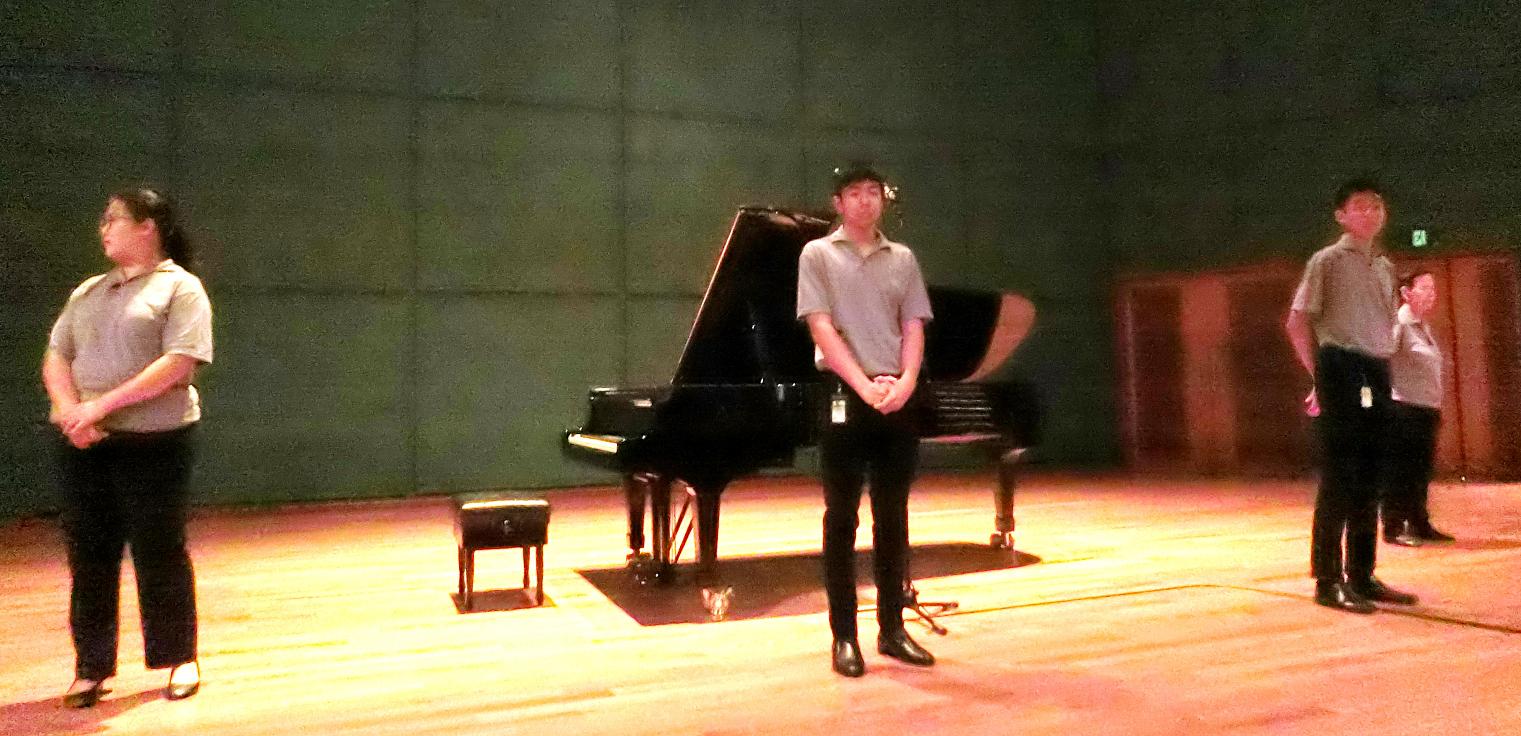
The answer is: Four
The question was: How many Esplanade staff
does it take to guard a piano?
Elaboration: One to say "Don't come near!"
The second to say "Don't touch the keys!"
and two more to say "No photography!"
No better than automatons, losers all.


Clarisse Teo was a graduate in law before deciding to pursue music full-time at the Royal Conservatoire of Scotland in Glasgow. Her recital on Sunday consisted wholly of rarities, works unlikely to be heard at a conventional concert. Like Catalan composer Federico Mompou's Variations On A Theme By Chopin, a flight of fantasy on the Pole's famous A major Prelude. Or Russian Nikolai Medtner's Three Pieces Op.31, which included a set of variations, funeral march and fairy tale.


For these, Frenchman Vincent D'Indy's Theme Varie, Fugue Et Chanson and Soviet composer Anatoly Alexandrov's psychedelic Fourth Sonata, she displayed utter confidence and a fearless disregard for their technical complexities, while making this arcane music sound totally fresh and natural. Whoever thought that Singapore's answer to the Canadian Marc-André Hamelin, widely regarded as the world's most prodigious pianist, would be wearing a skirt?


Thursday, 2 August 2018

TWO MORE PIANO RECITALS NOT TO BE MISSED: ALLURE


Here are two more piano recitals not to be missed! Featuring young Singaporean pianist See Ning Hui and young Malaysian pianist Yap Sin Yee, these two piano recitals are part of a mini piano festival called ALLURE presented by the Kris Foundation. 

ALLURE is a celebration of the empowerment of young women musicians, and these recitals showcase feminine charm and mystique with exquisite musicianship. See Ning Hui's recital on 7 August includes the works of two leading women composers, Clara Schumann and Unsuk Chin. Yap Sin Yee was recently a finalist and prizewinner at the Thailand International Piano Competition. 

The programmes are as follows:


SEE NING HUI Piano Recital
Tuesday 7 August 2018
7.30 pm, Esplanade Recital Studio

CHOPIN Scherzo No.2 in B flat minor, Op.31
CLARA SCHUMANN Sonata in C minor
SCARLATTI 2 Sonatas, K.474 & 551
UNSUK CHIN Etude No.6 "Grains"
ADES Darknesse Visible
SCHUMANN Sonata No.2 in G minor, Op.22


YAP SIN YEE Piano Recital
Wednesday 8 August 2018
7.30 pm, Esplanade Recital Studio

DEBUSSY Etude No.11 
  "Pour les arpéges composés"
BEETHOVEN Sonata No.30 in E mjor, Op.109
SCHUMANN Fantasie in C major, Op.17
SCRIABIN Sonata No.5

Tickets are available at all SISTIC outlets and online:
https://www.sistic.com.sg/events/callure0818

Both piano recitals are presented by the Kris Foundation.

Tuesday, 19 January 2016

GARY HOFFMAN Chamber Recital / Review


GARY HOFFMAN Chamber Recital
Yong Siew Toh Conservatory Concert Hall
Sunday (17 January 2016)

This review was published by The Straits Times on 19 January 2016 with the title "Cellist Gary Hoffman tugs at heartstrings".

A fairly sizeable audience turned up on a Sunday afternoon for a chamber concert by the Canadian cellist Gary Hoffman, who has developed a reputation as one of the world's leading chamber musicians. Performing with faculty and students of the Conservatory, the programme offered could scarcely have been more inviting as well.


Czech nationalist composer Leos Janacek's Pohadka is a musical fairy-tale in three short movements, scored in an unmistakeably haunting idiom with piquant harmonies and short repeated motifs which are largely derived from folk music. Hoffman's 1662 Amati cello opened with pizzicatos, sang and then wept, ably supported by Indonesian pianist Anthony Hartono's sensitive playing with well-nuanced pedalling.


That unusual palate-cleanser yielded the whiff of a breath mint before the more opulent offering of Anton Arensky's First Piano Trio in D minor. Colleague of Tchaikovsky and teacher of Rachmaninov, Arensky mined the same rich melodic vein which has come to characterise Russian romanticism.

Melancholic and sometimes sentimental, its thematic interest was shared by Hoffman's lush cello sound and Ukrainian Oleksandr Korniev's violin, which was every bit his match. Malaysian pianist Yap Sin Yee's busy part ranged from big-boned chords to an unexpected whimsicality in the scherzo 2nd movement which exuded salon-like schmaltz that recalled Saint-Saëns' frivolities.

In the slow movement, Elegia (Elegy), the dyed-in-the-wool Russian brooding came to the fore, contrasted by a gossamer-light and dreamy central section. The passionate finale was conducted at high voltage but was not without moments of levity, and a reprise of the 1st movement's opening theme. This seemed like a reminiscence of a past age, a yearning for the good old days.


The second half comprised just Rachmaninov's mighty Cello Sonata in G minor, which was a re-run of the heart-on-sleeve emotions displayed earlier in the Arensky trio. It seems one could not have enough of a good thing, because the performance with pianist and conservatory don Albert Tiu was a total treat.     
  
Hoffman's entry, literally a heave and sigh, was good enough to keep one transfixed for the work's entire 35-minute duration. His shaping of melodic phrases was excellent, keeping the thematic thrust and narrative coherent. He was aided by Tiu's unerring pianism, maintaining a cool head despite the multitudes of notes. The piano's bluster could have easily overwhelmed the cello, but that was never the case in this true partnership of equals.


The Andante slow movement tugged at the heart-strings with its unabashed lyricism, one of many high points in the recital. The hell-for-leather finale swept everything before it and the sonata concluded with the vocal ovation the performance deserved. One suspects the name of Rachmaninov helped draw the audience, but it is the quality of the playing that keeps them coming again.  


Monday, 9 December 2013

NATIONAL PIANO & VIOLIN COMPETITION 2013 / PIANO ARTIST FINALS / Review


NATIONAL PIANO & 
VIOLIN COMPETITION 2013
PIANO ARTIST CATEGORY FINALS
Sunday (8 December 2013)

The grand final of the Piano Artist Category of the biannual National Piano & Violin Competition is the closest thing one gets to the final round of any international piano competition. Three finalists get to play a full length concerto with an orchestra, a formula which also applied to international competitions I have attended in London and Shanghai. For years, it has been the grand showcase of piano talent in Singapore and the previous finals have been memorable to say the least. This year it was even better.

In some ways, this seemed like a repeat of the 2007 finals held at the Victoria Concert Hall. That edition pitted Tchaikovsky’s First Piano Concerto (played by a Chinese student from the Nanyang Academy of Fine Arts) against Mozart’s Piano Concerto No.20 (by a student from the Yong Siew Toh Conservatory), with a Grieg Piano Concerto as an also-ran. On that December evening, the Tchaikovsky triumphed.


Due to the order in which participants had drawn earlier, it was the Tchaikovsky that opened this final, accompanied by the Metropolitan Festival Orchestra conducted by Chan Tze Law. NAFA’s Wan Jing Jing (China) was a rock solid soloist, comfortably issuing big chords that thundered through the orchestra’s majestic statement of the main theme. The early cadenza was dispatched with relative ease. A crying baby (why are they even allowed entry?) did little to faze this assured young lady on her mission. There were a few missed notes in the long cadenza at the end of the first movement, but that mattered little.

The main problem with this warhorse of a concerto is that it calls for big gestures through most of its pages, stampeding octaves, emotionally driven romantic clichés and the like all worn heart-on-sleeve. Wan delivered these with true weight and aplomb, but the overall effect with her and the orchestra operating at full blast in this reverberant hall was one of sensory overload and exhaustion.

Some respite came in the second movement, where the serene opening theme was well contrasted with the quicksilver prestissimo central interlude. The rollicking finale was also well pulled off, with the orchestra build up towards the final salvo of octaves being one of the work’s most thrilling moments. Wan did not disappoint, and even though she could develop further by bringing more nuances to this less-than-subtle work, this was job well done.


There was a good reason why Camille Saint-Saëns’s Second Piano Concerto was not on the list of concertos for the last three editions of the competition. It was the 2005 final which infamously featured three consecutive performances of the piece, each worse than the last. It made for a mind-numbing concert that nobody was keen to repeat. Thankfully Yap Sin Yee (Malaysia) gave a swashbuckling performance that topped all three of those, thus restoring some faith to the superficial delights of this work.

“Bach to Offenbach” is the apt description applied to the concerto’s journey from sobriety to outright frivolity, one which Yap understood well and took to her heart. The opening G minor cadenza with its long held pedal-note was delivered in its full gothic glory. Hardly a note was missed in the loud parts of the first movement, but it was the fairy-tale lightness in the quieter passages that impressed. While the second movement’s scherzo could have done with more crispness, the waltz-like soft centre was milked to its max. Any more sentimentality would have been a descent into schmaltz, a fine line which the performers treaded quite gingerly. 

Any doubts as to this performance were dispelled in the tarantella finale, which saw Yap flying off the blocks at a furious pace. How she maintained this momentum from frenzied start to scintillating end was a testament to her athletic prowess, but one which took all musical considerations in the stride. Amid the chase, there was humour and an ebullience that sparkled like champagne.     


Singapore’s hopes lay in Jonathan Shin who cut a supremely confident figure in Mozart’s Piano Concerto No.20 in D minor (K.466). He was informally attired and looked like an epitome of coolness. The playing was however one of warmth and svelte elegance, though he closely identified with the music’s sturm und drang. Making the music come alive, with its emphasis on natural flow and innate urgency, there was no resorting to ear-catching agogics or exaggerated accents. The Beethoven cadenza was well-chosen, dramatic and trenchant in its delivery.

The slow movement’s Romanze was poetically shaded, and if there were a minor quibble, he could have stirred up the turbulent central G minor a bit more to show up the movement’s contrasts. The finale was a return to the first movement’s dramatics, and while some thought that it was taken too fast, I felt that he maintained the movement’s tension well, culminating with an excellent cadenza. In certain ways, this was for me the most satisfying performance of the afternoon. This was not because Shin did not put a foot wrong, but because Mozart is so darned hard to interpret convincingly. He seemed to get everything just right.


So how does one decide between a sturdy Tchaikovsky, a rip-roaring Saint-Saëns and an urbane Mozart? I don’t for a moment envy the jury of Gennady Dzubenko, Dean Kramer and Ick Choo Moon who have to judge these things. For myself, and those fortunate to have attended the final, this has been a most absorbing concert – perhaps the best final in years. The result had to be a close one, and here are the placings:

3. Jonathan Shin in Mozart 20
2. Wan Jing Jing in Tchaikovsky 1
1. Yap Sin Yee in Saint-Saëns 2

The moment when Yap Sin Yee
finds out she has won.

Congratulations are in order to all the pianists, as well as the semi-finalists (I heard another three) who have set a very high overall standard for the cohort of 2015 to emulate. Till the next time!

All the three winners (from L):
Wan Jing Jing, Yap Sin Yee & Jonathan Shin