Friday, 30 October 2020

PETWORTH FESTIVAL 2020: KADIATU KANNEH-MASON / Some Thoughts

Thursday 29 October 2020

KADIATU KANNEH-MASON

@ The Petworth Festival

Interviewed by Stewart Collins


By now, anybody who professes a love for classical music but has not yet heard of the young British cellist Sheku Kanneh-Mason probably lives under a rock or some cave in Afghanistan. Winner of the 2016 BBC Young Musician Award and star performer at the royal wedding of HRH Prince Harry and Meghan Markle, Sheku has six siblings who are also seriously good musicians. How did the seven Kanneh-Masons become Britain’s First Family of Music? Matriarch Kadiatu was on hand at Petworth to share insights into her recently published book House Of Music: Raising The Kanneh-Masons. I can imagine this to be the antithesis of another book, one which will hopefully never be published: House of Horrors: Raising The Kardashians.


Straight off, my wife and I were touched by Kadiatu’s overall sense of groundedness and authenticity in telling her story. The secret of the Kanneh-Masons’ success was down to a generational legacy good upbringing, good values, good discipline and above all, the closeness and love within a family. It is astonishing to learn that the children were students in normal secondary schools and not hot-housed in petri dish environments of conservatoriums. Sheku, despite his celebrity status, is still a student at the Royal Academy of Music and intends to graduate.


Down to earth and highly personable
was our impression of Mrs Kanneh-Mason. 


There was also none of the patented hocus pocus of religiosity, praying hard to be gifted heavenly blessings, nor the self-entitled glorification of toil, self-flagellation or self-immolation. There were sacrifices made by Kadiatu and her husband Stuart, for certain, but these were in the contexts of ensuring that love was never in short supply within the family while the kids were growing up. One thing we’ve also learnt: you do not need to be a “Tiger mother” or “Helicopter parent” to produce geniuses.  


Coming from a multi-cultural background of Sierra Leonese, Welsh and Antiguan ancestry, the Kanneh-Masons would have faced multiple hurdles in making good in the White-European dominated classical music sphere. However their emergence was not the result of  “affirmative action” but rather pure talent given the right opportunities and platforms to take flight and soar. Running alongside them is Britain’s first mixed-ethnic professional orchestra Chineke!, which has also been an inspirational and aspirational journey.


Stewart says, "Go out and buy this book!"


Credit goes to Petworth Festival Director Stewart Collins for posing both pertinent and pointed questions, which Kadiatu replied with a disarming grace and charm. It would seem that this cultured and decorous responses are a million miles away from the anger and aggression of the BLM movement. Watching this interview (and we’ve also ordered the book, arriving within the week!), we are encouraged that there is hope yet in our troubled world of multicultural relations. Thank you, Mrs Kanneh-Mason for helping to make this happen. 


Monday, 26 October 2020

PETWORTH FESTIVAL 2020 / Concert Reviews IV


Thursday 22 October 2020

MILOS KARADAGLIC, Guitar


It is amazing to ponder that the Balkan republic of Montenegro, with a population of just over 600 thousand, can boast the talents of pro footballers Mirko Vucinic and Stevan Jovetic, the dear mutual friend of Neil Franks and mine – pianist Boris Kraljevic - and possibly the world’s most popular classical guitarist Milos Karadaglic. He came to Britain as a teenager, studying in the Royal Academy of Music before becoming a recording star and global sensation. His hour-long recital was a world tour of popular guitar repertoire that spanned the entire spectrum of the instrument’s capabilities.


Spanish music came first with a set comprising Granados’ Andaluza (Spanish Dance No.5, also known as a piano piece), Tarrega’s Lagrima (Teardrop, a short piece of quiet reflection and melancholy), Falla’s Dance of the Miller’s Wife (from The Three-Cornered Hat), replete with its vigorous orchestral effects. From the greatest Brazilian composer Heitor Villa-Lobos came his five famous Preludes, written for Andres Segovia, displaying a kaleidoscopic range of colours and moods which Milos keenly lapped up.


Keen in exploring myriad aspects of guitarism, there were two transcriptions by Japanese contemporary great  Toru Takemitsu of popular songs: Harold Arlen’s  Over The Rainbow (from The Wizard of Oz) and Lennon-McCartney’s Yesterday. The melodies may be unforgettable to say the least but the harmonies employed were unusual, even exotic, resounding beautifully in Milos’ hands.


The most substantial work on the programme was perhaps the least familiar (except for guitar aficionados), the Italian guitarist-composer Carlo Domeniconi’s Coyunbaba Suite. The work is unusual as it requires special tuning to relive an Oriental mode in the key of C sharp minor, with its four linked movements influenced by Turkish music. Milos cast a hypnotic spell with this mesmerising music, which traversed from quiet contemplation to white-hot passion and ecstacy. The guitar is an instrument which shares the most private and intimate of thoughts, and rarely has it secrets been so trenchantly revealed.  


Friday 23 October 2020


PATTI BOULAYE – ARETHA AND ME


Popular music is so ubiquitous that you recognise the songs even if you did not know what they were called. Such were my impressions when tuning in to British-Nigerian singer Patti Boulaye’s personal tribute to legendary American singer-songwriter Aretha Franklin. Aretha’s songs are so well covered that the originals are sometimes forgotten. Patti’s natural ability and enthusiasm is infectious, which translated well for The Queen of Soul’s standards like Think, I Say A Little Prayer, Spanish Harlem, Son of A Preacher Man, I Never Loved A Man The Way I Love You and Baby I Love You.


Not everything heard this evening was by Aretha. There was Etta James’ I’d Rather Go Blind and At Last, and Bessie Smith’s Kitchen Man, which are of the similar genre. The less said about the cover of Nessun Dorma (from Puccini’s Turandot), the better. Pavarotti she is not, but at least Patti did it her way. Far more convincing was Dat’s Love or the Habanera from Carmen Jones (Bizet’s opera from the hood), which was more her kind of thing. Best of all was Amina from Patti’s musical Sun Dance which simply oozed the African vibe. Patti was ably accompanied by music director Alan Rogers who manned all the keyboards and extra sound effects.


The bewitching hour closed with more Aretha: Chain of Fools, Save Me and You Make Feel Like A Natural Woman, familiar favourites sealing an incredibly lively show for someone who’s mighty proud of being a grandma. Did someone say she is 66 years old? That is simply astonishing.  


Saturday 24 October 2020


CHARLES OWEN &

KATYA APEKISHEVA, Piano Duo


The final concert is this wonderful week at the Petworth Festival was a piano four hands recital by the duo of Charles Owen and Katya Apekisheva. Both pianists are the co-directors of the London Piano Festival at King’s Place, an annual event which I must attend sometime during my lifetime, and I even own a couple of their CD recordings. Their Petworth offering was not Stravinsky’s The Rite of Spring or Rachmaninov’s Suites but a Classical-Romantic affair which made more sense in the space of St Mary’s Church.


Charles Owen waxes lyrical about
Beethoven and Schubert.


Beethoven’s Sonata in D major (Op.6) is an early work in just two short movements. The vigour and brio stirred in his spirit came immediately to the fore, which made interesting contrasts with Schubert’s Rondo in A major (D.951). This was a late work composed in his final year, one blessed with an unremitting congeniality. As rondos go, this was not the usual jolly dance but a gentle portrait of polite Biedermeier sensibilities. The duo, technically adroit but totally sensitive at every turn, gave a most musical reading which can scarcely be bettered.


Then came the substantial Brahms set, opening with his Variations on a Theme by Robert Schumann (Op.23, and not Op.9 which is a totally different piece for two hands), based on a late piece written during Schumann’s final throes of insanity. This is the same theme of Schumann’s Geistervariationen (Ghost Variations), but Brahms’ is the far more interesting set, and the duo’s imaginative take sealed the deal. The 16 Waltzes (Op.39) may be considered amateur fodder, but it takes superior musicians to do the myriad subtleties full justice, which was what we got from Charles and Katya.


Charles and Katya could not have had a more
sympathetic page-turner than Neil Franks,
pianophile & Chairman of the Petworth Festival.

To close were four popular Hungarian Dances heard in their original form for piano four hands. Brahms was not a striver for authenticity (unlike Bartok and Kodaly) but he fully understood the Magyar gypsy spirit which comes alive in his 21 showpieces. For the record, the duo performed Nos.1, 7, 6 and 5, which are the best-known ones with all the beloved tunes. As they say, all good things must come to an end, but this had been a most enjoyable week of music, and the 2021 Petworth Festival cannot come any sooner!


Friday, 23 October 2020

PETWORTH FESTIVAL 2020 / Concert Reviews III

Tuesday 20 October 2020

TASMIN LITTLE, Violin

with JOHN LENEHAN, Piano


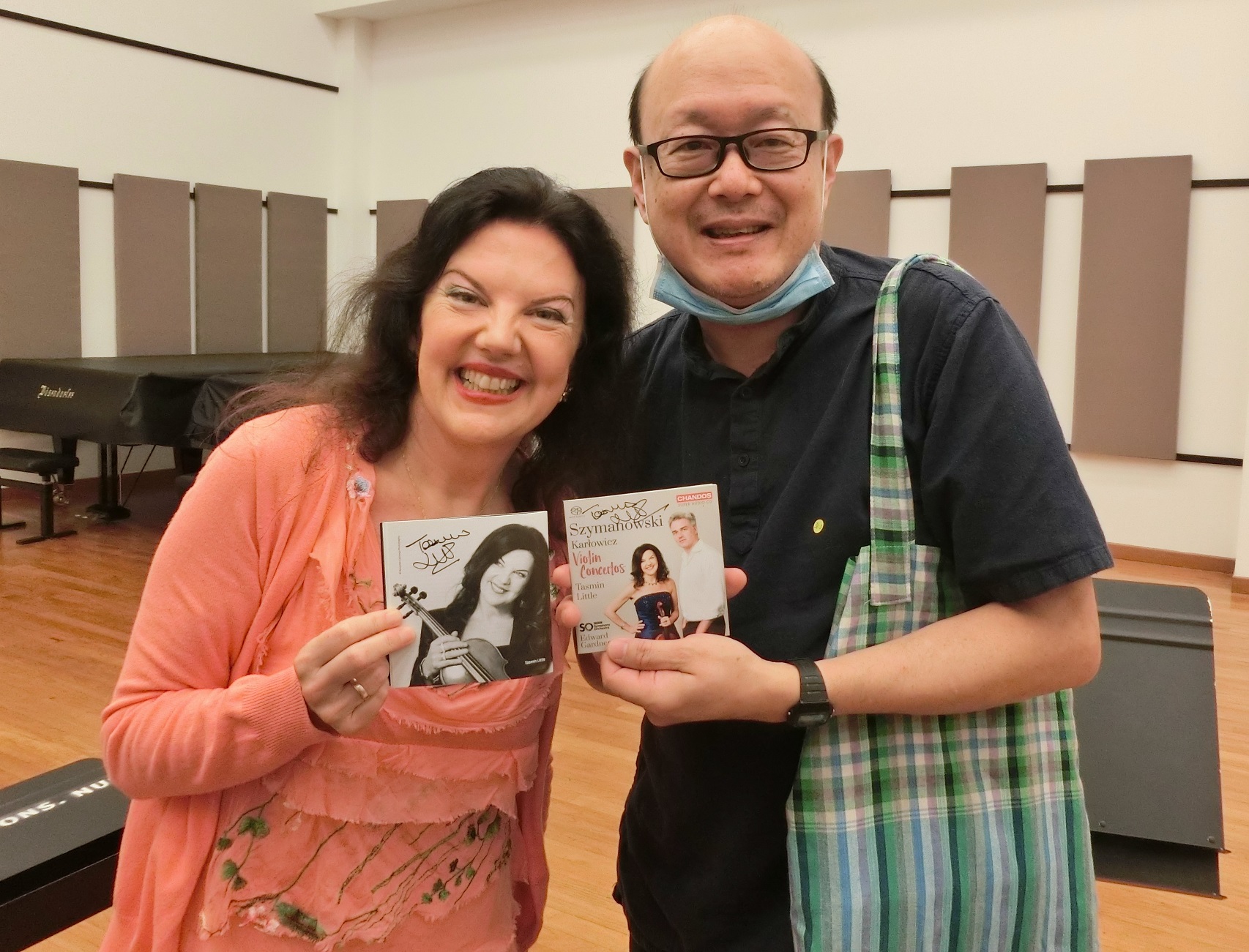
It is hard to believe that Tasmin Little is retiring from the world of performing. This might very well be one of her last concerts, having given a world farewell tour (including a date with the Singapore Symphony in February) to call a close to a stellar international career of over 2000 concerts in thirty years. I am privileged to have seen her perform in Singapore, Sydney and Hong Kong, and why not include Petworth into this august list?


Tasmin Little in Singapore,
playing Bruch's Violin Concerto No.1
with the Singapore Symphony Orchestra


Her programme with regular piano collaborator John Lenehan was all Romantic, opening with Brahms’ Scherzo in C minor from the so-called FAE Sonata written for Joseph Joachim by three composers (Brahms, Schumann and Dietrich). It is the only movement anybody remembers today, with the hot-blooded young Brahms sending sparks fly, amply reciprocated by the duo in a passionate reading. This was merely the prelude to the young Richard Strauss’ Violin Sonata in E flat major, the concert’s main piece, composed long before his great tone poems and operas.  


Here Little’s lyrical gifts come to the fore, with the work’s succession of luscious and flowing melodies given a gilded edge. Her tone is voluminous, sweet but not cloying, and intonation en point through its three movements. The slow movement is titled Improvisation, but its more of a meditation, its aria-like beauty shining through at every turn. The finale mirrored the first movement’s passionate throes, and with virtuosity to burn, the duo dispatched its pyrotechnics for a powerful close.


The next two works were by women composers: Lili Boulanger’s lovely Nocturne and Amy Beach’s Invocation (shorter and less well-known than her Romance, but just as pretty) were simply oases of calm and charm, played with a heartwarming sincerity. The closing piece, Tchaikovskyana, was a fantasy on popular melodies from the ballet Swan Lake, cunningly crafted by Little and Lenehan. In the hallowed tradition of such fantasies by Sarasate, Wieniawski and Ernst, this was a distillation of good tunes and virtuoso playing, throwing in snatches of Tchaikovsky’s First Piano Concerto and Violin Concerto for good measure. Naughty but nice, and brilliantly dispatched. To Tasmin, we bid adieu and thank you for the music.


Tasmin's got a fan in Singapore!


Wednesday 21 October 2020

CLARE TEAL & Friends


I can’t say I know much about jazz singing, for this is music one should be chilling to and simply enjoyed rather than analysed or critiqued. So I will keep this short and say I tremendously enjoyed Clare’s soothing mezzo voice, swinging vibe, and ad libbing, supported by an excellent trio of pianist Jason Rebello, bassist Simon Little and Ben Reynolds on drums, who also lent their voices for some numbers.


For the record, the songs she styled included I Love Being Here With You (Peggy Lee), An Occasional Man (Jeri Southern), They Say Its Spring (Blossom Dearie), You’ve Changed (Billie Holiday), Let’s Do It, Let’s Fall In Love (Ella Fitzgerald), If I Had A Ribbon Bow (Maxine Sullivan), It’s A Good Day (Peggy Lee), La Belle Dame Sans Regrets (Sting), The Song Is You (Doris Day), I Will (Lennon & McCartney), My Funny Valentine (Rodgers & Hart), Into Each Life Some Rain Must Fall (Ella & The Inkspots), Don’t (Elvis Presley), It Don’t Mean A Thing If It Ain’t Got That Swing (Duke Ellington) and several which I’ve either missed or forgotten. After a long day of work, this was certainly the perfect sort of tonic to go home to and lounge about.


Wednesday, 21 October 2020

PETWORTH FESTIVAL / Concert Reviews II


Sunday 18 October 2020

MITSUKO UCHIDA 

Piano Recital


Are there people who remember what life during the Blitz was like? When Dame Myra Hess organised the legendary series of recitals at the National Gallery, what comfort and solace did those concerts bring? And how was the “Keep Calm and Carry On Regardless” spirit upheld? The world is now under the cosh again, not by Nazis but unseen enemies lurking in unmasked and unwashed corners, waiting to strike. It is in this modern day siege that the Petworth Festival keeps the morale up. This evening, another Dame M provided a healthy dose of healing.


I am grateful that Dame Mitsuko Uchida dropped Beethoven’s Diabelli Variations in favour of two Schubert sonatas. I have also little doubt that the Schuberts were a greater intepretive proposition, besides challenging the listener that bit more. And what a delight that was too.


The opening movements of Schubert piano sonatas are where the meat is. These are heavenly in length and double the pleasure when exposition repeats are observed. This is music that takes its time, and where time stands still. In Uchida’s hands, every note and every measure meant something.


In the Sonata in C major (D.840), big chords and octaves portrayed defiance and resoluteness, and with its calculated jarring dissonances, a dimension of physical pain and angst was also evinced. In the Sonata in G major (D.894), there was unremitting congeniality and warmth, and I am reminded of the pop song People (People Who Need People). That sounds daft, but the association will always be with me, and this performance became a soothing balm for my ears and bruised soul.


The quite substantial second movement of the C major, now cast in melancholy and pathos of C minor, was one that remained tantalisingly unresolved. With only two movements, Schubert never did complete the work (called the Reliquie because it was then thought to be his last). Would this be his greatest sonata had he not been silenced by an early death? Uchida performed it as if it was.


The three latter movements of the G major (sometimes referred to as the Fantasie) was almost a breeze. The contrasts were refreshing: an excursion into Schubert’s world of lieder in the slow movement, a scherzo with symphonic ideas, but special place had to go to the playful Rondo finale. Its dance-like moves seemed to look forward to ragtime, just like the finale of Beethoven’s Op.111 predicting a future in jazz and boogie woogie. Despite the serious tone in the earlier movements, tongue-in-cheek was never far away in Uchida’s reading, which made for a rhythmic and cheery close.


The chorus of bravos was justly rewarded with an encore, but just a very brief one: Aveu from Schumann’s Carnaval. This was a truly breathtaking and masterly recital, from beginning to end.       


Monday 19 October 2020


PETWORTH SUMMER FESTIVAL SPECIAL


The Petworth Festival has enjoyed a five-year relationship with the Royal Academy of Music, the partnership providing opportunities for RAM students and alumni to perform for friendly audiences outside well-trodden concert venues in the capital. This summer festival special concert relived pre-recorded content from earlier in the year, a showcase for younger performers to display their wares.


The concert opened with pianist Harry Rylance performing Liszt’s transcription of Wagner’s Tannhäuser Overture, a sizzler filled with myriad orchestral effects downsized for the piano. Downsized or reduced are wrong words indeed, because the pianist is subjected to outsized and outrageous demands for choral, chordal and filigreed passages, all whipped up by just ten fingers. Rylance did a splendid job, thunderous for most part but also sensitive to fine and subtle details.


Next came the Vòreios Trio, comprising oboist Russell Coates, bassoonist Olivia Palmer-Baker  and pianist Shang Xiaowen, in Poulenc’s Trio for this unusual combination. Typical for the Frenchman, there was his mock-serious quasi-religious slow opening, followed by frivolity let loose without apology. The trio fully realised its potential for comedic humour in the outer movements, balanced by a slow movement of Mozartian simplicity and purity. Most of all, it was just a fine excuse to wallow in Poulenc’s bittersweet yet juicy melodies. Simply delicious!   


The evening concluded with Harry The Piano, not a cartoonish character but the sort of pianist all of us (who have pored over hours, years and decades of piano lessons) long to be. Harry Harris is his real name (I’ve checked) and he is the guy who hogs the piano at cocktail events and becomes the life of the party.


His medley of Gershwin tunes jam packs in Rhapsody in Blue, An American in Paris and hit songs like Fascinatin’ Rhythm, Love Is Here To Stay, Embraceable You, Do It Again, Summertime and I Got Rhythm within the span of just a few minutes. Playing audience requests, he does Climb Every Mountain in the style of Tchaikovsky’s Nutcracker, I Feel Pretty à la Debussy, an Elton John hit in the manner of Rachmaninov, a jazzy Hallelujah Chorus (Billy Mayerl and the striders would have been proud) and Schubert’s Ave Maria as dressed up by Little Richard. That was a blast too. He is no lounge pianist but My Music’s Steve Race come back to life. We are so envious indeed.

Monday, 19 October 2020

PETWORTH FESTIVAL 2020 / Concert Reviews I


PETWORTH FESTIVAL 2020 

This year has been a total washout for my insatiable appetite of attending concerts and music festivals. What the global Covid-19 pandemic has done to live music-making and the concert-going experience is unprecedented. In short, it has been shattering. Not being able to attend the Hong Kong Arts Festival (cancelled), the Singapore International Piano Festival (axed), the Rarities of Piano Music at Schloss vor Husum Festival (postponed) and The Joy of Music Festival in Hong Kong (still taking place but travel restricted) has been a major downer for me, and would have been a source of depression.


However, the one bright light that proudly shines is England’s Petworth Festival, held in a West Sussex town which has a history that goes back to medieval times. Home to the 17th century National Trust Petworth House, there are neither tall buildings, railway station nor Macdonald’s on its cobbled streets. But its summer music and autumn literary festivals have hosted some of the land’s top artists and writers. Due to the year’s circumstances, both festivals have now been combined as an autumn special, to form one exceptional fortnight of live and streamed events.


My two day whistle-stop visit to Petworth in the summer of 2018 was a revelation, and I wished I could have come back and stayed longer. This has not happened – yet - but being able to witness the performances, on my handy laptop and through headphones is nonetheless a much-welcome relief from the tedium and humdrum of a Covid lockdown.


Friday 16 October 2020 

HOWARD SHELLEY &

London Mozart Players Ensemble


The festival opened with a Haydn symphony, well sort of. In this period of social distancing, big orchestra performances have been ruled out, but in comes the idea that “small is good”. Thus what we got was impresario extraordinaire Johann Peter Salomon’s arrangement of Haydn’s Symphony No.94 in G major (better known by its nickname, the Surprise Symphony) for string quartet, flute, double bass and piano (serving as a sort of continuo). It is a septet, but good music remains, performed with the care and love one might expect in intimate chamber music.

Petworth Festival Director Stewart Collins
addresses the audience in St Mary's


Opening with a slow introduction, the 1st movement soon took off in the high spirits and wit that comes with the territory. The balance between the strings and piano chords was excellent, with the flute adding an extra line of timbre and texture. The main surprise here was the second movement’s theme and variations (remember that big abrupt tutti chord which gave the symphony its nickname?) being omitted.


The great British pianist Howard Shelley* then gave a scholarly but highly accessible preamble on Beethoven’s early style with relation to Mozart’s late piano concertos, and also played examples which helped in the appreciation of Beethoven’s Third Piano Concerto. Accompanied by just a string quintet, one need not have worried about missing the full orchestra. The piano rumbled in its series of ascending scales without apology, and never looked back. Here was a performance that lacked nothing in brio and vigour, with Shelley in scintillating form leading from the keyboard.


The usual big cadenza by Beethoven was played, and even this sounded perfectly appropriate. The slow movement’s opening chorale for piano solo was an epitome of purity, from which a glorious lyricism unfolded. The Rondo finale turned from drama to sheer joy, but not before some tense moments which Beethoven put his listeners through. Overall, this work - and performance -  represented a triumph of the spirit. The audience in St Mary’s were served up a real treat. Whoever thought a live Beethoven piano concerto be heard with such vivacity and vividness in the midst of a global pandemic?


* The discophile world will forever be in his debt for his indefatigable work in Hyperion’s Romantic and Classical Piano Concerto series and championship of British piano music.


Saturday 17 October 2020


SHEKU KANNEH-MASON, Cello &

ISATA KANNEH-MASON, Piano


Billed as the highlight of the festival, the duo recital by two members of Britain’s first family of music was every bit as as good as their programme suggested, if not better. Cellist Sheku, winner of the 2016 BBC Young Musician of the Year competition, and his older sister pianist Isata opened with Beethoven’s Fourth Cello Sonata in C major (Op.102 No.1). One would feel their chemistry from the outset, with the cello voicing the first notes and the piano joining in for the 1st movement’s slow introduction. Here were both instruments presented as first among equals, a status not previously recognised before Beethoven, and how. Sheku’s robust tone yet sensitive voice was well matched by Isata’s sure-fingered pianism through the sonata’s two movements.


The slow-fast-slow-fast form here is reminiscent of the sonata da chiesa of old, and made for splendid contrasts. Does anyone other than myself feel that a motif in the fast section of the 1st movement sound like The Stars and Stripes Forever? Maybe John Philip Sousa was influenced by Beethoven? Whatever that maybe, there were lots to enjoy in the 2nd movement’s interplay and counterpoint, which made this a fun outing.    


Frank Bridge may be regarded as a 20th century composer (besides being the most important teacher of Benjamin Britten), but his Melodie remains firmly entrenched in the Romantic era. Its brief three-and-a-half minutes cast a sumptuously lyrical spell, beautifully voiced and served as the prelude to the concert’s main event, Rachmaninov’s Cello Sonata in G minor (Op.19). Here the sibs unleashed a no holds barred performance that simmered, sizzled and then erupted into glorious life.


Ecstacy is written
all over Sheku's face!


It was easy for the piano with its multitudes of notes to overwhelm the cello, but that never happened. Isata’s sensitive musicianship and Sheku’s passion made sure of that. While the opening movement and ensuing scherzo flexed muscle and sinew, it was the gorgeous slow movement that revealed the Russian composer’s psyché heart-on-sleeve. The duo milked it for what it was worth, and the result was heartrending to say the least. The finale’s tarantella-like dance followed off where the initial fast movements left which made for a breathlessly exciting finish, greeted by the loudest of cheers.  


On the strength of this hour-long recital, I dare say the Kanneh-Masons, Sheku and Isata, have what it takes to become Britain’s finest sibling duo since Yehudi and Hephzibah – and yes, I mean the Menuhins.