Showing posts with label Benjamin Britten. Show all posts

Thursday, 20 January 2022

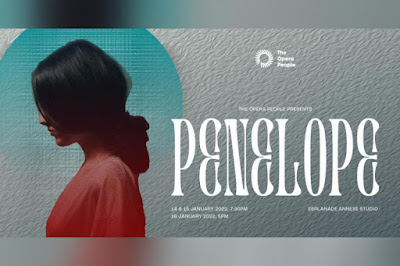
PENELOPE / The Opera People / Review


PENELOPE

The Opera People

Esplanade Annexe Studio

Saturday (15 January 2022)


This review was published in The Straits Times on 19 January 2022 with the title "Girl power in pared down opera".


When one thinks of opera, visions of heroic singers, humongous casts, epic sets and lavish costumes come to mind. At the opposite end of the spectrum is chamber opera, with production pared down to the minimum, supported by modest budgets and keen minds striving to do something different. Ambition, without compromising on quality, has been the vision of groups like New Opera Singapore, L’Arietta and The Opera People.


Plaudits go to The Opera People for even attempting to stage American composer-conductor Andre Previn’s final work, the opera Penelope based on Homer’s Odyssey, left unfinished when he died in 2019. With libretto in English by Tom Stoppard, the project was realised by Previn’s copyist David Fetherolf and premiered later in the same year with soprano Renee Fleming in the title role.


The Opera People’s production went one step further by merging the opera with English composer Benjamin Britten’s 1939 song cycle Les Illuminations, with words by Arthur Rimbaud sung in French. This odd mix might not have worked if not for the skilful curation of sung and spoken texts undertaken by the production team with stage director Edith Podesta.


The musical idiom of both works is tonal, and especially lyrical in the case of Britten, which made for quite seamless transitions between the set-pieces. Previn’s instrumentation was scored for string quartet and piano, while Britten’s was wholly for strings. All these were comfortably accommodated by the Wayfarer Sinfonietta conducted by Lien Boon Hua.


Photo: Moonrise Studio


Its story was simple: the trial of Penelope’s unwavering faith in her husband Odysseus twenty-year absence while fighting the Trojan War and his dangerous journey back. Penelope was personified by three women, sopranos Teng Xiang Ting and Felicia Teo Kaixin, and actor-narrator Koh Wan Ching, representing her heart, body and mind respectively.


There was however a clear delineation of roles, with Teng singing only Previn, and Teo singing just Britten. Fanfare, the first of Britten’s ten songs, opened the show boldly with, “J’ai seul la clef de cette parade sauvage” or “I alone have the key to this savage parade”.


This proclamation would reappear two further times, being a recurring theme but sung differently on each occasion. With this, Penelope established her self-determination and steely resolve. Although liberties were taken with reordering the sequence of Britten’s songs to suit the narrative, this gambit did not turn out to be too jarring.    


Through the action and music, one became privy to Penelope’s uncertainties, fears and anxieties. When will he return, if ever? If not, should I move on? All this in the face of mounting pressure, such as the plaints of a cynical son and hundred suitors. These were laid bare, symbolised by the women shedding their forbidding trench-coats to reveal snug maroon gowns.


Penelope stays true to the end, as the old man who puts her to the test is none other than Odysseus himself. This affirmation of female empowerment shone through in this well conceived and excellently executed 70 minutes of musical theatre.    

Monday, 19 August 2019

BENJAMIN BRITTEN A Midsummer Night's Dream / New Opera Singapore / Review


BENJAMIN BRITTEN
A MIDSUMMER NIGHT’S DREAM
New Opera Singapore
Victoria Theatre
Friday (16 August 2019)

This review was published in The Straits Times on 19 August 2019 with the title "Fantasy and hilarity rule the night".

It has been 22 years since Benjamin Britten’s operatic setting of Shakespeare’s comedy A Midsummer Night’s Dream last played in Singapore. In 1997, Singapore Lyric Opera mounted a production, with a largely foreign cast of singers and conducted by Lim Yau, which remains one of the company’s most remarkable achievements.

Although trailing in authenticity and refinement, New Opera Singapore’s production with a largely local cast, directed by Jeong Ae Ree and conducted by Chan Wei Shing, was nonetheless impressive for its freshness of ideas and ebullience of delivery.

Britten’s adaptation of Shakespeare saw its original five acts reduced to three, with the First Act dispensed altogether. Much of the libretto remained unchanged, thus retaining much of the humour and farce. Its story of fairies, humans and actors (here called rustics), their falling in and out of love, and mistakenly applied “love” juice, made for much fantasy and enchantment.


Soprano Victoria Songwei Li, returning from last year’s triumph in Poulenc’s Dialogues Of The Carmelites, was just as stunning in the coloratura role of Tytania. The range and agility of her voice was matched by an alluring physical presence that was hard to ignore. Coming quite close was actor Dwayne Lau Wei An as the playful Puck, prancing opposite countertenor Glenn Wong as the tyrannical Oberon.

The mortals Helena (sang by Jennifer Lien), Hermia (Rebecca Chellappah), Lysander (Shaun Lee), Demetrius (Kang Mingseong) as subjects of love were also well cast, especially the women. The rustics, comprising Bottom (Sangchul Jae), Quince (Keane Ong), Flute (Adrian Poon), Snout (Samuel Ng), Starveling (Francis Wong) and Snug (David Lee), who were planning a play within a play, provided further comic elements to an already hilarious script.


Although singing and speaking in English, not all the words were clearly enunciated and heard. The Korean singers were at a disadvantage here, made more difficult when wearing the headpiece of an ass. As such, the smart use of surtitles proved all the more vital.

The all-boys choir from Anglo Chinese School (Junior & Barker Road) provided the atmosphere of innocence which Britten sought. Mingling among them were the fairies Jasmine Towndrow (Moth), Lara Tan (Peaseblossom), Melissa Hecker (Cobweb) and Yssela Erquiaga (Mustardseed), youngsters who aquitted themselves with purity and grace.

The set made up from detachable and mobile ramps of different heights, designed by RT+Q Architects, was simple and highly effective. This allowed for clarity of story-telling on different planes besides preventing a cramped stage. Consistent with the company’s penchant for the edgy and slightly risque, there were scenes of cross-dressing (Poon as the awkward bride Thisby) and the hinting of bestiality (woman and ass).


New Opera Singapore has overachieved again, given its small budget that allows for just one major production annually. Next year sees the Singapore premiere of Stravinsky’s The Rake’s Progress, and expectations already run high.  

All photographs by the kind courtesy of New Opera Singapore.

Tuesday, 4 August 2015

BENJAMIN BRITTEN'S THE TURN OF THE SCREW / New Opera Singapore / Review


BENJAMIN BRITTEN'S
THE TURN OF THE SCREW
New Opera Singapore
Victoria Theatre
Sunday (2 August 2015)

This review was published in The Straits Times on 4 August 2015 with the title "New Opera Singapore turns in milestone performance".

For New Opera Singapore's fourth full-length production, the 4-year-old company took on its greatest challenge thus far, the Singapore premiere of Benjamin Britten's 1954 opera The Turn Of The Screw. This is a setting with words by Myfanwy Piper of Henry James' 1898 ghost story of the same title. While this might seem too progressive for Singaporeans' conservative tastes more accustomed to Puccini and Verdi, not to mention box office poison, the chamber opera was ideal for a young and forward-looking company hoping to make its mark.

Only eight singing parts and thirteen instrumentalists were required, and these were expertly marshalled by conductor Chan Wei Shing through its two performances. Britten's music utilised twelve-tone technique and the theme and variations form, which were so sophisticatedly employed as to be almost imperceptible. While the audience will not remember its tunes à la Boheme, it was clearly moved by the singing and acting.


Australian director Stefanos Rassios ensured that each part came across transparently in this gothic-styled suspense-mystery, and sets were kept minimal, with black and white with shades of grey being the only colours on stage. This dichotomy was to differentiate between the forces of innocence and evil (and a certain muddying of the two), that do battle through the course of the opera.

The intriguing story revolves around the care of two orphans, Miles and Flora, by a young governess who encounters the spirits of former caregivers who may be corrupting (or have corrupted) the children. The tension that builds up through its seemingly simple plot gets ratcheted to a fatal end, where “the ceremony of innocence is drowned” (a quote from W.B.Yeats), one in which paedophilia, demon-possession and psychosis could not be ruled out. In short, this was another R-rating that eluded the censors.


The young singers, most already veterans of the New Opera Singapore stable, were well-casted. Qualified lawyer turned soprano Teng Xiang Ting, now studying voice in Manchester, portrayed the conflicted governess with sympathy, one where wide-eyed optimism gets irreversibly transformed into obsession. Opposite her, David Charles Tay sang the spirit of dead valet Peter Quint, whose bright tenor voice and outward charm belied a deeper malevolence.

Sopranos Ashley Chua and Moira Loh sang Miles and Flora respectively, with the former being particularly convincing in conveying boyishness. Supporting well also were sopranos Yujin Kim and Rebecca Li as the ghost of Miss Jessel and housekeeper Mrs Grose. The other singing parts were was provided by tenors Leslie Tay (Driver) and Shaun Lee, whose brief Prologue set the tone for the opera.


An opera with no low vocal roles? That was the peculiar charm of this opera, which had a fairy-like feel to it at the beginning but later grew progressively dark and sinister. Further layers of textures were provided by the vivid orchestral sound, which boasted virtuoso roles from harpist Katryna Tan and pianist Thomas Ang, already well-known as soloists. This coming together of rising local vocal talents, instrumentalists and excellent production values provided for a performance that was far greater than the sum of its parts. 


Like Britten's A Midsummer Night's Dream, which in 1997 represented a high point in the Singapore Lyric Opera's portfolio, Britten's The Turn Of The Screw by New Opera Singapore represents another milestone for opera in Singapore. Can one hope for more edgy productions to come?


Production photographs by courtesy of New Opera Singapore.

Thursday, 29 May 2014

CD Reviews (The Straits Times, May 2014)


RACHMANINOV Piano Concerto No.3
PROKOFIEV Piano Concerto No.2
YUJA WANG, Piano
Simon Bolivar Symphony Orchestra
GUSTAVO DUDAMEL
Deutsche Grammophon 479 130 4 / *****

It’s official: Rachmaninov’s Third Piano Concerto and Prokofiev’s Second Piano Concerto have become the most performed 20th century concertos by young pianists of today. Both accounted for two thirds of the six finalists’ choices at the 2013 Van Cliburn International Piano Competition, and now this latest disc by young Chinese keyboard superstar Yuja Wang. Conceived within three years of each other, both exude Russian pathos at its darkest and most brooding, but take divergent paths to stratospheric virtuoso heights. Rachmaninov’s is the last great Romantic concerto, while Prokofiev’s melding of steely dissonance and percussiveness heralded a new age.

These are terrific live recordings which made up one explosive concert programme in Caracas, Venezuela in February 2013. Wang’s approach is reminiscent of Vladimir Ashkenazy’s scintillating first recording of the Rachmaninov in 1963. Lithe and mercurial, both used the smaller and lighter of two 1st movement cadenzas, and Wang shaves a full minute off Ashkenazy. The blistering pacing she and the young players of the Simon Bolivar Orchestra led by the charismatic Gustavo Dudamel adopt in the Prokofiev, especially in the tempestuous finale, leaves all rivals in their wake. This one does not disappoint.


BRITTEN Complete Orchestral
& Instrumental Music
Decca 478 545 1 (13 CDs) / *****

Although Benjamin Britten (1913-1976) was best regarded for his operas and vocal music, his orchestral and instrumental music hold a special place because of their accessibility and and inventiveness. Young listeners will always be indebted to his Young Person’s Guide to the Orchestra and concert-goers to his concertos, Sinfonia da Requiem and Frank Bridge Variations which do get performed off and on. In this definitive Decca commemorative release, it is Britten himself who conducts the major works, supporting major artists like Sviatoslav Richter (in the Piano Concerto), Mstislav Rostropovich (Cello Symphony), Mark Lubotsky (Violin Concerto) and Julius Katchen (Diversions for piano & orchestra) in definitive readings.

Much of his earlier instrumental music and student works for almost every instrumental combination possible (from humble recorders to pipe organ and string quartet) are virtually unknown. Some were written with children in mind and every note has been brought together in this multi-label (13 at last count) enterprise. These reveal an eclectic and innovative voice, sometimes naïve, playful but always witty, which eventually coalesce into his highly individual, often dissonant yet distinctive style. Many of the performances here are first recordings. There are surprises aplenty and repeated listening will be rewarded manifold.

This set retails at $84 
(excluding postage and packaging) 
at www.prestoclassical.co.uk

Monday, 28 October 2013

SSO CONCERT: YOUNG BRITTEN / Review


YOUNG BRITTEN
Singapore Symphony Orchestra
Esplanade Concert Hall
Friday (25 October 2013)

This review was published in The Straits Times on 28 October 2013 with the title "Britten scores with quirky charm".

Despite the fair number of recordings of Benjamin Britten’s Piano Concerto (Op.13) of 1938 that exist, it has never been performed in Singapore. That is until this evening, when 2013 Gramophone Award winning British pianist Steven Osborne threw off the gloves and took its white-knuckled challenges face on. It is one of the centenary-commemorated composer’s earlier, eclectic and more engaging scores.


The opening Toccata flashed across at a blistering pace, owing not a little to Prokofiev’s motoric and percussive brilliance, which Osborne realised with rhythmic precision and accuracy. The contrasting Waltz was more of a burlesque, with Zhang Manchin’s lilting viola solo and piquant contributions from piccolo and tambourine to begin.

The final revision of the third movement was performed, the original more discursive and improvisatory version giving way to the darkly introspective Impromptu and variations, which itself devolved into a ghostly little waltz along the way.

It is the quirky charms of the work that delighted, not least the over-the-top final March, full of mock heroics a la Shostakovich and a stampede of notes to close. Applause for Osborne (left) and the orchestra yielded yet another waltz as piano encore, from Ravel’s Valses nobles et sentimentales.

The concert conducted by SSO Associate Conductor Jason Lai began with Wagner’s Prelude to Parsifal, a quiet work formed by a succession of spiritual meditations with the Dresden Amen as centrepiece. The unison in the strings was warm and homogeneous, well matched by beautifully burnished brass chorales which impressed with restraint and control.

Schumann’s Second Symphony in C major, his longest and most Beethovenian of four symphonies, could easily sound portentous and bloated. Not so this evening, with orchestral forces pared down to almost chamber size, the result being a performance of much freshness and vitality. Grandeur was not sacrificed by swifter tempos, instead the sense of movement and momentum was thrillingly heightened in the first movement’s development.

This perpetual motion was furthered in the free-wheeling Scherzo, which seemed scarcely plausible when accomplished at this speed. The relative gravity in the slow movement provided a stable anchor and for once, there was time to breathe and deeply imbibe its love message.

Schumann was fond of ciphers and encryptions in his music, and collectors of themes will recognise that within the glory-making of the finale, a quote from Beethoven’s song cycle An die ferne Geliebte (To The Distant Beloved) boldly pronounced. With passions and hormones raging, the orchestra and Lai (above) at full flight made no secrets to the composer’s intentions as the symphony soared to a breathtaking close.    

Thursday, 23 May 2013

CD Reviews (The Straits Times, May 2013)


MOZART Piano Sonatas, K.330-332
NORIKO OGAWA, Piano
BIS 1985 / *****

One really should not be too surprised by this, Noriko Ogawa’s first recording of Mozart’s piano music. After all, one of her earliest appearances in Singapore featured an ebullient performance of Mozart’s Piano Concerto No.21 with the SSO during the late 1980s. Already celebrated for her interpretations of Debussy, Takemitsu and Romantic masters, her Mozart has much to recommend.

Unlike period-movement artists on fortépianos who make it a point to ornament and embellish ad libitum, she performs everything as it is written. She makes every second worth listening because of her crispness of articulation, bell-like resonance, singing tone and ultimately good taste. These are three of Mozart’s most popular sonatas, but none outstay their welcome through over-familiarity.

The slow movements linger with a graceful and lyrical beauty, while the busy finales sparkle with humour and lightness of touch, exemplified by the C major Sonata (K.330). The popular Theme And Variations and romping Turkish Rondo of the A major Sonata (K.331) sound fresh and unhackneyed. Even the prestidigitation in the finale of the F major Sonata (K.332) is never viewed as virtuosity for its own sake. Simply put, here is the purity of Mozart’s pianism heard at its finest.  


BENJAMIN BRITTEN
Song Cycles / Orchestra Works
EMI Classics 6955792 (2 CDs) / ****1/2

This is the centenary year of Benjamin Britten (1913-1976), widely regarded as the greatest British composer of the 20th century. Extremely versatile, his output reflected the ease he mastered different genres. His music could be highly accessible (he delighted composing for children) or conversely a tough nut to crack. This double CD album highlights both aspects with his best known works. Listen to Disc 2 first. It begins with the London Chamber Orchestra playing Simple Symphony for strings, a beginner’s primer to the 4-movement symphony form using melodies he composed as a child. Its natural successor is surely The Young Person’s Guide To The Orchestra, a highly inventive set of variations on the Rondeau from Purcell’s Abdelazer. 

The classic Britten orchestral scores are the Four Sea Interludes from his opera Peter Grimes, and the highly dramatic Sinfonia Da Requiem, written for the 2600th anniversary for the Japanese royal family but rejected because of its Christian title. The Royal Liverpool Philharmonic Orchestra conducted by Libor Pesek gives excellent accounts equal to the best in the catalogue. Disc 1 devoted to song cycles is more of an acquired taste. These include Les Illuminations (after Rimbaud’s verses), Serenade For Tenor, Horn & Strings (with Barry Tuckwell as celebrity hornist) and Nocturne For Tenor and obbligato instruments, the latter two written for Britten’s partner Peter Pears. Soprano Jill Gomez and tenors Neil Mackie and Robert Tear provide the sensitive and nuanced solo voices. There are unfortunately no libretti but these discs still represent a good guide to the best of Britten.

Monday, 13 May 2013

BRITTEN 100 / Wilson Goh and Friends / Review


BRITTEN 100
Wilson Goh & Friends
The Living Room @ The Arts House
Saturday (11 May 2013)

This review was published in The Straits Times on 13 May 2013 with the title "Intimate Britten".

The celebration of Benjamin Britten’s centenary in Singapore has come in earnest, heralded by the Singapore Symphony Orchestra’s production of his blockbuster War Requiem in April, and now with local tenor Wilson Goh’s two-concert tribute of a more intimate kind. No composer has quite matched Britten in setting English texts to music, who so skilfully married poetic eloquence with a rarefied and austere beauty.

The first evening was devoted to Britten’s five canticles, song settings for tenor, various combinations of voices and instruments on inspirations of a biblical or spiritual kind. Performed straight through, these demanding works would have strained the endurance and concentration of musicians and audience, and so each canticle was prefaced by introductory statements that were both helpful and educational.

Counter-tenor Cyril Wong, an award-winning poet himself, spoke on the origins of the texts while Goh explained each piece with musical examples. Britten without tears or fears, it would appear, but this gambit worked a charm as it kept the small audience totally attentive and engaged. Then the music began.


Tenor Adrian Poon sang the First Canticle, entitled My Beloved Is Mine, with a spring in his step. The lightest of the five pieces, its yearning and melisma came through winningly, and one was allowed to ponder the words which seemed deliberately ambivalent. Was this agape love as espoused by organised religion or one of a homoerotic variety?   


The Second Canticle, Abraham And Isaac, was a duet uniting tenor Goh and countertenor Wong as Genesis father and son on the touchy subject of child sacrifice and unwavering faith. Their voices blended beautifully, Goh’s rich resonance with Wong’s guileless innocence. Again the conversations between mankind and creator suggested a kind of divine ménage a trois. Little wonder printed texts were not provided.


Alan Kartik’s evocative French horn added an element of drama and conflict in the Third Canticle, from the poem Still Falls The Rain by Edith Sitwell. Challenged by each brassy rebuke, Goh’s response was one of sonorous sobriety and ultimately solace. With both declamatory threads united at the last page, the piece sought comfort in the midst of tragedy.  


For the Fourth Canticle, Goh and Wong was joined by baritone Ong Kok Leong to enact an imagined scene by T.S. Eliot of the Three Wise Men on their journey seeking the newborn Jesus. This version was not all gold, frankincense and myrrh, but three grumpy old codgers bemoaning their difficult journey, and concluding the mission to be just “satisfactory”. The reading was more than satisfactory, it was better than good.     


The terminally ill Britten omitted the piano for his Fifth Canticle (another T.S.Eliot setting), a gesture symbolic of his impending death. So replacing the ubiquitous and ever-sensitive pianist Shane Thio was harpist Jana Ang Fries, who provided an ethereal accompaniment to Poon’s final submission. Here was Britten crafting his own epitaph, no longer a rebel but one peaceably submitting to the inevitable. This was a sublime way to close a concert of much subtlety and imagination.

Monday, 8 April 2013

SSO Concert: WAR REQUIEM / Review


WAR REQUIEM
Singapore Symphony Orchestra
Esplanade Concert Hall
Friday (5 April 2013)

This review was published in The Straits Times on 8 April 2013 with the title "Britten's blockbuster".

Once in several years comes a momentous musical event that deserves to be called a blockbuster. In 2004, it was Mahler’s Symphony of a Thousand performed by the Singapore Symphony Orchestra and its associated choirs under Music Director Shui Lan. This year being the centenary of Benjamin Britten’s birth, his War Requiem took the honour.


Conceived for the 1962 consecration of the new Coventry Cathedral beside the bombed ruins of its predecessor, this was the pacifist English composer’s statement on the pity of war and a hope for reconciliation. Combining the Roman Catholic requiem mass with selected poems by First World War poet Wilfred Owen (above), it ran for a heart-rending 90 minutes that was both poignant and highly charged.

Seated for a change in Circle Three, this reviewer was afforded a celestial vista of the epic (below); three soloists, two orchestras, over 200 choristers in the gallery, and the Singapore Symphony Children’s Choir perched high up in the left wing of Circle Two. Sonic and visual spectaculars were the very reason why this hall was built.


The voices of the three singers Elena Zelenskaya, Barry Banks and Detlef Roth (each matching the same nations represented by Britten’s original cast of Galina Vishnevskaya, Peter Pears and Dietrich Fischer-Dieskau) wafted naturally and unimpeded to the upper reaches, as clear as crystal. Just as impressive were the children, conducted by Wong Lai Foon with Shane Thio as organ accompanist, who were impeccable in deportment and intonation for their small but important part,  

The main drama took place on stage, where two separate groups were pitted in the cut and thrust of the musical exchange. Lim Yau led the chamber orchestra that accompanied the male soloists singing the Owen poems, while Shui Lan helmed the main body, chorus and soprano for the Latin liturgy. Two distinct works were running in parallel, but inextricably joined by Britten’s seamless welding of the musical narrative.

There were many high points, including the mounting vehemence in Dies Irae, splendidly driven by the four choirs augmented by voices from the Shanghai Opera, and the Abraham episode where the father slew not only Isaac, but “half the seed of Europe, one by one.” What sort of loving God callously kills his own children? If one seeks scepticism in a sacred work, here it is served cold by the atheist composer.


This was emphatically not a requiem in praise of God and his eternal kingdom, but one seeking deliverance, dressed up with brassy splendour in the Hosanna in Excelsis, and the final irony of the two enemy soldiers united peacefully in deathly repose, eloquently delivered in the duet by Banks and Roth in Libera Me. If peace is accomplished by dying in futility, is it not better sought by the living, the listener is asked.

This Singapore premiere of a 20th century classic by the Singapore Symphony Orchestra was an artistic triumph from start to finish, and a moving experience for all involved. It was also accomplished outside of the Singapore Arts Festival, setting a new bar for that institution that formerly presented musical blockbusters to emulate. And would it have been too much to ask for enough programme booklets be printed so that all those who attended have a souvenir to remember it by?    


Thursday, 14 June 2012

CD Reviews (The Straits Times, June 2012)


MSTISLAV ROSTROPOVICH
Complete Decca Recordings
Decca 478 3577 (5 CDs) / *****

The 20th century’s greatest cellist, Mstislav Rostropovich (1927-2007), recorded on many labels but the focus of this slim Decca box-set is on his friendship and partnership with Benjamin Britten (1913-1976). Britain’s greatest 20th century composer wrote five major works for him, four of which are heard here in definitive performances. 

The Cello Symphony (1963) remains one of the great 20th century cello concertos, its pungent blend of dissonance and long-breathed poetry find a most sympathetic response in Rostropovich’s expressiveness and virtuosic playing. Britten himself conducts the English Chamber Orchestra. More intimate are the first two unaccompanied Cello Suites, which are Bach-like in their play on polyphony and intensity.

Britten is also the pianist in the more accessible Cello & Piano Sonata, his prowess as interpretive co-collaborator is confirmed in further sonatas by Frank Bridge, Debussy and Schubert (the lyrical Arpeggione Sonata), and Schumann’s Five Pieces in Folk Style. Britten’s modern-sounding cadenzas for Haydn’s Cello Concerto in C major complete this unusually fruitful relationship between two sides of the Iron Curtain. 

The legendary 1963 Philips recordings of the five Beethoven Cello Sonatas with Russian pianist Sviatoslav Richter come as a very generous bonus. Brief but illuminating sleeve-notes come from Elizabeth Wilson, Rostropovich’s former student and biographer. This set retails at $36.90 in HMV.  


KARLOWICZ Serenade / Violin Concerto
ILYA KALER, Violin
Warsaw Philharmonic / Antoni Wit
Naxos 8.572274 / ****

The fame and renown of Miecyslaw Karlowicz (1876-1909), however obscure outside his native Poland, probably lies with the fact he is the only composer of note to have been killed by an avalanche while mountaineering. A real pity, since this contemporary of Ravel and Respighi wrote such unremittingly melodious music that almost seems too old-fashioned for his time. 

The Serenade for Strings (Op.2) in four movements, his earliest orchestral work, has its models in Dvorak and Tchaikovsky, and there are moments that remind one of Elgar or Grieg. The opening March even looks ahead to the slow movement of Prokofiev’s Classical Symphony.   

The Violin Concerto in A major (1902) belongs to the old school of virtuoso violin concertos inspired by the virtuosity of violinists like Joachim, Sarasate and Wieniawski. Its 30 minutes pass by rather quickly, as its wellspring of flowing lyricism is immediately likeable. It also helps that the imposing opening theme returns at the end of the finale to round things up. 

Russian violinist Ilya Kaler, winner of the 1986 Tchaikovsky International Violin Competition, provides a high level of polish and slickness to the proceedings. There is an older recording of this concerto by Nigel Kennedy (on EMI Classics), possibly now deleted, but this new one at budget-price remains competitive.

Monday, 26 July 2010

WHAT DO THESE MUSICAL LEGENDS HAVE IN COMMON?

BENJAMIN BRITTEN, CLAUDIO ARRAU,
MSTISLAV ROSTROPOVICH, ITZHAK PERLMAN,
SERGIU CELIBIDACHE, SIR NEVILLE MARRINER,
GOH SOON TIOE, PAUL SELVARAJ ABISHEGANADEN
& CHOO HOEY.
Q: WHAT DO THESE MUSICAL LEGENDS HAVE IN COMMON?
A: THEY HAVE ALL PERFORMED AT
SINGAPORE'S VICTORIA CONCERT HALL.

Please see tomorrow's review of the
Victoria Concert Hall Gala Closing Concert.

Sunday, 1 March 2009

CD Reviews (The Straits Times, February 2009)

BRITTEN Piano Concerto / Diversions
STEVEN OSBORNE, Piano
BBC Scottish Symphony / Ilan Volkov
Hyperion 67625 / Rating *****


Benjamin Britten’s works for solo piano and orchestra hail from his eclectic youth. Characterised by a vigour of one making his mark yet upholding well-worn traditions, this is very accessible music. The 4-movement Piano Concerto relives Prokofiev’s blend of lyricism and dissonance. Its revised 3rd movement, a passacaglia entitled Impromptu is its spiritual centre and best music, replacing a more diffuse Recitative and Aria, which has been helpfully included. Diversions (for piano left hand) was commissioned by Paul Wittgenstein (who inspired similar creations by Ravel and Prokofiev) and is a marvellously inventive set of variations, while the 7-minute-long Young Apollo is a brilliant fanfare with string accompaniment. Scottish pianist Steven Osborne is fully attuned to this vibrant idiom, and the luxuriant recorded sound supplants those of historic recordings with Sviatoslav Richter and Julius Katchen, conducted by the composer himself. No small feat.


HANS KRASA Brundibar
Northwest Boychoir
Music of Remembrance
GERARD SCHWARZ, Conductor
Naxos 8.570119 / *****


The music on this disc is a reminder lest we forget the evil than men do in the name of ideology or religion. The Czech composer Hans Krasa (1899-1944) was one of many Jewish artists who were murdered during the Second World War. His children’s opera Brundibar received 55 performances in Terezin, the sham “model” concentration camp the Germans built to fool the International Red Cross. Virtually all the performers in the original production died in Nazi gas chambers. The half-hour long opera centres around two children who attempt to buy milk for their ailing mother but are accosted by the villainous organ grinder Brundibar, whose moustache suggests a certain fascist dictator.

The music is highly melodic, simple and folk-like, with the light orchestration built around what instruments were available then. The revised English libretto by Tony Kushner is typically crafted for American audiences. The children and young adult performers in this production are excellent. This disc also includes Krasa’s jazzy Overture and Lori Laitman’s song cycle I Never Saw Another Butterfly for soprano and clarinet, based on children’s poetry from the Holocaust. All this makes for a poignant musical experience.

BRAHMS & JOACHIM Violin Concertos
CHRISTIAN TETZLAFF, Violin
Danish National Symphony Orchestra
THOMAS DAUSGAARD, Conductor
Virgin Classics 5021092 / Rating ****


This paring is a totally apt one as the Hungarian violin virtuoso Joseph Joachim (1831-1907) was one of Johannes Brahms’ closest friends, and for whom the latter’s great Violin Concerto (Op.77) was dedicated. To be completely honest, Joachim’s Concerto in the Hungarian Manner is not in the same class as the Brahms. Predating it by almost 18 years, it runs past the 40 minute mark without saying as much. Its idiom is conservative, in the same vein as Max Bruch’s creations, but makes up with its virtuosity and delicious Hungarian-styled finale. German violinist Christian Tetzlaff has the requisite technique to make the best case possible for the music. His Brahms is very good too, and if this combo piques your interest, go for it.

MUSIC FOR TWO PIANOS
MARTHA ARGERICH & FRIENDS
EMI Classics 2076232 (2 CDs)
Rating *****

For anyone who loves the piano’s sonorities and its orchestral possibilities, this budget-priced set is a no-brainer. One finds Argerich, the Amazon of the keyboard in inspired form partnering a host of talented younger colleagues. The first disc is an all-Russian affair; Rachmaninov’s coruscating Second Suite (with Gabriela Montero) is happily contrasted with his simpler Six Pieces for 4 hands (with Lilya Zilberstein) and Tchaikovsky’s Nutcracker Suite (with Mirabela Dina), transcribed by the late Nicolas Economou. Brahms dominates the second disc. The Sonata in F Minor (with Zilberstein again), better known in its piano quintet guise and the Haydn Variations (with Polina Leschchenko) sound almost as colourful on two pianos. The rarity is Rikuya Terashima’s arrangement of Prokofiev’s Classical Symphony, where Argerich and an equally driven Yefim Bronfman cook up a storm. One simply does not miss the orchestra here.