Showing posts with label Tsung Yeh. Show all posts

Saturday, 18 April 2026

TRAVERSING / Ding Yi Music Company / Review


TRAVERSING
Ding Yi Music Company
Victoria Concert Hall
Saturday (11 April 2026)

This review was published in The Straits Times on 13 April 2026 with the title "Eclectic programme allows musicians to shine in Ding Yi concert".


The title of Ding Yi Music Company’s first evening of its concert season had to do with eclecticism and transcending geographical and cultural boundaries. Led by its chief artistic mentor Tsung Yeh, who regularly helmed similar programmes with the Singapore Chinese Orchestra, the concert was greater than the sum of its parts.

Tsung Yeh is the Conductor Emeritus
of the Singapore Chinese Orchestra
Photo: Ding Yi Music Company

Opening was the world premiere of Su Xiao’s short tone poem Sing A Pura. Beginning quietly with an air of mystery, the dizi gently rose above the percussion’s rhythmic accompaniment. The lilting dance that came after summed up the Chinese composer’s impressions of the city-state – lively, urbane and somewhat exotic.


More substantial was New York-based Singaporean composer Koh Cheng Jin’s Tang - Moonlight Fragrance, a single-movement concerto for orchestra inspired by Tang poetry. Huang Hsu-Lei’s long and impassioned dizi solo set the mood of contemplation. The demanding obbligato piano part with Ning An initially began as part of the general ensemble but soon grew in stature as the work picked up in tempo and volume.


Replacing guzheng and yangqin for creating specific sound textures, the part also included scraping the insides of the Steinway grand. Its percussive effects and virtuoso figurations also fueled the ethnic dance as the music lurched to a vigorous and wild close.

Photo: Ding Yi Music Company

The most demanding solo of the evening was by Yvonne Tay, whose guzheng worked overtime in Tang Jian Ping’s concerto Goddess of the Luo River. In a variegated score of multiple scenes, she cast a spellbinding thrall, from the gentlest of plinks to sweeping swathes of sound that rose above the orchestral throng. She literally personified the work’s subject, a figure of feminine grace and fearless self-empowerment.


Photo: Ding Yi Music Company

After a first half which did not pander to popular tastes, the concert’s latter half was to be much lighter. Bohemian cellist-composer David Popper’s Hungarian Rhapsody Op.68, arranged by Jon Lin Chua, was the virtuoso vehicle for Ding Yi’s Uzbek cellist Bekhzod Oblayorov. If the music sounded familiar, that was because it used the same Magyar folk sources as a number of Franz Liszt’s Hungarian Rhapsodies. As with those florid piano fantasies, the cello was obliged to jump through many hoops for an enjoyable romp.


Eric Watson’s Celtic Knots, receiving its world premiere, was an engaging succession of Scottish, Irish and Welsh melodies. Given the modal nature of the songs, among them Suo Gan (heard in Steven Spielberg’s Empire of the Sun), these translated very well for Chinese instrumental treatment. And one has not lived without hearing the suona imitating bagpipes or Londonderry Air played on pipa.

Photo: Ding Yi Music Company

Closing the evening was the 1950s Chinese Socialist-Realist and populist Youth Piano Concerto, concocted by a committee of composers including Liu Shikun, Sun Yilin, Huang Xiaofei and Pan Yiming. Ning An returned as the brilliant soloist in three movements influenced by Russians Dmitri Kabalevsky and Sergei Rachmaninov but with Chinese characteristics. It was so well received that its final four minutes had to be encored.

Photo: Ding Yi Music Company

Wednesday, 23 November 2022

TSUNG YEH 20 / Singapore Chinese Orchestra / Review


TSUNG YEH 20

Singapore Chinese Orchestra

Singapore Conference Hall

Saturday (19 November 2022) 


This review was published in The Straits Times on 23 November 2022 with the title "Yeh Tsung leads superbly honed charges".


Twenty years may be considered a relatively short stretch of time, but what Yeh Tsung has accomplished with the Singapore Chinese Orchestra as its Music Director since 2002 has been little short of awe-inspiring. During his tenure, he commissioned many new works for the medium of massed traditional Chinese instruments, including establishing a musical genre incorporating Southeast Asian elements now known as Nanyang music.


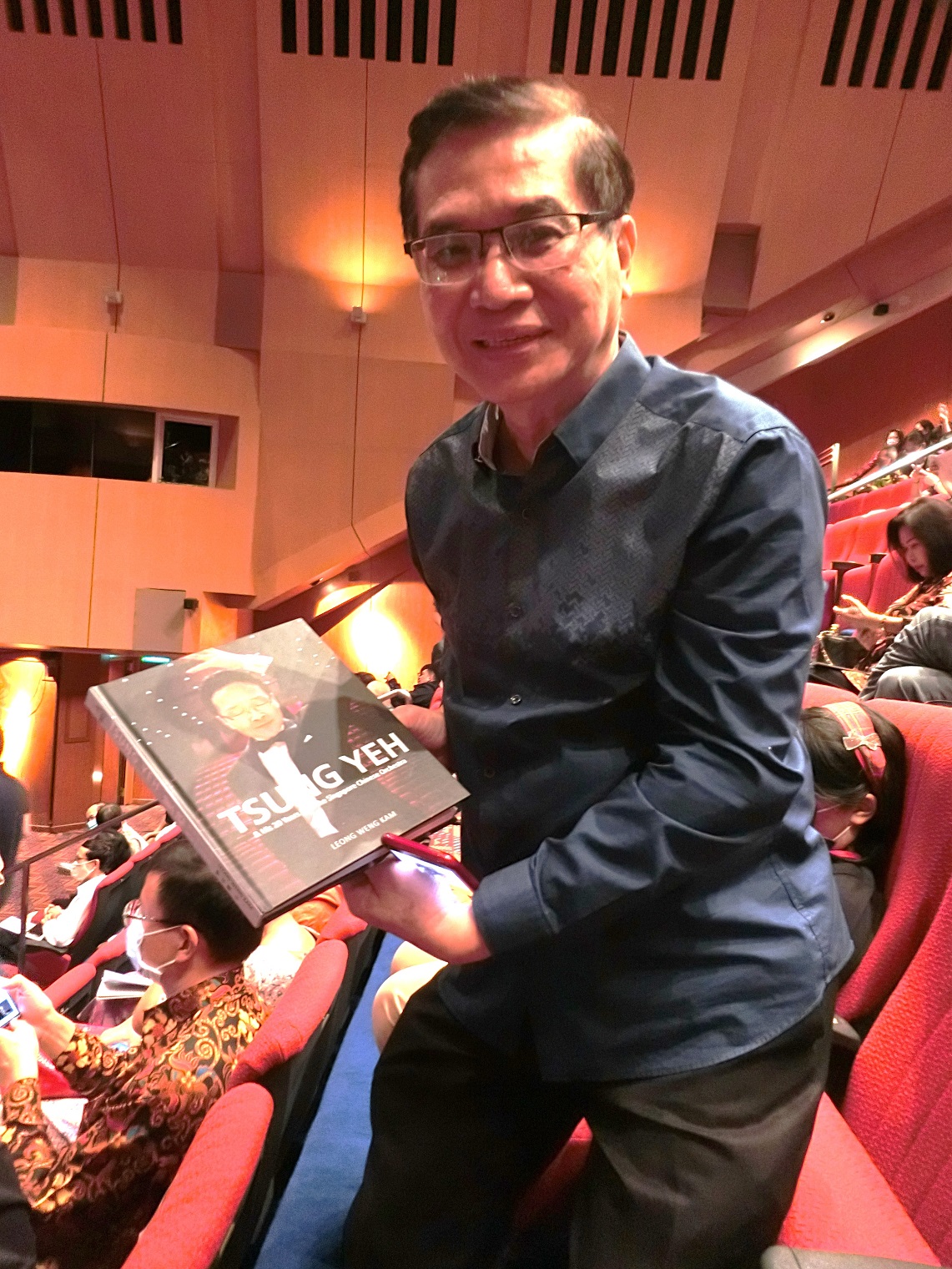
The official launch of the
Tsung Yeh 20 commemorative book.


This concert, commemorating his 20th anniversary at SCO’s helm, had a maritime theme which relived landmark works from his first ten years. Central to its narrative were two explorers of historical times, Zheng He (Cheng Ho) and Marco Polo, alluding to Yeh’s role as an intrepid discoverer of new pathways in Chinese music.    


Former SCO Composer-in-Residence Eric Watson’s Sea – The Source of Life, written for the 2007 National Day Parade opened the concert. Its quiet beginning was a beautiful evocation of dawn, leading to a faster section filled with dance rhythms reflecting different cultures and ethnicities. The lively music declared that the sea belonged to everybody, and this feel-good number made for a rousing prelude.   


Next were three movements from another former Composer-in-Residence Law Wai Lun’s Zheng He - Admiral Of The Seven Seas, a large-scaled work commissioned for the 2005 Singapore Arts Festival. Its imposing opening, Sea Burial, led by plangent winds and percussion, saw the Hand of Fate deal the Ming dynasty commander an untimely demise. With SYC Ensemble Singers (Chong Wai Lun, Chorus Master) at full tilt, the echoes of O Fortuna from Carl Orff’s Carmina Burana seemed almost appropriate even if the latter had more to do with itinerant Bavarian monks.


For this cantata, there were a key roles for narrator Jeffrey Low and tenor Zhuang Jie, and a cameo for soprano Joyce Lee Tung, who were excellent in fleshing out the romance of Zheng’s humble origins. The Voyage was the performance’s most colourful segment, a quasi-Wagnerian sojourn from Orient to Middle East, a picturesque seascape with birdsong later culminating in a rhapsody of Arabian dance movements. Here the imaginative scoring revealed Chinese orchestral instruments at their fullest potential.        


The concert’s second half comprised three movements from Liu Yuan’s Marco Polo and Princess Blue, composed for the Esplanade Opening Festival in 2002. Featuring similar forces and projecting as big sonorities as Zheng He, this was unfortunately the most derivative work of all.   


Its story centred on a fictional romance between Venetian explorer Marco Polo and the Kokachin Princess Buluhan, as he escorted the royal from Cathay by sea to her prospective marriage in Persia. As Providence has it, when they reach Eden in the East (guess where?), love blossoms. With every exposure, this music becomes increasingly cringeworthy and embarrassing.


The supposed love music with Italianate flavour (Neapolitan to be said) builds up inexorably, reaching a grand apotheosis with none other than the 1960s song Singapura (Oh Singapura, Sunny Island Set In The Sea)! Its grandiose Mahlerian ending, magnificently delivered by all on stage, nevertheless elicited a standing ovation. Hopefully this was for Maestro Yeh and his superbly honed charges, rather than the music. 


Leong Weng Kam, author of the
Tsung Yeh 20 commemorative book.

Friday, 8 October 2021

SCO 25: OUR SHARED MEMORIES / THE SCO YESTERYEAR / Review


SCO 25: OUR SHARED MEMORIES

THE SCO YESTERYEAR

Singapore Chinese Orchestra

Singapore Conference Hall

Saturday (2 October 2021)


This review was published in The Straits Times on 6 October 2021 with the title "Singapore Chinese Orchestra's walk down memory lane".


It is hard to believe that the Singapore Chinese Orchestra (SCO) is now twenty-five years old. Its history however goes further back to 1974 when the People’s Association Chinese Orchestra (PACO) was established as the first professional ensemble of traditional Chinese instruments outside China. Several musicians from that original outfit still perform in the SCO.


This 90-minute concert was a fond reminiscence of SCO’s forebears and a tribute to pioneers who showed the way. The first part entitled The Melodies We Used To Play showcased chamber music performed without conductor. The Beautiful Zhuang Brocade arranged by Wu Houyuan, premiered by PACO forty years ago at this same venue, was a soothing serenade with a lively dance-like end to close.


Equally animated was Pan Yunchong & Zhu Xiaogu’s The Bustling Docks, a 1970s paean to  progress in Communist China, which could easily have symbolised Singapore’s rise as a shipping hub during the same period. Renowned Chinese percussionist Li Minxiong’s Striving For A Bumper Harvest mined the same vein with young percussionist Benjamin Boo impressively leading the ensemble from his set of drums. As a point of interest, Boo was following in the footsteps of his percussion teacher Quek Ling Kiong (himself a student of Li), who gave its first Singapore performances decades ago.  


The second part, Those Classic Concertos We Grew Up With, featured two substantial concertante works. Liu Bin’s Haw Par Villa Myths, conducted by Associate Conductor Moses Gay, saw PACO veteran Lim Sin Yeo mastering four different wind instruments. These included the paixiao (panpipes), dadi (long flute), taoxun (ocarina) and xiaodi (piccolo) in a colourful four-movement suite that curiously united Chinese mysticism with modernist styles recalling sci-fi movie scores of Bernard Herrmann.


Liu Wenjin’s The Great Wall Capriccio was arguably the evening’s most familiar music. This four-movement erhu concerto, worthy counterpart of the Yellow River and Butterfly Lovers concertos, was premiered by the late erhu virtuoso Min Huifen in 1981. Her student SCO erhu principal Zhao Jianhua relived the demanding solo part with SCO Resident Conductor Quek Ling Kiong at the helm.


As expected, epic landscapes, heroism, sacrifice and commemoration were all encompassed, with its most poignant moments in the slow third movement Memorial For The Patriots. Here, Xu Zhong’s cello solo and Zhao crafted an elegy that left an indelible impression.   


SCO Music Director Yeh Tsung conducted the final work, three movements from late-lamented SCO musician and composer Yeo Puay Hian’s Torrent (1992). Inspired by tales of rivers and the sea, the work paid tribute to hard work, sweat and toil, aptly accompanied by black-and-white photographs of pioneering SCO members in their youth. Its final movement, Pass On The Light, also featured pre-recorded voices of  the Vocal Associates Chamber Choir, with the message that if we do not remember the past, we might as well forget about the future.


Wednesday, 15 November 2017

CD Review (The Straits Times, November 2017)


ERIC WATSON'S WORLD
OF CHINESE MUSIC
Singapore Chinese Orchestra / YEH TSUNG
SCO / ****1/2

The British composer-pedagogue Eric Watson is the present Composer-in-Residence of the Singapore Chinese Orchestra. This unusual accolade was a culmination of sorts after winning First Prize in the First Singapore International Competition for Chinese Orchestral Composition (2006) with his tone poem Tapestry - Time Dances, a sympathetic fusion of Western compositional technique and Chinese instrumentation with Nanyang characteristics.

His sound world is eclectic with myriad Asian influences and a popular slant without sounding derivative, which could not have been conceived by any Westerner not living in the Far East. Six works are represented in this 65-minute capsule profile, opening with Mahjong Kakis, a jazzy and blues-inflected orchestral scherzo. Tapestry – Time Dances and An Independent Note share a similar aesthete, the latter a collection of Lee Kuan Yew quotes recited with stentorian vigour by veteran actor Lim Kay Tong.

Dialogue for tabla and Chinese orchestra is a concerto with improvisation, featuring young tabla virtuoso Govin Tan doing the honours. The Ceilidh and Songs Of The North are concerto for orchestra and concerto grosso respectively, using songs from the British isles to stunning effect. The latter sees Celtic fiddle, English concertina, dizi and pipa sharing the stage as solo instruments. Such a heady combination could only come from Singapore, and performed with an irrepressible zest from the Singapore Chinese Orchestra.  

Monday, 1 February 2016

RHAPSODIES OF SPRING 2016 / Singapore Chinese Orchestra / Review


RHAPSODIES OF SPRING 2016
Singapore Chinese Orchestra
The Star Theatre
Saturday (30 January 2016)

This review was published in The Straits Times on 1 February 2016

Rhapsodies Of Spring is the Singapore Chinese Orchestra's way of celebrating the Lunar New Year in concert, and for the first time it performed in the massive arena that is The Star Theatre. As with previous editions, the concert took on the form of a variety show, and who better to host it than well-known local television personality Marcus Chin (Chen Jian Bin), emcee of the popular Golden Age Talentime?

He and conductor Yeh Tsung displayed good chemistry in their playful banter in Mandarin, peppered with a few English phrases, which most centred around how busy they were and how young each other looked. There were no skits from radio personalities this year but more music, which began with Li Huan Zhi's Spring Festival Overture.


This familiar work was accompanied by visuals of the orchestra projected on a giant screen behind the stage, which focused on groups of soloists. This was soon overtaken by the entrance of the 9-member ZingO Festival Drum Group which raised a racket that was wholly appropriate for the occasion. Its synchronised drumming in Soar and Xu Chang Jun's Dragon Dance was an impressive show of precision and togetherness.


The first half was otherwise the Marcus Chin show, who had no less than four costume changes and enthralled the aunties with his crooning in the Nostalgic Song Medley (arranged by Tan Kah Yong) and Mix Match Song Medley (Phang Kok Jun). He does not have an operatic voice for songs like Man Chang Fei, Azaleas Bloom, Yue Qin and The Traveller With A Bamboo Pole, but his tenor comfortably scaled the heights with oodles of personality and some epileptic dancing.

The Chinese Folksong Medley curiously included a Russian song, Under The Shimmering Moonlight (but sung in Mandarin) and concluded with Radiant With Joy, rendered in an authentic Sichuan accent. Then the concert took on the feel of a typical episode from Saturday Night Live. With the lights dimmed, the main orchestra dispersed leaving behind the 16-strong SCO Pop Ensemble, which resembled and played like a jazz combo.


TV Golden Medley (arranged by Law Wai Lun) revived melodies like Striving (from the early local serial The Awakening), Good Morning, Sir! and  Kopi O. Suona Principal Jin Shi Yi had a field day with his assorted reeds in the Taiwanese song Tian Hei Hei, alternating between jazzy riffs and Donald Duck imitations. Not to be outdone was Han Lei on guanzi in Beijing jazz pianist Kong Hong Wei's Summer Palace, with a stirring display that brought on loud cheers.


The 2-hour concert concluded with bidding farewell to the Year of the Goat and ushering the Year of the Monkey. Wang Li Ping's Shepherd Song gave way to Xu Jing Qing's Gan Wen Lu Zai He Fang from Journey To The West, which saw Chin imitating the moves of Sun Wu Kong (Monkey God). Joined by four ladies in gaudy red, a motley Chinese version of Solid Gold Dancers, the glittery ensemble got the audience singing and clapping along to Sim Boon Yew's Spring Suite VI.

Has there been that many Chinese New Year songs in circulation? The Singapore Chinese Orchestra under Yeh Tsung has played them all. 


Wednesday, 18 November 2015

CD Reviews (The Straits Times, November 2015)


CHARMS OF NANYANG II
Singapore Chinese Orchestra 
TSUNG YEH
SCO / ****1/2

By organising the Singapore International Competition for Chinese Orchestral Competition, the Singapore Chinese Orchestra has become a global prime mover and arbiter on Chinese instrumental and orchestral composition. The competition was inaugurated in 2006 and this disc presents the best works from the second competition, held in 2011.

An international jury picked as 1st Prize Xie Xiang Ming's A Stroll In The Lion City, a populist choice that opens with the rhythm to be found in the Dance Of The Adolescents from Stravinsky's The Rite Of Spring and progresses by way of minimalism and milking a big tune. More subtle are the 2nd and 3rd prizes awarded to Stephen Yip's Nine Actors and Zhu Yi Qing's The Silence Of Borubodur respectively. The former makes use of Fujian and Hakka folktunes in a theatrical manner while the latter is an atmospheric two-movement concerto for bamboo flute and pipa that depicts the rise and decline of the great Javanese Buddhist empire.

All the works melded various Asian compositional genres and techniques, some based on religious ideologies, creating a pan-Asian flavour that is immediately palpable. Completing the album are Raymond Mok's Cycles Of Destiny (Winner of the Nanyang Award), Wang Dong Xu's The Capriccio Of The Mountain Folk Song and young Singaporean Lee Ji Heng's Dark Light. The last, composed at 18, is an earthy procession that marries Chinese woodwinds and Javanese gamelan to stunning effect. 


BOOK IT:

3RD SINGAPORE INTERNATIONAL 
COMPETITION FOR CHINESE 
ORCHESTRAL COMPOSITION 2015
Prize Presentation Ceremony & Concert
Singapore Conference Hall
Saturday 21 November 2015, 7.30 pm
Tickets at $15 & 25, available at SISTIC

Tuesday, 26 November 2013

Photos from SINGAPORE CHINESE ORCHESTRA'S ANNUAL DINNER 2013


Musicians are passionate people who also need time to relax and let down their hair. Here are some photographs from the Singapore Chinese Orchestra's Annual Dinner held on Sunday 24 November 2013 at the Grand Copthorne Waterfront Hotel. The theme of the evening was Black & White, which kind of explains why almost everyone looked like they were going to a funeral. But they all had a good time.


Playing the part of Kato from the Green Hornet was
Young Assistant Conductor in Residence Moses Gay,
seen here with concertmaster Li Baoshun.

Three Amigos in black:
Maestro Tsung Yeh, Dr Ho Chee Kong & PianoManiac.

SCO General Manager Terence Ho receives his 15-years
long service award from SCO Chairman Patirck Lee.
Erhu principal Zhao Jian Hua wins a prize.
Conductors Quek Ling Kiong and Tsung Yeh look on.

All dressed out and ready to go.

Wrestlemania: Cizhongyin Suona player Boo Chin Kiah
tackles the Lydia Sum impersonator.

Let's do it Gangnam Style!

Candidates for the Best Dressed Awards.

And here are the winners!

Time to groove!

The lights go out, and its party time!