Showing posts with label SYC Ensemble Singers. Show all posts

Sunday, 14 June 2026

SINGAPORE COMPOSERS FESTIVAL 2026 / Morse Percussion & SYC Ensemble Singers


SINGAPORE COMPOSERS FESTIVAL 2026
Morse Percussion &
SYC Ensemble Singers
The Theatre Practice, 54 Waterloo Street
Sunday (7 June 2026)
11.30 am & 4.30 pm

This review was published in The Straits Times on 9 June 2026 with the title "Singaporean and South Korean talents on display".


Only in its second edition, the Singapore Composers Festival 2026 organised by Composers Society of Singapore (CSS) was an eight-hour affair that included two public roundtable chats and two concerts of contemporary music.

Singaporean and South Korean composers
with members of Morse Percussion.

The opening concert was a showcase for CSS and South Korean composer collective Space For Sound, with eight works performed by Morse Percussion, comprising Derek Koh, Joachim Lim, Cheong Kah Yiong and Yuru Lee. Those who regard music for percussion as just “banging on cans” will be surprised by the variety of sounds generated.

Photo: Amos Poh

Toh Yan Ee’s Atlas opened the show with timpani skins being scraped before proceeding to intricate rhythms on pitched percussion (marimba and xylophone) resembling gamelan, and drumming that extolled the majesty of the eponymous star constellation. Varying the sound palette completely, Won Jung Lee’s The Glittering Diamond Water delighted in extreme high registers. Minimalist textures emanating from marimba, slung gongs and bowed vibraphone keys, created a beautifully ethereal effect that bears repeated listening.

Photo: Amos Poh

The next two works were the most violent. Somin Lee’s Death of First-Borns was some orgy of militarist might, dominated by snare-drum, cymbals, triangles and xylophone employed strictly for beats not melody. The wanton biblical slaughter of Egyptians was its depiction. Hoh Chung Shih’s Rounding Round celebrated round objects, recurrent subjects as in a rondo (round dance) and three players rotating positions around a central axis of instruments. This later erupted into a free-for-all with mallets hurled in all directions.

Photo: Amos Poh

This concert was clearly a playground for exploring new sounds and techniques. Seung-ki Hong’s Resonant Ritual continued in its vein, tinkling on metal, tribal-drumming and walking in circles, now in a counter-clockwise direction. Hye-Jeong Hwang Lee’s Percussion Sanjo was a modern-day update of the traditional Korean sanjo instrumental essay with hints of melody emerging from a marimba, amid more drumming. All four works by Korean composers were world premieres

Photo: Amos Poh

Two local composers closed the matinee, with Emily Koh’s emoyo describing the emotional yo-yo involved in getting an American green card. Judging by the lack of angst, it was probably not such an ordeal. Tan Yuting’s Kotekan revelled in the repeated harmonic patterns found in gamelan, realised with mini-cymbals, temple blocks and a drum-set.

Photo: Amos Poh

The festival’s closing concert was the CSS Young Composer Forum, where budding composers were mentored by established practitioners in the creating music for choir. The 22-member SYC Ensemble Singers led by Jennifer Tham did the honours for seven works by mentee and mentor.

Photo: Amos Poh

Anvay Mathur’s Anahata, Sanskrit word for “unstruck sound”, relied on long-held syllables, vocal drones and sliding between pitches. Thomas Kai-ren Rettig’s Greenland used his friend Elliot Chew’s poem to eloquently describe a distant and unattainable goal, unrelated to Donald Trump’s territorial designs.

Photo: Amos Poh

The very dry acoustic in the venue’s black box theatre, while excellent for percussion, was far less conducive for voices. Despite the choir’s spotless diction, the first word of Bae Jun Soo’s Luminate, bi-cheul (빛을 or light), sounded like “bitch”, an unintended consequence. The next two works, Ding Jian Han’s Silenc(E)mpty? and Estene Cheong’s Why, had long stretches of spoken words, with the voices suspended in some form of sprechgesang (speech-song), a favourite technique of polytonalists.

Photo: Amos Poh

Alicia De Silva’s Quando La Rota used words from Dante’s Divine Comedy, closing in a devotional tone with visions of paradise within sight. To close, Danny Imson’s Ama Namin or The Lord’s Prayer in Tagalog opened with a very even unison. A mixed tape was slowly unreeled linking all the performers, before they walked off stage in a procession as the music dissipated into nothingness.


Both concerts at the Singapore Composers Festival were a veritable showcase of local creative talent, and long may that continue.


Monday, 3 June 2024

SYC & FRIENDS: 60 YEARS YOUNG / SYC Ensemble Singers / Review


SYC & FRIENDS: 
60 YEARS YOUNG 
SYC Ensemble Singers 
Victoria Concert Hall 
Saturday (1 June 2024)

This review was published in The Straits Times on 3 June 2024 with the title "SYC celebrates 60th anniversary with modern music".

In a Straits Times article from 1992, the Singapore Youth Choir (SYC) was named as Singapore’s top choir. SYC, founded in 1964, appointed young choral conductor Jennifer Tham as its artistic director in 1986. As its leader ever since, SYC was renamed the SYC Ensemble Singers in 2004 to reflect its coming of age. 


This trendsetting choir has been committed to new music, its 60th anniversary concert being a showcase of 20th and 21st century works. The show opened with works by three Singaporean composers. SYC alumna Diana Soh’s Vak (2013) comprised three short pieces, some with no actual words. 

Singers strolled onstage for its Salutanya Prelude, just mouthing single syllable tones. This was followed by seemingly random tongue-twisting consonants, whistling and oral clicking in Vak (Sanskrit for the goddess of speech and utterance), before a more traditional folksong-like close in Salutanya Postlude. 


Joyce Koh’s Le or Yue (1998), after the Chinese word for happiness and music, was a wordless melisma of long-held tones. Merging and coalescing into a mirage of sound effects, its progression as a dreamy meditation of joy was punctuated by well-placed strikes of five Tibetan brass bowls. Simply mesmerising. 


Described as a contemporary madrigal, Leong Yoon Pin’s Si Nian (Nostalgia, 1988) was SYC’s first ever commission. Sung in Mandarin, this work led to SYC winning first prize at the International Music Eisteddfod in Llangollen (Wales). Full of reassuring harmonies, these were premised on the words wo de gu xiang, reflecting love for one’s homeland and a mother’s embrace. 


Joined by its youth wing, a vastly-expanded SYC offered well-known American choral composer Eric Whitacre’s The Stolen Child (2008) with words by William Butler Yeats. With verses sung by a smaller subchoir backed by a larger body of singers, its refrain Come Away, O Human Child! was a lament on lost childhood youth and innocence. 


Venezuelan composer Cristian Grases’s Lux Aeterna (Eternal Light) from Canticles Of Light (2024), in Latin as with all Roman Catholic liturgy, received its world premiere. Its cascading and echoing harmonies provided a warm homogeneous blanket of sound, serenely closing a very eclectic first half. 


The main work on show was Estonian composer Arvo Pärt’s Te Deum (1984), performed by three choirs including alumni, Singapore Management University Chamber Choir and guests, backed by Wayfarer Sinfonietta’s string players and B-L Duo (Bertram Wee and Lynette Yeo) on prepared piano and windharp. 

Photo: Law Kian Yan

This Ambrosian praise hymn of 29 lines in Latin was a solid half-hour built upon the D triads (both major and minor) with drones in his trade-marked tintinnabuli style. Reliving the ethereal sound of bells, the music had a bit of everything, voices in unison and triadic harmonies, string meditations and calmly ecstatic outbursts. 

Photo: Law Kian Yan

The overall effect was a hauntingly beautiful one, so calming that it risked being soporific in parts. The music kept flowing under conductor Tham’s firm guiding hands till its conclusion of ultimate solace. For SYC’s intrepid programming and committed performances, may there be another 60 years of great music-making.


Wednesday, 23 November 2022

TSUNG YEH 20 / Singapore Chinese Orchestra / Review


TSUNG YEH 20

Singapore Chinese Orchestra

Singapore Conference Hall

Saturday (19 November 2022) 


This review was published in The Straits Times on 23 November 2022 with the title "Yeh Tsung leads superbly honed charges".


Twenty years may be considered a relatively short stretch of time, but what Yeh Tsung has accomplished with the Singapore Chinese Orchestra as its Music Director since 2002 has been little short of awe-inspiring. During his tenure, he commissioned many new works for the medium of massed traditional Chinese instruments, including establishing a musical genre incorporating Southeast Asian elements now known as Nanyang music.


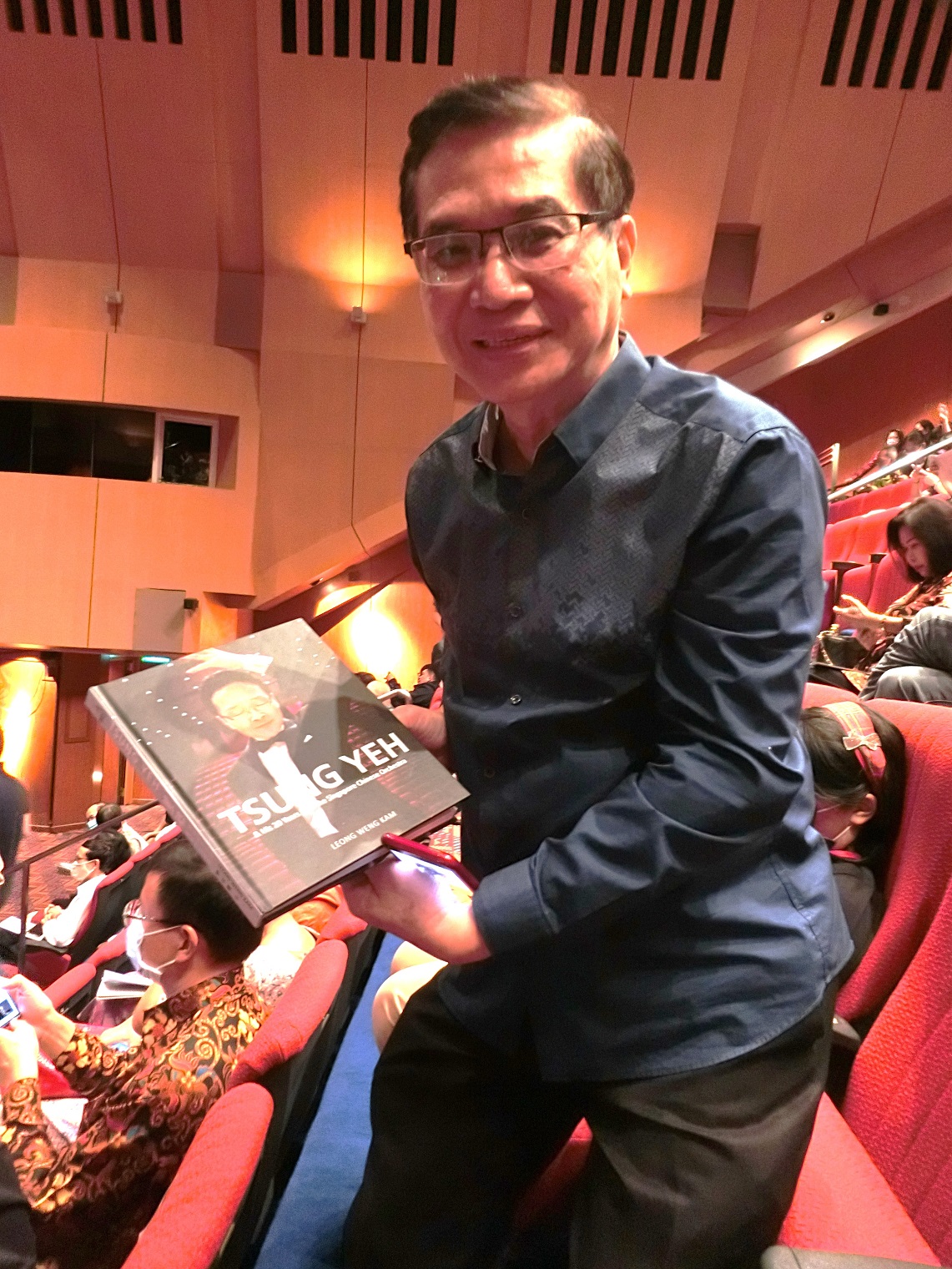
The official launch of the
Tsung Yeh 20 commemorative book.


This concert, commemorating his 20th anniversary at SCO’s helm, had a maritime theme which relived landmark works from his first ten years. Central to its narrative were two explorers of historical times, Zheng He (Cheng Ho) and Marco Polo, alluding to Yeh’s role as an intrepid discoverer of new pathways in Chinese music.    


Former SCO Composer-in-Residence Eric Watson’s Sea – The Source of Life, written for the 2007 National Day Parade opened the concert. Its quiet beginning was a beautiful evocation of dawn, leading to a faster section filled with dance rhythms reflecting different cultures and ethnicities. The lively music declared that the sea belonged to everybody, and this feel-good number made for a rousing prelude.   


Next were three movements from another former Composer-in-Residence Law Wai Lun’s Zheng He - Admiral Of The Seven Seas, a large-scaled work commissioned for the 2005 Singapore Arts Festival. Its imposing opening, Sea Burial, led by plangent winds and percussion, saw the Hand of Fate deal the Ming dynasty commander an untimely demise. With SYC Ensemble Singers (Chong Wai Lun, Chorus Master) at full tilt, the echoes of O Fortuna from Carl Orff’s Carmina Burana seemed almost appropriate even if the latter had more to do with itinerant Bavarian monks.


For this cantata, there were a key roles for narrator Jeffrey Low and tenor Zhuang Jie, and a cameo for soprano Joyce Lee Tung, who were excellent in fleshing out the romance of Zheng’s humble origins. The Voyage was the performance’s most colourful segment, a quasi-Wagnerian sojourn from Orient to Middle East, a picturesque seascape with birdsong later culminating in a rhapsody of Arabian dance movements. Here the imaginative scoring revealed Chinese orchestral instruments at their fullest potential.        


The concert’s second half comprised three movements from Liu Yuan’s Marco Polo and Princess Blue, composed for the Esplanade Opening Festival in 2002. Featuring similar forces and projecting as big sonorities as Zheng He, this was unfortunately the most derivative work of all.   


Its story centred on a fictional romance between Venetian explorer Marco Polo and the Kokachin Princess Buluhan, as he escorted the royal from Cathay by sea to her prospective marriage in Persia. As Providence has it, when they reach Eden in the East (guess where?), love blossoms. With every exposure, this music becomes increasingly cringeworthy and embarrassing.


The supposed love music with Italianate flavour (Neapolitan to be said) builds up inexorably, reaching a grand apotheosis with none other than the 1960s song Singapura (Oh Singapura, Sunny Island Set In The Sea)! Its grandiose Mahlerian ending, magnificently delivered by all on stage, nevertheless elicited a standing ovation. Hopefully this was for Maestro Yeh and his superbly honed charges, rather than the music. 


Leong Weng Kam, author of the
Tsung Yeh 20 commemorative book.

Wednesday, 28 September 2022

STRINGS FANTASY / Singapore Chinese Orchestra / Review


STRINGS FANTASY

Singapore Chinese Orchestra

Singapore Conference Hall

Saturday (24 September 2022)


This review was published in The Straits Times on 28 September 2022 with the title "Night of scintillating strings".


The sound of strings is one of the most evocative sensations known to the human ear. Those who attended the Singapore Symphony Orchestra’s screenings of Alfred Hitchcock’s horror movie Psycho will know exactly what fear feels like by just listening. The Singapore Chinese Orchestra’s latest string concert led by Yeh Tsung did quite the opposite, with sounds that soothed, entertained and excited.


All that, of course, depends on the repertoire performed, and Liu Changyuan’s Memories, opening the concert, did all the these. Conceived in two parts, Warm Memories was a gentle dance with string pizzicatos accompanying melodic lines, while Passionate Memories upped the ante with perpetual motion from the gaohus. Then it went for broke with an abrupt shift to dissonance, harmonics and high pitches, as if to shock one’s innermost emotions. Somehow, violent and tumultuous memories seem to stick most in the mind.


Chinese composer Zhao Jiping, well-known for his movie scores for Farewell, My Concubine and Raise The Red Lantern, was represented by two string concertos. His Violin Concerto No.1 received its premiere in 2017 in Beijing by Chinese violinist Ning Feng, who brought warmth and lyricism to the proceedings. More like a single-movement symphonic poem with violin so, his job involved engaging the orchestra in intimate conversation at its outset, before letting it rip with virtuosic exercises and a recurring big melody.


Resembling the best of film music, the rhapsodic score had moments of tear-jerking melodrama, the obligatory fugal passages and a riproaring cadenza. That big tune first introduced by the guan and accompanied by harp did what was intended, to bring down the house at its apotheosis. Ning’s encore of Massenet’s Meditation from Thais, accompanied by huqins and harp, was a heart-warmer as well.


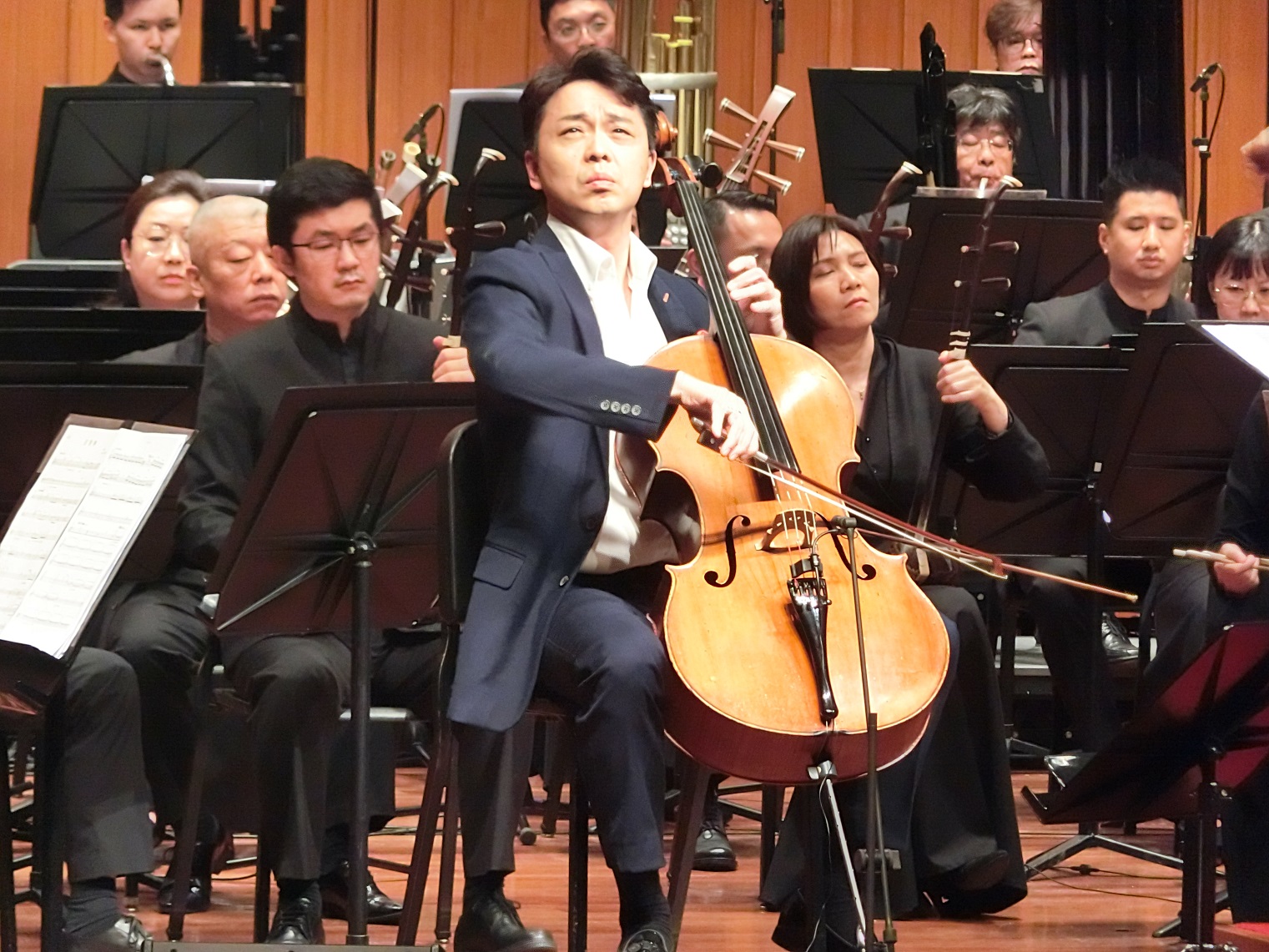
Zhao’s Zhuang Zhou’s Dream was the more subtle concertante work, its long-breathed lyrical lines well suited to Australian-Chinese cellist Qin Li-Wei’s glorious tone production. World weariness was worn heart-on-sleeve, the elegiac mood enhanced by the use of temple bell, singing bowl and drumming. The music did go into full battle mode before retiring to a serene close which embraced tenets of Taoist philosophy. Qin also had an encore of his own: Saint-Saens’ The Swan from Carnival of the Animals accompanied by harpist Nigel Foo.


One would have totally loved to see both Ning and Qin in some sort of double concerto but instead, the audience was treated to Law Wai Lun’s cantata The Celestial Web in its version for chorus and orchestra. Using verses by Tan Swie Hian, this was a paean to universal brotherhood (including sentient and non-sentient beings), a nod to Schiller and Beethoven’s Ode To Joy.


Even its opening in D minor had an obvious debt to the German, but beyond that the music was unremittingly  colourful and joyous, abetted in large part by the well-drilled SYC Ensemble Singers (Chorusmaster: Chong Wai Lun) which sang in Mandarin. It made for a satisfying end to an evening otherwise dominated by strings.


Friday, 13 December 2013

PAGDIRIWANG / SYC Ensemble Singers / Review


PAGDIRIWANG
SYC Ensemble Singers
Esplanade Concert Hall
Wednesday (11 December 2013)

This review was published in The Straits Times on 13 December 2013 with the title "Celebrating Christmas, the Filipino way".

Pagdiriwang is the Tagalog word for celebration. This concert by the SYC Ensemble Singers helmed by veteran Filipino choral conductor Jonathan Velasco (left) was exactly that, espressed in the manner only Pinoys know how – with mellifluous song, unfettered joy and gusto.

Every work performed, from European traditions, Afro-American spiritual to songs of the Philippines, was related to the Christmas season, but not many were familiar. However the excellent selections, clever juxtapositions of contrasted pairings, prefaced by well-presented quips in place of programme notes, made the 140-minute long concert seem a breeze.


A Bruckner motet and Praetorius’s Lo, How A Rose E’er Blooming seemed traditional fare, except that Jan Sandstrom’s arrangement of the latter was a study of stillness and pristine pianissimo. A semi-chorus of eight sang words of the German hymn, while a larger group forming an extended arc intoned a shimmering accompaniment that exploited the hall’s reverberant qualities to perfection.

A younger and larger group of singers forming the Atelier Choir, which had worked intensively with Velasco for a week, contributed four songs. These included Arnel De Pano’s Gloria and Ryan Cayabyab’s Memorare, works in Tagalog and Latin respectively, varying between joyous exuberance and quiet contemplation.

The two choirs combined to deliver Cayabyab’s (above) carol-cum-lovesong Paskong Walang Hanggan, the gist of which is “every day with you is Christmas without end”. The anthem was highly melodious without being cloying, reaching a passionate climax that the 90 voices effortlessly mustered. The performance was dedicated to the ten million Filipinos celebrating Christmas outside their home country.

For the Singapore Youth Choir’s 50th anniversary next year, Nativitas by John Pamintuan (left) was the first commissioned work to be performed. Like the earlier choruses, this was another feast of agreeable harmonies, beginning with pastoral serenity and then scaling lofty reaches of vocal rapture. The same composer’s Maghimaya Ka Maria (Hail Mary) was chant-like, with a pervasive aura of soothing reassurance.    

Speaking of feasts, De Pano’s Noche Buena delighted in the Christmas banquet table, of treats like lechon (roast pork), bulaloo (beef marrow stew), adobo and fried chicken. The last of which is properly pronounced as “chee-ken”, according to the choir’s sole Filipino singer John Rae Cortes.

To this was added Cayabyab’s upbeat Kumukutikutitap (Twinkling), the onomatopoeic word for the brightly lit stars that hang off Christmas trees. Cayabyab’s arrangement of A Christmas Carol from the movie Scrooge closed the concert on a high, with two further Cayabyab encores to rouse a standing ovation.  


Photograph of concert by Kong Chong Yew.