Monday, 3 June 2024
SYC & FRIENDS: 60 YEARS YOUNG / SYC Ensemble Singers / Review
Sunday, 14 May 2023
IMPOSSIBLE THINGS / Wayfarer Sinfonietta / Review
IMPOSSIBLE THINGS
Wayfarer Sinfonietta
Esplanade Annexe Studio
Thursday (11 May 2023)
This review was published in The Straits Times on 13 May 2023 with the title "Wayfarer Sinfonietta plays contemporary fare with flair."
Established in 2021, Wayfarer Sinfonietta is a professional chamber group that specialises in performing contemporary music and accompanying singers, led by prize-winning young conductor Lien Boon Hua, who is also the director of Yong Siew Toh Conservatory’s new music ensemble OpusNovus. Its latest concert for string ensemble was as uncompromisingly edgy as it was original, putting a marker on future programmes to come.
Icelandic composer Anna Thorvaldsdottir’s Illumine (2016) exploited all possibilities of string playing, opening the evening with literally a chill. Its skilful use of tremolos, harmonics, slides and explosive pizzicatos generated an unnerving atmosphere. Although one of calm and stasis, it however radiated a strange warmth. The sonorities generated in the blackbox theatre was not unlike the sun casting rays on a frigid Arctic landscape.
What followed was far more tonal, with American composer Nico Muhly’s three-part song cycle Impossible Things (2009), a setting of six poems by Egypt-born Greek poet Constantine Cavafy (or C.P.Cavafy), translated into English and scored for voice, solo violin and strings. Tenor David Charles Tay was the protagonist, opening with I Believe In The Hereafter. This and each of the subsequent verses translocated the listener to some distinct time and place.
His clear diction was complemented by Chan Yoong-Han’s virtuosic violin, serving as partner in commentary as well as conflicting voice. The final part, dated at precisely 27 June 1906, 2 p.m., could not have more diverse subjects, the brutal execution of a teenager followed by the eponymous Impossible Things. Accompanied by repetitious patterns favoured by minimalists, the words “The loveliest music is the one that cannot be played... the best life is the one that cannot be lived.” had a ringing resonance.
After Tay trooped offstage, Chan continued without a break into Finnish composer Kaija Saariaho’s Nocturne (1994) for solo violin with its grinding dissonances and fiendishly tricky passages. This was a brief return to the desolate and wintry climes that opened the concert, before massed strings erupted into perhaps the programme’s only remotely familiar work, American minimalist John Adams’ Shaker Loops (1978).
If there were any preconceptions that this ensemble was merely a pick-up group of free-lancers, this performance shattered all such illusions. A work demanding such immense precision and incisiveness, playing at neck-breaking pace, could only be accomplished by the best in the land. Scanning faces and names of the players, one found Singapore Symphony Orchestra musicians and competition award-winners among them, and why not?

Look who's playing?
Ng Pei-Sian, Joelle Hsu,
Olivia Chuang & Wang Dandan (from L)
Photo: Moonrise Studio
| What minimalism looks like, a view of violinist Chikako Sasaki's score. |
The challenge of playing difficult music and surmounting all kinds of odds are what sets true professionals apart. There was a visceral thrill in witnessing the incessant buzz, rapidly shifting rhythms and tonalities of the opening movement Shaking And Trembling. The middle movements were an epiphany of control and restrain, with no less attention paid to finer details. Closing with more dynamism in A Final Shaking and a surprisingly quiet final bar, the 70-minute-long concert was greeted by nothing less than tumultuous applause.
Friday, 6 May 2022
LOST DREAMS / Wayfarer Sinfonietta / Review
LOST DREAMS:
MUSIC OF WEBERN, BERG & STRAUSS
Wayfarer Sinfonietta
Victoria Concert Hall
Sunday (3 May 2022)
The Wayfarer Sinfonietta is a chamber orchestra of young professional musicians formed last year by Singaporean conductor Lien Boon Hua. It has been very active, partnering local singers in concerts and opera productions including recent performances of Andre Previn’s Penelope, Benjamin Britten’s Les Illuminations and Rossini’s L’Inganno Felice. Its forte is late Romantic repertoire and 20th century music, evident in its debut with Mahler’s Lieder eines Fahrenden Gesellen (Songs of the Wayfarer) and its most recent concert.
![]() |
| Photo: Moonrise Studio |
The music of the Second Viennese School dominated the concert’s first half, opening with Anton Webern’s Passacaglia Op.1 arranged by Huang Dingchao. This still-tonal work by music’s most notorious serialist was the direct continuation from the passacaglia finale of Brahms’ Fourth Symphony. Had Brahms lived another 11 years, he might have heard it and possibly approved. Played by just 14 musicians (7 strings, 5 winds, piano and percussion), the performance was characterised by clarity and leanness of textures, allowing many individual passages to stand out. Very satisfying.
This brave new world, reliving the austere pioneering spirit of Arnold Schoenberg’s Society for Private Performances in post-war Vienna, continued with Alban Berg’s Seven Early Songs (arr. Paul Leonard Schaffer) sung by soprano Joyce Lee Tung. These short songs (none longer than a few minutes each) carry on from the Lieder of Mahler and Richard Strauss, coming close to breaching the limits of tonality but not crossing the line. Lee’s idiomatic German (texts by Lenau, Rilke, Storm and others), accurate intonation and vocal lustre brought an alluring sensuality to the music.
![]() |
| Photo: Moonrise Studio |
The Richard Strauss half of the concert saw the Sextet and Mondscheinmusik (Moonlight Music, arr. Lee Jinjun) from Capriccio sandwich the scene and duet Ich Danke, Fraulein from Act 1 of Arabella (arr. Jonathan Shin). The operatic roles of two sisters were helmed by Lee (Zdenka) and soprano Teng Xiang Ting (Arabella), in a semi-staged affair (with a large sofa placed front and centre) directed by Tang Xinxin. The chemistry was developed between both singers was palpable, and one unfamiliar with opera’s plot might have suspected a hint of homoeroticism. Transliterations of texts in English were provided in the digital programme (but not a sypnosis), which is why programme notes are so important in relaying the contexts for every opera.
![]() |
| Photo: Moonrise Studio |
The highlight of the evening was the Four Last Songs (arr. James Ledger), sung by Teng. It would seem that Xiang Ting was born to sing this music, its dark autumnal hues eminently suited for her velvety smooth voice. And she knows how to emote the trials of ageing convincingly and with emotional heft. I remember some years ago hearing one young soprano (now better known as a pop and media star in a neighbouring country) singing these in a concert when she was barely ready for its deep emotional content.
The sequence of the songs was that of its 1950 London premiere by Kirsten Flagstad and conducted by Wilhelm Furtwangler, opening with Beim Schlafengehn (When Falling Asleep), supported by concertmaster Edward Tan’s sublime violin solo, followed by the rapturous September. The darker tones of Fruhling (Spring) would give way to the final song Im Abendrot (At Sunset), literally Strauss’ farewell to life itself. Its last line Ist dies etwa der Tod? (Is this perhaps Death?), poignantly voiced by Teng, alongside Strauss’ own theme from his early tone poem Death and Transfiguration showed that music did come a full circle for the German composer.
| Photo: PianoManiac |
It was curious to note that as the works traversed chronologically from 1908 (Webern and Berg) to 1948 (Strauss), the music got progressively more tonal and less dissonant. Such are the pendulum swings of musical trends, where the radicals Berg and Webern (and their guru Schoenberg) could harmoniously co-exist with arch-Romantics like Strauss and Korngold. That a group like the Wayfarer Sinfonietta and Lien Boon Hua would explore this interesting segment of 20th century music really makes concert-going even more exciting these days.
| Photo: PianoManiac |
Thursday, 20 January 2022
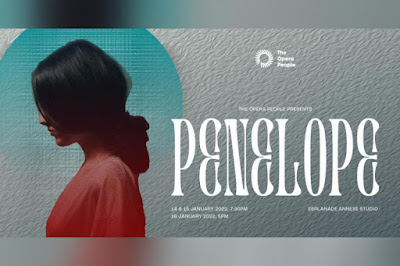
PENELOPE / The Opera People / Review
PENELOPE
The Opera People
Esplanade Annexe Studio
Saturday (15 January 2022)
This review was published in The Straits Times on 19 January 2022 with the title "Girl power in pared down opera".
When one thinks of opera, visions of heroic singers, humongous casts, epic sets and lavish costumes come to mind. At the opposite end of the spectrum is chamber opera, with production pared down to the minimum, supported by modest budgets and keen minds striving to do something different. Ambition, without compromising on quality, has been the vision of groups like New Opera Singapore, L’Arietta and The Opera People.
Plaudits go to The Opera People for even attempting to stage American composer-conductor Andre Previn’s final work, the opera Penelope based on Homer’s Odyssey, left unfinished when he died in 2019. With libretto in English by Tom Stoppard, the project was realised by Previn’s copyist David Fetherolf and premiered later in the same year with soprano Renee Fleming in the title role.
The Opera People’s production went one step further by merging the opera with English composer Benjamin Britten’s 1939 song cycle Les Illuminations, with words by Arthur Rimbaud sung in French. This odd mix might not have worked if not for the skilful curation of sung and spoken texts undertaken by the production team with stage director Edith Podesta.
The musical idiom of both works is tonal, and especially lyrical in the case of Britten, which made for quite seamless transitions between the set-pieces. Previn’s instrumentation was scored for string quartet and piano, while Britten’s was wholly for strings. All these were comfortably accommodated by the Wayfarer Sinfonietta conducted by Lien Boon Hua.
| Photo: Moonrise Studio |
Its story was simple: the trial of Penelope’s unwavering faith in her husband Odysseus twenty-year absence while fighting the Trojan War and his dangerous journey back. Penelope was personified by three women, sopranos Teng Xiang Ting and Felicia Teo Kaixin, and actor-narrator Koh Wan Ching, representing her heart, body and mind respectively.
There was however a clear delineation of roles, with Teng singing only Previn, and Teo singing just Britten. Fanfare, the first of Britten’s ten songs, opened the show boldly with, “J’ai seul la clef de cette parade sauvage” or “I alone have the key to this savage parade”.
This proclamation would reappear two further times, being a recurring theme but sung differently on each occasion. With this, Penelope established her self-determination and steely resolve. Although liberties were taken with reordering the sequence of Britten’s songs to suit the narrative, this gambit did not turn out to be too jarring.
Through the action and music, one became privy to Penelope’s uncertainties, fears and anxieties. When will he return, if ever? If not, should I move on? All this in the face of mounting pressure, such as the plaints of a cynical son and hundred suitors. These were laid bare, symbolised by the women shedding their forbidding trench-coats to reveal snug maroon gowns.
Penelope stays true to the end, as the old man who puts her to the test is none other than Odysseus himself. This affirmation of female empowerment shone through in this well conceived and excellently executed 70 minutes of musical theatre.
.jpg)